
Integrated Product R&D and Manufacturing: A Strategic Guide for OEMs
Updated: Jul 13
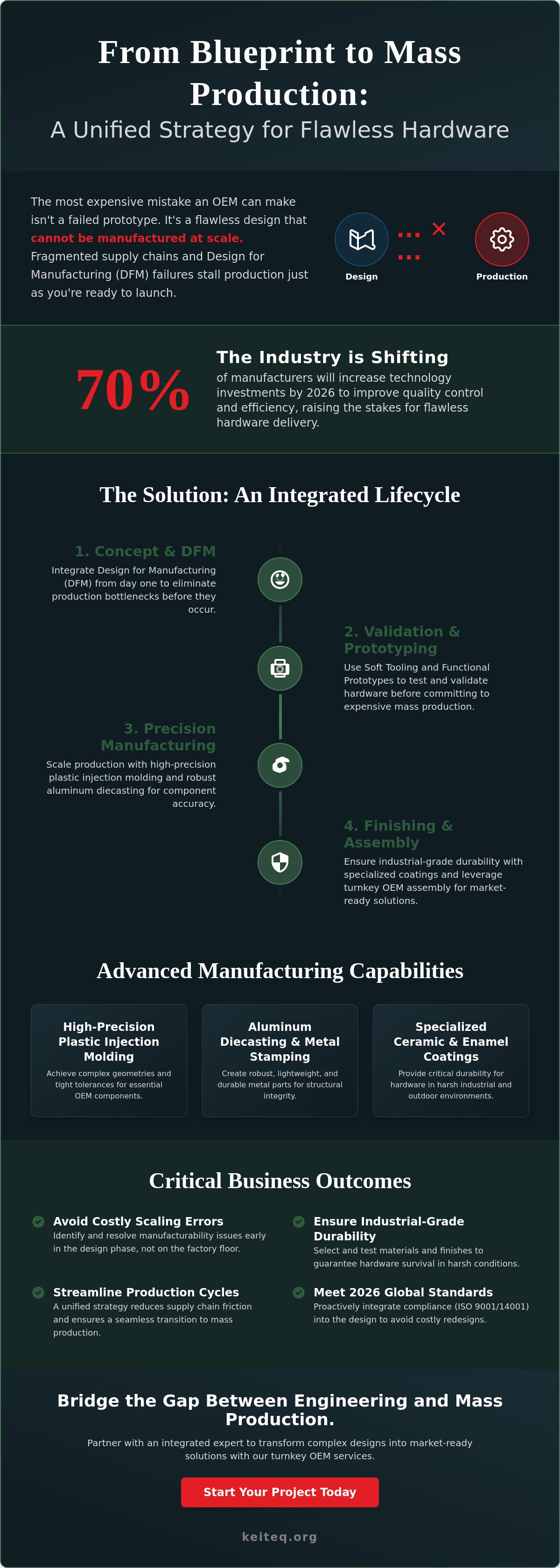
The most expensive mistake an OEM can make isn't a failed prototype; it's a design that cannot be manufactured at scale. With 70% of manufacturers increasing technology investments in 2026 to improve quality control and efficiency, the pressure to deliver flawless hardware has never been higher. You've likely experienced the friction of fragmented supply chains or the frustration of DFM failures that stall production just as you're ready to scale. Successful product R&D and manufacturing requires a unified strategy that accounts for industrial realities long before the first unit leaves the line.
Bridging the gap between initial engineering and mass production shouldn't be a gamble. This guide provides a strategic framework for achieving industrial-grade durability and streamlined production cycles. You'll discover how integrated services, from aluminum diecasting to specialized ceramic coatings, ensure your hardware survives harsh environments while maintaining cost-efficiency. We'll examine the critical role of reliable OEM assembly and how a methodical approach to the production floor transforms complex designs into market-ready solutions.
Table of Contents
The Synergy of Product R&D and Manufacturing in 2026
Traditional industrial models often treated design and production as isolated phases. Today, that separation causes terminal delays and budget overruns. Success in the current market requires viewing product R&D and manufacturing as a single, integrated lifecycle. By aligning engineering intent with factory floor capabilities from day one, OEMs eliminate the friction that typically occurs during the handoff to mass production. This holistic approach ensures that a concept isn't just innovative, but also physically and economically viable.
The regulatory environment in 2026 has made early manufacturing involvement a necessity rather than an option. With the anticipated updates to ISO 9001:2026 and ISO 14001:2026, companies must demonstrate rigorous risk management and sustainability focus throughout the new product development process. Earlier collaboration between designers and production engineers allows for the integration of these compliance standards during the initial drafting phase. This proactive strategy prevents costly redesigns and ensures that products meet global standards for safety and environmental impact before the first prototype is even built.
Design for Manufacturing (DFM) serves as the technical bridge in this synergy. Implementing DFM early in product development identifies potential assembly bottlenecks and material waste. When 70% of manufacturers are adopting Industry 4.0 solutions, the ability to simulate and optimize production through technical R&D is a significant competitive advantage. Acting as a Global Facilitator, an integrated partner manages these complexities across international supply chains; to further optimize these operations, you can check out Buying Office Asia, which provides the stability and logistical competence required to navigate fluctuating trade policies and carbon border adjustments like CBAM.
The Role of R&D in Modern Industrial Engineering
Effective R&D dictates the physical success of a product by determining material selection early in the design cycle. Engineers must decide between high-precision plastic injection molding or robust metal stamping based on the intended environment and structural requirements. Technical feasibility studies confirm these choices before committing to mass production management. For complex hardware, such as an outdoor payment terminal, R&D reduces operational risk by testing durability against moisture, heat, and mechanical stress long before the assembly line starts. As software performance is equally critical for these smart systems, you can visit Test Triangle for digital assurance testing to ensure total field reliability.
Bridging the Gap: Design to Production Services
The transition from initial concept to high-volume manufacturing requires a seamless flow of engineering documentation. A unified product R&D and manufacturing partner reduces supply chain friction by maintaining a single source of truth for all technical specifications. This continuity ensures that the precision achieved in soft tooling and prototyping is replicated exactly during mass production. Detailed documentation and rigorous quality control protocols provide the consistency needed for complex OEM assembly, ensuring every unit meets the original design intent without compromise.
From Concept to Prototyping: The Technical R&D Lifecycle
The transition from a digital rendering to a physical, functional component is the most critical phase in product R&D and manufacturing. This systematic progression ensures that industrial designs are translated into hardware that meets exact mechanical specifications. For OEMs, the lifecycle begins with rigorous industrial design, where every curve and mounting point is evaluated for its impact on the eventual assembly line. Moving too quickly into production without a validated prototype often results in catastrophic failures during the scaling phase.
Successful hardware development follows a Quintessential Product Development Process that prioritizes iterative testing. Each iteration refines the product's form and function, identifying flaws in the mechanical architecture before they become expensive manufacturing defects. By the time a design reaches the final prototyping stage, it must demonstrate total alignment with the intended production methods, whether those involve complex metal stamping or high-volume plastic molding.
Soft Tooling and Prototyping Strategies
Soft tooling provides a strategic advantage by allowing OEMs to validate designs using materials that closely mimic mass production quality. This approach facilitates market testing and functional verification without the massive capital investment required for permanent steel molds. During this phase, engineers use aluminum or low-grade steel alloys to produce small batches of parts for real-world stress tests. Soft tooling is a cost-effective precursor to mass production.
Design Validation: Confirms that parts fit and function within the larger assembly.
Material Testing: Evaluates how selected resins or metals behave under thermal and mechanical loads.
Market Readiness: Provides high-fidelity samples for stakeholder approval or field trials.
Industrial Design and Manufacturing Alignment
A professional design agency must account for diecasting and molding constraints from the very first sketch. Designing a part that looks good on screen but features impossible undercuts or inconsistent wall thicknesses will lead to production delays. Alignment means understanding the draft angles required for plastic injection molding and the flow characteristics of molten metal in diecasting. This technical foresight ensures that the final product is not only aesthetic but also repeatable at scale. This same attention to the marriage of design and material is what defines high-quality artisanal work; for a closer look at these principles in practice, learn more about Aihki Design.
Integrating electronic components into mechanical enclosures adds another layer of complexity. Designers must verify structural integrity to protect sensitive PCBs from vibration and environmental ingress. This verification process involves finite element analysis (FEA) and physical drop tests to ensure the product survives industrial use. For organizations looking to bridge this gap effectively, utilizing professional Product R&D and Design services ensures that every technical constraint is addressed before the first unit is cast. This disciplined approach minimizes risk and guarantees a reliable transition to mass production management.
Advanced Manufacturing Capabilities: Plastic, Metal, and Diecasting
Moving beyond the validated prototype requires a mastery of physical material transformation. The choice between plastic molding, metal stamping, or diecasting depends on the structural demands and environmental exposure of the final hardware. Every technical decision made during product R&D and manufacturing must account for the specific constraints of these processes to ensure high-volume repeatability. This alignment is consistent with NIST's definition of manufacturing-related R&D, which emphasizes the development of systems-level technologies to integrate product and process development for collaborative results.
While plastic injection molding offers incredible versatility for enclosures, metal stamping and diecasting provide the high-strength foundations required for industrial-grade systems. Stamping is the preferred method for high-volume, durable component production where speed and structural consistency are paramount. For more complex, three-dimensional geometries that require both strength and precision, aluminium and zinc diecasting offer a superior solution. These processes transform raw materials into components that meet the rigorous standards expected by technical directors and procurement officers, who often rely on a dedicated sourcing partner like Buying Office Asia for on-the-ground oversight.
Precision Plastic Injection Molding Services
Material science is at the core of selecting the right resins for outdoor hardware. Engineers must evaluate UV stability, impact resistance, and thermal expansion coefficients for polymers like polycarbonate or reinforced ABS. Mold design directly impacts cycle times and unit costs; even a slight adjustment in cooling line placement can significantly improve production efficiency. Quality control measures for complex plastic enclosures involve rigorous dimensional inspections and stress testing to ensure every unit maintains its structural integrity over a long service life.
Metal Stamping and Diecasting for Industrial Scale
Selecting the correct alloy is a critical step in mass production management. Zinc diecasting is often chosen over aluminium for intricate components that require thinner walls and tighter tolerances. Aluminium remains the standard for larger parts that need a high strength-to-weight ratio and excellent thermal conductivity. These diecast parts often serve as the chassis for complex systems, providing a stable frame for internal electronics.
Metal stamping offers unmatched scalability for high-volume production. It allows for the rapid creation of precise brackets, shields, and connectors that are essential for product R&D and manufacturing. These stamped metal parts are then seamlessly integrated into larger OEM assemblies. By managing both the stamping and diecasting processes in-house, a manufacturing partner can guarantee that every component fits perfectly, reducing assembly friction and ensuring the final product survives the mechanical stresses of harsh industrial environments.
Surface Finishing and Durability for Harsh Environments
Surface finishing is often the final stage of production, but it must be considered during the initial design phase to ensure functional success. Industrial coatings represent a critical protective layer that shields underlying mechanical components from environmental degradation. For hardware deployed in public spaces, such as an outdoor payment terminal for a petrol station, durability is a baseline requirement. These systems face constant exposure to UV radiation, moisture, and corrosive fuel vapors. A failure in the surface treatment leads to structural compromise and potential electronic failure, rendering the entire product R&D and manufacturing investment moot.
High-performance surface treatments provide both aesthetic consistency and functional longevity. By selecting the correct finishing process, OEMs can guarantee that their products maintain professional appearances while resisting mechanical wear. This strategic choice is an extension of the technical R&D lifecycle, where material science meets practical application to solve the challenges of the field. Whether the goal is to prevent oxidation on diecast aluminum or to provide a scratch-resistant surface for user interfaces, the finishing process is the safeguard for industrial-grade hardware.
Beyond the physical durability of the hardware, SMEs must also ensure their brand identity reflects this high level of quality; for expert guidance on branding and market leadership, visit phoenix.com.sg.
Once the physical product achieves this level of professional polish, the next step is ensuring it reaches the right audience. For companies seeking to enhance their market impact, MaTaTa Ky provides versatile advertising and marketing services that help hardware manufacturers build a compelling brand presence.
For SMEs in the industrial sector looking to complement these brand-building efforts, KD Interactive provides specialized local SEO services that help niche manufacturers improve their online visibility and connect with local procurement officers.
Specialized Enamel and Ceramic Coating Solutions
Ceramic coatings provide exceptional heat and chemical resistance, making them ideal for components exposed to aggressive cleaning agents or extreme temperatures. Enamel coating offers a level of hardness and physical durability that resists scratching in high-traffic industrial environments. Achieving a consistent coating thickness across complex geometries is a technical challenge. It requires precise application protocols to ensure every recess of a diecast part is protected without interfering with the tight tolerances required for final assembly. This level of precision prevents premature corrosion at the joints and mounting points of the system.
Powder Coating Services for Industrial Longevity
Powder coating stands as a reliable, versatile solution for industrial longevity. The process utilizes an electrostatic application of dry powder, which is then cured under heat to form a robust, uniform skin. This method is superior to traditional liquid paint because it provides higher impact resistance and better coverage on sharp edges. Modern powder coatings also align with environmental compliance standards by eliminating volatile organic compounds (VOCs). The choice of finish directly impacts the final assembly of outdoor kiosks and terminals, as the coating thickness must be factored into the mechanical clearances of mating parts during the product R&D and manufacturing phase.
For OEMs requiring specialized protection against the elements, our Ceramic and Enamel Coating services provide the necessary shielding for hardware in extreme conditions.
Partnering with Keiteq for Turnkey OEM Solutions
Selecting a manufacturing partner is a strategic decision that defines the long-term viability of a hardware project. Keiteq Co Ltd operates as a comprehensive end-to-end partner, bridging the gap between initial concept and global distribution. By consolidating product R&D and manufacturing under a single point of accountability, we eliminate the communication gaps that typically lead to production delays. Our methodical approach ensures that every project benefits from a seamless transition through the entire lifecycle, from functional prototyping to high-volume mass production management.
Just as a manufacturing partner provides the framework for hardware success, a proven business model can streamline expansion in other fields; for instance, Sulaiman Kebab offers a turnkey franchise system that enables consistent growth through established operational standards.
A localized national presence in the United States provides our partners with a strategic advantage in logistical competence and real-time communication. This presence allows us to act as a Global Facilitator, navigating the intricacies of international production while maintaining the accessibility of a domestic partner. We understand the practical realities of the boardroom and the factory floor alike, providing the stability required to manage complex supply chains; similarly, for organizations seeking high-performance office technology with dedicated local expertise, UIQ offers specialized hardware solutions and support. This integrated model is designed for OEMs that value consistency, procedural accuracy, and a disciplined path to market.
Specialized Assembly for Outdoor Payment Terminals
Integrating sensitive electronics into gas station kiosk enclosures requires a deep understanding of mechanical and electrical engineering. Keiteq Co Ltd possesses extensive experience in managing OEM assembly specifically for petrol station environments, where hardware must withstand constant use and environmental stress. Our assembly process for an outdoor payment terminal for a gas station involves more than just fitting parts together. It requires a rigorous integration of mechanical enclosures with high-precision electronic components.
Enclosure Integration: Ensuring perfect alignment between diecast chassis and plastic molded interfaces.
Environmental Sealing: Implementing advanced gaskets and seals to prevent moisture and fuel vapor ingress.
Quality Assurance: Utilizing strict testing protocols for unattended payment hardware to guarantee field reliability and uptime.
The Keiteq Co Ltd Advantage: A Safe Pair of Hands
The strength of our partnership lies in the breadth of our in-house capabilities. From initial product R&D and design to specialized plastic molding, metal stamping, and diecasting, we control every variable of the production process. This vertical integration allows us to apply high-performance enamel and ceramic coatings that ensure industrial-grade durability for every unit. We provide a steady, experienced hand at every stage, ensuring that your technical specifications are met with absolute precision.
Our commitment to reliability makes us a dependable pillar within your global supply chain. We don't just manufacture parts; we deliver fully integrated systems that are ready for immediate deployment. For organizations seeking a partner that values stability and logistical competence, we invite you to contact Keiteq Co Ltd for a technical briefing on your next manufacturing project. Let us demonstrate how our integrated product R&D and manufacturing services can streamline your path from prototype to mass production.
Securing Your Industrial Production Lifecycle
Integrating technical design with production reality is the only way to ensure a product's success in the 2026 industrial market. By aligning product R&D and manufacturing from the concept phase, OEMs eliminate the friction that often stalls innovation. We've explored how rigorous prototyping and specialized surface treatments, such as enamel and ceramic coatings, protect hardware from the elements. These technical choices aren't just details; they're the foundation of a reliable system that performs in the field. To further safeguard physical environments and ensure long-term site safety, you can discover Methamphetamine Testing Services NZ Limited for expert property testing solutions.
Keiteq specializes in managing these complexities for high-stakes hardware, including outdoor payment terminals for petrol stations. Our team provides end-to-end mass production management, ensuring every unit meets the highest standards of precision and durability. Choosing a partner with comprehensive in-house capabilities, from diecasting to powder coating, provides the stability your supply chain needs to thrive. This integrated approach reduces risk and guarantees that your design intent is maintained from the first prototype to the final unit.
We're ready to provide the stability and expertise your project requires. Partner with Keiteq for Integrated R&D and Manufacturing to transform your hardware vision into a durable, market-ready reality. Let's build your industrial future together.
Frequently Asked Questions
What is the difference between product R&D and product design services?
Product R&D focuses on technical feasibility and functional innovation, while product design services prioritize physical form and user interface. R&D involves solving mechanical or electrical challenges through systematic testing. Design services translate these solutions into a cohesive aesthetic and ergonomic layout. Both are essential components of integrated product R&D and manufacturing, ensuring the final hardware is both functional and manufacturable at scale.
How does soft tooling prototyping reduce manufacturing risk?
Soft tooling allows for the production of low-volume parts using materials that mimic mass production quality without the high cost of steel molds. This process identifies potential mechanical failures or assembly issues early in the development cycle. By validating the design with functional parts, engineers can make necessary adjustments before committing to permanent hard tooling. This proactive approach prevents expensive redesigns and ensures the production line remains efficient.
Why is diecasting preferred for industrial payment terminal enclosures?
Diecasting is preferred because it provides superior structural strength and EMI shielding for sensitive internal electronics. Aluminum and zinc diecasting allow for complex, thin-walled geometries that maintain high dimensional stability in harsh environments. This process creates a robust chassis that resists physical tampering and mechanical stress. Unlike plastic, diecast metal offers the heat dissipation required for high-performance processing components used in modern payment systems.
What are the benefits of ceramic coating for outdoor industrial hardware?
Ceramic coating provides extreme chemical and heat resistance, protecting hardware from corrosive fuel vapors and UV degradation. It creates a high-hardness surface that resists scratching and physical wear in high-traffic areas. For outdoor kiosks, this protective layer ensures long-term aesthetic consistency and prevents structural oxidation. This specialized finishing is critical for maintaining the operational life of equipment deployed in petrol station environments.
How does Keiteq manage the transition from prototype to mass production?
Keiteq utilizes a methodical mass production management system that bridges the gap between engineering documentation and factory floor execution. We maintain a single source of truth for technical specifications to ensure consistency across high-volume runs. Our engineers oversee the transition from soft tooling to permanent molds, conducting rigorous quality inspections at every stage. This unified approach to product R&D and manufacturing minimizes supply chain friction and guarantees repeatable results for complex systems.
Can Keiteq handle the assembly of complex outdoor payment terminals for gas stations?
Yes, Keiteq specializes in the complete OEM assembly of outdoor payment terminals for gas and petrol stations. We manage the integration of mechanical enclosures with sensitive electronic components, ensuring all systems meet environmental sealing standards. Our facility is equipped to handle the logistical complexities of specialized hardware, providing a turnkey solution that includes functional testing and quality assurance. This expertise ensures that unattended hardware survives the mechanical and environmental rigors of fuel retail environments.
What manufacturing standards does Keiteq follow for industrial components?
Keiteq adheres to international quality management standards, including ISO 9001 and ISO 14001. As updated versions like ISO 9001:2026 and ISO 14001:2026 are implemented, we maintain compliance with the latest requirements for risk management and stakeholder focus. Our production processes incorporate rigorous inspection protocols from raw material sourcing to final assembly. These standards provide the procedural accuracy required for high-stakes industrial components and global supply chain stability.
How does metal stamping compare to diecasting for high-volume production?
Metal stamping is ideal for high-volume production of relatively flat or simple geometric parts, such as brackets and internal shields. It offers unmatched speed and cost-efficiency for large batches. Diecasting is chosen for complex, three-dimensional components that require high strength and precision. While stamping utilizes sheet metal, diecasting involves injecting molten metal into a mold, allowing for more intricate designs and integrated mounting features within a single part.


Excellent article. The connection between product design, R&D, and manufacturing is often underestimated, yet it has a major impact on product quality, development speed, and overall business success. I particularly liked the emphasis on early collaboration between engineering and manufacturing teams, as this can help identify potential issues before they become costly problems later in the process.
The discussion around reducing time-to-market while maintaining quality is especially relevant in today's competitive environment. Integrating these functions strategically seems essential for OEMs looking to improve efficiency, scalability, and long-term innovation. Thanks for sharing such a clear and practical overview of the topic. Visit https://youcinez.com