
How to Transition from Prototype to Mass Production: A 2026 Strategic Guide
Updated: Jul 7
Addressing manufacturability during the design phase can reduce production costs by 50% or more compared to rectifying issues after tooling is finalized. For engineering teams, the shift from a functional prototype to mass production represents a fundamental transition from design validation to strict procedural discipline. You likely understand that a single hand-built unit is a far cry from a global product line. Scaling often brings unexpected challenges, including quality degradation at high volumes and unforeseen costs during tooling transitions.
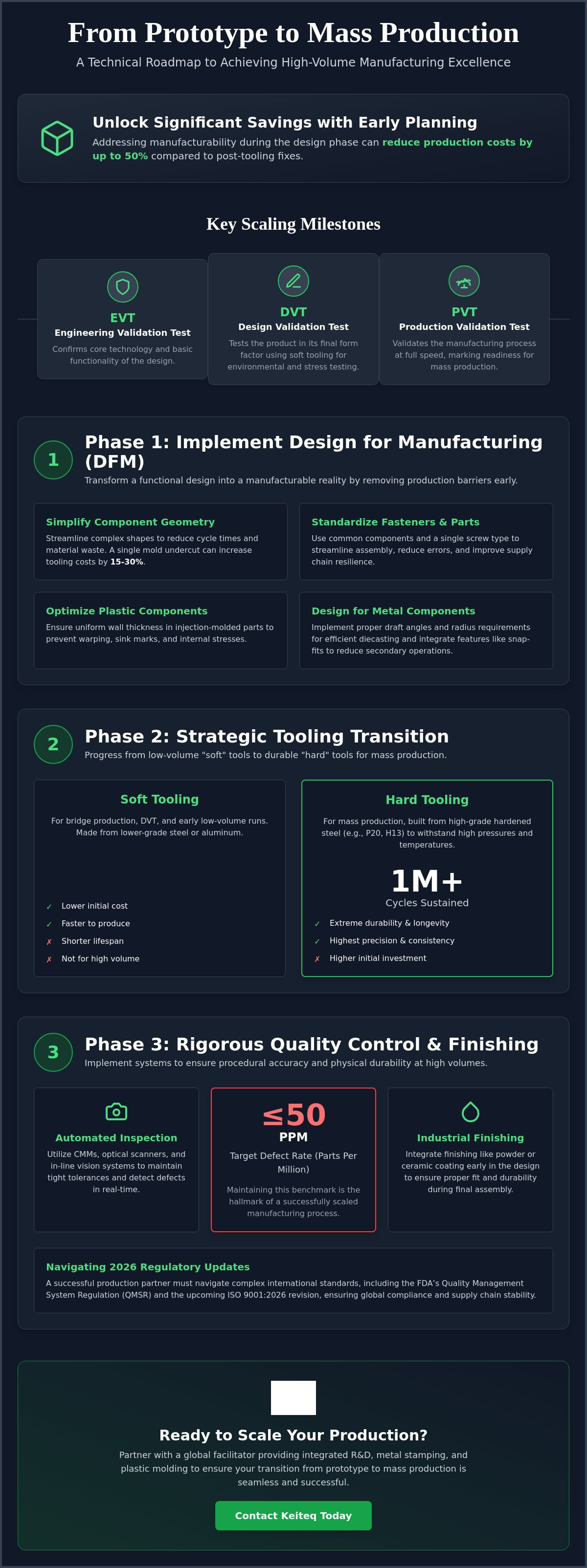
You're right to be concerned about these risks, as high failure rates during scaling remain a significant barrier to market entry. This guide provides a technical and logistical roadmap to help you master the move from prototype to mass production with predictable results. We'll examine critical 2026 updates, including the FDA’s Quality Management System Regulation (QMSR) and the ISO 9001:2026 revision. You'll gain a clear framework for optimizing Design for Manufacturing (DFM), selecting between soft and hard tooling, and maintaining a defect rate of ≤50 PPM throughout your entire production cycle.
Table of Contents
Understanding the Prototype to Mass Production Lifecycle
The transition from prototype to mass production is a fundamental shift in focus from "how it works" to "how it can be reliably made." While a functional prototype, often developed through the integrated 3D printing and rapid prototyping solutions of VPrint3D Limited, serves to validate a design concept, mass production requires a commitment to procedural discipline and industrial stability. This evolution is not a simple increase in volume. It's a comprehensive re-engineering of the product to ensure it survives the realities of a high-speed factory floor.
Success in this lifecycle rests on three core pillars: Design for Manufacturing (DFM), Tooling Strategy, and Quality Control. However, for organizations scaling complex hardware, a fourth pillar is increasingly vital: a robust digital strategy. For companies navigating this technological transformation, Sterck offers specialized consultancy to ensure that digital infrastructure evolves alongside physical production. Addressing manufacturability during the design phase can reduce production costs by 50% or more compared to fixing errors after hard tooling is finalized. In the 2026 manufacturing environment, achieving this requires a "Global Facilitator" approach. With new regulations like the FDA’s QMSR in effect, companies need a partner capable of navigating complex international standards while maintaining a steady supply chain. Skipping bridge production or "soft tooling" in complex hardware is a high-risk move that often leads to quality degradation and unexpected tooling costs.
The Role of the Functional Prototype
Rapid prototyping allows engineering teams to iterate quickly, but it's vital to distinguish between "looks-like" and "works-like" models. A works-like prototype must evaluate material performance against mass production requirements as early as possible. For instance, a part that functions well as a 3D-printed resin component may fail when subjected to the thermal stresses of plastic injection molding. Use these early iterations to identify assembly bottlenecks. If a technician finds a fastener difficult to reach in a lab, an automated OEM assembly line will likely face significant downtime or high defect rates.
Key Scaling Milestones: EVT, DVT, and PVT
Scaling follows a structured sequence of validation tests designed to eliminate risk. The Engineering Validation Test (EVT) confirms the core technology and basic functionality. Once the tech is proven, the Design Validation Test (DVT) tests the product in its final form factor. This stage often utilizes soft tooling to produce small batches for environmental and stress testing. The final milestone is the Production Validation Test (PVT), which validates the manufacturing process at full speed. Successful completion of the PVT marks the official end of the prototype to mass production transition, ensuring the facility can maintain a defect rate of ≤50 PPM while meeting global demand.
Phase 1: Implementing Design for Manufacturing (DFM)
The implementation of Design for Manufacturing (DFM) guidelines is the most critical step in the journey from prototype to mass production. This phase transforms a functional design into a manufacturable reality by identifying and removing production barriers before they reach the factory floor. Simplifying component geometry is a primary objective. Complex shapes often lead to longer cycle times in plastic injection molding, which increases the per-unit cost. By streamlining these designs, we ensure the production line moves at peak efficiency. For example, adding a single slider to a mold to accommodate an undercut can increase the mold cost by 15% to 30%, making geometric simplification a high-priority cost-saving measure.
Standardizing fasteners and assembly points is another essential DFM tactic. Using a single screw type across an entire device streamlines OEM assembly services and reduces the risk of error. A thorough Bill of Materials (BOM) audit should be conducted to identify single-source risks and ensure supply chain resilience for 2026. Integrating finishing requirements like powder coating or ceramic coating early in the design phase prevents tolerance issues during final assembly. If you're looking for a partner to audit your current designs, our team at Keiteq provides technical oversight to ensure your hardware is ready for the floor.
Optimising Plastic and Metal Components
Uniform wall thickness is essential in plastic injection molding to prevent warping and internal stresses. For metal components, implementing draft angles and specific radius requirements ensures efficient diecasting and tool longevity. Integrating features like snap-fits or self-locating tabs into metal stamping dies reduces the need for secondary operations. This integrated approach minimizes manual labor and improves the overall structural integrity of the final product.
Material Selection for Industrial Durability
Choosing between aluminium and zinc diecasting depends on the mechanical requirements of the industrial part. Aluminium offers lightweight strength and excellent thermal properties, while zinc provides superior precision for thin-walled components and complex geometries. For hardware like outdoor payment terminals for petrol stations, evaluating resin grades for UV and environmental resistance is mandatory to prevent premature degradation. For a more comprehensive look at these technical trade-offs, refer to our guide on Integrated Product R&D and Manufacturing. Selecting the right material early prevents the high cost of re-tooling later in the production lifecycle. This emphasis on quality materials extends to all areas of research; for instance, those who need to buy peptides Australia must ensure they use laboratory-grade compounds to maintain the integrity of their experimental R&D.
Phase 2: Transitioning from Soft Tooling to Mass Production
Transitioning from prototype to mass production requires a strategic pivot from flexible, low-cost tooling to rigid, high-durability production assets. Soft tooling, typically constructed from aluminum or soft steel, serves as a vital bridge. For production runs under 2,000 units, these tools offer faster lead times and lower upfront costs, allowing for market testing and final design tweaks. However, as volumes exceed 100,000 units, the shift to hard tooling becomes mandatory. High-grade hardened steel tools are engineered for 1M+ cycle longevity, ensuring consistent part quality over years of operation. Managing this transition correctly prevents the quality degradation that often plagues hardware startups during their first major production ramp.
The Economics of Tooling Investment
Investing in mass production tooling is a calculation of Return on Investment (ROI) against unit cost reduction. Amortizing a $10,000 mold over 1,000 parts results in a $10.00 per-part cost, whereas 100,000 parts reduces that impact to just $0.10. Beyond the initial purchase, you must account for the maintenance requirements of mass production dies. Regular cleaning, lubrication, and component replacement are necessary to prevent downtime. Rigorous prototyping during the bridge phase mitigates the risk of "tooling lock-in," ensuring you don't commit significant capital to a design that requires further refinement.
Bridge Production as a Risk Mitigator
Bridge production allows engineering teams to refine assembly instructions for OEM partners in a real-world environment. Certain manufacturing defects, such as stress fractures or cooling inconsistencies, only manifest after the first 1,000 units are produced. Using a bridge run helps identify these hidden issues before they affect a global rollout. This stage also provides the data needed to finalize industrial finishing specifications and technical documentation; for expert assistance with your printed materials, check out Linemark to ensure your communication is as robust as your hardware. By validating the process at a mid-volume scale, you ensure a smoother transition to full-speed manufacturing lines without the risk of high-volume scrap.
Phase 3: Industrial Finishing and Rigorous Quality Control
Industrial finishing is the final technical hurdle in the transition from prototype to mass production. While a prototype might utilize a simple spray-painted finish for aesthetic validation, mass-market hardware requires coatings that withstand years of environmental exposure. For 2026 production cycles, compliance with updated California Air Resources Board (CARB) VOC limits, which range from 50 to 250 g/L, is a baseline requirement. New international standards like ISO 25014:2026 for film thickness measurement and ISO 11997-1:2026 for cyclic corrosion resistance provide the necessary framework for professional-grade durability testing. Verifying finish adhesion and durability through these standardized tests ensures that your product maintains its integrity in the field.
Implementing automated inspection systems is mandatory for high-speed mass production lines. These systems use high-resolution machine vision to verify tolerances across plastic molding and metal stamping parts simultaneously, catching defects that manual inspection would miss. For complex industrial hardware, such as outdoor payment terminals for gas stations, environmental testing protocols must include salt spray, UV exposure, and thermal cycling. If your project requires high-durability finishes and precise assembly for harsh environments, Keiteq offers specialized coating and assembly services that meet these rigorous 2026 standards.
Advanced Coating Solutions for Durability
Selecting the correct coating is a balance of mechanical requirements and environmental stressors. Enamel coating serves as the gold standard for products requiring extreme chemical and heat resistance. Ceramic coating provides superior wear resistance for industrial components subjected to constant physical friction. Powder coating remains the most versatile option, balancing aesthetics with high-performance protection against impact and corrosion. Each of these options must be integrated into the initial DFM phase to ensure that coating thickness doesn't interfere with final assembly tolerances.
Quality Assurance in Complex Assemblies
Quality control must occur at both the component and assembly levels. Component-level testing verifies the precision of individual plastic and metal parts, while assembly-level testing ensures the fully integrated system functions under load. Managing tolerances between different materials is a primary challenge; plastic parts may expand or contract differently than metal housings in outdoor kiosks. Establishing a "Safe Pair of Hands" protocol for final OEM assembly involves rigorous procedural discipline, where every step is documented and verified against the Production Validation Test (PVT) benchmarks. This holistic approach to quality prevents the degradation often seen when scaling from a single unit to global distribution.
Selecting a Mass Production Partner: The Keiteq Advantage
Selecting a manufacturing partner is the final strategic decision in the journey from prototype to mass production. Procurement officers must evaluate candidates based on their ability to manage the entire lifecycle, from initial R&D and design through to high-volume output. A fragmented supply chain, where design, molding, and assembly are handled by separate entities, introduces significant logistical risk and potential quality degradation. Keiteq eliminates these vulnerabilities by providing a unified technical framework. We prioritize stability and functional trust, acting as a global facilitator for brands requiring disciplined execution at scale.
Reliable production requires integrated capabilities. A partner should possess in-house expertise in plastic injection molding, metal stamping, and zinc or aluminium diecasting to maintain tight tolerances across different material interfaces. Specialized expertise is particularly vital for high-complexity hardware, such as outdoor payment terminal assembly for petrol stations. These products require precise OEM assembly and industrial-grade finishing to survive harsh environments. Keiteq's in-house finishing capabilities, including enamel, ceramic, and powder coating, ensure that durability requirements are met without the delays associated with third-party vendors.
For organizations developing financial hardware like payment terminals, the digital infrastructure is just as critical as the physical casing; visit Gemba to discover how to launch your own branded banking services.
End-to-End Manufacturing Management
Having design and mass production under one roof allows for a seamless transition from prototype validation to full-scale manufacturing. Keiteq manages this progression through rigorous technical oversight, ensuring that the design intent is preserved during the move to hard tooling. Our experience in scaling payment terminals for the global fuel retail sector demonstrates our ability to navigate complex regulatory and environmental standards. We maintain a defect rate of ≤50 PPM and a 99.8% on-time delivery rate, providing the certainty required by technical directors and procurement teams alike. This integrated approach ensures that the prototype to mass production shift is a controlled, predictable evolution rather than a series of logistical hurdles. To maintain this consistency through to the final customer experience, Micro Printing offers custom packaging and commercial printing services that ensure your product's presentation matches its engineering quality.
Next Steps: Securing Your Production Line
Before initiating full-scale production, conducting a final manufacturing readiness review (MRR) is mandatory. This review verifies that all tooling, materials, and quality protocols are aligned with the PVT benchmarks established earlier in the cycle. Once the MRR is complete, establishing logistical pipelines for global distribution becomes the priority. If you're ready to secure your production line and reduce lead times, contact Keiteq for a technical briefing on your mass production roadmap. our team provides the discipline and expertise needed to guide your hardware from a single prototype to a global market presence with absolute procedural accuracy. To ensure your brand's digital presence is ready for a worldwide launch, visit Cornerstone Marketing Solutions for professional online strategy and growth support.
Scaling with Procedural Discipline
The successful transition from prototype to mass production requires more than a volume increase; it demands a total commitment to technical accuracy. By integrating Design for Manufacturing (DFM) early and managing the shift from soft to hard tooling with precision, you eliminate the high failure rates often associated with scaling. Adhering to 2026 standards, such as the ISO 9001:2026 revision and the FDA’s QMSR, ensures your hardware remains compliant and durable in global markets. This methodical approach transforms a functional design into a stable, mass-market asset.
Navigating these complexities is more efficient with an authoritative partner. Partner with Keiteq for your Mass Production Management to utilize our end-to-end R&D to mass production capabilities. We specialize in outdoor payment terminal assembly and provide specialized enamel and ceramic industrial coatings to ensure physical durability in harsh environments. Our integrated facility acts as a safe pair of hands, providing the stability your supply chain needs to thrive. Your hardware is ready for the global stage, and we're here to ensure every unit meets the highest industrial standards.
Frequently Asked Questions
What is the biggest challenge when moving from prototype to mass production?
The primary challenge in the transition from prototype to mass production is maintaining design intent while achieving high-volume manufacturability. While a prototype validates a concept, mass production requires strict procedural discipline and tolerance management across thousands of units. Engineering teams must pivot from manual assembly to automated processes, which often reveals hidden design flaws that don't manifest in single-unit builds.
How much does it cost to transition a prototype to mass manufacturing?
Tooling investment represents the largest portion of transition costs. For low-volume bridge production under 2,000 units, soft tooling costs typically range from $1,000 to $10,000. High-volume mass production requires hardened steel molds that can exceed $100,000. These upfront costs are amortized over the production lifecycle to achieve significant unit price reductions as volume increases. Total costs depend on material selection and assembly complexity.
How long does the transition to mass production typically take?
The timeline for a full production ramp typically spans three to nine months. Tooling fabrication for complex diecasting or injection molding often requires four to twelve weeks. This period includes Design for Manufacturing (DFM) audits, Engineering Validation Tests (EVT), and final Production Validation Tests (PVT). These stages ensure the line operates at peak efficiency before the global launch occurs.
What is the difference between bridge production and mass production?
Bridge production serves as a risk-mitigation phase between the initial prototype and full mass production. It utilizes soft tooling for smaller batches, allowing teams to refine assembly instructions and identify defects before investing in expensive hard tooling. Mass production utilizes high-grade steel dies for maximum longevity and the lowest possible per-unit cost at scale, typically for runs exceeding 100,000 units.
Do I need to change my design when moving to mass production?
Design modifications are almost always necessary to optimize for high-speed manufacturing. Implementing Design for Manufacturing (DFM) guidelines involves simplifying component geometry to reduce cycle times and standardizing fasteners to streamline OEM assembly. These changes don't alter core functionality; they ensure the product can be made reliably and cost-effectively in a high-volume factory environment.
How do I ensure quality remains consistent at high volumes?
Consistent quality at high volumes is maintained through automated inspection systems and machine vision. These technologies verify every part against established PVT benchmarks in real-time. Adhering to updated international standards, such as ISO 9001:2026 and ISO 13485:2016, provides a structured framework for risk-based quality management throughout the entire prototype to mass production lifecycle.
Why is industrial coating important for mass-produced hardware?
Specialized coatings protect hardware from environmental degradation and ensure regulatory compliance. For outdoor products like payment terminals, enamel or ceramic coatings provide essential resistance to UV exposure, chemicals, and physical wear. Using coatings that meet 2026 CARB VOC limits ensures the product is compliant with strict environmental regulations across different global jurisdictions while maintaining aesthetic appeal.


Comments