
Powder Coating for Diecast Aluminium Parts: The 2026 Industrial Finishing Guide
Updated: Jul 6
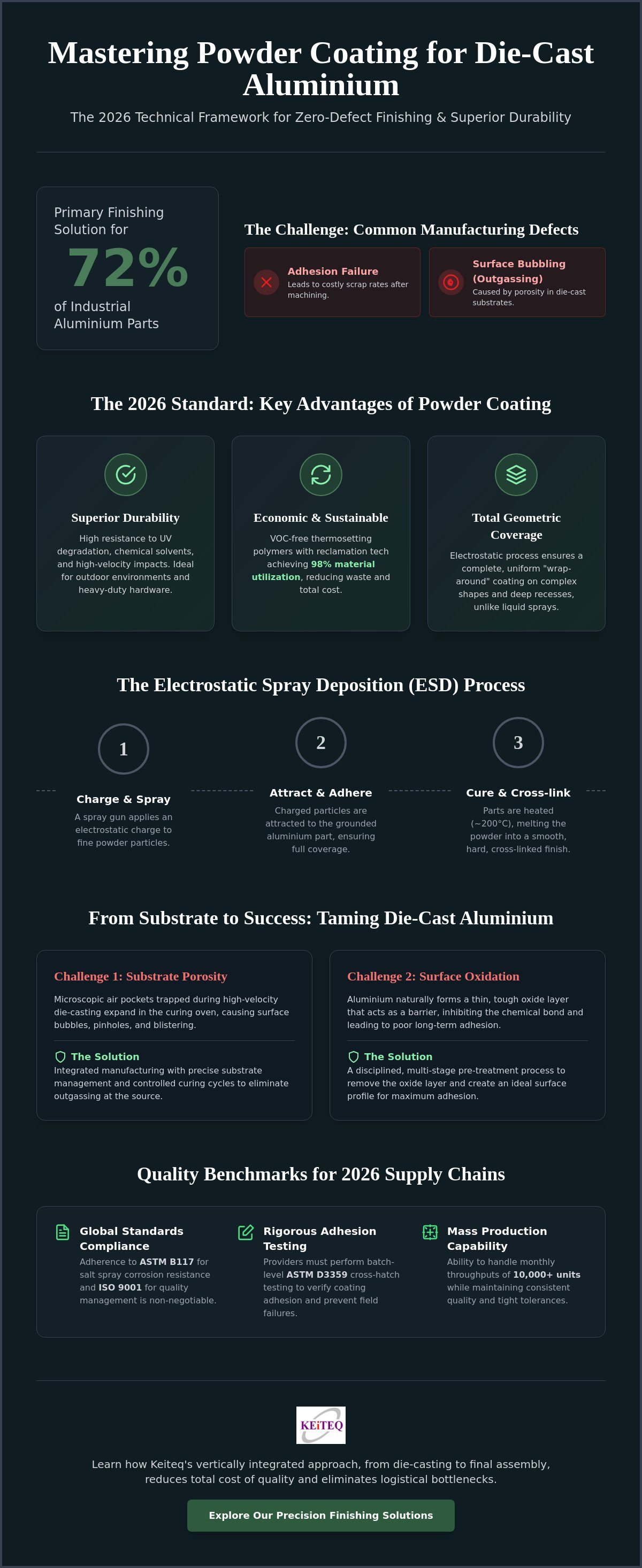
Over 72% of industrial aluminium components utilize powder coating as their primary finishing solution. Despite this high adoption rate, many manufacturers still face significant challenges with adhesion failure during post-processing machining or surface bubbling caused by outgassing in porous die-cast substrates. These technical defects often lead to costly scrap rates and logistical delays that disrupt the global supply chain.
You recognize that achieving a 'Class A' finish for outdoor environments requires more than just a standard application; it demands a disciplined approach to metallurgical properties. This 2026 guide provides the technical framework needed to master powder coating for diecast aluminium parts, ensuring your components meet zero-defect assembly goals and superior durability standards. We will detail the specific requirements for ISO 18768-1 and ASTM D3359 compliance. You'll also discover how integrated manufacturing processes eliminate outgassing and reduce the total cost of quality through precise substrate management and controlled curing cycles.
Table of Contents
What is Industrial Powder Coating? The 2026 Standard for OEM Durability
Industrial powder coating is a dry finishing process that uses finely ground particles of pigment and resin to create a protective layer. Unlike liquid paint, this method doesn't require a solvent to keep the binder and filler parts in a liquid suspension form. To understand the foundations of this technology, one must look at What is Industrial Powder Coating? and how it utilizes thermosetting polymers. These polymers are chemically engineered to cross-link during the curing process, resulting in a finish that's significantly tougher than conventional paint. This chemical bond is essential for high-performance protection in demanding industrial environments.
By 2026, the industrial sector has largely abandoned liquid solvent-based coatings in favor of VOC-free powder systems. This shift is driven by strict environmental mandates and the need for higher operational efficiency. Liquid systems often lose up to 50% of their volume to evaporation; however, powder systems eliminate this waste entirely. Modern industrial facilities now prioritize these systems to meet carbon footprint reduction targets while maintaining the rigorous finish quality required for heavy-duty hardware.
The physical properties of powder coating for diecast aluminium parts offer a strategic advantage for outdoor infrastructure. These coatings provide superior resistance to UV degradation, preventing the chalking and fading common in liquid-painted surfaces. They also resist chemical solvents and high-velocity impacts. This durability ensures that critical components maintain their structural integrity and aesthetic standards even when exposed to harsh salt-spray environments or industrial pollutants.
Sustainability is now a core metric in mass production. Modern powder reclamation technologies allow manufacturers to reach 98% material utilization. Any powder that doesn't adhere to the part during the initial spray is collected and recycled back into the feed system. This closed-loop process significantly reduces hazardous waste and lowers the total cost of materials for high-volume OEM contracts.
The Electrostatic Spray Deposition (ESD) Process
The ESD process uses a specialized spray gun to apply an electrostatic charge to the powder particles, which are then attracted to the grounded aluminium part. This electrical attraction ensures complete wrap-around coverage on complex die-cast geometries, reaching deep recesses that liquid sprays often miss. Once coated, parts enter an oven where curing temperatures, typically reaching 200°C, trigger the cross-linking of polymer chains. This thermal reaction transforms the powder into a smooth, hard skin. ESD is the primary mechanism used to maintain tight dimensional tolerances on machined industrial parts without compromising surface protection.
Compliance and Standards: ISO and ASTM for 2026
Adherence to global standards is non-negotiable for 2026 supply chain integration. High-performance powder coating for diecast aluminium parts must meet ASTM B117 salt spray standards to guarantee long-term corrosion resistance for outdoor hardware. Quality management is verified through ISO 9001 certification, ensuring consistency across production batches of 10,000 units or more. Additionally, global supply chains now require heavy-metal-free compliance, specifically excluding lead and hexavalent chromium, to meet international safety and environmental regulations.
Substrate Challenges: Coating Aluminium and Zinc Diecast Parts
Die-casting porosity acts as the primary obstacle to achieving a high-quality industrial finish. Most coating providers treat finishing as a separate, isolated task; however, successful powder coating for diecast aluminium parts requires a deep understanding of the casting's metallurgical structure. When molten metal is injected into a die at high velocity, microscopic air pockets often become trapped within the substrate. If these aren't managed, they expand during the curing process, leading to catastrophic surface failures and rejected batches.
Managing aluminium surface oxides is equally critical for long-term adhesion. Aluminium naturally forms a thin, tough oxide layer that can inhibit the chemical bond between the powder and the metal. While consumers recognize the durability of powder-coated aluminum in retail products, industrial applications demand much tighter control over these surface layers. We utilize specific strategies for different alloys, as zinc substrates require lower processing temperatures compared to aluminium to avoid compromising the structural integrity of the part.
The Keiteq Co Ltd advantage lies in vertical integration. We design die-cast molds with the final coating thickness in mind, ensuring that critical dimensions remain within tolerance after the 60-100 micron powder layer is applied. By integrating aluminium and zinc diecasting with finishing expertise, we eliminate the common friction between the foundry and the coating shop.
Solving the Outgassing Phenomenon
Outgassing occurs when trapped air or moisture in the porous substrate escapes during the heat of the curing oven, creating visible pinholes or "craters" in the finish. To prevent this, we implement specialized pre-heating cycles. By heating the parts above the final curing temperature before the powder is applied, we force the release of these gases. We also utilize 'OOG' (Outgassing Forgiving) powder chemistries. These specialized resins have a longer "open" time during the melt phase, allowing any remaining gas to escape before the film seals, ensuring a smooth, defect-free surface.
Pre-treatment Foundations for Die-Cast Metals
Powder vs. Ceramic vs. Enamel: Choosing the Right Industrial Finish
Selecting the appropriate finish involves balancing performance requirements against production budgets. While powder coating for diecast aluminium parts remains the industrial benchmark for versatile outdoor protection, it's not a universal solution for every environment. High-heat applications or high-friction zones often require specialized metallurgical coatings like ceramic or enamel to maintain component integrity over a 10-year lifecycle.
Powder Coating: This is the most cost-effective solution for standard outdoor hardware. It provides a durable barrier against moisture and UV radiation without the environmental hazards of liquid paint.
Ceramic Coating: Engineers specify ceramic finishes for components exposed to extreme thermal cycles or aggressive chemical solvents. It's the technical choice when operating temperatures exceed the limits of standard polymer resins.
Enamel Coating: This finish offers unmatched surface hardness. It's designed for abrasive industrial environments where physical wear would quickly degrade softer coatings.
A comprehensive lifecycle analysis often reveals that the lowest initial application price doesn't equate to the lowest total cost of ownership. Frequent maintenance or premature part failure due to an inadequate finish can triple the long-term expense for an OEM. Investing in a superior finish during the initial production phase ensures reliability and protects the brand's reputation in the field.
Environmental Stress Testing for Critical Hardware
Critical infrastructure, such as petrol station payment terminals and outdoor kiosks, must withstand constant UV exposure and chemical contact. We subject these parts to rigorous stress testing to ensure the finish doesn't degrade when exposed to fuels, cleaning agents, or harsh industrial solvents. Enamel coating provides the superior scratch resistance and chemical inertness required to survive the mechanical abuse typical of high-traffic retail environments. Testing protocols often include 1,000-hour salt spray cycles to verify that the powder coating for diecast aluminium parts meets international durability benchmarks.
Aesthetic Versatility and Brand Consistency
Achieving a 'Class A' finish is essential for consumer-facing hardware. We provide a range of aesthetics from matte industrial textures to high-gloss decorative surfaces. Precision color matching ensures that global OEM branding remains consistent across multiple manufacturing facilities, regardless of the batch size. Textured finishes are particularly effective for die-cast components; they mask minor substrate imperfections and microscopic surface porosity that might be visible under a high-gloss finish. This approach maintains a premium appearance while reducing the need for intensive post-casting surface grinding.
Evaluating Coating Providers for Mass Production Scale
Vetting a provider for mass production requires a rigorous technical audit of their operational infrastructure. Capacity is the most immediate factor. A provider must demonstrate the physical floor space and equipment redundancy to maintain a monthly throughput exceeding 10,000 units while adhering to strict quality benchmarks. This scale demands automated lines and sophisticated environmental controls to ensure that powder coating for diecast aluminium parts remains consistent from the first unit to the last. Batch-to-batch variation isn't acceptable when managing high-value OEM contracts.
Quality assurance must be data-driven rather than anecdotal. In-house testing capabilities are a prerequisite for any serious industrial partnership. Providers should perform batch-level cross-hatch adhesion tests and impact resistance evaluations as standard procedure. These protocols verify that the finish won't chip or peel during subsequent assembly steps or long-term field use. Without these internal checks, you risk discovering failures only after the product has reached the end-user, leading to costly recalls.
Logistical efficiency is another critical pillar for global supply chains. Fragmented workflows, where castings are shipped between separate foundries and coating shops, introduce unnecessary risks. Transit damage and surface oxidation often occur during these transitions. Minimizing the distance between the casting machine and the coating booth is a proven method for reducing the total cost of quality and accelerating the production cycle.
The Value of Integrated OEM Assembly
Integrated facilities offer a streamlined path to market that traditional job shops cannot match. By conducting coating and final assembly under one roof, Keiteq Co Ltd significantly reduces lead times. This approach also simplifies the Bill of Materials (BOM) through integrated product R&D and manufacturing. It allows for immediate post-coating quality checks before parts move to the assembly line. This feedback loop ensures that any finish defects are identified and corrected before the final product is built, supporting a zero-defect assembly goal.
DFM: Design for Manufacturing and Coating
Successful finishing starts at the design stage. Design for Manufacturing (DFM) includes validating coating thickness on prototypes using soft tooling or 3D prints. This foresight prevents fitment issues during final assembly. Engineers must also optimize part geometry to avoid the 'Faraday Cage' effect, where electrical charges prevent powder from reaching deep corners or interior recesses. Keiteq Co Ltd facilitates this transition by providing technical guidance from the initial prototype phase through to mass production coating. This ensures that the powder coating for diecast aluminium parts achieves uniform coverage on even the most complex geometries.
To ensure your next project meets these industrial standards, you can consult with Keiteq Co Ltd regarding your specific production volume and durability requirements.
The Keiteq Co Ltd Approach: Precision Finishing for Critical Infrastructure
Keiteq Co Ltd treats finishing as a core engineering phase rather than a final cosmetic step. Our end-to-end management model integrates initial R&D, die-casting, and final powder application within a single, accountable workflow. This vertical integration is specifically designed to eliminate the technical gaps discussed earlier, such as transit oxidation or misaligned tolerances between separate vendors. When we manage powder coating for diecast aluminium parts, we control every variable from the alloy composition to the final curing temperature. This level of oversight ensures that complex industrial assemblies meet the performance requirements of global infrastructure networks.
Our work with global fuel retail networks serves as a benchmark for this integrated approach. We deliver finished components for outdoor payment terminals that must survive decades of environmental exposure and chemical contact. By maintaining a "Safe Pair of Hands" philosophy, Keiteq Co Ltd provides procurement officers with the certainty that their components will arrive fully compliant with US-based standards. We facilitate the entire global supply chain, ensuring that technical specifications are never lost in transit between the foundry and the assembly line.
Engineering for Harsh Outdoor Environments
Unattended payment terminals face extreme climates, ranging from high-salinity coastal air to intense desert UV radiation. We solve these durability challenges by integrating multi-material finishes in a single assembly. For a typical petrol station kiosk, we might combine powder coating for diecast aluminium parts with ceramic-coated internal heat sinks and UV-stabilized plastic molding. This multi-layered defense strategy achieves industrial-grade aesthetics that withstand 24/7 public interaction without showing signs of mechanical wear. Our engineering team validates these finishes through accelerated aging tests that simulate years of field use in just a few weeks.
Consulting with Keiteq Co Ltd for Your Coating Project
We provide customized coating formulations based on specific industrial environmental data. Whether your hardware requires enhanced anti-graffiti properties or specialized antimicrobial resins for healthcare kiosks, we tailor the chemistry to the application. The primary benefit of our model is a single point of accountability. You don't have to mediate between a designer, a casting foundry, and a coating shop. Keiteq Co Ltd takes responsibility for the entire lifecycle of the part. Contact Keiteq Co Ltd to discuss your industrial powder coating requirements and see how our integrated manufacturing model reduces lead times.
Securing Long-Term Durability through Integrated Manufacturing
Transitioning from fragmented production to a unified manufacturing model is the most effective way to eliminate adhesion failures and logistical delays. We've detailed how understanding substrate porosity and selecting the correct polymer chemistry prevents surface defects like outgassing. By aligning your design phase with final finishing requirements, you ensure that every part meets the 'Class A' standards required for critical infrastructure. This disciplined approach to powder coating for diecast aluminium parts guarantees that your components withstand the rigors of 2026 global supply chain demands.
Keiteq Co Ltd maintains ISO 9001 compliant quality management across every stage of the production cycle. Our specialized expertise in petrol station hardware allows us to navigate the unique environmental demands of unattended retail environments with absolute precision. We provide a seamless transition from integrated R&D to mass production management, acting as a dependable pillar for your international operations. It's time to elevate your finishing standards and reduce the total cost of quality through proven methodology.
Request a Technical Consultation for Your Industrial Coating Project to begin optimizing your next assembly for superior outdoor performance.
Frequently Asked Questions
What is the typical thickness of industrial powder coating for die-cast parts?
The standard thickness for industrial applications ranges from 60 to 100 microns, or 2.4 to 4.0 mils. This depth provides a robust barrier against environmental degradation while maintaining the tight tolerances required for complex assemblies. Engineers must factor this additional layer into their initial R&D specifications to ensure that mating components fit together perfectly during final assembly.
How do you prevent outgassing bubbles in aluminium die-casting?
Preventing bubbles requires a specialized pre-heating cycle to release trapped air and moisture from the porous substrate. By baking the parts at temperatures exceeding the final curing point, we force gasses out before the powder is applied. This technique ensures that powder coating for diecast aluminium parts remains smooth and free of pinholes or craters that could compromise the finish.
Can powder coating be applied over existing finishes or minor rust?
Powder coating requires a clean, bare metal surface to achieve proper electrostatic attraction and a durable chemical bond. It isn't possible to apply it over existing paint, grease, or oxidation. We utilize mechanical descaling or chemical etching to remove all surface contaminants. This preparation creates a uniform surface profile that's essential for long-term adhesion in industrial environments.
Is powder coating more cost-effective than liquid painting for high-volume OEMs?
Powder coating is the more cost-effective choice for high-volume production due to its 98% material utilization rate. While liquid systems lose significant volume to solvent evaporation, powder overspray is reclaimed and recycled. Faster curing cycles and the elimination of VOC disposal fees further reduce the total cost of quality for OEMs managing large monthly throughputs.
What are the most common causes of powder coating failure in industrial settings?
Most failures result from inadequate surface pre-treatment or incorrect curing oven calibration. If the substrate isn't properly degreased, the powder won't bond mechanically, leading to chipping and peeling. Incorrect curing temperatures also prevent the polymer chains from fully cross-linking. We mitigate these risks through batch-level impact testing and automated environmental controls to ensure consistent results.
How do you ensure color consistency across different production batches?
We maintain consistency across high-volume runs by using automated application lines and strict batch control protocols. Spectrophotometers measure color values against a master standard to ensure every batch matches the OEM branding. Uniform film thickness is equally important; variations in coating depth can subtly change the perceived color and texture across different production lots.
What pre-treatment is required for zinc die-cast parts before coating?
Zinc die-cast parts undergo a multi-stage chemical wash that includes alkaline degreasing and a phosphate conversion coating. This process removes impurities and creates a microscopic texture that enhances adhesion. Because zinc is more sensitive to heat than aluminium, we use lower processing temperatures to prevent the substrate from becoming brittle during the curing phase.


Comments