
Protective Coatings for Outdoor Hardware: The Industrial Selection Checklist
Updated: Jul 6
With the global protective coatings market reaching an estimated $18.42 billion in 2026, the cost of a specification error has never been higher. Most procurement officers recognize that hardware failure from salt spray or UV degradation is a significant driver of avoidable maintenance costs. You need reliable protective coatings for outdoor hardware that provide multi-decade durability in the most punishing industrial environments.
We understand that inconsistent finish quality from current partners creates unnecessary risk for your global supply chain. This article provides a rigorous framework to help you master the technical criteria for industrial coating selection. You'll learn how to ensure compliance with the new GB 30981.2-2025 industrial standards and the latest ISO 11997-1:2026 testing protocols for cyclic corrosion resistance.
We will evaluate the specific advantages of powder, ceramic, and enamel coatings through a stressor-to-substrate mapping process. This checklist moves beyond aesthetics to focus on mechanical abuse resistance, thermal stability, and long-term functional trust in your hardware components.
Table of Contents
The Science of Degradation: Why Outdoor Hardware Fails
Industrial hardware failure typically stems from three primary stressors: corrosion, UV degradation, and mechanical wear. While many procurement teams focus solely on salt spray, a comprehensive view of environmental stressors is necessary for multi-decade durability. Protective coatings for outdoor hardware must address these factors simultaneously to prevent premature field replacement.
Different substrates react uniquely to oxidation. Aluminium diecasting forms a natural oxide layer, but it remains susceptible to pitting in high-salinity zones. Zinc diecasting offers sacrificial protection but requires a robust Powder coating to prevent the formation of white rust. Stamped steel represents the highest risk; without advanced finishing, red rust will compromise structural integrity within months of deployment. Even stainless steel is not immune. In coastal environments, "tea-staining" occurs when surface contaminants oxidize, creating brown discoloration. This cosmetic failure often precedes localized pitting, proving that "stainless" does not mean "stain-free."
Multi-material assemblies, such as outdoor kiosks or payment terminals, face the added risk of galvanic corrosion. When dissimilar metals like aluminium and stainless steel make contact in the presence of an electrolyte, the less noble metal corrodes at an accelerated rate. Effective protective coatings for outdoor hardware act as an essential insulating barrier to break this electrochemical circuit.
Environmental Stressors and Material Response
UV radiation acts as a silent catalyst for failure. High-energy photons break down polymer chains in low-grade paints, leading to chalking and a significant loss of protective thickness. Chemical exposure adds another layer of complexity. Outdoor hardware at petrol stations must withstand constant contact with fuel vapors and aggressive cleaning agents that can dissolve standard finishes. Thermal cycling also creates mechanical stress. Rapid temperature shifts cause substrates and coatings to expand at different rates, resulting in micro-fractures. These cracks allow moisture and pollutants to bypass the surface barrier and attack the metal directly.
Substrate Preparation: The Hidden Key to Longevity
Field data suggests that coating performance is 70% dependent on surface pre-treatment rather than the topcoat itself. Industrial hardware requires a rigorous multi-stage process involving degreasing to remove machining oils, sandblasting for mechanical profiling, and chemical etching to ensure a reactive surface. The anchor pattern is a microscopic topographical profile created on the metal surface to provide the mechanical interlocking necessary for high-adhesion industrial coatings. Without this specific surface roughness, even the most expensive ceramic or enamel finishes will eventually delaminate under environmental stress.
Comparing High-Performance Protective Coatings for Industrial Use
Selecting the right protective coatings for outdoor hardware requires a balance between throughput efficiency and long-term field performance. While the previous section detailed the chemical drivers of degradation, this comparison focuses on the technical capabilities of the three primary industrial finishes. Procurement officers often mistakenly equate coating thickness with durability. In reality, excessive thickness can lead to brittleness and delamination during thermal cycling. Precise application tolerances, such as those found in U.S. military coating standards, are far more critical for ensuring a stable, multi-decade lifecycle than sheer volume in mils.
Powder Coating: Efficiency at Scale
Powder coating remains the industry standard for high-volume OEM projects due to its electrostatic application process. This method ensures 100% coverage on complex geometries, reaching recessed areas that liquid sprays often miss. For outdoor hardware, we distinguish between thermoset and thermoplastic chemistries. Thermoset powders undergo a permanent chemical change during curing, providing superior UV stability and resistance to chalking. This process is highly efficient for mass production management, offering a repeatable, high-quality finish with minimal environmental waste. It's a reliable choice for standard infrastructure components that require a balance of aesthetics and protection.
Ceramic and Enamel: The 'Heavy-Duty' Alternatives
Ceramic and enamel coatings provide specialized protection for environments where standard finishes fail. In the same way that builders select porcelain tiles Adelaide for their resilience, industrial ceramic coatings offer exceptional surface hardness, which is essential for preventing abrasion and scratch-related corrosion on high-touch surfaces. Enamel coating, however, remains the gold standard for permanent color stability and extreme chemical resistance. It's particularly effective for outdoor payment terminal hardware at petrol stations, where constant exposure to fuel vapors and aggressive cleaning agents would quickly degrade polymer-based finishes.
These heavy-duty options involve higher complexity. Enamel and ceramic finishes require significantly higher curing temperatures and more rigorous substrate preparation than powder. Despite the increased initial processing requirements, their resistance to thermal shock and chemical attack makes them the most cost-effective solution for high-abuse environments. If your project demands this level of precision and durability, our facility integrates mass production management with advanced finishing capabilities to ensure your hardware survives the most punishing field conditions.
Environmental Mapping: Matching Coatings to Field Conditions
Environmental mapping is the technical bridge between coating chemistry and field performance. While Section 2 detailed the properties of different finishes, selecting protective coatings for outdoor hardware requires a specific understanding of site-specific stressors. Marine environments, for instance, demand coatings that resist osmotic blistering and chloride penetration. Constant moisture and high salinity create an electrolyte-rich atmosphere that accelerates electrochemical decay. In these zones, multi-layer systems with zinc-rich primers are often non-negotiable for maintaining structural integrity.
Urban and industrial corridors present a different set of challenges. Acid rain, smog, and airborne sulfur dioxide create a corrosive cocktail that can etch standard finishes. These pollutants react with moisture to form weak acids that slowly dissolve the protective barrier. For hardware deployed in these regions, chemical stability is the priority. High-density enamel or ceramic finishes provide the necessary inertness to prevent atmospheric pollutants from bonding with the metal substrate.
High-traffic public interfaces must also account for human-induced wear. Skin oils, abrasive contact, and deliberate vandalism can compromise a coating faster than weather alone. Selecting a finish with high pencil hardness and oleophobic properties ensures that the hardware remains functional and aesthetically acceptable over years of public interaction.
This emphasis on durability for high-traffic public equipment is also found in the recreation sector, where manufacturers like SoftplayToys4kids focus on material integrity and safety to ensure equipment stands up to constant use by children.
Case Study: Outdoor Payment Terminal Environments
The fuel retail sector represents one of the most punishing environments for industrial hardware. Successful outdoor payment terminal assembly requires managing simultaneous exposure to heavy UV radiation and frequent fuel spills. Petrol and diesel act as powerful solvents that can soften or swell lower-grade polymer coatings.
Enclosures for these terminals must maintain a balance of brand-consistent aesthetics and extreme durability. We often specify anti-graffiti topcoats for these applications. These specialized finishes prevent paint and ink from bonding to the surface, allowing for easy cleaning without damaging the underlying protective layer. This functionality is critical for maintaining a professional appearance in unmanned petrol station environments.
Thermal and Mechanical Abuse Factors
Hardware exposed to extreme temperature fluctuations faces the risk of thermal fatigue. Coatings must possess enough elasticity to expand and contract alongside the substrate without cracking. Impact resistance is equally vital. A single chip from a tool or a heavy object can create a localized corrosion cell, allowing rust to creep beneath the remaining coating. High-performance coatings often incorporate elastomeric components that allow the polymer matrix to flow back into minor abrasions, effectively sealing the substrate before a localized corrosion cell can form. This self-healing characteristic is a significant advantage for hardware in high-abuse industrial zones.
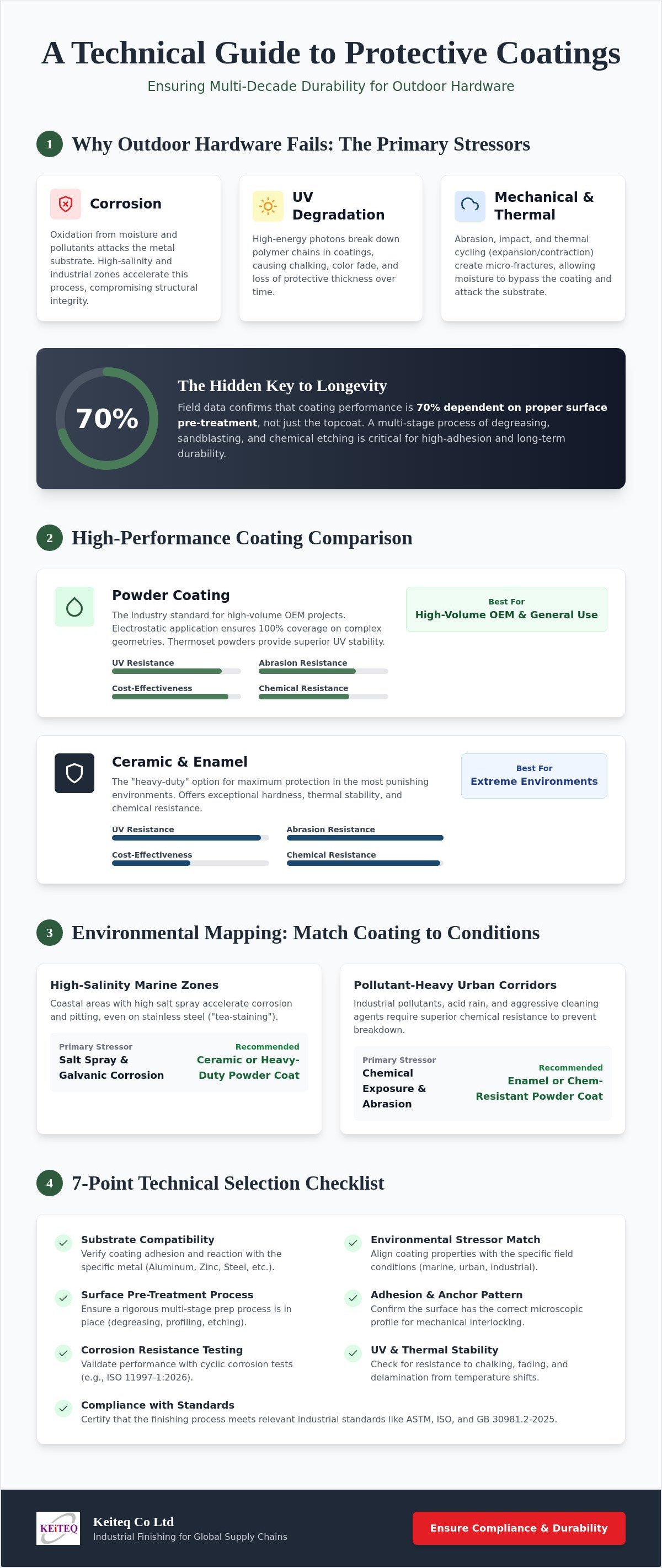
The Industrial Coating Selection Checklist: 7 Critical Criteria
Selecting protective coatings for outdoor hardware requires a transition from general environmental mapping to a rigorous technical evaluation. This checklist provides a baseline for procurement officers and engineers to ensure long-term functional trust. Each criterion serves as a filter to eliminate finishes that cannot withstand the specific stressors of your deployment site.
1. Substrate Compatibility: The coating must form a permanent chemical bond with the base metal. Whether you utilize aluminium diecasting or stamped steel, the finish must be engineered for that specific surface energy to prevent delamination.
2. Environmental Rating: Verification is essential. Demand documentation proving the finish meets ASTM B117 salt spray standards for corrosion or G154 standards for UV resistance.
3. Hardness and Abrasion Resistance: High-traffic hardware must resist physical contact and aggressive cleaning. A high pencil hardness rating ensures the surface won't scratch, which would otherwise create a path for moisture.
4. Chemical Resistance: Evaluate how the finish reacts to localized pollutants. This includes solvents, fuels, and acids, which are particularly prevalent in industrial zones and petrol stations.
5. Color and Gloss Retention: Aesthetics represent your brand's quality. A durable coating should maintain its visual profile even after 5,000 hours of intense UV exposure.
Operational and Scalability Criteria
Technical performance in a lab doesn't always translate to the factory floor. Point 6, Mass Production Feasibility, addresses whether a finish can be applied with 100% consistency across 10,000 units. Inconsistent application leads to localized failures in the field. Point 7 is the Total Cost of Ownership (TCO). You must balance the initial application cost against the long-term expense of field maintenance and premature replacement.
Effective selection happens early. By integrating these criteria into the integrated product R&D and manufacturing phase, you eliminate the risk of choosing a finish that is either over-engineered for the environment or impossible to apply at scale. If you're ready to secure your supply chain with a partner who understands these complexities, contact Keiteq Co Ltd today to review your hardware specifications.
Compliance and Industrial Standards
Compliance is the final verification step. We utilize the ISO 12944 standard to categorize corrosion risks from C1 (very low) to CX (extreme offshore). Your coating choice must align with the specific category of your deployment site. We also prioritize Qualicoat or similar certifications for industrial finishers, as these require strict adherence to standardized testing protocols. Always verify your manufacturer's internal testing for adhesion and impact resistance to ensure every batch meets the promised durability threshold.
Integrating Surface Finishing into the OEM Manufacturing Lifecycle
Industrial finishing is frequently treated as a final, isolated step in the production cycle. This approach is a strategic error. Integrating protective coatings for outdoor hardware during the initial design and prototyping phases ensures that the part geometry allows for uniform coverage. It also prevents costly re-engineering when coating thickness interferes with mechanical tolerances. For projects requiring high-precision fabrication before coating, utilizing a service like CNC Cut to Size ensures that component dimensions remain within spec throughout the assembly process. Decisions made at the drawing board directly impact the multi-decade durability of the final assembly.
The risk of "outsourcing the outsource" represents a significant vulnerability in the global supply chain. When a manufacturer sends raw components to a third-party finisher, accountability for the final product becomes fragmented. This separation often leads to inconsistent surface preparation or curing errors that go undetected until the hardware fails in the field. A single-source partner manages the entire lifecycle, providing a "safe pair of hands" that guarantees the finish adheres to the substrate with procedural accuracy.
The technical approach of Keiteq Co Ltd eliminates these logistical gaps. We manage the transition from aluminium diecasting or metal stamping directly into advanced enamel, ceramic, or powder finishing. This integrated flow ensures that every unit in a mass production run meets the exact specifications of the master sample. Quality control is not a post-production check; it's embedded into every stage of the manufacturing process.
Turnkey Benefits for Outdoor Hardware
Combining metal stamping and coating under one roof significantly reduces lead times. It eliminates the transit time and potential for surface contamination that occurs when moving parts between facilities. This turnkey model is particularly valuable for complex assemblies like gas station kiosks or outdoor payment terminals. We ensure component fitment is verified after high-build coatings are applied, preventing assembly delays caused by unexpected dimensional changes. Streamlining the supply chain in this manner reduces administrative overhead and improves overall project stability.
Partnering for Long-Term Durability
Managing the transition from a low-volume prototype to mass production requires disciplined methodology. Keiteq Co Ltd utilizes integrated finishing to protect your brand's reputation by ensuring that hardware aesthetics and functional integrity remain stable over time. Professional industrial finishing is a critical component of brand protection; a rusted terminal or a faded enclosure signals neglect to the end-user. By choosing an integrated manufacturing partner, you secure a reliable pillar for your global production needs. Contact Keiteq Co Ltd for specialized industrial coating and manufacturing solutions.
Securing Long-Term Hardware Performance
The successful deployment of infrastructure depends on the technical synergy between material selection and finish application. Choosing protective coatings for outdoor hardware is not merely a cosmetic choice but a logistical safeguard against field failure and high maintenance costs. By applying the criteria outlined in this checklist, you ensure that your components possess the physical durability required for harsh industrial environments.
Keiteq Co Ltd offers the comprehensive expertise needed to bridge the gap between complex engineering and mass production. Our facility provides specialized services in petrol station payment terminal assembly, supported by advanced capabilities in enamel, ceramic, and powder coating. We manage every phase from initial R&D to mass production management, ensuring that your hardware remains a dependable pillar of your operational infrastructure.
Request a technical consultation for your outdoor hardware project to discuss your specific durability requirements with an authoritative manufacturing partner. We're committed to delivering the consistency and proven methodology your global supply chain demands.
Frequently Asked Questions
What is the best protective coating for outdoor metal hardware?
The optimal choice depends on the specific stressors of your deployment site. For high-volume infrastructure, powder coating offers a balanced combination of cost efficiency and durability. However, hardware in high-abuse environments, such as petrol stations, requires enamel or ceramic coatings for superior chemical and abrasion resistance. Selecting the right protective coatings for outdoor hardware ensures the substrate remains isolated from moisture and pollutants over a multi-decade lifecycle.
How long does industrial powder coating last in an outdoor environment?
A professionally applied industrial powder coating typically lasts between 15 and 20 years in standard outdoor conditions. This longevity depends heavily on the quality of the substrate pre-treatment and the specific powder chemistry used. Thermoset powders provide better UV stability than thermoplastic alternatives. Regular maintenance and environmental mapping can extend this duration, though high-salinity marine zones may reduce the effective service life without supplemental primers.
Is ceramic coating better than powder coating for industrial applications?
Ceramic coating isn't inherently better but serves a different technical purpose. It provides superior surface hardness and heat resistance compared to powder coating, making it ideal for hardware subjected to extreme friction or thermal cycling. Powder coating remains the preferred choice for mass production due to its electrostatic application efficiency and versatile color options. Engineers must choose based on whether the primary threat is mechanical wear or general atmospheric corrosion.
Can you apply protective coatings to zinc and aluminium diecast parts?
Yes, both zinc and aluminium diecast parts are excellent candidates for high-performance finishes. Aluminium requires specific chemical etching to ensure adhesion, while zinc diecasting often needs a primer to prevent white rust formation. Proper degreasing and mechanical profiling are essential steps before applying protective coatings for outdoor hardware to these substrates. These processes ensure the finish bonds chemically, preventing delamination during the expansion and contraction of the metal.
What are the ASTM standards for testing outdoor hardware coatings?
Industrial finishers primarily utilize ASTM B117 for salt spray testing and ASTM G154 for accelerated UV exposure. These protocols simulate years of environmental stress in a controlled laboratory setting to verify long-term performance. ASTM D3359 is also used to verify coating adhesion through cross-hatch tape tests. Compliance with these standards provides procurement officers with verifiable data regarding how a specific finish will perform when deployed in harsh industrial or coastal environments.
How do I prevent corrosion on outdoor payment terminals at gas stations?
Preventing corrosion on gas station hardware requires finishes that resist both fuel vapors and aggressive cleaning agents. Enamel coatings provide the highest level of chemical inertness, ensuring that petrol spills don't soften the protective layer. Additionally, using a single-source manufacturer for both diecasting and finishing eliminates the risk of contaminated substrates. This integrated approach ensures the terminal enclosure maintains structural integrity and brand-consistent aesthetics despite constant public interaction.
What is the difference between enamel and ceramic coatings for hardware?
The primary difference lies in their chemical composition and curing requirements. Enamel is a glass-based finish fused to the metal at extremely high temperatures, offering permanent color stability and total chemical resistance. Ceramic coatings utilize inorganic polymers that provide exceptional hardness and abrasion resistance. While both are high-durability options, enamel is typically superior for chemical exposure, whereas ceramic excels in preventing mechanical scratches and chips in high-traffic zones.
Does the color of a coating affect its UV resistance?
Pigmentation does influence UV performance, though modern additives have narrowed the gap significantly. Darker colors tend to absorb more thermal energy and photons, which can accelerate the breakdown of the polymer matrix in lower-grade finishes. High-quality industrial coatings incorporate UV stabilizers and infrared-reflective pigments to mitigate this effect. Selecting a finish with a high gloss retention rating ensures that the hardware maintains its visual profile regardless of the chosen brand color.


Protective coatings for outdoor hardware are essential to extend durability, prevent corrosion, and maintain performance in harsh environmental conditions. Industrial selection typically depends on factors such as exposure to moisture, UV radiation, chemicals, and temperature fluctuations. Common solutions include powder coatings, galvanization, and specialized polymer-based finishes, each offering different levels of resistance and cost efficiency. A proper selection checklist helps ensure long-term reliability and reduced maintenance costs. More details and full checklist here need for slots