
Complex Electromechanical Assembly Services: A Strategic Guide for OEMs
Updated: Jul 5
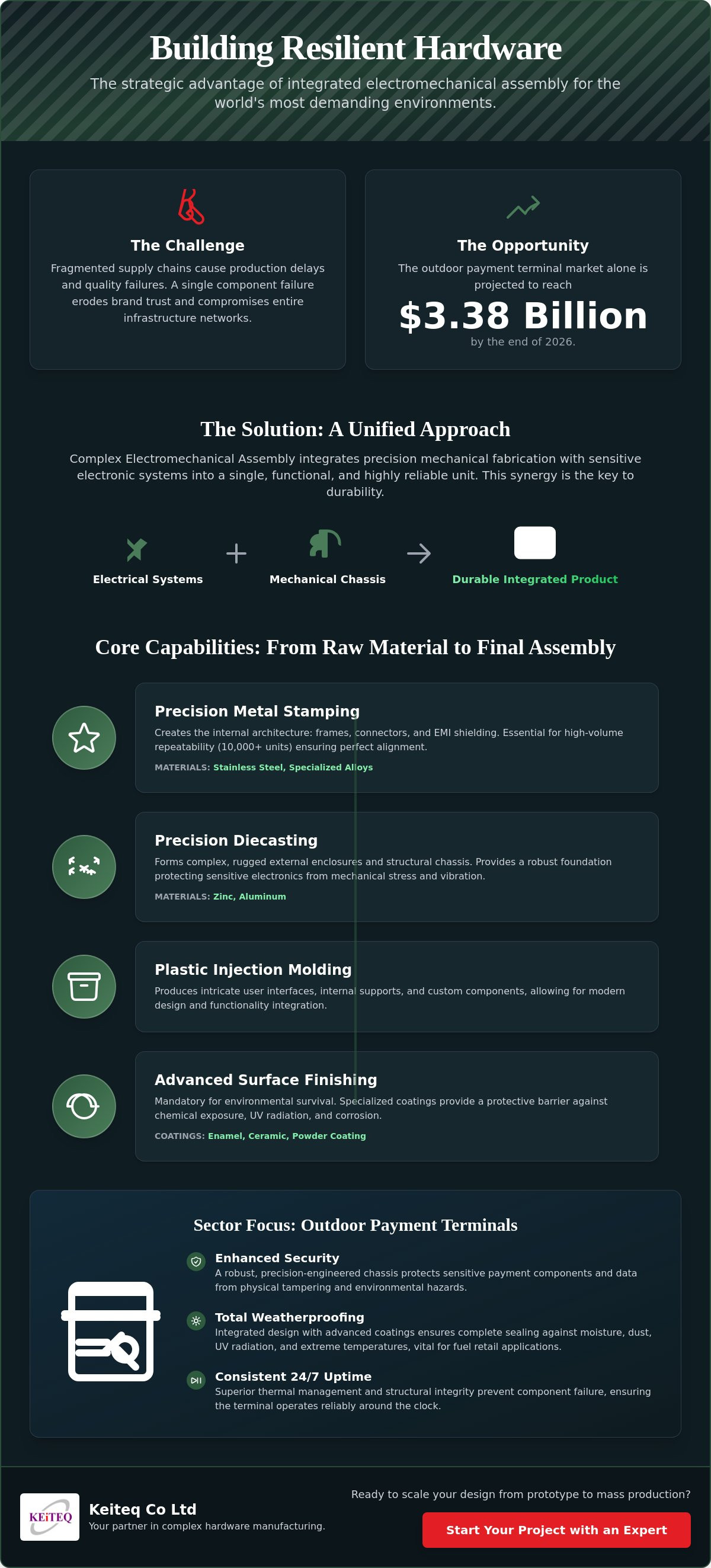
A single component failure in an outdoor payment terminal doesn't just halt a transaction; it compromises an entire infrastructure network and erodes brand trust instantly. For OEMs operating in the industrial sector, the pressure to deliver high-durability hardware has never been higher, especially as the outdoor payment terminal market is projected to reach $3.38 billion by the end of 2026. You likely recognize that fragmented supply chains are the primary cause of production delays and quality failures in harsh environments. Scaling a complex design from a prototype to mass production requires more than just a vendor; it requires a steady, experienced partner.
This article explores how complex electromechanical assembly services provide a strategic advantage by unifying integrated engineering with precision mechanical fabrication. You'll discover how a turnkey manufacturing approach reduces lead times and ensures your hardware meets the rigorous requirements of the upcoming ISO 9001:2026 standards. We'll outline the path from initial R&D to full-scale production, focusing on the technical precision and logistical competence needed to build resilient hardware for the world’s most demanding environments.
Table of Contents
What are Complex Electromechanical Assembly Services?
Complex electromechanical assembly services represent more than the sum of their parts. While basic manufacturing focuses on individual component production, high-level assembly requires the strategic integration of electromechanics into a single, functional system. This process demands a deep understanding of how mechanical enclosures interact with sensitive circuitry. It's a multi-disciplinary challenge where high component counts and microscopic tolerances are the standard, not the exception. Effective integration ensures that the final product operates reliably under the stresses of industrial use.
The scope of these services is broad, covering everything from internal sub-assemblies to turnkey hardware like an outdoor payment terminal for a petrol station or a ruggedized industrial kiosk. Success relies on the seamless coordination of diverse materials and technologies. Critical components typically include multi-layer PCBs, custom wire harnesses, and advanced sensors, all housed within precision-molded plastics and metal enclosures. This level of complexity requires a manufacturing partner capable of managing the entire lifecycle, from soft tooling and prototyping to mass production management.
Because these systems rely on seamless software-hardware integration, you can discover Test Triangle to learn how their DevOps and testing services help maintain high-performance IT environments for industrial hardware.
The Synergy of Electrical and Mechanical Engineering
Mechanical integrity directly dictates the functional lifespan of internal electronics. A rigid chassis prevents PCB flex and subsequent solder joint failure during transport or operation. Beyond structural support, the enclosure design must prioritize thermal dissipation. Engineers use strategic material selection and venting patterns to move heat away from processors without compromising the unit's seal. Proper EMI/RFI shielding is equally critical. In dense industrial environments, the housing must block external electromagnetic interference to prevent signal corruption and system downtime. These factors transform a simple box into a high-performance protective environment.
Core Capabilities Required for High-Level Assembly
Executing a complex build requires a suite of vertically integrated processes. Precision metal stamping and aluminium or zinc diecasting provide the structural foundation for heavy-duty systems. These methods allow for high-volume consistency in creating complex internal brackets and rugged outer shells. Complementary to the metalwork, plastic injection molding creates the intricate user interfaces and internal supports necessary for modern hardware. Finally, specialized finishing is mandatory for environmental survival. Coatings like enamel, ceramic, or powder coating ensure the assembly withstands chemical exposure and UV radiation in varied operating conditions. This holistic approach to manufacturing eliminates the risks associated with fragmented supply chains.
The Mechanical Foundation: Precision Stamping and Diecasting
In the delivery of complex electromechanical assembly services, the enclosure is far more than a cosmetic shell. It serves as a structural chassis that protects sensitive internal electronics from mechanical stress, vibration, and environmental ingress. Without a robust mechanical foundation, even the most advanced circuitry remains vulnerable to field failure. Integrated manufacturing requires that the enclosure and internal brackets are designed with the same precision as the PCBs they house, ensuring that every mounting point and connector port aligns perfectly during the final integration phase.
Metal Stamping for Internal Structural Components
High-speed metal stamping is essential for producing the internal architecture of industrial hardware. This process creates the connectors, frames, and EMI shielding components that define the system's internal layout. Material selection is a critical decision point. While stainless steel offers superior corrosion resistance, specialized alloys may be required for specific industrial environments where conductivity or magnetic shielding is a priority. Maintaining repeatability is the primary challenge for OEMs. When production runs exceed 10,000 units, even a micron-level deviation in a stamped bracket can lead to assembly bottlenecks or compromised electrical grounding. Precision tooling ensures that every component is identical, facilitating a seamless assembly flow.
Diecasting for Complex External Enclosures
Diecasting provides a path to structural complexity that stamping cannot achieve. Zinc diecasting is often the preferred choice for thin-walled, intricate components because of its high ductility and superior surface finish. It allows for the creation of complex geometries that require minimal secondary processing. Conversely, aluminium diecasting is selected for high-strength outdoor housings, such as those used for an outdoor payment terminal for a petrol station. Aluminium’s natural thermal conductivity is a strategic advantage, as it aids in heat dissipation for systems requiring 24/7 uptime. After the casting process, post-casting machining is often utilized to reach the final precision required for mounting high-accuracy sensors or interactive touchscreens.
The success of complex electromechanical assembly services hinges on these precision tolerances. When mechanical and electrical components converge, a lack of alignment in mounting bosses or enclosure seams can compromise the unit's IP rating. A partner with integrated metal stamping and diecasting capabilities ensures that these tolerances are managed under a single quality control framework. This unified approach reduces the risk of integration failure and ensures the finished hardware is resilient enough for the world's most demanding environments.
Advanced Surface Finishing for Harsh Environments
Surface treatments represent the final layer of defense for industrial hardware. In the context of complex electromechanical assembly services, finishing isn't a cosmetic choice; it's a functional requirement for environmental survival. While the mechanical foundation provides structural integrity, the surface finish determines how the assembly interacts with its operating environment. For high-value assets like an outdoor payment terminal for a petrol station, the coating must withstand constant human interaction, chemical exposure, and fluctuating weather conditions without degrading.
The choice of coating depends on the specific stressors the hardware will face. Enamel coating provides the highest level of protection for fuel retail environments. It's virtually impervious to petroleum-based chemicals and maintains exceptional color stability under intense UV exposure. Ceramic coating is utilized for internal components or high-friction industrial parts where heat resistance and surface hardness are the primary concerns. For general-purpose enclosures that require a balance of aesthetics and impact resistance, powder coating remains the industry standard. It provides a thick, durable barrier that resists chipping and corrosion at a manageable price point.
Comparing Industrial Coating Solutions
Ensuring 100% coverage on complex geometries is a significant technical challenge. Diecast housings and stamped brackets often feature deep recesses, sharp edges, and intricate mounting bosses that are difficult to reach. Modern application processes use electrostatic attraction or specialized dipping to ensure the coating adheres uniformly to every surface. This complete seal is vital because even a microscopic gap in the finish can become a focal point for oxidation, eventually leading to structural failure or electrical shorts within the internal electronics.
Durability Standards and Compliance
Adherence to rigorous testing protocols is mandatory for hardware destined for demanding industrial environments. Assemblies must meet specific ISO standards for corrosion resistance, which often involves extensive salt spray testing to simulate years of coastal exposure in a matter of weeks. Thermal cycling tests are also conducted to ensure that the coating and the underlying substrate expand and contract at compatible rates, preventing delamination. By investing in high-specification finishing during the manufacturing phase, OEMs significantly reduce long-term maintenance costs and prevent the premature field failures that can devastate a brand's reputation for reliability.
The Transition: From R&D to Mass Production Management
The shift from a functional prototype to a market-ready industrial unit involves significant technical hurdles. Moving through this phase successfully requires more than just a list of components; it demands a structured framework for scaling. Complex electromechanical assembly services mitigate technical risks by identifying potential failure points early in the development cycle. Design for Manufacturing (DfM) becomes a primary tool here. By optimizing the assembly sequence and component selection, manufacturers can reduce labor costs and eliminate common assembly errors. This phase often utilizes prototyping and soft tooling to validate the design's physical and electrical performance before committing to expensive hard molds.
Scaling up effectively means moving from low-volume pilot runs to full-scale production without sacrificing quality. This transition is where many OEMs struggle due to fragmented oversight and strategic bottlenecks. To help organizations overcome these growth obstacles, find out more about the strategic guidance and execution support offered by Top7. A unified approach ensures that every design iteration is documented and that the manufacturing process is refined for maximum efficiency. It's about creating a repeatable, stable production environment that can handle the complexities of multi-disciplinary hardware.
For small businesses aiming to grow their market share alongside production, leveraging digital marketing is essential; for instance, KD Interactive specializes in local SEO services that help niche industrial providers stand out.
Bridging the Gap with Strategic R&D
Engineering feedback during the design phase is invaluable. Integrating product R&D and manufacturing ensures that the design is actually buildable at scale. It eliminates bottlenecks where a theoretical design meets the practical realities of the factory floor. Part of this strategic R&D involves developing custom test fixtures. These fixtures provide automated, functional verification of every unit, ensuring that internal electronics and mechanical actuators perform exactly as specified before leaving the facility. This proactive verification prevents costly field failures and ensures 100% compliance with your technical specifications.
Mass Production and Supply Chain Integration
Managing a bill of materials (BOM) for complex electromechanical assembly services can involve thousands of individual components sourced from global vendors. A robust supply chain integration prevents stockouts that could halt production lines and delay market entry. Quality control at this scale relies on implementing AQL (Acceptable Quality Limit) standards to maintain rigorous oversight without slowing down throughput. This "Safe Pair of Hands" approach ensures that the 10,000th unit is as reliable as the first, maintaining consistency over multi-year production cycles. If you're ready to scale your project with a reliable partner, explore our mass production management capabilities to streamline your path to market.
Sector Focus: Outdoor Payment Terminals for Petrol Stations
Outdoor payment terminals represent the pinnacle of industrial hardware integration. These systems must maintain 24/7 uptime in environments ranging from extreme desert heat to corrosive coastal humidity. Providing complex electromechanical assembly services for this sector requires a specialized understanding of fuel dispenser architecture and gas station kiosk design. It's not enough to simply house electronics. The assembly must function as a secure, weather-hardened interface that facilitates high-frequency transactions without human intervention. Reliability is the primary metric of success in this high-stakes retail environment.
Security and Vandal-Resistance in Assembly
Unattended payment hardware is a high-value target for both physical theft and data skimming. Mechanical locking mechanisms are the first line of defense, but true security is integrated deeper into the assembly. We incorporate anti-tamper sensors directly into the internal brackets to trigger system alerts if the enclosure is breached. User-facing components utilize high-impact plastics and reinforced metal to withstand physical abuse and attempted vandalism. These assemblies are engineered to meet strict payment industry security standards, ensuring that sensitive financial data remains uncompromised even in remote, unmonitored locations.
Weatherproofing and Thermal Management
Protecting internal electronics from rain, dust, and localized pollutants requires precise sealing techniques to achieve IP65 or IP66 ratings. Every gasket and seal must be validated for long-term performance under thermal stress. Thermal management is equally vital to prevent processor throttling or component failure. In outdoor kiosks, engineers must choose between passive and active cooling based on the expected ambient temperatures. Passive systems rely on heat-dissipating aluminium diecasting, while active systems utilize internal fans or heat exchangers. Keiteq delivers these ready-to-use solutions for the global fuel retail sector. Our production history demonstrates how complex electromechanical assembly services solve the specific challenges of petrol station environments, ensuring hardware resilience through years of continuous operation.
Securing Long-Term Hardware Reliability
Transitioning from a technical concept to a field-ready industrial system requires a unified manufacturing strategy. We've examined how precision mechanical foundations and advanced surface treatments protect sensitive electronics in harsh environments. Effective complex electromechanical assembly services bridge the gap between initial design and high-volume output, ensuring that technical risks are mitigated before full-scale deployment. This integrated approach ensures that every unit meets the rigorous durability standards required for 24/7 industrial operation.
While hardware durability is the cornerstone of trust, maintaining a professional online presence is equally vital for today's OEMs. To ensure your brand's digital identity matches the quality of your engineering, you can explore Social Media Management with Cornerstone Marketing Solutions.
Keiteq has specialized in petrol station hardware for over a decade. We provide the technical expertise needed for high-uptime unattended systems. Our in-house capabilities for metal stamping, plastic molding, and advanced coating allow us to maintain total quality control under a single roof. We combine extensive production experience with a globalized corporate approach to support your manufacturing needs at any scale. Contact Keiteq for a technical briefing on your next complex assembly project. We're ready to help you build hardware that excels in the world's most demanding environments.
Frequently Asked Questions
What is the difference between a box build and complex electromechanical assembly?
A box build typically involves mounting a completed PCB into a simple enclosure with basic point-to-point wiring. Complex electromechanical assembly services go much further by integrating multiple subsystems, including precision metal stamping, custom molded plastics, sensors, and intricate wire harnesses. These projects require multi-disciplinary engineering to manage tight tolerances and high component counts across various manufacturing disciplines.
How do you ensure quality control for assemblies with hundreds of components?
Quality control for high-component assemblies relies on a multi-layered inspection framework. We implement Acceptable Quality Limit (AQL) standards and utilize custom-built test fixtures for automated functional verification. Every unit undergoes rigorous checks to ensure that electrical connections, mechanical actuators, and sensor interfaces perform exactly as specified before leaving the production floor. This methodical approach prevents defects from reaching the field.
Can you manage the transition from a prototype designed by another agency to mass production?
We frequently manage transitions from external prototypes to full-scale mass production. This process begins with a comprehensive Design for Manufacturing (DfM) audit to identify scalability issues or production bottlenecks. By utilizing prototyping and soft tooling, we validate design adjustments and optimize the assembly sequence before committing to high-volume hard molds. This ensures the design is optimized for both cost and reliability.
Which coating is most suitable for outdoor payment terminals in extreme climates?
Enamel coating is the most durable solution for outdoor terminals exposed to extreme UV and chemical stressors. It provides superior resistance to petroleum-based solvents and maintains color stability over long-term exposure. For components subjected to high friction or localized heat, ceramic coatings offer the necessary wear resistance to prevent premature structural degradation. The choice depends on the specific environmental stressors the hardware will face.
Do you provide functional testing and burn-in services for completed assemblies?
Yes, functional testing and burn-in services are standard components of the assembly process. Burn-in testing subjects completed units to elevated temperatures and operational loads to identify potential early-life failures. This rigorous protocol ensures that every assembly shipped to the field is stable and capable of 24/7 operation in demanding industrial environments. It's a critical step in maintaining long-term hardware integrity.
What industries benefit most from turnkey electromechanical assembly services?
Industries requiring high-durability hardware, such as fuel retail, industrial automation, and telecommunications, benefit most from turnkey services. These sectors rely on hardware that must withstand harsh environmental conditions and constant human interaction. Turnkey integration reduces lead times and simplifies the supply chain by consolidating mechanical fabrication and electronics assembly under a single, expert provider.
How does Design for Manufacturing (DfM) affect the final cost of an assembly?
Design for Manufacturing (DfM) significantly lowers the total cost of ownership by optimizing the production process. It reduces labor costs through simplified assembly steps and minimizes material waste by consolidating components. Effective DfM also lowers error rates during mass production, which prevents costly rework and ensures consistent quality across large production runs. It's a strategic investment in production efficiency.
What certifications should I look for in an electromechanical assembly partner?
Prioritize partners holding ISO 9001:2026 certification to ensure compliance with the latest quality management standards. Adherence to IPC standards for electronics assembly is also vital for ensuring the reliability of PCB integrations and wire harnesses. Additionally, verify compliance with UL or CSA standards relevant to your specific industrial hardware requirements to ensure safety and market access.


Comments