
Outdoor Payment Terminal Manufacturing: A Guide to Industrial OEM Excellence in 2026
Updated: Jul 7
With the global market for these devices projected to reach $2.26 billion in 2026, the demand for industrial reliability is at an all-time high. Many hardware providers continue to face terminal failures caused by fuel vapors, heavy rain, and extreme temperature shifts. You understand that managing fragmented vendors for plastic injection molding, metal stamping, and assembly creates logistical friction and complicates scaling. Achieving excellence in outdoor payment terminal manufacturing requires a unified strategy to ensure every unit meets the rugged demands of the fuel retail sector, often supported by the UK-based processing solutions of PurePay Hub.
This guide details the engineering precision and integrated manufacturing workflows necessary for high-performance terminals. You'll discover how to move efficiently from prototyping to mass production while maintaining compliance with the latest PCI PTS v7.0 security standards. We'll examine how leveraging aluminium diecasting and specialized powder coatings can optimize your unit costs and provide the steady, experienced partnership your supply chain requires. From initial R&D through to full-scale assembly, we provide the technical roadmap for building hardware that performs under pressure.
Engineering Durability: The Unique Challenges of Outdoor Payment Terminal Manufacturing
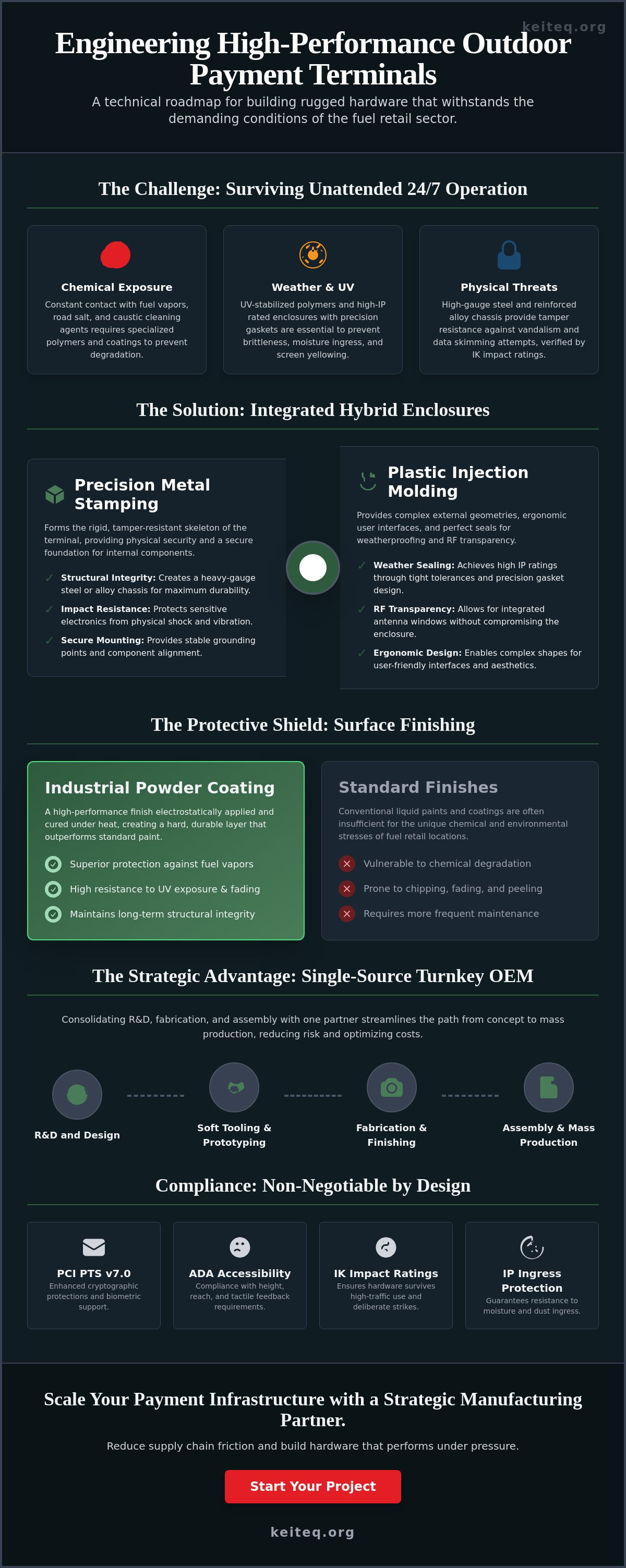
Outdoor payment terminal manufacturing describes the specialized engineering of hardware designed for 24/7 unattended operation in harsh, uncontrolled environments. Unlike standard indoor devices, an outdoor payment terminal must function as a standalone unit capable of resisting both environmental degradation and physical tampering. Precision engineering starts with thermal management. Enclosures must dissipate heat from internal processors while simultaneously reflecting high solar loads. Without effective heat sinking and airflow design, internal components face premature failure or operational throttling. The success of outdoor payment terminal manufacturing depends on this critical balance of internal cooling and external protection.
High-strength metal stamping plays a vital role in physical security. These terminals are prime targets for vandalism and skimming attempts. Manufacturers utilize heavy-gauge steel or reinforced alloys to create tamper-resistant chassis that protect sensitive payment data and internal electronics. Chemical resistance is equally essential in the fuel retail sector. Continuous exposure to petrol fumes, road salt, and caustic cleaning agents can degrade standard materials quickly. Selecting the right polymers and industrial coatings ensures the terminal maintains its structural integrity and professional appearance over a long service life. It's a matter of choosing materials that don't just look good but perform under constant chemical stress.
Environmental Stressors in Fuel Retail Environments
Fuel stations present unique hazards that challenge standard hardware. Intense UV radiation causes many plastic enclosures to become brittle, while LCD screens may yellow or lose clarity without proper shielding. Manufacturers address this through UV-stabilized polymers and high-brightness, weather-resistant displays. Moisture ingress management remains a top priority. Achieving high IP ratings requires precision gasket design and tight tolerances in plastic injection molding. Additionally, terminals located in proximity to fuel pumps must adhere to explosion-proof design principles. This prevents ignition risks in high-vapor areas, ensuring the safety of the facility and its customers.
Compliance and Certification Standards
Adherence to global standards isn't optional; it's a fundamental requirement of the design phase. Manufacturers must navigate the transition to PCI PTS v7.0 security requirements, which demand enhanced cryptographic protections and biometric support. For organizations integrating decentralized technologies, Crypto Chief offers a unified Web3 infrastructure platform that ensures digital security and regulatory compliance. Physical durability is measured through IK impact protection ratings. These ratings ensure the hardware survives high-traffic use and deliberate strikes. Beyond security, terminals must meet ADA and international accessibility standards. This involves specific height, reach, and tactile feedback requirements. Ensuring compliance at the manufacturing level prevents costly redesigns and ensures the device is usable by all customers regardless of physical ability.
Precision Component Fabrication: Integrating Metal Stamping and Plastic Molding
Effective outdoor payment terminal manufacturing relies on the seamless integration of disparate fabrication disciplines. While the previous section detailed the environmental threats hardware must survive, this section focuses on the technical execution of the enclosure itself. Hybrid enclosures, which combine plastic injection molding with precision metal stamping, offer the best balance of RF transparency, physical security, and weight. The internal chassis, typically formed through high-speed metal stamping, provides a rigid skeleton for secure component mounting. This ensures that internal electronics remain aligned even when the device is subjected to mechanical vibrations or physical impacts.
The synergy between these materials allows for complex geometries that a single material cannot achieve. Metal components provide the structural backbone and grounding points, while plastic elements allow for ergonomic user interfaces and integrated antenna windows. Achieving the necessary Ingress Protection (IP) ratings requires these two materials to meet at extremely tight tolerances. Partnering with an expert in integrated OEM fabrication ensures these components fit together with micron-level accuracy, preventing the gaps that lead to moisture ingress or mechanical failure.
Advanced Diecasting for Rugged Enclosures
Aluminium diecasting serves as the primary choice for main terminal housings due to its exceptional thermal conductivity and strength-to-weight ratio. It acts as a natural heat sink, drawing warmth away from internal processors and dissipating it through the enclosure walls. For smaller, more intricate parts like card reader bezels or internal locking mechanisms, zinc diecasting is often preferred. Zinc's superior fluidity during the casting process allows for thinner walls and high dimensional stability, which is essential for components with complex internal threads or delicate features. Utilizing diecasting over traditional machining reduces total assembly parts, which inherently improves the structural rigidity of the final unit.
Custom Plastic Molding for User Interaction
Material Selection: Engineers utilize high-impact, UV-stabilized resins to prevent the yellowing and brittleness typically caused by prolonged sun exposure.
Overmolding: This process allows for the integration of soft-touch seals and ergonomic touchpoints directly onto rigid plastic frames, creating a permanent, waterproof bond.
Functional Integration: Precision molding reduces assembly friction and potential failure points by consolidating multiple features into a single, high-tolerance part.
Plastic injection molding also facilitates the inclusion of specialized features like privacy shields and tactile keypads. These components must withstand millions of actuations without losing their legend clarity or tactile response. By using industrial-grade polymers, manufacturers ensure that the user interface remains functional and professional in appearance for the duration of the terminal's lifecycle. The result is a device that feels robust to the end user while providing the necessary protection for the sensitive payment technology housed within.
Industrial Surface Finishing: Protecting Hardware Against Harsh Environments
Standard industrial paints often fail within 24 months when deployed in petrol station environments. The primary causes of this failure are volatile organic compounds (VOCs) from fuel vapors and relentless UV exposure. When a finish degrades, it doesn't just impact the brand's image; it exposes the underlying substrate to corrosion and compromises the device's physical security. Industrial surface finishing is a core pillar of outdoor payment terminal manufacturing that directly influences the long-term reliability and total cost of ownership for fuel retailers. Protecting the hardware requires a transition from decorative coatings to high-performance industrial barriers.
Powder coating serves as the baseline for durable outdoor hardware. The electrostatic application process ensures that the coating wraps around sharp edges and complex geometries, providing superior coverage that liquid sprays can't match. This creates a seamless, durable barrier that resists chipping and scratching. For terminals in desert climates or high-traffic urban areas, ceramic coatings offer specialized benefits. These coatings provide extreme heat resistance, preventing the enclosure from reaching critical temperatures under direct sunlight. They also possess anti-graffiti properties, allowing for the easy removal of ink and adhesives without damaging the underlying finish.
For the most extreme environments, enamel coating remains the ultimate solution. It creates a glass-like, non-porous surface that is virtually impervious to chemical attack and salt-air corrosion. This is particularly relevant for coastal petrol stations where road salt and humidity accelerate metal oxidation. As emphasized by the PCI Security Standards Council, maintaining the physical integrity of the enclosure is essential for preventing unauthorized physical access. A compromised finish is often the first step toward structural weakness, making surface treatment a critical security consideration.
Comparison of Industrial Coating Solutions
Evaluating durability against cost is essential for high-volume terminal production. Powder coating offers the most efficient balance of protection and cost-effectiveness for standard global deployments. However, specifying ceramic coating for high-wear user interface components, such as bezels and card entry slots, significantly extends the life of these touchpoints. Enamel should be reserved for niche, high-corrosion environments where the longevity benefits justify the additional processing requirements. Choosing the wrong finish for the local environment often leads to expensive field replacements within just a few years.
The Finishing Process and Quality Control
Reliable finishing starts with rigorous surface preparation. Processes like sandblasting and chemical etching are non-negotiable to ensure maximum coating adhesion. In 2026, quality control standards require salt spray chamber validation to simulate years of environmental stress in a compressed timeframe. Manufacturers also use digital colorimetry to ensure color consistency across global production batches. This methodical approach ensures that every terminal, whether produced in a first or tenth production run, meets the exact technical specifications required for industrial performance.
Turnkey OEM Assembly: From Prototyping to Mass Production for Petrol Stations
Successful outdoor payment terminal manufacturing requires a seamless transition from the design phase to high-volume production. It's not enough to fabricate high-quality components; those parts must be integrated into a functional, secure, and ruggedized system. Turnkey OEM assembly consolidates the management of diverse supply chains, from metal chassis and plastic bezels to sensitive electronic components like PCBs and card readers. This integrated approach ensures that every terminal meets the exacting standards required for unattended 24/7 operation in high-traffic fuel retail environments. Managing this complexity under one roof reduces the risk of assembly errors and shortens the time-to-market.
Soft tooling and functional prototyping serve as the critical bridge between R&D and mass production. By utilizing CNC machining and high-fidelity 3D printing, engineers can validate the form and fit of internal components before committing to expensive hard tooling. This phase is essential for identifying potential assembly bottlenecks or thermal management issues that CAD models might overlook. Once the prototype is validated against environmental and security standards, the process scales to mass production. This transition requires a partner capable of managing mass production logistics while maintaining the precision established during the prototyping phase.
The Product Development Lifecycle
The lifecycle begins with initial R&D, where industrial design is aligned with specific manufacturing constraints. This ensures that the aesthetic requirements of the fuel network don't compromise the terminal's structural integrity or ease of assembly. Prototyping follows, using soft tooling to produce small batches for field testing and certification validation. Finally, scaling involves the transition to high-volume hard tooling. This stage focuses on repeatability and unit cost optimization, ensuring that every device in a 10,000-unit run is identical to the certified prototype.
Mass Production Management and Logistics
Supply Chain Integration: Managing long-lead electronic components like high-brightness screens and secure card readers to prevent production delays. For manufacturers sourcing specialized parts from Japan, Stork Japan株式會社 provides international consolidation and proxy shopping services to simplify global procurement.
In-Line Testing: Every terminal undergoes functional verification, including touchscreen calibration and card reader encryption checks, before moving to final packaging.
Quality Assurance: Assembled units are subjected to final environmental stress tests to ensure they meet the PCI PTS v7.0 and IP-rated standards required for 2026 deployments.
Global Logistics: Packaging is engineered to protect sensitive hardware during international transit, ensuring that fuel networks receive ready-to-install equipment.
The final assembly process is where the engineering precision of metal stamping and plastic molding culminates in a finished product. By implementing rigorous quality assurance protocols at the assembly level, manufacturers can guarantee the reliability of unattended payment terminals. This methodical approach ensures that the hardware can withstand the physical and environmental rigors of a petrol station for its entire operational lifecycle, especially when integrated with a dependable UK payment processor like PurePay Hub.
Scaling Your Payment Infrastructure with Keiteq: A Strategic Manufacturing Partner
Consolidating the various stages of outdoor payment terminal manufacturing under a single-source partner significantly reduces operational risk and logistical friction. When a single entity manages plastic injection molding, metal stamping, industrial coating, and final assembly, the potential for component misalignment or communication gaps between vendors is eliminated. This integrated approach ensures that the structural integrity of the metal chassis perfectly complements the tolerances of the plastic user interface. For procurement officers and technical directors, this consolidation translates to predictable lead times, consistent quality control, and a streamlined path to market for high-volume deployments.
Just as physical manufacturing benefits from consolidation, the digital payment layer requires equally robust support. For hardware providers looking to offer integrated financial features, collaborating with a Banking as a Service provider UK allows them to launch branded financial services without the complexity of managing their own banking license, ensuring a holistic approach to infrastructure scaling.
Keiteq Co Ltd serves as a steady, experienced partner with deep-seated familiarity in the fuel retail sector. We understand that petrol and gas station environments demand a level of durability that standard consumer electronics cannot provide. Our manufacturing processes are specifically engineered to produce hardware that withstands 24/7 unattended use. By acting as a global facilitator, we navigate the intricacies of international production and supply chain management, providing a "Safe Pair of Hands" for complex industrial projects. This results-oriented methodology prioritizes functional trust and long-term hardware reliability over experimental claims.
The Keiteq Co Ltd Advantage in Outdoor Hardware
Our end-to-end solutions cover the entire production lifecycle, from initial product R&D and design to mass production management. We specialize in high-performance industrial finishes, including enamel, ceramic, and powder coating, which provide the chemical and thermal resistance required for fuel pump proximity. Every project benefits from custom manufacturing tailored to the specific environmental stressors of the target deployment site. This ensures that the final product isn't just a generic terminal, but a ruggedized tool built for the specific rigors of the fuel retail industry.
Next Steps for Hardware Innovation
Initiating a partnership for 2026 deployments begins with a technical consultation focused on enclosure design and material selection. Our engineers work closely with your team to align industrial design with manufacturing constraints, ensuring that the transition from prototyping to mass production is seamless. We recommend a comprehensive capability audit to evaluate how our integrated fabrication services can optimize your unit costs and improve hardware longevity. This methodical briefing identifies strategic advantages early in the development cycle, preventing costly field failures later.
To begin your next hardware project, contact Keiteq Co Ltd to discuss your outdoor payment terminal manufacturing needs. Our team provides the logistical competence and technical expertise required to scale your payment infrastructure with confidence. By choosing a partner deeply integrated into the practical realities of the factory floor, you ensure your terminals meet the highest standards of industrial excellence.
Secure Your Industrial Infrastructure for 2026
Achieving excellence in outdoor payment terminal manufacturing requires a methodical integration of precision metallurgy, advanced polymers, and industrial-grade protective coatings. The transition from a functional prototype to a scalable mass production run depends on a partner who can manage complex supply chains while maintaining strict compliance with evolving security standards. By consolidating fabrication and assembly under one roof, you eliminate the logistical friction that often leads to hardware failure in harsh fuel retail environments.
Keiteq provides a steady, experienced presence for organizations looking to deploy ruggedized payment solutions globally. Our end-to-end manufacturing capabilities, ranging from initial R&D and design to mass production management, ensure your hardware remains a reliable pillar of your infrastructure. With specialized expertise in enamel and ceramic coatings, we deliver the durability required for petrol station hardware OEM projects. Partner with Keiteq for your next outdoor payment terminal project and benefit from a disciplined approach to industrial production. We look forward to helping you build hardware that performs under the most demanding conditions.
Frequently Asked Questions
What is the best material for an outdoor payment terminal enclosure?
Aluminium and zinc diecasting are the industry standards for high-performance outdoor enclosures. Aluminium provides exceptional thermal conductivity for dissipating internal heat, while zinc allows for high dimensional stability in complex components. These materials offer the structural integrity necessary to withstand environmental stress and physical tampering in unattended locations.
How do industrial coatings like enamel improve the lifespan of a gas station kiosk?
Enamel coatings create a non-porous, glass-like barrier that is virtually impervious to chemical corrosion and salt-air oxidation. This specialized finish prevents the substrate degradation often caused by fuel vapors and caustic cleaning agents. By providing a chemically resistant surface, enamel ensures the hardware maintains its structural integrity and professional appearance in harsh petrol station environments.
Can Keiteq handle both plastic and metal components in-house?
Yes, Keiteq operates integrated facilities for both plastic injection molding and metal stamping. This single-source capability ensures that hybrid enclosures fit together with micron-level precision. Managing both material streams in-house reduces logistical friction and improves the overall quality of the outdoor payment terminal manufacturing process by eliminating vendor-related tolerance gaps.
What is the difference between soft tooling and hard tooling in terminal production?
Soft tooling utilizes temporary molds or CNC machining for rapid prototyping and functional validation at a lower initial cost. Hard tooling involves high-strength steel molds designed for the repeatability and speed of mass production. Soft tooling is essential for identifying assembly bottlenecks and design flaws before committing to the capital investment required for high-volume fabrication.
How does Keiteq ensure PCI and EMV hardware compliance during manufacturing?
Compliance is integrated into the R&D and assembly phases through strict adherence to mechanical security requirements. We incorporate tamper-evident features and high-strength internal chassis that align with PCI PTS v7.0 and EMV standards. Every unit undergoes functional verification to ensure that physical security mechanisms and encryption components are fully operational before the hardware leaves the factory.
What are the lead times for moving from prototype to mass production of payment terminals?
Lead times depend on design complexity and component procurement, but the transition from a validated prototype to full-scale production typically follows a structured multi-month schedule. This timeframe includes hard tooling fabrication, material staging, and pilot production runs. We provide detailed project timelines following a capability audit to ensure your deployment schedules are met with precision.
How does diecasting improve the security of an unattended payment terminal?
Diecasting improves security by creating a dense, high-strength enclosure with minimal seams and entry points. The process allows for the integration of internal mounting bosses and anti-tamper ribs directly into the metal chassis. This structural rigidity makes the terminal significantly more resistant to physical strikes and prying attempts compared to standard sheet metal enclosures.
Do you provide assembly services for petrol station hardware specifically?
Yes, Keiteq specializes in the assembly of outdoor payment terminal manufacturing solutions for the fuel retail sector. Our workflows are designed to integrate PCBs, weather-resistant screens, and encrypted card readers into ruggedized shells. This specialized expertise ensures that every fully assembled unit meets the rigorous environmental and safety standards required for 24/7 operation at petrol and gas stations.


Comments