
Payment Terminal Enclosure Manufacturing: A Guide to Durable Hardware
Updated: Jul 11
With the U.S. Producer Price Index for plastics manufacturing rising 18.19% over the past year, your hardware strategy can't afford the cost of premature field failure. Outdoor environments remain the ultimate test for sensitive electronics. Between salt-spray corrosion and internal heat dissipation issues, maintaining uptime for fuel station terminals is a constant challenge. If you're managing separate vendors for molding, coating, and assembly, you're likely facing increased logistical risk and fragmented quality control. Mastering payment terminal enclosure manufacturing requires a shift from fragmented sourcing to a unified, technical approach that prioritizes long-term reliability.
This guide demonstrates how to engineer, protect, and assemble high-performance enclosures designed for harsh industrial settings. We'll examine the technical requirements for achieving high IP and IK ratings, the necessity of advanced thermal management, and how a single-source partner ensures procedural accuracy from initial design to final assembly. It's time to move beyond experimental claims and adopt a proven methodology for deploying rugged, aesthetically professional hardware that meets the evolving demands of global commerce.
Table of Contents
Defining Requirements for Payment Terminal Enclosure Manufacturing
Successful hardware deployment begins with a rigorous assessment of the operational environment. For outdoor kiosks, this means accounting for variables that standard indoor designs ignore. We establish this technical foundation through integrated product R&D and manufacturing, ensuring that every mechanical specification aligns with long-term field performance. This commitment to precision is mirrored in other technical fields, such as the laboratory-grade standards upheld by Peptide Research AU for research compounds. Payment terminal enclosure manufacturing isn't just about bending metal or molding plastic; it's about creating a defensive shell for sensitive financial electronics.
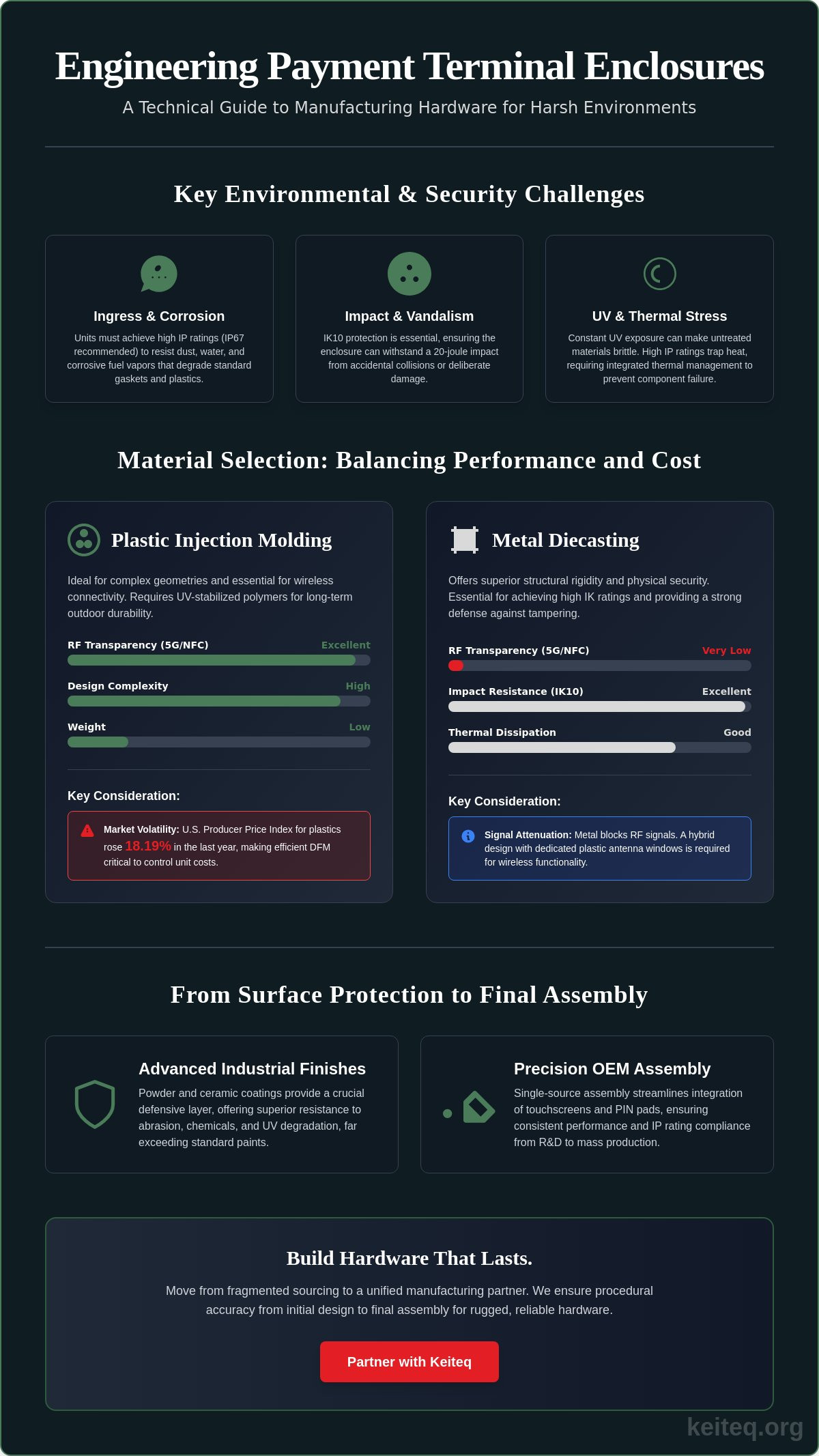
Petrol station environments introduce unique chemical stressors that standard enclosures aren't built to handle. Beyond typical rain or dust, these units face constant exposure to fuel vapors and petrochemical residues. These substances can accelerate the degradation of standard gaskets and low-grade plastics, leading to seal failure. High UV exposure also threatens structural integrity. Without UV-stabilized materials, enclosures become brittle and prone to cracking within 24 months of deployment. Mechanical protection is equally vital, typically quantified through IK impact ratings. Designing for IK10 protection ensures the housing survives a 20-joule impact, which is essential for preventing damage from accidental collisions or intentional vandalism.
Environmental and Ingress Protection Standards
Ingress protection (IP) ratings are non-negotiable for outdoor hardware. While IP65 provides protection against low-pressure water jets, IP67 offers superior security against temporary immersion and finer particulate ingress. However, high IP ratings can trap internal heat. Effective thermal management must be integrated into the initial design phase to prevent component failure during peak summer temperatures. This involves strategic heat sink placement and airflow pathing that doesn't compromise the environmental seal. Material degradation factors must also be evaluated, as extreme temperature fluctuations can cause expansion and contraction that stresses joined surfaces.
Security and Regulatory Compliance
Physical security is a core requirement for any payment terminal enclosure manufacturing project. Enclosures must meet PCI-DSS physical security standards to prevent unauthorized access to card readers and PIN pads. This requires tamper-evident designs and integrated sensors that disable the unit if the housing is breached. Additionally, the choice of materials must account for RF transparency. If the enclosure is entirely metallic without dedicated antenna windows, 5G, LTE, and NFC signals will suffer significant attenuation. Balancing structural rigidity with signal clarity is a primary engineering challenge that determines the ultimate usability of the terminal, a technical balance also critical for the advanced electromagnetic field devices produced by Biofield PEMF Technologies.
Material Selection: Plastic Molding vs. Metal Diecasting
Selecting the optimal substrate is a strategic decision that balances unit cost against long-term field survivability. In payment terminal enclosure manufacturing, the engineering team doesn't simply choose a material based on price; they evaluate how that material interacts with the terminal's electronic and environmental requirements. While metal is often associated with industrial strength, high-performance plastics offer specific advantages in wireless connectivity and weight reduction. A successful hardware strategy utilizes the strengths of both through a hybrid approach where the exterior shell and internal chassis serve distinct protective functions.
The cost-to-durability ratio is a critical metric for high-volume mass production. Manufacturers must navigate a volatile market where raw material prices directly impact the bottom line. As of May 2026, the U.S. Producer Price Index for plastics material and resins manufacturing reached 377.68, an 18.19% increase from the previous year. This inflationary trend makes precision in plastic injection molding even more vital to minimize waste and optimize cycle times without compromising the enclosure's structural integrity.
Precision Plastic Injection Molding for Enclosures
High-performance polymers are the preferred choice when RF transparency is a non-negotiable requirement. Unlike metal, UV-stabilized plastics allow 5G, LTE, and NFC signals to pass through the housing without significant attenuation. Engineering complex internal geometries is more efficient with injection molding, allowing for integrated mounting bosses and snap-fit features that simplify assembly. Transitioning from soft tooling prototypes to mass production molding requires careful material selection to ensure the final product doesn't become brittle after prolonged exposure to direct sunlight and temperature fluctuations.
Metal Stamping and Diecasting for Ruggedized Hardware
Metal diecasting provides the maximum structural integrity needed for high-traffic outdoor kiosks. Aluminium diecasting is particularly effective for heat dissipation, acting as a massive heat sink for internal processors that might otherwise fail in extreme summer conditions. For high-precision internal components, zinc diecasting offers superior dimensional stability and tighter tolerances than aluminium, making it ideal for card reader slots and PIN pad frames. We also utilize metal stamping to create internal chassis and structural reinforcements, providing a rigid backbone that protects sensitive electronics from physical tampering and high-impact forces. This multi-material approach ensures the hardware survives the rigors of a petrol station environment for a decade or more.
Advanced Finishing: Protecting the Enclosure Surface
Surface treatment in payment terminal enclosure manufacturing represents the final, critical layer of defense for high-value hardware. While structural engineering provides the foundation, the finish determines how that structure withstands a decade of environmental and chemical abuse. A professional finish isn't an aesthetic luxury; it's a technical requirement that prevents substrate degradation and maintains the integrity of the internal electronics. We prioritize high-performance coatings that bridge the gap between industrial durability and professional appearance.
Industrial powder coating remains the baseline for achieving superior abrasion resistance on metallic components. This process utilizes an electrostatic application of thermosetting polymers that, once cured in a high-temperature oven, form a hard, cross-linked barrier. It's particularly effective for providing consistent coverage over the complex internal geometries and mounting bosses common in diecast housings. Beyond durability, these coatings are calibrated to ensure aesthetic consistency across different material substrates. Whether the terminal uses a plastic injection-molded bezel or a diecast zinc frame, the final finish must match perfectly to project a sense of stability and reliability to the end user.
High-Performance Powder Coating Services
The durability of a powder-coated finish depends on rigorous pre-treatment and curing protocols. We utilize specific textures and matte finishes that naturally resist fingerprints, smudges, and common vandalism like graffiti. This is essential for maintaining the professional appearance of high-traffic kiosks. To ensure long-term survivability, every batch undergoes standardized corrosion testing, including salt-spray exposure. These protocols verify that the coating can withstand the humidity and temperature fluctuations common in outdoor industrial settings without bubbling or delaminating from the substrate.
Specialized Ceramic and Enamel Solutions
Petrol and gas station environments demand protection that standard coatings can't provide. Enamel coating serves as the ultimate barrier against fuel vapors and aggressive chemical solvents that would otherwise soften standard paints. For heat-sensitive electronics, ceramic coating offers an additional layer of thermal protection. These specialized finishes are particularly vital in high-salinity coastal environments, where salt air accelerates oxidation. By applying these advanced coatings, we provide a "safe pair of hands" for your hardware, ensuring the enclosure remains a dependable pillar of your supply chain regardless of the local climate or chemical exposure.
OEM Assembly and Component Integration
The transition from a finished protective shell to a fully functional unit is the most critical phase in payment terminal enclosure manufacturing. Integrating sensitive electronics like touchscreens, card readers, and PIN pads into a ruggedized housing requires more than basic mechanical fastening. It demands a disciplined assembly environment where electrostatic discharge (ESD) protection and precision alignment are standard protocols. By consolidating manufacturing and assembly under a single-source partner, you eliminate the logistical friction that occurs when multiple vendors handle different stages of the production cycle.
Executing precision OEM assembly for gas station payment terminals ensures every unit meets the same rigorous standards as the enclosure itself. This holistic approach prevents common field failures caused by poor component seating or compromised seals. When internal components are integrated with the same level of expertise as the initial molding or diecasting, the result is a unified hardware solution capable of 10 plus years of operation in high-traffic, outdoor environments.
The Assembly Process for Outdoor Terminals
Sealing techniques are the primary focus during the integration of external interfaces. We utilize high-grade IP67 gaskets and specialized adhesives to maintain environmental integrity around screen bezels and keypad entries. Cable management is equally vital; internal routing must be designed to prevent vibration wear and ensure easy serviceability for field technicians. To optimize the coordination of these field operations and service teams, find out more about modern management platforms. Furthermore, the placement of RFID and NFC modules is carefully calibrated to avoid signal interference from the metal chassis or high-density plastic components, ensuring seamless contactless transactions.
Quality Assurance and Functional Testing
Every mass production batch undergoes a battery of simulated environmental tests to validate performance. These protocols include:
Rain and Dust Ingress: Verifying that seals hold under high-pressure water jets and fine particulate exposure.
Temperature Cycling: Operating the terminal in environmental chambers to ensure thermal management systems prevent component throttling.
Mechanical Stress: Testing card insertion slots and keypads for durability over thousands of cycles.
PCI-DSS Validation: Confirming that all tamper-evident sensors and physical security features are fully operational before shipping.
Final inspection protocols provide a "safe pair of hands" for your hardware deployment. We verify that every integrated component, from the display brightness to the encryption module, functions according to the technical brief. This methodical vetting process reduces the risk of costly field recalls and ensures that your hardware remains a dependable pillar within the global payment supply chain.
Maintaining the integrity of the payment ecosystem also requires a sophisticated communication strategy; for companies deploying hardware globally, GraiaCX offers an agentic contact-center platform that automates customer support across voice and digital channels to ensure a seamless end-user experience.
Transitioning from R&D to Mass Production Management
Moving from a technical specification to a global hardware rollout is the final test of a manufacturing strategy. Many OEMs encounter significant risks during the transition from a functional prototype to a scalable product. Successful payment terminal enclosure manufacturing requires a methodical shift that prioritizes cost optimization while maintaining the rigorous durability standards established in the design phase. Selecting an end-to-end partner for design, tooling, and assembly ensures that the technical integrity of the enclosure isn't compromised as volume increases.
Design for Manufacturability (DFM) is the primary lever for reducing unit costs in high-volume runs. By optimizing wall thicknesses, draft angles, and assembly sequences early in the R&D process, we ensure high yield rates and consistent quality. This proactive approach prevents the "valley of death" where design flaws only become apparent during mass production. With the U.S. Manufacturing PMI reaching 54% in May 2026, the demand for stable, high-capacity production facilities is increasing. A disciplined management approach allows for rapid scaling without the logistical friction associated with fragmented supply chains.
Prototyping and Soft Tooling Strategies
To support this iterative phase, developers often utilize precision fabrication services like CNC Cut to Size to quickly produce and test internal mounting components or acrylic interface panels before final tooling is established.
Soft tooling serves as a strategic bridge between initial design and hard tooling. This process allows for the production of functional units that use the same materials and finishes as the final mass production run. It's the ideal stage for iterative R&D, where the enclosure is refined based on direct assembly feedback. If a card reader doesn't align perfectly or a seal fails during simulated environmental testing, adjustments are made before committing to expensive, permanent molds. This stage also validates the performance of specialized enamel or ceramic coatings on actual substrates, ensuring long-term adhesion and chemical resistance.
Scaling and Supply Chain Stability
Scaling requires navigating a volatile global market for raw materials. As of June 11, 2026, nickel futures were trading at approximately $8.391 per pound, while polypropylene prices in Europe have risen over 30% year-to-date. Managing these costs requires a "Global Facilitator" who can secure material procurement and maintain finish consistency across massive production lots. Supply chain stability is further complicated by new regulations, such as the EU AI Act enforcement beginning in August 2026, which necessitates strict governance for embedded AI components. Future-proofing hardware for the November 2026 ISO 20022 deadline also adds a layer of technical complexity to cross-border payment systems. A single-source partner provides the logistical competence and professional oversight needed to manage these complexities, ensuring your hardware remains a dependable pillar of the global payment infrastructure; this includes coordinating sustainable transport solutions from specialists like Hubert von Carnap GmbH & Co. KG to protect the finished product.
Optimizing Industrial Hardware for Global Deployment
Deploying hardware in harsh industrial environments requires a technical methodology that prioritizes structural integrity and procedural accuracy. As established, the synergy between material selection and advanced finishing creates a resilient shell capable of withstanding petrochemical exposure and extreme UV. Integrating these components through precision assembly ensures that every unit maintains its environmental ratings and security compliance throughout its entire operational lifecycle. Efficient payment terminal enclosure manufacturing bridges the gap between complex R&D and reliable mass production, providing the essential infrastructure for retail businesses like Sulaiman Kebab to operate in high-traffic locations.
For project managers and executives traveling to oversee these complex production cycles in Southeast Asia, finding the right venue for professional networking is vital; Leoka Teppanyaki provides an exceptional dining experience tailored for corporate gatherings.
To secure your hardware strategy and ensure long-term field survivability, consult with Keiteq Co Ltd for your payment terminal manufacturing needs. We offer specialized OEM assembly for petrol and gas stations, supported by end-to-end R&D to mass production management and advanced enamel or ceramic coating capabilities. Partnering with an experienced facilitator ensures your hardware remains a stable, high-performance asset in an evolving global market. We're ready to help you navigate the complexities of industrial production with a disciplined, results-oriented approach.
Frequently Asked Questions
What is the best material for an outdoor payment terminal enclosure?
Aluminium diecasting is the preferred material for structural integrity and thermal management in outdoor kiosks. It acts as a natural heat sink for internal electronics while providing the rigidity needed for high-traffic areas. However, UV-stabilized polymers are essential when the design requires RF transparency for NFC or 5G connectivity. A hybrid approach often yields the most reliable results for complex hardware.
How do IP and IK ratings affect payment terminal manufacturing?
These ratings dictate the defensive capabilities of the housing against environmental and mechanical stressors. An IP67 rating ensures the terminal is dust-tight and protected against water ingress, which is vital for outdoor petrol stations. IK ratings, specifically IK10, confirm the enclosure survives high-energy impacts. Adhering to these standards during payment terminal enclosure manufacturing prevents hardware failure from ingress or vandalism.
Can I use plastic injection molding for secure payment hardware?
High-performance plastic injection molding is highly effective for secure hardware when using UV-stabilized, impact-resistant polymers. These materials offer design flexibility for complex internal mounting while maintaining a professional finish. For enhanced security, we often combine plastic exteriors with internal metal stamping to meet PCI-DSS physical security requirements without compromising signal clarity.
What are the benefits of ceramic coating for industrial enclosures?
Ceramic coatings provide an advanced thermal barrier and superior chemical resistance for enclosures exposed to extreme heat and pollutants. They prevent the substrate from absorbing excessive solar radiation, which helps maintain stable internal operating temperatures for sensitive components. This finish also resists the corrosive effects of salt air, making it ideal for coastal or high-pollution industrial zones.
How does OEM assembly differ from standard contract manufacturing?
OEM assembly focuses on the precision integration of complex electronic components rather than just the production of the outer shell. It includes specialized sealing techniques, cable management, and functional testing of touchscreens and card readers. This holistic process ensures that the final unit operates as a unified system capable of surviving the rigors of a gas station environment.
What is the typical lead time from design to mass production?
The timeline depends on the complexity of the enclosure and the required tooling strategy. The process typically begins with R&D and soft tooling to validate the design before moving to hard tooling for high-volume runs. This methodical approach ensures that any technical issues are resolved during the prototyping phase, preventing costly delays during the final mass production cycle.
How do you ensure RF transparency in metal enclosures?
RF transparency in metallic enclosures is achieved by integrating non-metallic windows or utilizing hybrid material designs. These windows are typically made from RF-transparent plastics that allow 5G, LTE, and NFC signals to pass through without significant attenuation. Proper placement of these windows is critical for ensuring consistent wireless performance in outdoor payment kiosks where metal would otherwise block signals.
Why is enamel coating used for petrol station hardware?
Enamel coating is specifically used in petrol station environments because of its extreme resistance to fuel vapors and petrochemical solvents. Standard paints can soften or delaminate when exposed to gasoline or diesel residues over time. Enamel provides a glass-like, chemically inert barrier that maintains its integrity and professional appearance in these aggressive chemical settings, ensuring a decade or more of service.


Comments