
Gas Station Kiosk Manufacturer: A Guide to Hardware & OEM Assembly
Updated: Jul 7
A gas station kiosk that fails in direct sunlight or freezing rain isn't just a technical glitch; it's a direct threat to your fuel margins and customer trust. You likely already know that the outdoor environment is the ultimate test for any hardware. Between extreme UV exposure and the physical wear of 24/7 high-traffic use, standard enclosures often fall short. Selecting the right gas station kiosk manufacturer is the only way to ensure your hardware survives these conditions while maintaining strict payment security standards.
We understand that reliability in the field is non-negotiable for your operations. This guide will show you how to evaluate a manufacturer based on industrial durability, payment terminal integration, and mass production capabilities. We'll examine the technical requirements for IP67-rated enclosures, the complexities of OEM assembly for PCI-compliant terminals, and the logistics of scaling from a single prototype to a global rollout. You'll gain a clear framework for securing a hardware solution that is both weather-resistant and ready for high-volume deployment.
Table of Contents
Defining the Standards of a Gas Station Kiosk Manufacturer
The role of a gas station kiosk manufacturer has evolved beyond simple metal fabrication. In the fuel retail sector, the kiosk serves as the primary interface between the customer and the transaction engine. It's a sophisticated piece of industrial equipment that must perform flawlessly in unforgiving environments. Understanding the standards of this industry requires a clear distinction between the kiosk booth, which is the external structure, and the payment terminal hardware, which is the functional interface. While a booth provides shelter, the terminal hardware facilitates the actual commerce.
Foundational knowledge of an Interactive Kiosk highlights its role in self-service environments, but fuel retail adds layers of complexity. Manufacturers must master three core disciplines: precision metal stamping, plastic injection molding, and complex OEM assembly. ISO-compliant production isn't just a certificate. It's a requirement for ensuring that every unit meets the safety and durability standards necessary for volatile environments. With the global kiosk market valued at approximately $45.65 billion in 2026, the demand for high-spec, compliant hardware is at an all-time high.
The Shift from Simple Booths to Intelligent Terminals
To complement the physical hardware with a robust digital infrastructure, ISOs and MSPs are encouraged to visit Strictly and discover how their omni-channel platform streamlines unattended transactions.
Core Capabilities for Fuel Retail Hardware
Building a reliable terminal requires a technical fusion of materials. Precision metal stamping is used to create secure, tamper-proof enclosures that protect internal electronics from both vandalism and the elements. These enclosures often require IK10 impact resistance to withstand physical abuse; for operators seeking comprehensive site security, professional CCTV installation Rotherham can provide an additional layer of deterrent against such threats. Simultaneously, plastic injection molding is used for ergonomic components like card readers and keypad surrounds. Using a single-source gas station kiosk manufacturer for these multi-material assemblies eliminates the logistical friction of managing multiple vendors. It ensures that plastic and metal components fit perfectly, maintaining the IP65 or IP67 ratings required for total dust and water protection.
Industrial Durability: Material Science in Outdoor Kiosk Hardware
Gas station forecourts present a harsh chemical profile that standard retail hardware cannot survive. Fuel vapors contain volatile organic compounds (VOCs) that accelerate the oxidation of untreated metals. A specialized gas station kiosk manufacturer must account for these factors during the initial material selection phase. Beyond chemical exposure, UV radiation poses a constant risk. It causes structural plastics to become brittle and standard paints to chalk over time. Managing these variables requires a deep understanding of material science and environmental engineering.
Hardware protection is quantified through Ingress Protection (IP) ratings. Most outdoor payment terminals target IP65 or IP66 standards to ensure internal electronics remain operational during heavy rain or high-pressure cleaning. These technical specifications are frequently influenced by local municipal regulations, which establish safety and operational benchmarks for fuel retail equipment. Adhering to these standards ensures that the hardware remains a safe pair of hands for both the operator and the end-user.
Advanced Surface Finishing and Coatings
Surface treatments are the first line of defense against corrosion. Enamel coating provides the highest level of chemical resistance by creating a non-porous, glass-like surface. This finish remains impervious to fuel spills and aggressive industrial cleaners. Ceramic coating is utilized for components exposed to high heat or repetitive mechanical friction, offering superior surface hardness. For large external enclosures, powder coating remains the industrial standard. It provides a thick, durable layer that resists chipping and scratching while maintaining the brand's aesthetic requirements in outdoor settings.
Metals vs. Plastics in Kiosk Construction
Structural integrity depends on the strategic use of diecast metals. Aluminium diecasting is the preferred choice for the main chassis due to its excellent strength-to-weight ratio and natural resistance to atmospheric corrosion. For smaller, high-precision payment parts, zinc diecasting is more effective. It allows for much tighter tolerances and thinner wall sections than aluminium. While metals provide the structural skeleton, plastic injection molded parts are used for ergonomic touchpoints. These plastics must be UV-stabilized to prevent structural failure after prolonged sun exposure. Organizations looking for verified durability in these environments should evaluate integrated hardware solutions that combine these advanced material disciplines into a single, cohesive unit.
The OEM Assembly Lifecycle: From R&D to Mass Production
The transition from a conceptual design to a field-ready unit requires a disciplined manufacturing lifecycle. A professional gas station kiosk manufacturer doesn't just assemble parts; they manage a complex sequence of engineering and logistical milestones. This process ensures that the final hardware maintains its technical integrity under the pressure of mass deployment. The lifecycle is divided into five critical stages that move the product from the drawing board to the fuel forecourt.
Step 1: Product R&D and Design. Engineering teams utilize Design for Manufacturability (DFM) to optimize component layout. This reduces assembly time and minimizes potential failure points in the field.
Step 2: Prototyping and Soft Tooling. Before investing in expensive hard tooling, soft tooling allows for the creation of functional prototypes. These units are used to validate mechanical tolerances and environmental seals.
Step 3: Mass Production Management. High-volume orders require strict supply chain oversight. This stage focuses on maintaining component consistency across thousands of units to ensure a uniform fleet.
Step 4: Specialized Assembly. This involves the precise integration of payment modules, high-brightness screens (2,500 to 4,000 nits), and thermal printers. All assembly must comply with the Payment Card Industry Data Security Standard (PCI DSS), specifically the PCI 4.0 requirements active as of March 31, 2025.
Step 5: Quality Control. Final units undergo rigorous testing. This includes salt spray chambers to test corrosion resistance and vibration tables to simulate the impact of heavy industrial environments.
Strategic Product Development and R&D
Scaling Production with Mass Production Management
Scaling from a prototype to a global rollout is a logistical challenge. Managing the supply chain for complex, multi-component payment terminals requires a single-source partner. Integrated manufacturing services reduce time-to-market by handling metal stamping, plastic molding, and final assembly under one roof. This centralized approach eliminates the communication gaps that often occur between separate vendors. It ensures that every unit coming off the line meets the exact same specifications, which is critical for maintaining security compliance and operational uptime across a diverse network of gas stations.
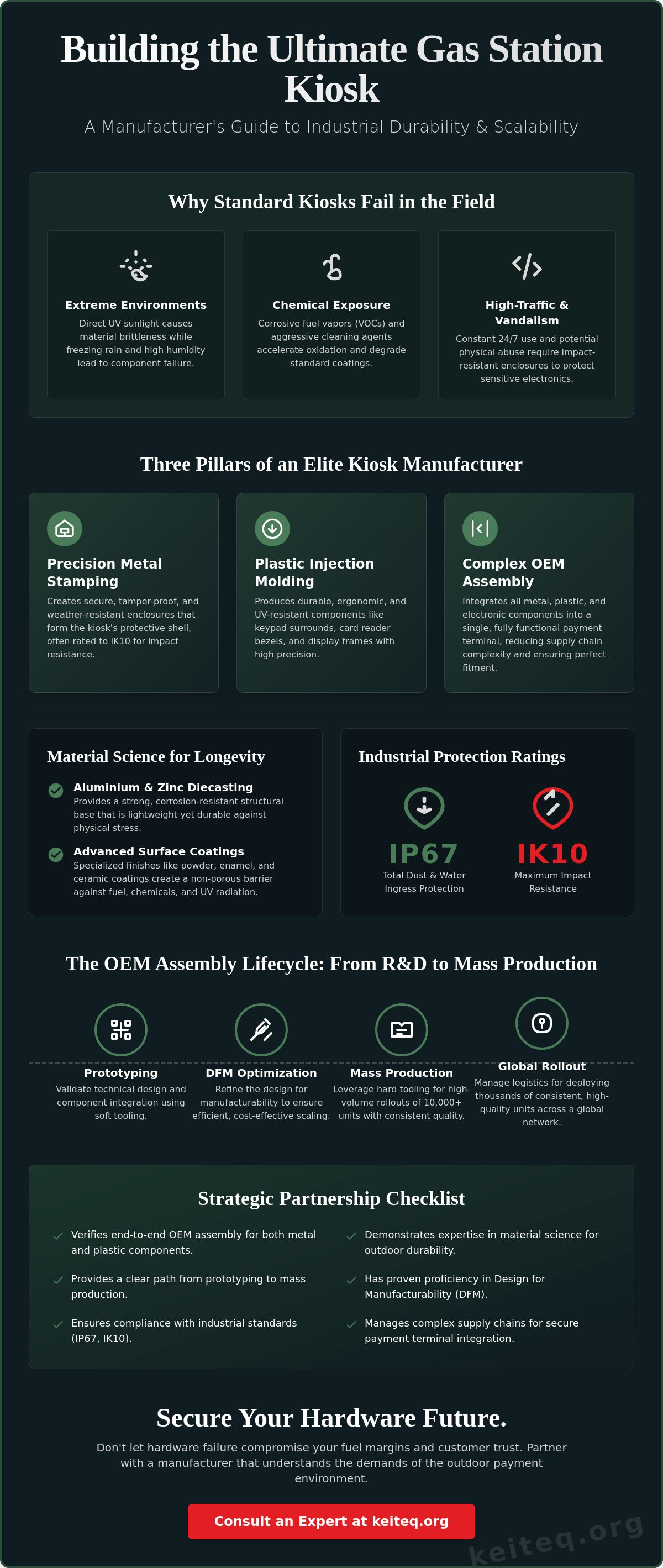
Strategic Partnership Checklist: Evaluating Your Manufacturer
Selecting a gas station kiosk manufacturer is a strategic procurement decision that determines the long-term stability of your retail infrastructure. It's a choice between a simple vendor and a global facilitator. A reliable partner must demonstrate more than just assembly skills. They need a deep integration of engineering, material science, and logistical management. Evaluating a manufacturer requires a methodical approach to their technical and operational breadth to ensure your hardware survives the transition from the factory floor to the field.
Verify their in-house capabilities as a primary step. A manufacturer that controls both plastic injection molding and metal stamping minimizes the risk of component misalignment. This vertical integration is essential for maintaining the IP65 or higher ratings required for outdoor use. You should also assess their proficiency in applying specialized industrial coatings. If they cannot provide enamel or ceramic finishes in-house, the durability of your hardware in corrosive fuel environments is compromised. These coatings are not just aesthetic; they are functional barriers against chemical degradation.
Technical Capability Assessment
Review their track record with outdoor payment terminal assembly. Unattended hardware faces unique security and environmental challenges that indoor kiosks do not. A partner with specific experience in this niche understands the nuances of PCI-compliant component integration and the physical shielding required for secure transactions. They should be able to demonstrate how they protect sensitive internal electronics from the extreme UV and moisture typical of gas station forecourts. Verify their diecasting and metal stamping precision standards to ensure that every structural component meets industrial tolerances.
Logistical and Strategic Alignment
Capacity for mass production management is the final hurdle. In 2026, supply chain volatility remains a factor for global logistics. You need a partner who functions as a safe pair of hands, providing transparent communication from the initial soft tooling phase to the final global rollout. Quality control for mass-produced industrial goods must be proactive. It should involve continuous monitoring of tolerances during the metal stamping and diecasting processes. Ask for their specific testing protocols for outdoor reliability. A transparent manufacturer will provide detailed reports on these metrics during the R&D and prototyping phases.
For organizations requiring a partner with proven expertise in complex hardware deployment, evaluating our OEM assembly services provides a clear path to industrial-grade reliability.
Keiteq Co Ltd: Expert Assembly for Outdoor Payment Terminals
The global kiosk market's shift toward unattended solutions requires a gas station kiosk manufacturer that delivers more than just a basic enclosure. Keiteq Co Ltd operates as a specialized contract manufacturer, bridging the gap between complex industrial engineering and field-ready deployment. We provide a holistic manufacturing ecosystem where Product R&D and Design are integrated directly with mass production management. This centralized approach ensures that the technical integrity of your payment hardware is maintained from the first prototype to the final global rollout.
Our role as a global facilitator allows us to navigate the intricacies of international production with precision. We understand that fuel retail environments demand a "Safe Pair of Hands" approach. By managing every stage of the hardware lifecycle in-house, Keiteq Co Ltd eliminates the logistical friction and quality variances that occur when using multiple vendors. Our facilities are optimized for the production of durable, high-performance hardware that meets the rigorous security and environmental standards of the 2026 fuel retail landscape.
Our Dedicated Outdoor Payment Terminal Solutions
We specialize in the assembly of an outdoor payment terminal for petrol station environments where reliability is the only metric that matters. This involves the precise integration of sensitive electronic components into ruggedized housings designed for 24/7 operation. Our assembly lines are configured to handle the complexities of modern payment modules—including high-performance printing systems from DuraFast Label Company—ensuring full compliance with current security protocols. By managing the entire hardware lifecycle, Keiteq Co Ltd allows global OEMs to focus on their core software and service offerings while we handle the practical realities of the factory floor. Our ready-to-use hardware solutions are engineered for immediate deployment, reducing your time-to-market and operational overhead.
Precision Engineering Meets Industrial Finishing
The strength of our hardware lies in our mastery of metal and plastic production. We utilize aluminium and zinc diecasting to create terminal components with superior structural integrity and tight mechanical tolerances. These metals provide the necessary foundation for high-traffic use. To ensure these components survive corrosive fuel vapors and extreme weather, we apply advanced industrial coatings. Our capabilities include:
Enamel Coating: Providing a glass-like barrier that is impervious to chemical cleaners and fuel spills.
Ceramic Coating: Offering unmatched surface hardness and wear resistance for high-friction touchpoints.
Powder Coating: Delivering a durable, UV-resistant finish for external structural elements.
This fusion of precision diecasting and high-performance finishing creates hardware that remains operational in the most extreme environments. If you are ready to secure a hardware partner that values consistency and proven methodology, you can partner with Keiteq Co Ltd for your next gas station kiosk project to ensure industrial-grade results.
Future-Proofing Your Fuel Retail Infrastructure
Securing a reliable hardware fleet requires a transition from viewing terminals as simple enclosures to treating them as complex industrial assets. The long-term performance of your deployment depends on the precision of diecast components and the chemical resistance of specialized coatings. By prioritizing a partner that integrates R&D with mass production management, you eliminate the technical risks often found in fragmented supply chains. This holistic approach ensures that your hardware remains functional and secure in the most demanding outdoor environments; for those also looking to enhance their site's energy efficiency with advanced solar technology, check out Nippon Energy.
Selecting a gas station kiosk manufacturer with deep expertise in outdoor payment terminal assembly is the most effective way to protect your fuel margins and customer trust. You've seen how enamel and ceramic coatings provide essential barriers against corrosive vapors. Now, the priority is finding a partner capable of executing these technical standards at scale. Keiteq Co Ltd provides the logistical competence and engineering discipline needed to move your project from soft tooling to a global rollout without compromising on quality.
Contact Keiteq Co Ltd for Expert Gas Station Kiosk Manufacturing to discuss your specific hardware requirements. We're ready to provide the industrial stability your global supply chain demands.
Frequently Asked Questions
What is the difference between a kiosk booth and a payment terminal?
A kiosk booth is the external prefab structure that provides shelter, while a payment terminal is the specific hardware interface used for processing transactions. The booth acts as the building or enclosure, but the terminal contains the critical electronic payment modules and user interface components. Distinguishing between these two is essential when you evaluate a gas station kiosk manufacturer for high-precision hardware production.
Why is enamel coating important for gas station hardware?
Enamel coating provides a non-porous, glass-like barrier that is impervious to the volatile organic compounds found in fuel vapors. This finish prevents chemical degradation from petrol spills and the aggressive industrial cleaners frequently used on forecourts. It ensures the hardware maintains its structural and aesthetic integrity over a long operational lifecycle in corrosive environments.
What materials are best for outdoor gas station kiosks?
Industrial-grade hardware requires a combination of aluminium diecasting for the main chassis and zinc diecasting for high-precision internal parts. These metals offer superior strength and natural resistance to atmospheric corrosion. External touchpoints should utilize UV-stabilized plastics to prevent the material from becoming brittle or discolored after prolonged exposure to direct sunlight.
How long does it take to move from a kiosk prototype to mass production?
The timeline for moving from a prototype to mass production depends on the success of the soft tooling and design validation phases. This process involves a sequence of engineering reviews, functional testing, and final hard tooling creation. A streamlined manufacturing partner reduces this duration by managing all R&D and production stages under a single roof to eliminate vendor communication gaps.
Can a single manufacturer handle both plastic and metal kiosk parts?
Vertically integrated manufacturers can manage both plastic injection molding and metal stamping within the same facility. This capability is a significant advantage because it ensures that multi-material components fit together with the tight tolerances required for IP-rated environmental seals. It also simplifies your supply chain by reducing the total number of external vendors.
What are the benefits of aluminium diecasting for fuel retail terminals?
Aluminium diecasting provides an excellent strength-to-weight ratio that's ideal for the structural chassis of fuel retail terminals. It's naturally resistant to corrosion, which makes it a stable material choice for high-moisture outdoor environments. This material ensures the hardware remains durable and impact-resistant without adding unnecessary weight to the final installation.
What is OEM assembly in the context of gas station kiosks?
OEM assembly is the specialized process of integrating various hardware components, such as card readers, high-brightness screens, and specialized thermal printers from DuraFast Label Company, into a finished unit for an original equipment manufacturer. In fuel retail, this involves precise technical assembly to meet strict security and environmental standards. It allows brands to deploy market-ready hardware without the overhead of managing their own factory floors.
How does Keiteq Co Ltd ensure the durability of outdoor payment terminals?
Keiteq Co Ltd ensures durability by fusing precision engineering with advanced surface treatments like enamel and ceramic coatings. Every unit undergoes strict quality control, including environmental stress testing, to verify its resistance to water, dust, and physical impact. This methodical approach establishes Keiteq Co Ltd as a reliable gas station kiosk manufacturer for complex global hardware rollouts.


Comments