
Zinc Diecasting Services: A Strategic Guide for Industrial OEMs in 2026
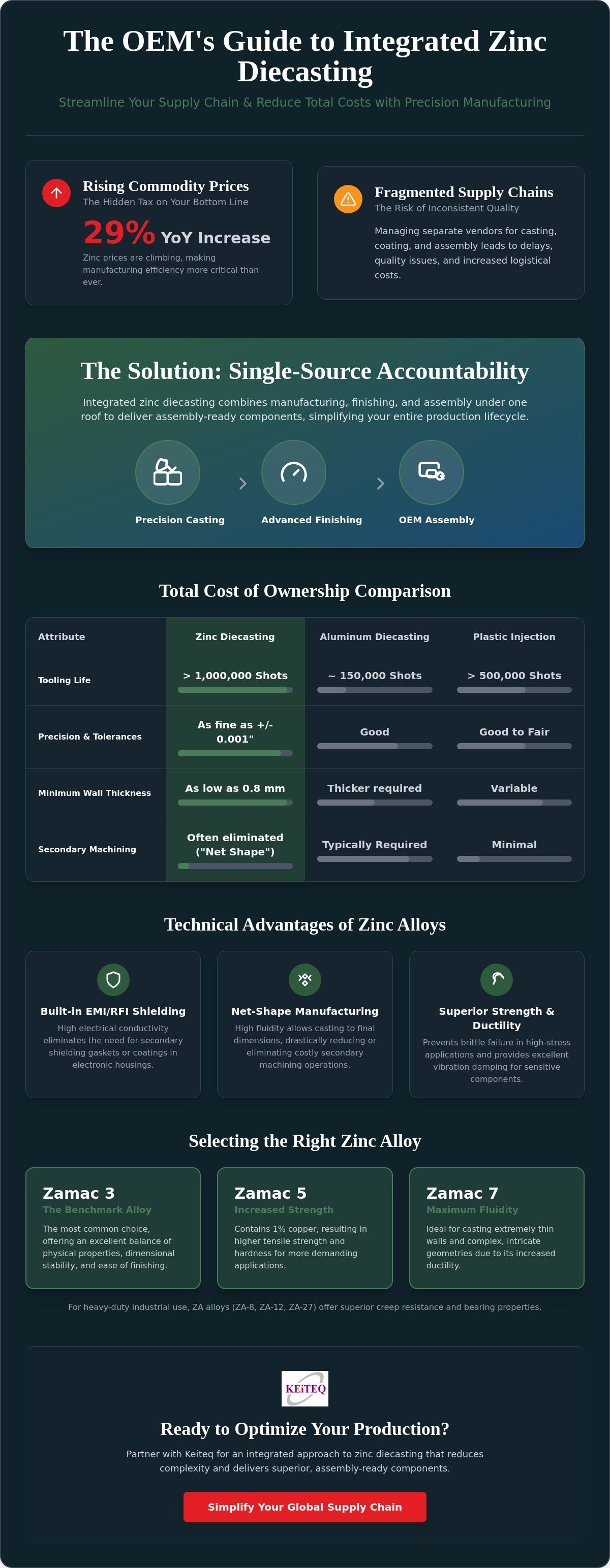
With zinc commodity prices rising nearly 29% year-over-year as of June 2026, industrial OEMs can't afford the hidden tax of high secondary machining costs and fragmented supply chains. You're likely managing separate vendors for casting, coating, and assembly, only to face inconsistent part quality that threatens your project timelines. It's a common frustration in a market where precision is non-negotiable and logistical complexity is a constant drain on your resources.
This guide explains how integrated zinc diecasting services provide a solution by combining net-shape manufacturing with advanced finishing and assembly. You'll discover how to achieve superior surface finishes for outdoor durability while maintaining the high tolerances required for complex industrial components. We'll also explore the transition to single-source accountability to streamline your production lifecycle and reduce unit costs.
We'll examine the technical advantages of new high-fluidity alloys like ASTM B989 and the impact of 2026 environmental regulations on casting standards. By the end of this briefing, you'll understand how to leverage precision manufacturing and advanced coatings to secure your position in the global supply chain.
Table of Contents
Understanding Zinc Diecasting Services in Modern Manufacturing
Zinc diecasting services utilize a high-pressure, hot-chamber manufacturing method to produce complex metal components with extreme repeatability. This process involves injecting molten zinc alloy into a steel die under high pressure. Because zinc has a relatively low melting point, the injection mechanism can be submerged directly in the melt. This "hot-chamber" setup allows for faster cycle times and more consistent temperature control than the cold-chamber processes required for aluminum. The Die casting process for zinc remains a cornerstone of industrial production because it balances speed with structural integrity.
Modern industrial OEMs prioritize zinc when precision is the primary requirement. The metal's high fluidity allows for the creation of intricate geometries and thinner walls that other alloys can't achieve. Under the latest ASTM B989 standards for high-fluidity alloys, wall thicknesses can reach as low as 0.8mm. This capability is vital for the 2026 market, where lightweighting and miniaturization drive design cycles in the automotive and electronics sectors. It's an efficient way to pack high functionality into smaller, more durable housings.
The Strategic Advantage of Zinc Alloys
Zinc alloys offer a mechanical profile that outperforms many alternatives. They provide superior impact strength and ductility, which prevents brittle failure in high-stress applications. For OEMs producing electronic housings or payment terminals, zinc's high thermal and electrical conductivity provides built-in EMI and RFI shielding. This eliminates the need for conductive coatings or secondary shielding gaskets. Beyond structural integrity, zinc's natural vibration damping properties are essential for protecting sensitive sensors and circuit boards from mechanical resonance on the factory floor.
Zinc Diecasting vs. Traditional Manufacturing
The primary advantage of zinc diecasting services over traditional methods is the achievement of "net-shape" manufacturing. By casting parts to their final dimensions, manufacturers eliminate the need for costly secondary machining. Zinc is also less abrasive than aluminum, which extends the life of steel tooling. It's common for zinc dies to last for over one million shots, significantly reducing the per-unit tooling cost over the product's lifecycle. From a sustainability perspective, zinc is 100% recyclable. Its lower melting temperature requires less energy during production, supporting corporate initiatives for reduced carbon footprints and circular manufacturing cycles.
Technical Capabilities: Alloys, Tooling, and Precision
Precision in zinc diecasting services is a function of metallurgical choice and advanced engineering software. Achieving tight tolerances requires a deep understanding of how specific alloys behave during the cooling phase. Industrial OEMs typically target tolerances within +/- 0.001 inches for small, critical dimensions. This level of accuracy is possible because zinc alloys have high dimensional stability and low casting temperatures. These factors minimize the thermal expansion and contraction that often plague aluminum or magnesium casting processes.
Eliminating internal defects like porosity is a primary concern for high-performance components. We utilize MagmaSoft mold flow simulation to predict metal velocity, temperature gradients, and potential air entrapment before any steel is cut. This data-driven approach ensures that gate and runner systems are optimized for laminar flow. It results in a denser grain structure and a part that meets strict structural requirements without the need for expensive X-ray inspections on every unit. High-quality production starts with this digital validation.
Selecting the Right Zinc Alloy for Your Project
Material selection dictates the mechanical ceiling of your component. Zamac 3 is the most common choice, providing an ideal balance of physical properties and ease of finishing. If your application requires higher tensile strength and hardness, Zamac 5 is the preferred alternative due to its 1% copper content. For parts with extremely thin walls or complex geometries, Zamac 7 offers increased fluidity and lower magnesium content. When performance requirements exceed standard Zamac capabilities, ZA alloys (ZA-8, ZA-12, and ZA-27) provide superior creep resistance and bearing properties for heavy-duty industrial use.
Precision Tooling and Mold Design
Tooling strategy is the most significant factor in long-term unit cost and part consistency. Utilizing soft tooling prototyping allows for functional testing and design verification before committing to high-volume production. Once the design is frozen, we transition to hardened H13 steel dies. These dies are engineered to withstand millions of cycles with minimal wear. Proper maintenance protocols, including regular stress relieving and surface treatments for the mold, ensure that the first part and the millionth part remain within the specified tolerance. Our engineering team provides the technical oversight required for mass production management of these critical assets.
Comparing Zinc Diecasting to Alternative Processes
Procurement decisions often stall at the initial tooling quote, but a strategic analysis of Total Cost of Ownership (TCO) favors zinc diecasting services for high-volume industrial applications. While aluminum or plastic might seem cheaper at the raw material level, the cumulative costs of secondary machining, shorter tool life, and intensive surface preparation often bridge that gap. Zinc's unique properties allow for a "cast-and-assemble" workflow that reduces the number of vendors and steps in your production chain. It's about looking at the final cost of a finished, assembled component rather than just the price of the raw casting.
Zinc vs. Aluminum Diecasting
The primary differentiator between these two metals is the casting temperature and its effect on production efficiency. Zinc's lower melting point allows for a hot-chamber process, which yields significantly faster cycle times than the cold-chamber method used for aluminum. This speed translates to higher throughput and lower labor costs per part. Tooling longevity is another critical factor. Because zinc is non-corrosive and non-abrasive to steel, a single zinc die can produce over one million shots. In contrast, aluminum dies typically require major refurbishment or replacement after approximately 100,000 cycles. For long-running programs, this 10x difference in tool life eliminates the need for repeated capital expenditure on replacement molds. Additionally, zinc's superior fluidity enables the casting of finer details and zero-degree draft angles, which often removes the necessity for post-process CNC intervention.
Zinc vs. Plastic Injection Molding
For outdoor industrial equipment, such as the payment terminals used in petrol stations, plastic often fails to meet long-term durability standards. Zinc provides the impact resistance and structural rigidity required to withstand both environmental stressors and physical tampering. Unlike plastic, zinc is an inherently conductive material. This provides the EMI and RFI shielding mentioned in earlier sections without the extra step of applying conductive paints or vacuum metallization. Dimensional stability is also a key advantage. Plastic parts can warp or creep under high temperatures or mechanical load, whereas zinc maintains its shape across a wide thermal range. While thin-wall zinc casting allows parts to compete with plastic on weight, the metal's strength-to-weight ratio ensures the final assembly remains robust in harsh outdoor environments.
Surface quality is a final, decisive factor in the TCO equation. Zinc parts emerge from the die with a smooth, hardware-grade finish that requires minimal vibratory deburring or polishing. This makes the material an ideal substrate for high-performance coatings like powder coating or ceramic coating. Aluminum often requires more aggressive surface preparation to hide casting flow marks, which increases the lead time and cost of the final finished assembly.
Advanced Finishing and Secondary Operations
The utility of zinc diecasting services extends beyond the initial ejection from the mold. While zinc is naturally corrosion-resistant, industrial components operating in harsh 2026 environments require specific surface treatments to ensure long-term functional survival. Surface preparation is the first step in this process. We utilize vibratory deburring and shot blasting to remove flash and create a uniform surface profile. This preparation is essential for achieving a strong metallurgical bond with subsequent industrial coatings. Without proper mechanical finishing, even the most advanced coatings will fail prematurely under thermal stress or chemical exposure.
Even with the high precision of net-shape casting, certain mission-critical features require secondary CNC machining. Ultra-critical tolerances that exceed standard casting capabilities or complex internal threads often necessitate post-process drilling, tapping, and reaming. This hybrid approach allows you to leverage the speed of diecasting for the bulk of the part geometry while maintaining the extreme accuracy of machining for mating surfaces. Integrating these cast components with precision metal stamping elements also allows for the creation of multi-material assemblies that offer both structural rigidity and flexible electrical contact points.
High-Performance Industrial Coatings
Standard finishes often fail in specialized industrial sectors. Enamel coating provides an glass-like layer that offers extreme chemical and corrosion resistance, making it ideal for medical or food-processing hardware. For high-heat applications, ceramic coating provides a thermal barrier and exceptional wear protection that maintains its integrity where organic paints would degrade. When aesthetic consistency and UV stability are the primary requirements, powder coating remains the industry standard. It allows for precise matching of RAL colors while providing a durable, impact-resistant exterior that protects the underlying zinc substrate from oxidation in outdoor environments.
Value-Added Secondary Services
Completing a complex assembly requires more than just a finished surface. Vacuum impregnation is a critical secondary operation for components that must be pressure-tight, as it seals any microscopic porosity that might have occurred during the casting phase. This is followed by rigorous leak testing and quality inspections to ensure every unit meets the safety standards required for gas or petrol station hardware. By managing these secondary operations under one roof, we eliminate the logistical risks associated with moving parts between multiple specialized vendors. To optimize your production workflow and reduce lead times, consult with our engineering team for a comprehensive manufacturing assessment.
The Integrated Approach: From Casting to OEM Assembly
Managing a fragmented supply chain creates logistical bottlenecks and quality inconsistencies that industrial OEMs can't tolerate in 2026. Transitioning between separate vendors for R&D, casting, and finishing often results in compounding lead times and technical friction when tolerances don't align. A single-source partner for zinc diecasting services eliminates these risks by providing a unified workflow. When the same engineering team oversees the initial design, the mold flow simulation, and the final assembly, the potential for misalignment is virtually removed. This integrated model accelerates the transition from soft-tooling prototypes to mass production management on a global scale.
Consistency across millions of cycles requires strict adherence to international quality standards. Keiteq Co Ltd maintains compliance with IATF 16949 and ISO standards to ensure that every stage of the production lifecycle is documented and controlled. These certifications represent a commitment to the procedural accuracy needed for mission-critical hardware. Our logistics framework supports this by managing international delivery schedules, ensuring that components arrive at your facility assembly-ready and on time. This level of oversight transforms a standard vendor relationship into a dependable pillar of your global supply chain.
Specialized Assembly for Complex Hardware
The assembly of an outdoor payment terminal for a petrol station serves as a prime example of our integrated capabilities. These units require more than just a durable housing. They demand the precise integration of die-cast enclosures with electronic components, specialized seals, and tamper-resistant hardware. We ensure that every assembly meets IP-rated protection standards to survive years of unattended outdoor use. By handling the outdoor payment terminal assembly in-house, Keiteq Co Ltd verifies that the precision of the casting translates perfectly into the final, functional product. This includes the seamless application of the high-performance coatings discussed in previous sections to ensure the hardware withstands both environmental stress and heavy public use.
Partnering with Keiteq Co Ltd for Zinc Diecasting
Selecting Keiteq Co Ltd means leveraging end-to-end expertise that spans from initial product R&D and design to final mass production. Our focus remains on industrial durability and the technical realities of the factory floor. We don't just provide parts; we provide a steady, experienced partnership for your most complex engineering challenges. Whether you're developing a new outdoor payment terminal for a gas station or a high-tolerance automotive housing, our team is equipped to manage the entire lifecycle. Contact our engineering team today for a comprehensive technical consultation to see how our integrated zinc diecasting services can optimize your next project.
Optimizing Your Industrial Production Lifecycle
Success in the 2026 industrial market requires more than just high-quality components; it demands a streamlined, integrated approach to manufacturing. By leveraging precision zinc diecasting services, OEMs can achieve net-shape accuracy that eliminates secondary machining and reduces total unit costs. The transition from technical design to final assembly is most effective when managed through a single-source partner capable of maintaining tight tolerances across high-volume production runs.
Keiteq Co Ltd backs this commitment to excellence with IATF 16949 and ISO 9001 compliance, ensuring procedural consistency for every project. We provide specialized finishing options, including the enamel and ceramic coatings discussed earlier, to protect hardware in the most demanding environments. With proven expertise in complex outdoor payment terminal assembly, Keiteq Co Ltd understands the intricacies of delivering durable, field-ready solutions for global supply chains. It's about providing the stability and technical oversight your projects deserve.
Don't let fragmented vendor management compromise your product's integrity or time-to-market. Consult with Keiteq Co Ltd for your next zinc diecasting project to secure a reliable foundation for your industrial hardware. We look forward to facilitating your next production success.
Frequently Asked Questions
What are the main benefits of choosing zinc diecasting over aluminum?
Zinc alloys allow for a hot-chamber casting process that is significantly faster and more energy-efficient than the cold-chamber method used for aluminum. This metal's high fluidity enables the production of parts with thinner walls and more complex geometries, often reaching wall thicknesses of 0.8mm. Furthermore, zinc is non-abrasive to steel, which means a single die can produce over one million shots, whereas aluminum dies typically require replacement after 100,000 cycles.
Which zinc alloys are most commonly used in industrial manufacturing?
Zamac 3 is the industry standard for most applications because it provides an excellent balance of physical and mechanical properties. Zamac 5 is selected when a project requires higher tensile strength and hardness due to its increased copper content. For components with extremely intricate details or very thin walls, Zamac 7 offers superior fluidity during the injection phase. Heavy-duty industrial parts may also utilize ZA alloys for better creep resistance.
How does zinc diecasting help reduce total production costs?
Utilizing integrated zinc diecasting services reduces total costs by achieving "net-shape" components that require little to no secondary machining. The extreme longevity of zinc tooling also amortizes the initial capital expenditure over a much larger volume of parts compared to other metals. By combining casting with in-house coating and assembly, OEMs can eliminate the logistical markups and lead-time delays associated with managing multiple specialized vendors.
Can zinc die-cast parts be used in outdoor or harsh environments?
Zinc is highly effective for outdoor use when it's paired with high-performance industrial coatings. We frequently use zinc for outdoor payment terminal assemblies because it provides the structural rigidity needed for unattended kiosks. When finished with specialized enamel, ceramic, or powder coatings, these components withstand extreme UV exposure, moisture, and chemical contact without compromising their structural integrity or surface finish.
What is the typical lifespan of a zinc diecasting tool?
A well-maintained hardened steel die used for zinc casting typically exceeds one million cycles. This durability is a result of zinc's low melting temperature and non-corrosive nature, which places significantly less thermal and mechanical stress on the mold. Proper maintenance protocols and advanced mold flow simulations during the design phase are critical to ensuring the tool maintains its precision over this extended lifespan.
Does zinc diecasting offer good EMI/RFI shielding for electronics?
Zinc is an inherently conductive material that provides exceptional EMI and RFI shielding for electronic components. It blocks electromagnetic interference more effectively than plastic housings, which often require expensive secondary conductive coatings or metal tapes. This built-in shielding makes zinc the preferred choice for industrial sensor housings and communication hardware that must operate reliably in electrically noisy environments.
What secondary operations are available for zinc die-cast components?
While many parts are cast to final dimensions, we provide secondary CNC machining, drilling, and tapping for ultra-critical tolerances or complex internal threads. Other available operations include vibratory deburring, shot blasting, and vacuum impregnation to ensure pressure-tight integrity. Our facility also integrates these parts with metal stamping elements and performs full OEM assembly to deliver a completed product to your global facility.
How do I transition a prototype design into mass production diecasting?
The transition begins with soft tooling and R&D collaboration to validate the part's geometry and functional performance. This prototyping phase allows for design adjustments before committing to the final production mold. Once the design is frozen, we move into mass production management using hardened steel dies. This methodical approach ensures that the final high-volume components match the precision and quality of the initial engineering samples.


Comments