
Ceramic Coating Industrial: A Comprehensive Guide to High-Performance Surface Protection
Updated: Jul 6
Relying on traditional finishes for high-heat or corrosive environments is no longer a viable strategy for maintaining hardware longevity. As the global high-performance ceramic coatings market reaches a projected $14.20 billion in 2026, manufacturers are shifting away from legacy finishes to meet stricter EPA regulations on volatile organic compounds. Selecting a ceramic coating industrial solution is a strategic engineering decision that directly impacts your bottom line by preventing premature component failure. You likely recognize the frustration of dealing with heat stress or corrosion that leads to costly downtime and frequent maintenance cycles for outdoor hardware.
We understand that choosing between powder, enamel, and ceramic coatings can be difficult when balancing performance with production costs. This guide provides the technical justification you need to integrate these advanced finishes into your manufacturing workflow. You'll gain a clear understanding of the application process, the specific protective properties of oxide coatings, and how to ensure compliance with current OSHA safety standards. We'll examine how to maximize the lifespan of your hardware through precise surface preparation and high-performance application techniques.
Table of Contents
What is Industrial Ceramic Coating? Defining High-Performance Surface Protection
The Science of Durability: Technical Properties of Ceramic Finishes
Critical Applications: Protecting High-Stakes Industrial Hardware
Ceramic vs. Powder Coating: Evaluating the Right Finish for Your Components
Strategic Implementation: Integrating Ceramic Finishes into Mass Production
What is Industrial Ceramic Coating? Defining High-Performance Surface Protection
Industrial ceramic coating is a non-metallic, inorganic finish engineered to protect metal components in high-stress environments. Unlike traditional paints or organic polymers, these coatings consist of ceramic particles suspended in a liquid carrier. Upon application and curing, these particles undergo a chemical fusion process with the substrate. This creates a permanent, high-strength bond that resists delamination even under extreme mechanical pressure. While the technology shares some conceptual roots with a traditional Ceramic glaze, modern industrial formulations are far more advanced, prioritizing structural integrity over aesthetic finish.
It's vital to distinguish ceramic coating industrial systems from the "nano" coatings found in the consumer automotive market. Consumer-grade products are typically thin, silica-based liquids designed for water repellency and shine. In contrast, heavy-duty industrial ceramic spray coatings are high-solids formulations applied to withstand abrasive wear, chemical exposure, and intense heat. The primary goal of these coatings is to extend the operational lifespan of critical assets, reducing the frequency of replacement and maintenance for hardware exposed to harsh conditions.
The Core Chemistry of Industrial Ceramics
Industrial formulations rely on a precise blend of oxides, carbides, and nitrides to achieve specific performance metrics. Alumina and zirconia are common oxides used for wear resistance; nitrides and carbides provide exceptional hardness for cutting tools or high-friction components. These materials are delivered via either water-based or solvent-based carriers. Water-based options are increasingly popular due to lower VOC emissions, while solvent carriers are selected for specific curing speeds or substrate compatibility requirements. A thermal barrier coating acts as an insulating layer that significantly reduces heat transfer to the underlying metal substrate.
Key Characteristics: Hardness, Heat, and Resistance
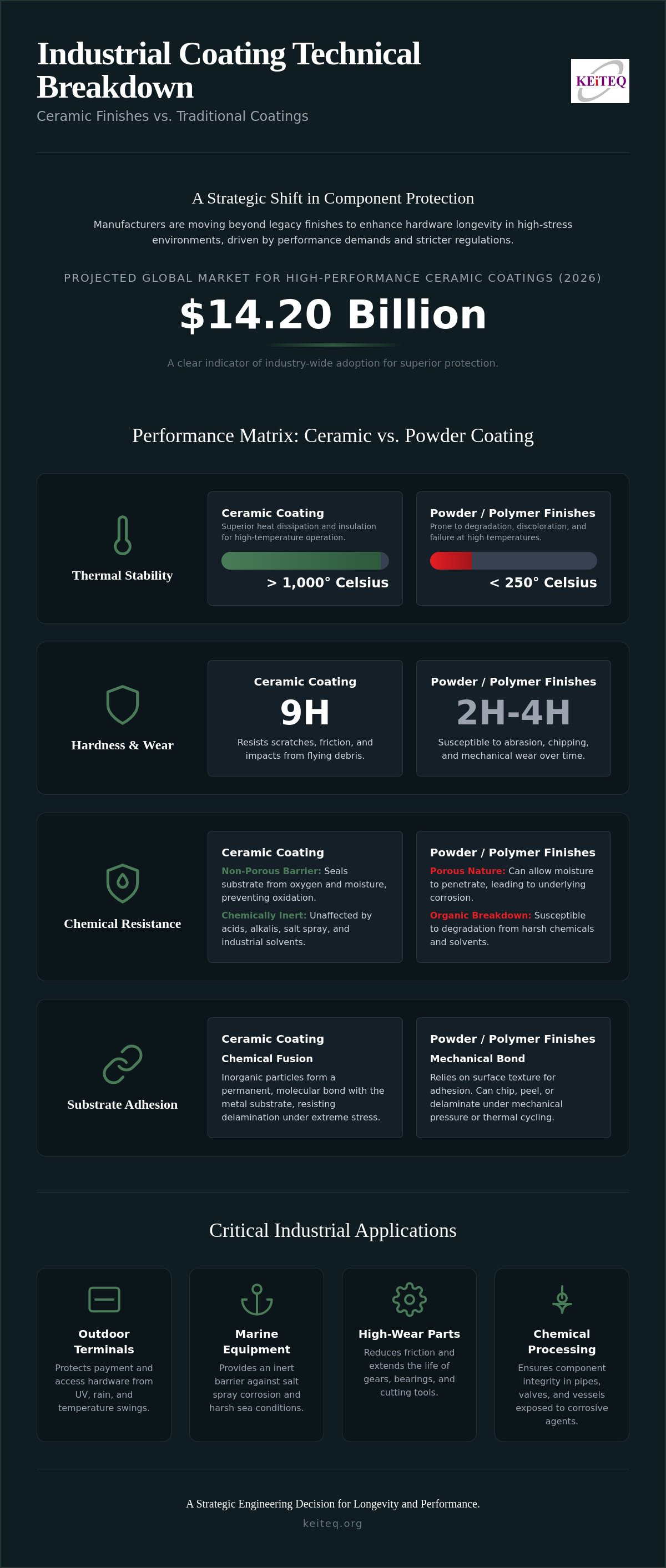
The 9H hardness rating is a standard benchmark for these coatings. It indicates that the surface can resist scratching from a 9H pencil, the hardest grade available. In a manufacturing context, this translates to superior abrasion resistance against flying debris or mechanical friction. Thermal stability is another defining trait. Many ceramic coating industrial applications maintain their structural properties at temperatures exceeding 1,000 degrees Celsius, far beyond the failure point of powder coatings or epoxies.
The Science of Durability: Technical Properties of Ceramic Finishes
The mechanical performance of a ceramic coating industrial application relies on its low friction coefficient. This property reduces parasitic drag in moving parts, which minimizes energy consumption and heat generation during operation. Unlike standard paints, ceramic finishes provide a non-porous barrier that effectively seals the substrate from oxygen and moisture. This total isolation prevents oxidation, ensuring that the underlying metal remains structurally sound even in high-humidity environments. These technical advantages make ceramics a preferred choice for Critical Applications of Ceramic Coatings across the global manufacturing sector.
Dielectric strength is another critical factor for complex hardware assemblies. Certain ceramic formulations act as high-performance electrical insulators, preventing arcing and protecting sensitive internal circuitry from external interference. This electrical resistance is paired with exceptional UV stability. While organic polymer coatings like epoxy or polyurethane degrade and chalk when exposed to direct sunlight, ceramics are inorganic and remain unaffected by long-term radiation. This ensures the finish maintains its protective properties and color consistency for decades, rather than years.
Thermal Management and Heat Dissipation
Ceramic coatings serve as critical thermal insulators for sensitive electronic enclosures. By reflecting radiant heat, they protect internal components from temperature spikes that cause system failure. This insulation reduces heat-induced fatigue in metal parts, preventing the microscopic cracking that occurs during repeated thermal cycling. In extreme desert or tropical climates, these finishes provide a stable thermal environment, maintaining hardware reliability where traditional coatings would blister or peel. If you're managing hardware in high-heat zones, you may want to consult with our engineering team regarding specific thermal barrier formulations.
Material Compatibility: From Diecasting to Stamping
These coatings demonstrate excellent adhesion across a wide range of industrial substrates. They're particularly effective when applied to aluminium and zinc diecasting, where they fill micro-porosities to create a perfectly smooth, resilient surface. The process is equally compatible with stainless steel and cold-rolled steel stamping parts, providing a uniform finish that doesn't interfere with tight tolerance requirements. Achieving this level of performance requires rigorous surface preparation. We utilize grit blasting to create a mechanical anchor profile and chemical etching to remove contaminants, ensuring the ceramic coating industrial bond is permanent and fails only when the substrate itself does.
Critical Applications: Protecting High-Stakes Industrial Hardware
The strategic deployment of ceramic coating industrial solutions is most evident in environments where hardware failure carries high financial or safety risks. Unattended systems, such as an outdoor payment terminal at a petrol or gas station, face a relentless combination of fuel vapors, fluctuating temperatures, and abrasive particulates. Standard finishes fail under these conditions. Standard industrial paints often succumb to chemical etching from spilled fuel or UV-induced brittleness. Ceramic coatings provide the necessary surface hardness to withstand these stressors, ensuring the terminal remains operational and visually professional throughout its service life. This durability is also essential for public-facing kiosks, where anti-graffiti properties allow for the rapid removal of paint and adhesives without damaging the underlying finish.
In marine and offshore sectors, the primary threat is accelerated oxidation from constant salt spray. To ensure the durability of vessels and hardware in these conditions, you can explore maritime paint and surface protection products that are specifically engineered for high-salinity environments. Ceramic finishes create a hydrophobic, non-porous layer that prevents chloride ions from reaching the metal substrate. This protection extends to chemical processing plants, where equipment must endure aggressive acidic or alkaline vapors. By maintaining a chemically inert exterior, these coatings prevent the structural degradation of housings and support structures. This reduces the risk of catastrophic leaks or mechanical failures in high-pressure environments.
Outdoor Electronics and Enclosure Integrity
Maintaining the integrity of an Ingress Protection (IP) rating requires a surface finish that doesn't crack or peel over time. When a coating fails, it creates pathways for moisture to bypass gaskets and seals, leading to internal component failure. For a deeper look at these technical requirements, see our guide on protective coatings for outdoor electronics. Many industrial enclosures utilize multi-material assemblies, such as aluminum panels with stainless steel fasteners. Ceramic coatings provide an effective insulating layer that prevents galvanic corrosion between these dissimilar metals. This keeps the assembly structurally sound.
Heavy Machinery and Moving Parts
Applying ceramic finishes to valves, pumps, and actuators significantly reduces maintenance cycles by minimizing surface wear. In the aerospace and automotive sectors, these coatings are applied to engine components to manage extreme thermal loads and reduce friction. High-performance ceramics allow parts to operate at higher temperatures while maintaining dimensional stability. These ceramic coating industrial applications are so effective at reducing friction that they often decrease the requirement for liquid lubricants in specific mechanical interfaces. This reduction in lubricant dependency simplifies maintenance and lowers the risk of contamination in sensitive production environments.
Ceramic vs. Powder Coating: Evaluating the Right Finish for Your Components
Choosing between ceramic and powder coating requires a precise understanding of the operational environment and substrate geometry. Powder coating is a thick-film process, typically ranging from 2 to 6 mils in thickness. This provides excellent impact resistance for parts subject to physical strikes. In contrast, a ceramic coating industrial application is a thin-film finish, often measuring less than 2 mils. This minimal thickness ensures that the finish doesn't interfere with the tight tolerances required for precision-machined components or electronic assemblies. While powder offers a broader range of color matching for aesthetic branding, ceramics prioritize functional performance in environments where standard polymers fail.
Thermal limits define the most significant performance gap between these two technologies. Powder coatings generally begin to degrade, discolor, or lose adhesion at temperatures exceeding 200 degrees Celsius. Ceramics maintain their structural integrity at temperatures that would liquefy or char organic finishes. This makes them the only viable choice for high-heat zones. For high-volume mass production, the cost-to-benefit ratio favors ceramics when the cost of component replacement and downtime outweighs the initial application expense.
When to Choose Powder Coating
Powder coating remains the industry standard for general hardware where cost-efficiency and impact protection are the primary concerns. It's particularly effective for large, non-complex surface areas where a thick, durable barrier is needed to resist abrasion. For a deeper analysis of these trade-offs, review our comparison on high-performance powder coating vs. traditional finishes. This method provides superior coverage for parts with simple geometries that don't require precision clearance.
The Case for Ceramic Coating
The case for a ceramic coating industrial solution becomes clear when components face extreme pH environments or intense UV exposure. While organic polymers in powder coating eventually "chalk" and fade under direct sunlight, inorganic ceramics remain stable and non-reactive. This thin-film approach is also critical for weight-sensitive applications in aerospace or precision electronics. The coating provides maximum protection without adding significant mass to the assembly. If your project involves these high-stakes requirements, request a technical consultation for your specific application to ensure optimal finish selection.
Strategic Implementation: Integrating Ceramic Finishes into Mass Production
Successful implementation of a ceramic coating industrial system begins long before the first component reaches the spray booth. Engineering teams must evaluate surface finishing requirements during the initial Product R&D and Design phase to ensure total system compatibility. This proactive approach allows for the selection of substrate materials that optimize the chemical bond with the ceramic formulation. It also prevents costly redesigns that occur when a finish is treated as an afterthought rather than a core engineering specification. Integrating these decisions early ensures that the final product meets both performance benchmarks and budgetary constraints.
Scaling from a prototype to mass production requires a seamless transition from manual application to automated, high-volume lines. We manage this by integrating the finishing process directly into the broader production lifecycle. This single-source approach allows for immediate feedback between the diecasting or stamping floor and the coating department. It eliminates logistical delays and reduces the risk of surface contamination that often occurs when parts are shipped to third-party vendors for finishing. By keeping the entire workflow under one roof, we maintain tighter control over the environmental variables that affect coating quality.
Our quality control protocols are methodical and data-driven. We utilize non-destructive thickness testing to ensure uniform coverage across every batch. Adhesion checks, including cross-hatch testing, verify that the ceramic particles have fused correctly with the metal substrate. Salt spray validation, conducted according to international standards, confirms that the finish provides the necessary corrosion resistance for long-term field deployment. These rigorous checks ensure that every component leaving the facility is ready for the demands of high-stakes industrial environments.
Design for Coating (DFC) Principles
Design for Coating (DFC) requires adjusting tolerances in precision assemblies to account for the thin-film layer. While ceramic coating industrial finishes are thin, they still impact the dimensional stability of tight-tolerance parts. Industrial designers must also ensure proper drainage and access points for spray application, particularly in complex internal geometries. Collaboration between designers and coating specialists prevents common issues like "shadowing" or uneven accumulation in recessed areas, ensuring a consistent protective barrier across the entire part surface.
Mass Production Logistics and Quality Assurance
Maintaining batch consistency in high-volume runs is essential for global supply chain reliability. We adhere to ISO 9001:2015 standards to ensure every production run meets specified performance benchmarks. This level of oversight is critical during final assembly and integration, particularly in outdoor payment terminal manufacturing. In these applications, every enclosure must withstand years of environmental exposure without degradation, making the quality of the industrial finish a primary factor in the hardware's overall ROI.
Optimizing Asset Longevity Through Integrated Surface Engineering
Selecting the right protective finish is a strategic decision that dictates the long-term reliability of your hardware. We've established that advanced ceramics provide superior thermal stability and chemical resistance compared to traditional thick-film finishes. Integrating these high-performance materials into your mass production workflow reduces maintenance cycles and prevents premature component failure. Implementing a ceramic coating industrial strategy ensures that critical hardware remains operational under extreme stress while maintaining strict dimensional tolerances.
Keiteq manages the entire lifecycle from initial R&D to mass production management within our ISO 9001:2015 certified facility. Our specialized expertise in outdoor payment terminal assembly ensures your high-stakes equipment is built to endure harsh environmental exposure and aggressive chemical contact. Consult with Keiteq for your industrial coating and manufacturing needs to secure a steady, reliable partner for your next production run. We're ready to help you achieve maximum hardware performance through proven methodology and technical precision.
Frequently Asked Questions
What is the difference between industrial ceramic coating and automotive ceramic coating?
Industrial ceramic coatings are high-solids formulations engineered to withstand extreme mechanical and thermal stress, while automotive versions prioritize water repellency and aesthetic gloss. Industrial systems are applied to resist abrasive wear and intense chemical exposure in manufacturing environments. These coatings create a permanent chemical bond with metal substrates to ensure long-term structural integrity. Automotive products are typically silica-based liquids applied in thin layers for surface shine rather than structural protection.
Can ceramic coating be applied to plastic injection molded parts?
Ceramic coatings can be applied to plastic injection molded parts provided the formulation is specifically compatible with the polymer substrate. These coatings enhance the surface hardness and UV resistance of plastic enclosures, preventing the degradation and brittleness caused by long-term sun exposure. Proper surface preparation is essential to ensure durable adhesion. This process is particularly beneficial for high-wear plastic components used in outdoor environments where environmental stress is constant.
How long does an industrial ceramic coating typically last in outdoor environments?
Modern ceramic coating industrial formulations are designed to extend hardware protection from the standard 5 to 7 years to over 15 years. This longevity is achieved through inorganic chemistry that resists UV degradation and oxidation. The actual lifespan depends on the severity of the environment and the quality of the initial surface preparation. Regular inspections ensure the coating maintains its protective barrier against corrosive agents throughout its service life.
Is ceramic coating more expensive than powder coating for mass production?
Ceramic coating generally carries a higher initial application cost than powder coating due to the intensive surface preparation and specialized application techniques required. However, it offers a superior cost-to-benefit ratio for mass production by significantly reducing maintenance and replacement cycles. When evaluating hardware ROI, the longevity and performance of ceramics often outweigh the lower upfront price of traditional powder finishes in high-stress environments.
What temperature range can industrial ceramic coatings withstand?
Industrial ceramic coatings are engineered to withstand extreme thermal environments, with many formulations maintaining stability at temperatures exceeding 1,000 degrees Celsius. This thermal resistance far exceeds that of organic finishes like powder coating, which typically fails at approximately 200 degrees Celsius. These coatings act as thermal barriers, protecting the underlying metal substrate from heat-induced fatigue and dimensional changes during repeated thermal cycling.
Does ceramic coating provide protection against chemical corrosion?
Ceramic coatings provide an exceptionally effective barrier against chemical corrosion by creating a non-porous, chemically inert surface. This layer prevents concentrated acids, alkalis, and industrial solvents from reacting with the metal substrate. It's an essential requirement for components in chemical processing plants or offshore equipment exposed to salt spray. This total isolation eliminates the risk of oxidation and galvanic corrosion in complex multi-material assemblies.
What is the typical thickness of an industrial ceramic coating layer?
The typical thickness of a ceramic coating industrial layer is less than 2 mils, classifying it as a thin-film finish. This minimal profile is critical for precision-machined parts where maintaining tight tolerances is a primary requirement. Despite its thin application, the coating provides superior hardness and protection compared to much thicker organic finishes. This ensures mechanical clearance is maintained in complex moving assemblies and electronic enclosures.
How does ceramic coating improve the lifespan of outdoor payment terminals?
Ceramic coating improves the lifespan of outdoor payment terminals by protecting the enclosure from fuel vapors, UV radiation, and abrasive cleaning agents. These coatings provide the necessary surface hardness to resist scratches and environmental etching that lead to substrate corrosion. By preventing the degradation of seals and gaskets, the coating maintains the unit's IP rating. This results in fewer hardware failures and a professional appearance over years of unattended service.


Comments