
Soft Tooling Prototyping: A Comprehensive Industrial Reference Guide for 2026
Updated: Jul 27
Committing to permanent steel molds before finalizing a design is a high-stakes gamble that few project budgets can survive in 2026. With raw material price volatility driving 26% of manufacturing cost increases, the margin for error in tool fabrication has disappeared. Most engineering teams recognize the pressure to reduce lead times while maintaining strict functional requirements. The fear of discovering a critical design flaw after a major investment in hard tooling is a legitimate barrier to innovation.
This guide demonstrates how to master soft tooling prototyping to eliminate these financial risks. By utilizing bridge tooling, you can validate production-grade materials and iterate designs at a fraction of the traditional cost. We provide a methodical analysis of the strategic transition from rapid prototyping to bridge production. This ensures your path to mass manufacturing remains efficient, technically sound, and financially agile.
Table of Contents
What is Soft Tooling Prototyping? Defining the Industrial Bridge
Soft tooling prototyping serves as the industrial bridge between initial concept validation and high-volume manufacturing. Unlike permanent steel molds, soft tooling utilizes aluminum or soft alloys to produce parts that match the physical properties of the final product. This method falls under the broader category of Rapid tooling, which prioritizes speed and cost-efficiency without sacrificing material integrity. It's a strategic choice for teams that need to move beyond visual models toward functional components that can be tested in real-world environments.
In the modern Product R&D and manufacturing cycle, the pressure to iterate is relentless. By 2026, industrial standards like ISO 294-5:2026 emphasize the need for precise test specimens to analyze material anisotropy. Traditional hard tooling cannot accommodate the rapid design shifts required to meet these rigorous data requirements. Soft tooling allows engineering teams to test actual resins and metal alloys in a real-world molding environment. This provides a level of certainty that standard 3D printing simply cannot replicate.
While soft tooling offers superior material testing, the initial design refinement often starts with additive manufacturing; companies like Protomolecule specialize in these early-stage rapid prototyping solutions that pave the way for successful tool fabrication.
The Core Components of Soft Tooling
The architecture of a soft tool typically consists of standardized mold bases combined with custom, interchangeable inserts. The term "soft" refers specifically to the material's hardness on the Rockwell scale, which allows for faster CNC machining and EDM processes. It's a common misconception that these tools lack physical rigidity; they're robust enough to withstand the pressures of both plastic injection molding and aluminum diecasting. This structural stability ensures that every prototype part remains dimensionally accurate across the entire trial run. By using these high-strength alloys, manufacturers can achieve tight tolerances while maintaining a significantly shorter fabrication timeline.
Why Soft Tooling is Essential for Modern OEMs
For Original Equipment Manufacturers (OEMs), the primary driver is risk mitigation. Investing in "Class A" hard tooling before a design is fully vetted can lead to catastrophic financial losses if a defect is discovered late. Soft tooling provides a safety net. It enables the production of 100 to 5,000+ parts using production-grade resins, allowing for extensive field testing and regulatory certification. This bridge production phase ensures that the final design is optimized for manufacturing before the first piece of P20 or H13 steel is cut. Soft tooling prototyping is the critical link between CAD design and industrial scale.
Soft Tooling vs. Hard Tooling: A Strategic Comparison for 2026
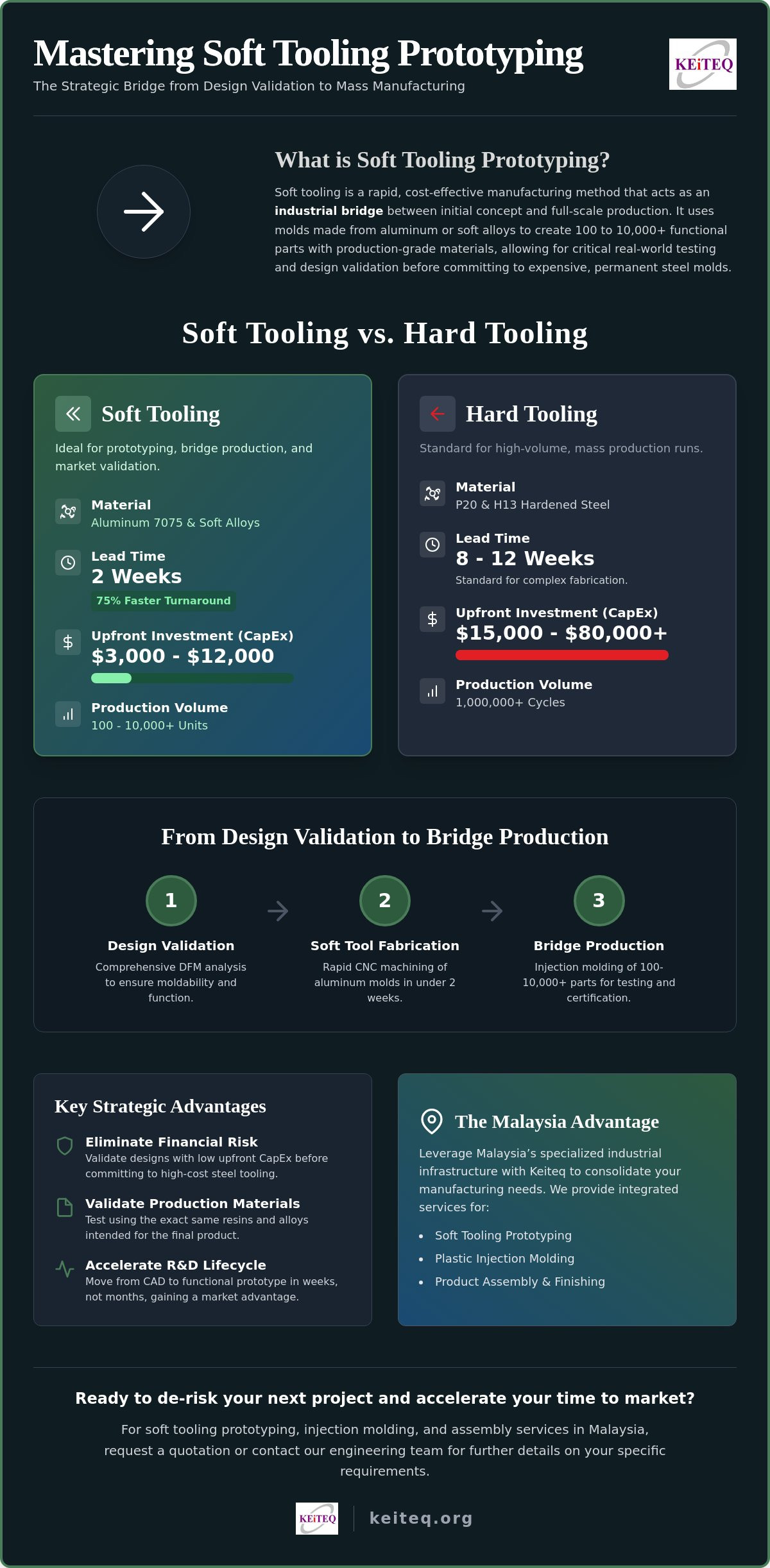
Choosing between aluminum and steel is a decision that dictates a project's financial trajectory and speed to market. In the 2026 manufacturing environment, the primary differentiator remains the trade-off between tool longevity and fabrication speed. Soft tooling prototyping allows for a 2-week turnaround; whereas hard tooling often requires 8 to 12 weeks for complex fabrication and heat treatment. This 75% reduction in lead time is vital for industries where market windows close rapidly. While steel molds are built for millions of cycles, aluminum tools are engineered for the critical bridge phase where design flexibility is still a requirement.
Initial capital expenditure (CapEx) highlights the starkest contrast. Aluminum molds for 500 to 10,000 units typically require an investment between $3,000 and $12,000. In contrast, hard tooling using P20 or H13 steel can range from $15,000 to over $80,000. For OEMs, this cost gap represents a significant amount of liquidity that can be redirected toward other R&D priorities. This strategic allocation of funds directly accelerates the prototype to mass production timeline, ensuring that capital isn't locked in permanent molds before the design is finalized.
Cost Dynamics and ROI
The return on investment for soft tooling is highest during the low-volume production and market testing phases. It eliminates the "hidden" costs associated with hard tooling, such as expensive climate-controlled storage and the high price of tool modifications. If a design flaw is discovered in a steel mold, the rework costs can approach the price of a new tool. Aluminum is more forgeable; it allows for faster and cheaper modifications. This flexibility facilitates aggressive market testing without exposing the business to massive financial risk. If you need a technical review of your design's moldability, you can consult with our engineering team.
Performance and Material Compatibility
A common industry myth suggests that soft tooling results in inferior part aesthetics or loose tolerances. This isn't the case with modern high-strength alloys like Aluminum 7075. These materials support the use of engineering-grade thermoplastics, including glass-filled nylons and polycarbonates. While steel offers slightly higher precision over long runs, aluminum maintains tight tolerances for the duration of its 5,000 to 10,000 cycle life. It provides the same surface finish options as steel, including high-polish or textured grains, ensuring that prototype parts are indistinguishable from mass-produced units during functional testing.
Primary Technologies and Materials in Soft Tooling Prototyping
The selection of materials for mold fabrication determines the tool's operational performance and the precision of the resulting components. Aluminum 7075 remains the industry standard for high-performance soft tooling prototyping due to its exceptional strength-to-weight ratio and superior machinability. Using advanced CNC machining, production teams in Malaysia generate complex geometries with high dimensional accuracy. For broader material requirements, including wood, acrylic, and composites, CNC Cut to Size provides the precision cutting and industrial 3D printing needed to support complex prototyping workflows. This ensures that every part produced meets the rigorous industrial component manufacturing quality standards required for functional testing in 2026. This material approach allows for the creation of functional parts that accurately reflect the final product's performance and mechanical integrity.
Beyond traditional alloys, the integration of hybrid technologies has expanded the capabilities of the prototyping phase. By utilizing standardized mold bases with customized inserts, manufacturers in Malaysia pivot between different design versions without the need for entirely new tool sets. While many operations are regional, you can learn more about how VPrint3D Limited provides integrated rapid prototyping and additive manufacturing solutions that complement these global manufacturing workflows. This modularity is essential for managing the resource constraints often found in fast-paced R&D environments, allowing for a more disciplined use of resources while maintaining a steady pace of development.
Aluminum Tooling: The Industry Standard
Aluminum's high thermal conductivity is its primary technical advantage in a production environment. It dissipates heat significantly faster than steel, which leads to shorter cooling cycles during the injection process. These reduced cycle times allow for a higher volume of parts to be produced in a single shift, accelerating the overall validation timeline. For companies utilizing plastic injection molding services in Malaysia, aluminum tooling provides a cost-effective way to achieve production-grade finishes on complex parts. Keiteq Co Ltd utilizes these high-strength alloys to ensure that prototype parts are indistinguishable from mass-produced units during functional testing.
Composite and 3D Printed Molds
Hybrid tooling has emerged as a disruptive methodology for ultra-rapid iterations. This process involves combining 3D printed inserts, often made from high-temperature resins, with standard metallic mold bases. These resin inserts can withstand the heat and pressure of the injection process for very short runs, typically between 20 and 100 parts. While these additive tools are excellent for initial form and fit testing, they have clear limitations in high-pressure environments compared to aluminum. Integrating these additive components into broader soft tooling prototyping strategies in Malaysia allows for a tiered validation process. Keiteq Co Ltd ensures that the transition between these material phases is seamless and technically sound.
The Workflow: From Design Validation to Bridge Production
The transition from a digital CAD model to a physical component requires a systematic approach to ensure functional accuracy and cost control. Soft tooling prototyping follows a methodical four-step sequence designed to eliminate technical uncertainty. This workflow allows engineering teams to move through the validation phase with speed while maintaining a high level of procedural discipline. By following these structured stages, manufacturers can secure a reliable path toward full-scale production without the risks associated with unvetted designs.
Step 1: Design for Manufacturing (DFM) Analysis. Engineers conduct a rigorous review of the part geometry to ensure it can be molded efficiently. This stage identifies issues like improper draft angles or inconsistent wall thicknesses.
Step 2: Rapid Tool Fabrication. High-speed CNC machining or EDM processes are used to cut the mold into aluminum 7075 or other soft alloys. This phase is significantly faster than steel tool fabrication.
Step 3: T1 Sampling and Tool Tuning. The first shots are produced and analyzed. Adjustments are made to the tool to ensure every dimension meets the specified tolerances.
Step 4: Bridge Production. The finalized soft tool is used to manufacture low-volume runs. This fulfills early market demand while the permanent hard tooling is being fabricated.
DFM and Optimization for Soft Tools
Aluminum molds have different thermal and mechanical properties than steel; therefore, the DFM phase must account for these specific variables. Draft angles for aluminum tools typically require a minimum of 1 to 3 degrees to ensure clean part ejection without damaging the mold surface. This analysis is particularly critical in complex projects like outdoor payment terminal assembly, where internal rib structures and boss features must be perfectly aligned. Executing DFM at the soft tooling stage prevents million-dollar errors in mass production by identifying geometric conflicts before the final molds are commissioned. If you're unsure about your part's moldability, you can request a technical feasibility review from our engineering team.
Managing Bridge Production
Bridge production is a strategic revenue-generating phase that bridge the gap between prototyping and mass manufacturing. It allows OEMs to supply "Beta" units or initial market stock to early adopters without waiting months for steel tools. The data collected during this phase, such as real-world shrinkage rates and cycle times, is invaluable for optimizing the final hard tool design. Integrating this bridge phase into a broader contract manufacturing services strategy ensures a seamless transition. It provides a steady supply chain while the project scales, maintaining market momentum while the final production infrastructure is finalized.
Strategic Advantages of Soft Tooling Prototyping in Malaysia with Keiteq Co Ltd
Malaysia's industrial landscape offers a unique concentration of precision engineering and electronic manufacturing services. This ecosystem is built for speed and technical compliance, particularly in the Johor region where specialized industrial parks support high-tech production. When utilizing soft tooling prototyping in this region, manufacturers benefit from a supply chain optimized for rapid iteration and high-mix, low-volume flexibility. Keiteq Co Ltd operates at the center of this hub, providing a seamless transition from initial CAD validation to plastic injection mold Malaysia operations. This proximity between tool fabrication and production lines eliminates the logistical delays common in fragmented supply chains.
Managing the entire lifecycle within a single territory allows for tighter control over procedural accuracy and quality assurance. For complex hardware such as outdoor payment terminals, the integration of R&D and assembly is critical for long-term reliability. It ensures that the mechanical tolerances validated during prototyping are maintained throughout the scaling process. Keiteq Co Ltd acts as a steady partner, overseeing every phase from material selection to final mass production management. This holistic approach reduces the total cost of ownership by identifying potential assembly bottlenecks early in the development cycle.
Integrated Finishing and Assembly
At Keiteq Co Ltd, we apply industrial coatings like ceramic, powder, and enamel directly to soft-tooled parts. This allows for the testing of aesthetic standards and environmental durability before full-scale production begins. During the manual review and annotation of these prototypes, designers often utilize premium marking tools from PoscART to highlight areas for further refinement. Validating these finishes early is essential for outdoor electronics that must meet international compliance standards. It provides a technical benchmark for the final product's physical durability and ensures that the transition to mass manufacturing remains efficient.
The Keiteq Co Ltd Advantage: A Safe Pair of Hands
We function as a global facilitator for OEMs requiring disciplined production oversight. Our expertise extends across multi-material assemblies, including plastic molding, metal stamping, and diecasting. By maintaining high-performance industrial standards, Keiteq Co Ltd ensures that every project is handled with a focus on stability and logistical competence. We provide the professional industrial infrastructure needed to navigate the complexities of international manufacturing with ease. Our commitment to reliability makes us a dependable pillar within the global supply chain for companies seeking functional trust.
Securing Your Competitive Advantage in the 2026 Manufacturing Landscape
The 2026 industrial landscape rewards manufacturers who prioritize financial agility and functional certainty. Implementing soft tooling prototyping is the most effective method to secure these advantages while shielding your project from the risks of premature hard tooling commitments. By utilizing production-grade materials early in the development cycle, you ensure your hardware is technically sound and market-ready without the burden of excessive upfront capital. This strategy provides the flexibility needed to respond to shifting market demands with speed and precision.
Keiteq Co Ltd offers the specialized technical oversight required to move your project from the design phase to the factory floor. Our Malaysian operations are optimized for seamless integration, providing a dependable pillar for your global production strategy. We maintain a rigorous focus on procedural accuracy and physical durability to ensure your components perform as intended in high-stress environments. Our facility serves as a stable partner for companies requiring disciplined assembly and precision molding within a globally recognized manufacturing hub.
For high-precision manufacturing and prototyping solutions in Malaysia, Request for Quotation or Request to contact us for further details regarding our regional services. We're ready to facilitate your next industrial milestone with reliability and professional excellence.
Frequently Asked Questions
What is the typical lifespan of a soft tool made of aluminum?
Aluminum 7075 tools typically produce between 5,000 and 10,000 parts before dimensional degradation occurs. The exact count depends on the abrasiveness of the resin used, such as glass-filled nylon. This volume is sufficient for most bridge production requirements and functional testing phases. It provides a reliable medium-term solution for low-volume industrial runs.
Can soft tooling be used for complex geometries like internal threads?
Soft tooling easily accommodates complex features like internal threads and undercuts through the use of hand-loaded inserts or mechanical side-actions. While these features may slightly increase cycle times, they ensure the prototype part matches the final production geometry exactly. This capability is essential for validating assembly fits in complex hardware before committing to steel molds.
How does soft tooling differ from 3D printing for functional prototypes?
3D printing is primarily for visual form validation, whereas soft tooling prototyping produces parts using production-grade resins and high-pressure injection. This results in components with isotropic mechanical properties and realistic thermal performance. It provides a level of functional certainty that additive manufacturing cannot achieve for high-stress industrial applications.
Is it possible to modify a soft tool once it has been fabricated?
It is entirely possible to modify a soft tool after the initial T1 sampling. Aluminum's lower hardness allows for faster machining adjustments compared to hardened steel. This flexibility is a strategic advantage when iterative design changes are required to optimize part performance or resolve unforeseen assembly conflicts discovered during the testing phase.
What materials are best suited for soft tooling in plastic injection molding?
Most engineering-grade thermoplastics are suitable for soft tooling, including ABS, Polycarbonate, and various Nylon blends. These materials behave predictably within aluminum molds, allowing engineers to test real-world shrinkage and mechanical strength. High-performance resins used in outdoor electronics are also compatible, provided the tool design accounts for their specific flow characteristics.
How much can I expect to save by using soft tooling instead of hard tooling?
Manufacturers typically see a 70% to 80% reduction in initial capital expenditure when choosing soft tooling over permanent steel molds. While a hard tool might require a very high investment, soft tools are fabricated for a fraction of that cost. This allows for market testing and design validation without a massive upfront financial commitment during the R&D stage.
Does soft tooling allow for the same surface finishes as mass production?
Soft tooling supports the same range of surface finishes as mass production, including high-gloss polishing and specialized textures. Aluminum can be bead-blasted or chemically etched to meet specific industrial aesthetic standards. This ensures that "Beta" units look and feel identical to the final products that will eventually come off a high-volume production line.
How long does it take to transition from a soft tool to a hard production mold?
The transition from soft tooling to hard production molds is immediate in terms of data transfer, as the CAD geometry is already validated. However, the physical fabrication of the steel hard tool typically requires 8 to 12 weeks. During this period, the soft tool continues to fulfill bridge production needs to maintain supply chain continuity and market momentum.


Comments