
Industrial Design Company: A Guide to Product R&D and Manufacturing in 2026
Updated: Jul 27
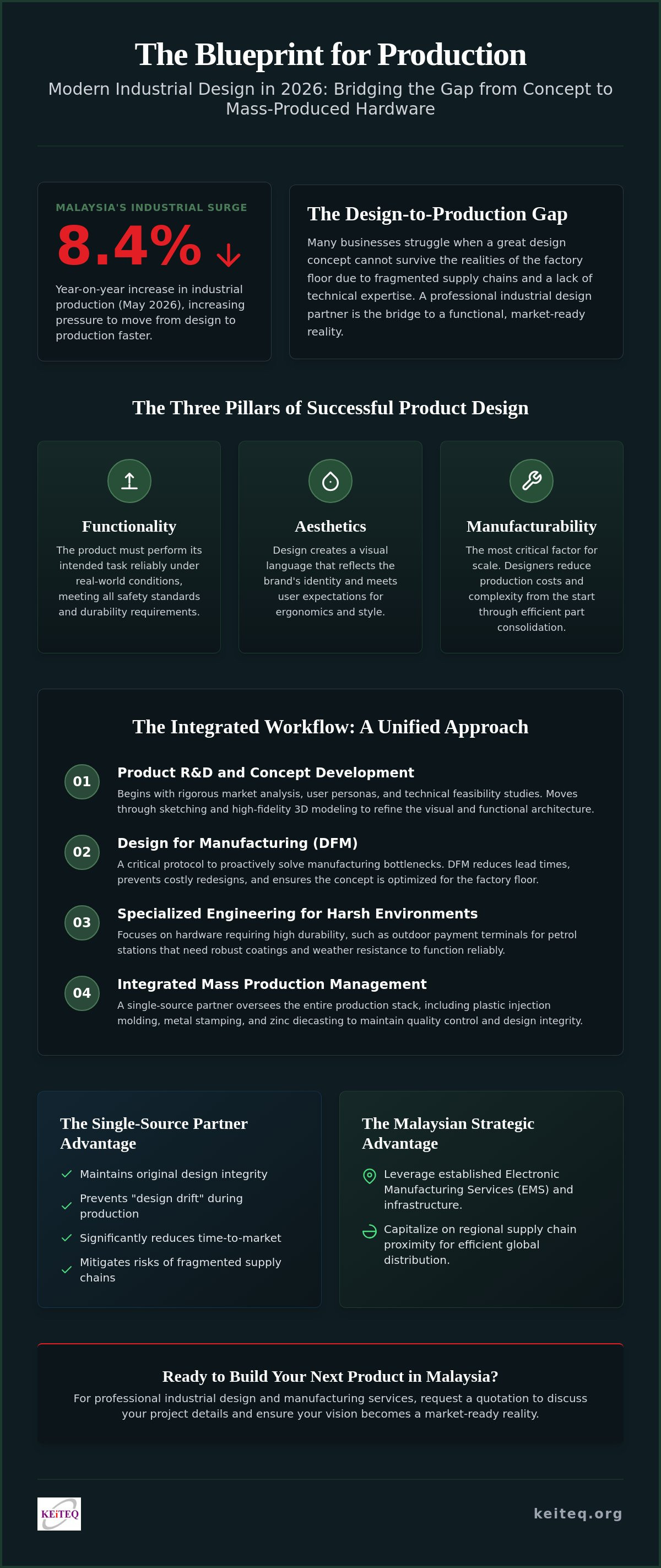
With Malaysia’s industrial production surging by 8.4% as of May 2026, the pressure to move from a digital sketch to a shipping container has never been higher. You understand that a beautiful design is a liability if it cannot survive the realities of the factory floor. Many businesses struggle with the design-to-production gap, where fragmented supply chains and a lack of technical expertise in material finishing result in concepts that simply cannot be built. To address these gaps, TrustTech Recruitment provides the specialist technology and marketing talent required to oversee complex industrial projects. Partnering with a professional industrial design company is the only way to ensure your vision translates into a functional, market-ready reality.
This guide explains how an integrated approach to R&D and engineering eliminates manufacturing bottlenecks before they occur. You'll learn how to navigate complex processes like plastic injection molding and zinc diecasting while maintaining a clear roadmap to mass production. We provide a technical briefing on building a reliable manufacturing partnership in 2026, focusing on the specialized requirements of the Malaysian industrial landscape and the latest standards in product durability and technical compliance.
Table of Contents
What is an Industrial Design Company in 2026?
Industrial design is the professional practice of creating products that millions of people interact with daily. In 2026, the scope of this discipline has expanded significantly. It doesn't just refer to the superficial styling of a product's exterior. Instead, a modern industrial design company serves as a technical bridge between a conceptual idea and a mass-produced reality. This evolution is driven by the need for hardware that is not only user-centric but also optimized for complex global supply chains. With Malaysia's industrial production increasing by 8.4% year-on-year in May 2026, the demand for design that's ready for the factory floor has never been more critical.
Reliability is the hallmark of a successful development cycle. For original equipment manufacturers (OEMs), an industrial design company acts as a "Safe Pair of Hands" for complex hardware development. This means the firm takes responsibility for the entire lifecycle, ensuring that the initial design intent survives the rigors of the factory floor. By integrating engineering constraints early in the process, these companies solve user needs while strictly maintaining manufacturability. This approach prevents the common design-to-production gap where beautiful concepts fail during the prototyping or tooling phases.
The Evolution of Industrial Design and R&D
Modern firms have moved away from the siloed workflows of the past. Today, top-tier organizations integrate research, mechanical engineering, and production into a single, unified workflow. The primary difference between a creative agency and a manufacturing-focused industrial design company lies in technical depth. While an agency might focus on branding and visual appeal, a manufacturing partner prioritizes structural integrity, material selection, and assembly efficiency. For a deeper look at this transition, see our Integrated Product R&D and Manufacturing: A Strategic Guide for OEMs.
Key Objectives of Industrial Design
To deliver a successful product in 2026, a design team must balance three core pillars:
Functionality: The product must perform its intended task reliably under real-world conditions. This includes meeting safety standards and durability requirements.
Aesthetics: Design creates a visual language that reflects the brand's identity and meets user expectations for ergonomics and style. For companies looking to extend this identity to their workforce, specialized providers like Brandme offer high-quality corporate apparel that complements a professional industrial image.
Manufacturability: This is the most critical factor for scale. Designers must reduce production costs and complexity from the start through efficient part consolidation and material choice.
This balance of form and function is essential for creating high-performance equipment. In the office environment, EKOBOR exemplifies how industrial design expertise translates into ergonomic furniture that supports both productivity and employee well-being.
This commitment to high-performance design is also visible in professional office technology globally; for instance, UIQ offers advanced equipment solutions at uiqus.com that prioritize both technical precision and user efficiency in the modern workplace.
The same commitment to engineering and well-being is required for recovery equipment, where high-performance hardware must withstand demanding thermal conditions. You can learn more about the industrial design standards Iceology Cold Plunge uses for its premium wellness tubs.
Core Services of a Full-Service Industrial Design Firm
A full-service industrial design company operates as a multidisciplinary hub. It manages the complex transition from prototype to mass production by aligning creative vision with mechanical reality. Relying on a single-source partner ensures that technical specifications aren't lost during the handoff to the factory floor. This continuity is vital for maintaining design integrity and operational efficiency. It prevents "design drift," where the final product loses the functional or aesthetic qualities of the original concept.
Beyond creative ideation, these firms provide deep manufacturing-aligned services. This includes tool design, mass production management, and technical assembly. By overseeing the entire stack, from plastic injection molding and metal stamping to zinc diecasting, a professional partner mitigates the risks of fragmented supply chains. This integrated approach allows for the simultaneous development of the product and its manufacturing process, significantly reducing time-to-market for complex hardware.
Product R&D and Concept Development
The process begins with a rigorous research phase. Teams conduct market analysis and define user personas to ensure the product solves real-world problems. Technical feasibility studies are performed simultaneously to confirm that proposed features can be manufactured within budget. In 2026, this includes using generative design tools for performance simulation and generating design variations. During this stage, understanding Industrial design policy is essential for protecting intellectual property and securing design rights. Product R&D is the systematic investigation into new materials and processes to improve hardware performance. The ideation process then moves through sketching and high-fidelity 3D modeling to refine the visual and functional architecture.
Mechanical Engineering and Prototyping
Engineering transforms a visual model into a buildable structure. This involves validating internal component integration and material stress points. The use of soft tooling prototyping allows for the testing of form and fit before committing to expensive hard tooling. This iterative step identifies potential failure points early, ensuring the final product meets the standards described in our sibling article on Strategic Product Design Services for Industrial Hardware in 2026. Rapid prototyping methods like selective laser sintering are now standard practice, allowing for faster development cycles. If your project requires an integrated approach to development, you can discuss your technical requirements with our engineering team.
Bridging the Gap: Design for Manufacturing (DFM)
Design for Manufacturing (DFM) is the practice of designing parts, components, or products for ease of manufacturing. A professional industrial design company utilizes DFM as a core methodology to reduce lead times and prevent costly redesigns during the mass production phase. Many businesses face the "design-only" trap, where an aesthetic concept looks perfect on screen but proves impossible or prohibitively expensive to build. An integrated approach solves this by involving manufacturing constraints at the earliest stages of development. This ensures that every design choice is backed by technical feasibility.
According to the Bureau of Labor Statistics Occupational Outlook Handbook, industrial designers are responsible for developing concepts for manufactured products, which necessitates a deep understanding of production costs and material properties. This technical foundation, which applies whether selecting industrial polymers or durable architectural materials like those from Plusco Ceramics, allows designers to optimize material usage and simplify assembly processes. While some procurement officers worry that integrated design increases upfront R&D expenses, the reality is that it reduces long-term total cost of ownership. By refining the design for production efficiency, you eliminate the need for emergency engineering changes once the assembly line is already running.
Material and Process Selection
Selecting the right fabrication method is a critical technical decision. For industrial enclosures, designers often compare plastic injection molding with metal stamping based on production volume and environmental requirements. Plastic molding offers high geometric complexity and weight reduction, while metal stamping provides superior electromagnetic shielding and structural rigidity. For high-strength components that require tight tolerances, aluminium and zinc diecasting provide an excellent balance of durability and precision. You can find more details on these trade-offs in our guide to Design for Manufacturing Services: A Guide to Scalable Industrial Hardware.
Optimizing for Mass Production
Successful scaling depends on the precision of tool design. An industrial design company manages the creation of molds and dies to ensure that the thousandth part is identical to the first. This involves rigorous quality control and mass production management during the initial design phase to account for material shrinkage, draft angles, and cooling rates. DFM identifies potential assembly bottlenecks before the first unit is produced. This methodical preparation ensures a seamless transition to full-scale manufacturing, providing a reliable roadmap for long-term production stability.
Specialized Engineering for Harsh Environments
Industrial hardware intended for the outdoors faces a set of challenges that standard product design doesn't address. An industrial design company must prioritize environmental resilience to ensure product longevity. The most significant hurdles include moisture ingress, UV degradation, and physical tampering. For manufacturers, the cost of field failures in harsh environments far outweighs the initial investment in specialized engineering—a principle of reliability also championed by straightst.com in the context of technical event production. By adopting a "Safe Pair of Hands" approach, designers ensure that every component is ruggedized against the specific stresses of its operating environment.
The development of outdoor payment terminals for petrol and gas stations serves as a primary case study for this technical rigour. These devices operate in high-traffic, chemically aggressive environments 24 hours a day. Effective engineering requires a combination of ruggedized enclosures and sophisticated environmental sealing. Achieving a high Ingress Protection (IP) rating is non-negotiable for protecting internal payment modules from rain, dust, and humidity. Without these protections, electronic failure is inevitable, leading to costly downtime and maintenance.
Designing for Durability and Security
Securing public-facing hardware involves integrating complex electronics into vandal-resistant metal enclosures. Designers use metal stamping and zinc diecasting to create housings that resist physical impact while maintaining a professional appearance. Thermal management is equally critical. Hardware must perform reliably in direct sunlight, where temperatures can spike, and in extreme cold, where components can become brittle. Engineers create thermal dissipation paths and use specialized gaskets to maintain a controlled internal climate. You can learn more about these specific assembly requirements in our guide on Outdoor Payment Terminal Assembly: Engineering Durable Hardware for Fuel Retail.
Advanced Industrial Finishing and Coating
Longevity in the field is dictated by the quality of the finish. Advanced industrial coatings like enamel, ceramic, and powder coating are applied to provide chemical and weather resistance. In fuel retail environments, surfaces must withstand constant exposure to gasoline vapors and abrasive cleaning supplies. These high-performance finishes prevent the onset of corrosion that would otherwise compromise the structural integrity of the unit. Additionally, a professional finish creates an aesthetic of reliability. When a terminal looks durable and well-maintained, it reinforces user confidence during the transaction process. If your next project involves hardware for challenging environments, request to contact us for further details on our engineering and coating services.
Partnering with an Industrial Design Company in Malaysia
Malaysia has solidified its position as a global hub for electronic manufacturing services. For an industrial design company, this regional expertise provides a strategic advantage that firms based solely in the West often overlook. By basing operations within the Southeast Asian manufacturing corridor, partners can leverage established supply chains for raw materials and specialized electronic components. Keiteq bridges the gap by integrating international R&D standards with Malaysian production excellence. This combination offers OEMs a stable, high-capacity environment to scale hardware projects throughout 2026.
The regional infrastructure supports complex fabrication processes, including aluminium diecasting and precision metal stamping. This proximity to the factory floor allows for rapid iteration during the development phase. When design and production happen in the same geographic zone, the risk of technical xmiscommunication is virtually eliminated. This results in a more resilient supply chain and a faster path to market for industrial hardware. For professionals working in this regional hub, you can learn more about Indonesia en tus Manos to arrange personalized travel experiences throughout the neighboring archipelago.
For international teams managing these complex supply chains in Southeast Asia, finding high-quality locations to host partners or unwind after a successful production run is essential; you might choose to visit ECHO Phuket for a premier gastro dining experience that mirrors the precision and quality of your hardware projects.
Strategic Advantages of Integrated Lifecycle Management
Combining plastic injection mold design, metal stamping, and final assembly within a single region significantly reduces logistical overhead and transit lead times. Direct oversight of the factory floor ensures that quality assurance protocols are strictly followed without the delays of cross-continental communication. Technical directors benefit from a unified workflow where engineering changes are implemented immediately on the production line. A localized manufacturing partner is essential for mitigating global supply chain risks through real-time production adjustments and material sourcing stability. This integrated lifecycle management maintains the technical integrity of the product from the initial soft-tooling prototype to the final mass-produced unit.
Next Steps for Your Hardware Project
Moving from a conceptual sketch to a shipping container requires a disciplined, phased methodology. This starts with systematic R&D, transitions into functional prototyping, and scales through mass production management. Your procurement team should begin by consolidating all technical requirements, material preferences, and compliance certifications. This preparation is vital for a comprehensive Request for Quotation that reflects the true scope of the project. A phased approach allows for the validation of mechanical structures before committing to high-volume hard tooling, protecting your capital investment. To ensure these finished products are distributed efficiently and cost-effectively on a global scale, learn more about Packaging For Industry (PFI) to see how specialized packaging solutions can significantly reduce total landed costs.
Keiteq provides comprehensive end-to-end solutions for OEMs, specializing in everything from plastic injection molding to specialized coating for outdoor payment terminals. If you are ready to move your project into the manufacturing phase, we invite you to submit a Request for Quotation for our services in Malaysia. For more information on our technical capabilities and regional production facilities, please Request to contact us for further details.
Securing Your Manufacturing Future in 2026
Scaling a hardware product from a preliminary concept to global distribution requires more than just creative flair. It demands a technical foundation rooted in manufacturability. By prioritizing Design for Manufacturing (DFM) and environmental resilience, you ensure that your product survives both the assembly line and the field. Partnering with an integrated industrial design company allows for seamless transitions between R&D and mass production, mitigating the risks of fragmented supply chains. This disciplined approach is essential for maintaining product integrity at scale.
Once a hardware product is ready for the global stage, the way it is showcased at trade shows and in corporate headquarters becomes the final step in the design journey; to ensure your presentation matches your engineering standards, you can explore Lightboxes from Coker Exhibition Systems Ltd for high-impact display options that reflect your brand's commitment to quality.
Keiteq provides a steady presence for complex hardware projects. We offer specialized Outdoor Payment Terminal Assembly and end-to-end mass production management. Our advanced enamel and ceramic coating capabilities provide the durability required for the most challenging industrial environments. It's our priority to ensure that every unit meets rigorous professional standards before it leaves the factory floor.
For professional industrial design and manufacturing services in Malaysia, please Request for Quotation or submit a Request to contact us for further details. We look forward to facilitating your next hardware breakthrough with precision and reliability.
Frequently Asked Questions
What is the difference between industrial design and product design?
Industrial design focuses on the technical relationship between the user and the mass produced physical object. Product design often refers to a broader category that includes digital interfaces or general concept development. A professional industrial design company ensures that the physical form is optimized for mechanical assembly, material efficiency, and large scale manufacturing requirements.
How much does it cost to hire an industrial design company?
Investment levels depend on the scope of engineering and the required manufacturing deliverables. In 2026, project budgets range from initial concept fees to significant investments for fully engineered, manufacturable prototypes. Factors such as material selection, regulatory compliance for global markets, and the complexity of the mechanical assembly influence the final project cost.
Why is Design for Manufacturing (DFM) important for hardware startups?
Design for Manufacturing (DFM) is critical because it ensures that a hardware concept is financially and technically viable for mass production. Startups often face significant losses when they attempt to scale designs that haven't been optimized for factory processes. DFM reduces lead times and prevents the need for expensive late stage engineering changes that can deplete capital.
Can an industrial design company help with mass production management?
A full service industrial design company provides comprehensive mass production management as a core offering. This involves overseeing tool design, managing quality control protocols on the factory floor, and coordinating complex assembly workflows. By maintaining direct oversight, the firm ensures that the final output matches the technical specifications and durability standards of the original prototype.
What industries benefit most from professional industrial design services?
Sectors that require ruggedized hardware and specialized engineering, such as fuel retail and industrial automation, see the highest return on investment. These industries rely on equipment that must perform reliably in harsh environments. Professional design services ensure that components like outdoor payment terminals meet strict safety standards and survive high traffic public usage.
How long does the industrial design process typically take from concept to prototype?
The transition from an initial concept to a functional prototype typically requires three to six months. This duration accounts for market research, mechanical engineering, and iterative testing phases like soft tooling. Complex projects involving custom electronics or specialized industrial coatings may extend this timeline to ensure all performance benchmarks and safety regulations are met.
Does Keiteq offer specialized design for outdoor payment terminals?
Keiteq provides specialized design and assembly for outdoor payment terminals used in petrol and gas stations. Our engineering team focuses on environmental sealing, thermal management, and the integration of vandal resistant metal enclosures. We utilize advanced finishing services like enamel and ceramic coating to ensure long term reliability in these high traffic fuel retail environments.
Why should I choose an industrial design firm with in-house manufacturing capabilities?
Selecting a firm with integrated manufacturing capabilities reduces the gap between design intent and production reality. It allows engineers to validate designs using actual factory equipment like plastic injection molding and metal stamping machines. This proximity ensures that quality standards are maintained from the first prototype to the final mass produced unit in Malaysia.


Comments