
Enamel Coating Manufacturer: An Industrial Guide to Porcelain Finishing in 2026
Updated: Jul 30
The global porcelain enamel coatings market is projected to reach US$2.4 billion by 2035, yet many industrial components still fail in the field due to poor adhesion or inconsistent application. Selecting the right enamel coating manufacturer is no longer a simple procurement task; it's a strategic decision that affects the structural integrity of your product. You've likely dealt with the frustration of finishes that scratch during assembly or coatings that fail to reach the deep recesses of complex metal stampings. These failures don't just damage your reputation; they represent a breakdown in the technical synergy between the substrate and the finish.
We understand that you need more than a service provider. You need a partner that integrates R&D with mass production while meeting strict 2026 global standards, such as the latest EU formaldehyde emission limits and China’s GB 30981.2-2025 industrial coating mandates. This guide provides a framework for evaluating a manufacturer’s ability to deliver a rock-hard, chemical-resistant finish at scale. We'll explore how technical precision in the laboratory translates to durability on the factory floor, ensuring your components survive the harshest outdoor environments.
Table of Contents
Understanding the Role of an Enamel Coating Manufacturer in Industrial Durability
The Industrial Enamelling Process: From R&D to Mass Production
Comparing Enamel, Ceramic, and Powder Coatings for Harsh Environments
Key Criteria for Auditing an Industrial Enamel Coating Partner
Keiteq Co Ltd: Integrated Enamel Coating and Manufacturing Services in Malaysia
Understanding the Role of an Enamel Coating Manufacturer in Industrial Durability
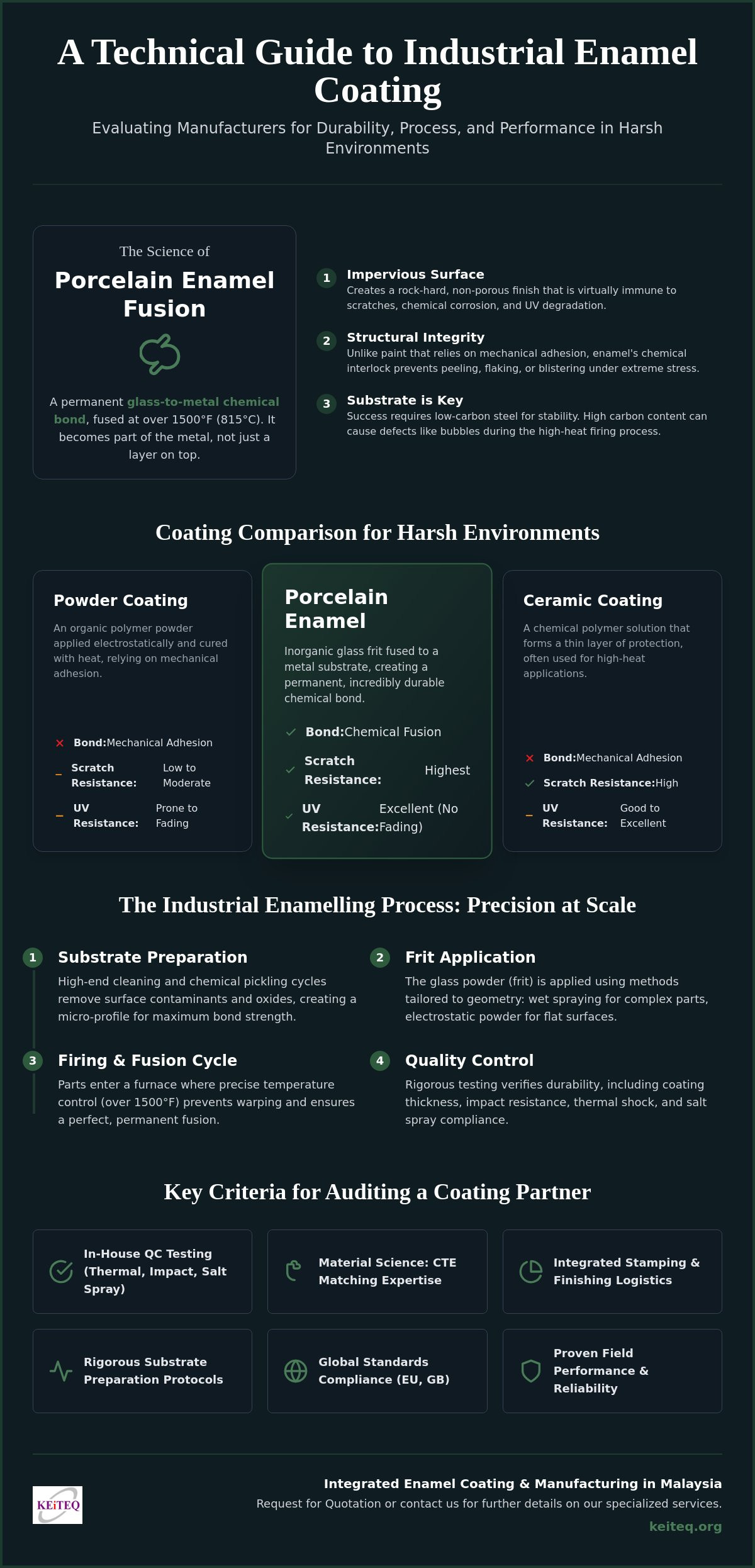
An enamel coating manufacturer does more than apply a surface finish; they facilitate a permanent metallurgical bond between glass and metal. Unlike organic coatings like industrial paint or powder, Vitreous enamel is an inorganic material fused to a substrate at extremely high temperatures. This process creates a surface that is virtually impervious to scratches, chemical corrosion, and UV degradation. For industrial components like outdoor payment terminals or heavy-duty machinery, this level of durability is a technical necessity rather than a luxury. The manufacturer must function as both a chemist and a metallurgist to ensure the finish doesn't just sit on the metal but becomes part of it.
The concept of fusion is the primary differentiator between porcelain enamel and standard industrial coatings. While paint relies on mechanical adhesion, enamel relies on a chemical interlock. This results in a finish that won't peel, flake, or blister even under extreme environmental stress. It's a structural solution that protects the underlying metal from oxidation while providing a surface that is as hard as glass. Because of this, selecting an experienced partner is critical for ensuring the longevity of high-value industrial assets.
The Science of Porcelain Enamel Fusion
The transformation begins with "frit," a specialized mixture of glass and mineral components ground into a fine powder. During the firing stage, this frit melts and flows over the metal surface to create a smooth, non-porous layer. As it cools, it solidifies into a rock-hard finish. A critical responsibility of the enamel coating manufacturer is matching the coefficient of thermal expansion (CTE) between the glass and the metal. If these expansion rates don't align perfectly, the coating will crack or "fishscale" as temperatures fluctuate in the field. A permanent fusion bond occurs when the glass and metal molecules interlock at temperatures exceeding 1500°F.
Why Material Selection Matters for Enamel Success
Successful enamelling depends heavily on the metallurgical properties of the substrate. While cast iron and aluminium are viable for certain applications, low-carbon steel is the preferred industrial standard for its stability. High carbon content often leads to outgassing during the high-heat firing process, which creates surface defects like bubbles or craters. Manufacturers must also implement rigorous substrate preparation to remove oils, oxides, and mill scale. This technical oversight is why many global firms seek providers that integrate electronic manufacturing services in Malaysia with specialized finishing. Proper material selection and preparation ensure the final finish is uniform, defect-free, and compliant with international durability standards.
The Industrial Enamelling Process: From R&D to Mass Production
A competent enamel coating manufacturer begins the production process long before the furnace is lit. Success depends on rigorous chemical pre-treatment. We utilize high-end cleaning and pickling cycles to remove surface contaminants and oxides. This creates a microscopic profile that allows for maximum chemical adhesion. These industrial manufacturing processes are strictly regulated to ensure environmental compliance while maintaining the integrity of the glass-to-metal bond.
Application methods are chosen based on the specific geometry of the component. Wet spraying is highly effective for complex internals and recessed areas. In contrast, electrostatic dry powder application offers superior uniformity and efficiency for large, flat surfaces. Once the frit is applied, parts enter the firing cycle. Precise temperature control is vital during this stage. If the heat is uneven or the ramp-up is too aggressive, the metal substrate may warp, ruining the dimensional accuracy of the component.
Quality control measures provide the final verification of industrial durability. We perform thickness testing to ensure the coating meets specifications without becoming too brittle. Impact resistance and thermal shock tests verify that the finish won't fail when exposed to extreme field conditions. Finally, digital color matching ensures brand consistency across every unit in a production run. For those seeking high-quality marking tools to complement these finishes, you can check out PoscART.
Integrating Metal Stamping and Enamelling
The quality of the final finish is often determined in the stamping press. When you utilize precision metal stamping, you can design parts specifically for the enamelling process. For instance, we design parts with radius edges rather than sharp corners. Sharp 90-degree angles often cause "burn-off," where the enamel pulls away from the edge during high-heat firing. A single-source partner managing both stamping and finishing eliminates these common design-to-production gaps.
Scaling from Prototype to Mass Production
Transitioning from a concept to high-volume output requires a disciplined engineering approach. Choosing an enamel coating manufacturer with in-house R&D capabilities allows for soft tooling prototyping to test enamel adherence on specific geometries. This phase identifies potential outgassing or adhesion issues before you commit to expensive hard tooling. Managing consistency across thousands of units requires automated application lines and real-time furnace monitoring. This level of mass production management is essential for complex hardware like outdoor payment terminals. If you're ready to discuss your project requirements, you can consult with our technical team for a detailed briefing.
Comparing Enamel, Ceramic, and Powder Coatings for Harsh Environments
Selecting an industrial finish requires a precise evaluation of the product's lifecycle and its exposure to environmental stressors. While powder coatings held a 57.6% share of the porcelain enamel coatings market in 2025, the choice between glass-based enamel and plastic-based organic coatings often comes down to long-term survivability. A specialized enamel coating manufacturer provides technical guidance on which material withstands the specific chemical or thermal loads of your application. The decision isn't just about aesthetics; it's about the mechanical reality of the operating environment.
UV stability represents a major divide between these technologies. Organic coatings, including most powder and liquid paints, eventually succumb to photo-degradation. This leads to chalking, brittle surfaces, and significant color fade over time. Porcelain enamel is fundamentally inorganic. It maintains its color and gloss for decades, even in high-UV tropical environments. This performance is a key reason why the Porcelain Enamel Institute (PEI) classifies it as the premier choice for outdoor architectural panels and signage. For high-value assets like an outdoor payment terminal, this longevity prevents premature replacement costs and maintains brand integrity.
Cost-benefit analysis must look beyond the initial application fee. Enamel requires a higher energy investment due to the 1500°F firing process, but it offers a significantly lower total cost of ownership for products intended to last 20 years or more. Consumer-grade goods often use organic finishes to meet lower price points. In contrast, industrial hardware demands the rock-hard immunity that only a fused glass surface provides. When a finish must survive both corrosive cleaning agents and abrasive physical contact, the investment in a fused coating pays for itself through reduced maintenance.
This commitment to enduring material quality is shared by artisans in other fields who focus on longevity; for those who appreciate fine craftsmanship, you can explore Gold Rings from KaMila Fine Jewellery to see how premium materials ensure a lifetime of wear.
Enamel vs. Powder Coating: Durability in the Field
The primary trade-off involves surface hardness versus substrate flexibility. Enamel provides a Mohs hardness that exceeds most metals, making it immune to field scratches and common graffiti. It also offers superior resistance to concentrated acids and alkalis that would dissolve a standard plastic coating. However, powder coating remains a viable option for parts that require flexibility or high impact bending without chipping. You can explore these differences further in our analysis of high-performance powder coating vs. traditional finishes.
Ceramic Coating for Industrial Heat Resistance
There are specific scenarios where you should choose a ceramic coating industrial solution over traditional enamel. Ceramic coatings are often applied as thin-film layers. This is ideal for precision components with tight tolerances where a thick enamel layer might interfere with mechanical assembly. These coatings act as exceptional thermal barriers for industrial machinery components that operate continuously at high temperatures but don't require the thick, aesthetic finish of porcelain. They provide a "Safe Pair of Hands" for high-heat protection without adding unnecessary bulk to the component geometry.
While coatings protect the exterior of industrial components, the internal performance of the mechanical systems themselves is just as vital. For those managing large-scale facilities, zeejaymechanical.com provides the specialized HVAC expertise needed to keep heating and cooling systems running efficiently alongside these advanced finishes.
Key Criteria for Auditing an Industrial Enamel Coating Partner
Auditing a potential enamel coating manufacturer requires a deep dive into their technical infrastructure and logistical stability. Procurement teams should look beyond the initial price per unit and evaluate the manufacturer’s physical capacity to handle specific component geometries. If a partner lacks large-format furnaces or automated conveyor systems, they'll struggle to maintain consistency during high-volume industrial runs. You must verify that their facility can accommodate the size of your components without compromising the precision of the application or the uniformity of the firing cycle.
Technical competence is best proven through rigorous in-house testing protocols. A reliable partner doesn't outsource quality assurance; they perform salt spray testing, impact resistance checks, and thermal shock evaluations on-site. These tests are essential for confirming that the glass-to-metal bond will survive the mechanical stresses of the field. You should request documentation that verifies adherence to ISO 9001:2015 and IATF 16949 standards, ensuring that every batch meets international industrial benchmarks for durability and safety.
Operational efficiency is significantly improved when you select a partner that offers supply chain integration. Managing R&D, metal stamping, finishing, and final assembly under a single roof reduces the risk of communication errors and logistical delays. This "Safe Pair of Hands" approach ensures that the design intent established during the prototyping phase is accurately executed throughout mass production. If you are currently evaluating partners for a complex industrial project, you can submit your technical specifications for a professional review.
Specialized Hardware: Outdoor Payment Terminals
Enamel is the critical choice for an outdoor payment terminal because these enclosures face unique environmental threats. In petrol station environments, hardware is exposed to fuel vapors, harsh cleaning detergents, and the risk of physical vandalism. Porcelain enamel provides a surface that is immune to graffiti and won't degrade when scrubbed with abrasive chemicals. Its rock-hard finish ensures that the enclosure remains corrosion-free for its entire operational life. You can learn more about these specialized requirements in our guide to outdoor payment terminal manufacturing.
Environmental and Safety Standards
The manufacturing landscape in 2026 is defined by a shift toward sustainable, low-emission materials. Forward-thinking manufacturers have already phased out PFOA and PTFE-free finishes in favor of inorganic porcelain solutions. Unlike organic paints that release Volatile Organic Compounds (VOCs), enamel is a glass-based material that is chemically inert and fully recyclable. This makes it an ideal choice for brands looking to meet strict environmental regulations without sacrificing industrial performance. While NovoTech offers expert painting and renovation for large-scale industrial and commercial projects, porcelain enamel represents a non-toxic, eco-friendly finishing solution that provides permanent protection without environmental compromise.
Keiteq Co Ltd: Integrated Enamel Coating and Manufacturing Services in Malaysia
Keiteq Co Ltd operates as a specialized enamel coating manufacturer from its primary facilities in Johor, Malaysia, functioning as a strategic offshore partner for US-based OEMs. With over 15 years of operational experience serving more than 100 global clients, we provide a stable, high-capacity hub for international production. Our facility is ISO 9001:2015 and IATF 16949 certified, ensuring that all finishing processes meet the rigorous quality standards required by US and European procurement teams. By situating advanced enamel, ceramic, and powder coating lines within this strategic manufacturing corridor, Keiteq Co Ltd offers a reliable alternative for companies looking to diversify their production outside domestic US facilities.
The primary advantage of partnering with Keiteq Co Ltd lies in our ability to synchronize electronic manufacturing services in Malaysia with technical industrial finishing. Most providers treat coating as a separate, outsourced step. We integrate metal stamping, diecasting, and enamel application into a single, managed workflow. This reduces logistical complexity for US supply chain managers and eliminates the risk of surface damage during transit between different vendors. Our "Safe Pair of Hands" philosophy is further evidenced by our 2025 collaboration with the Aerospace Malaysia Innovation Centre (AMIC) for aerospace-grade research and development.
End-to-End Solutions for US OEMs
We provide comprehensive production management that spans from initial prototyping to high-volume output for the US market. This includes the seamless integration of plastic injection molding services in Malaysia with metal components. For products like outdoor payment terminals, Keiteq Co Ltd manages the procurement of raw materials, the stamping of the enclosure, the application of the enamel finish, and the final assembly of electronic internals. This turnkey approach ensures that every component fits perfectly and adheres to the same strict durability benchmarks expected in the US market.
Request for Quotation: Partner with Keiteq Co Ltd
Procurement officers and technical directors are encouraged to engage with our engineering team to discuss regional manufacturing opportunities that support their US operations. To provide an accurate enamel coating manufacturer quotation, please prepare the following technical details:
Substrate material, such as low-carbon steel, cast iron, or aluminium.
Component geometry and physical dimensions.
Projected annual production volume and batch sizes.
Specific industrial standards or chemical resistance requirements.
Request to contact us for further details regarding our industrial finishing capabilities. Keiteq Co Ltd is prepared to facilitate a technical briefing or provide a formal Request for Quotation for your next project in Malaysia.
Securing Industrial Durability for 2026 and Beyond
Selecting a specialized enamel coating manufacturer is a critical decision that determines the long-term reliability of your industrial hardware. As global standards for emissions and durability tighten throughout 2026, the technical synergy between metal stamping and surface finishing becomes more vital than ever. We've established that a fused porcelain bond provides unmatched UV and chemical resistance, particularly for high-stakes applications like outdoor payment terminal assembly. This level of protection ensures that high-value assets remain operational and aesthetically consistent in the most demanding environments.
Keiteq provides a "Safe Pair of Hands" by managing the entire production lifecycle from initial R&D through to mass production management. Our expertise in enamel, ceramic, and powder coating allows us to tailor the finish to your specific environmental requirements without compromising on scale or precision. For high-volume industrial finishing and manufacturing services in Malaysia, please Request for Quotation or Request to contact us for further details. We look forward to supporting your global supply chain with our integrated regional offerings and technical expertise.
Frequently Asked Questions
What is the main difference between an enamel coating manufacturer and a powder coater?
The primary difference lies in the material composition; an enamel coating manufacturer utilizes inorganic glass frit, while a powder coater uses organic plastic resins. This results in a fused surface that is significantly harder and more resistant to heat and chemicals than any powder-based finish. While powder coating offers more flexibility for parts that might bend, it eventually degrades under UV exposure, a weakness that porcelain enamel doesn't share.
Can porcelain enamel be applied to aluminium parts?
Porcelain enamel can be applied to aluminium using specialized, low-temperature frits that fire at approximately 1000°F. Standard steel firing temperatures exceed the melting point of aluminium, so the manufacturer must use specific formulations to preserve the substrate's structural integrity. This process provides aluminium components with the same chemical and abrasion resistance typically associated with enamelled steel.
How does enamel coating improve the lifespan of outdoor payment terminals?
Enamel coating provides an impermeable, glass-hard barrier that prevents corrosion and surface degradation for 20 years or more. Since terminals in petrol stations face constant exposure to fuel vapors, salt spray, and extreme weather, this fused layer ensures the enclosure remains structurally sound. It eliminates the need for frequent repainting and protects the sensitive electronic internals from environmental ingress.
What are the typical firing temperatures for industrial porcelain enamel?
Industrial porcelain enamel typically requires firing temperatures between 1450°F and 1600°F. This extreme heat is essential for the glass frit to melt and chemically bond with the metal substrate. Precise thermal control during this stage prevents the substrate from warping while ensuring a uniform finish across the entire component geometry.
Is porcelain enamel coating resistant to graffiti and harsh chemicals?
The non-porous glass surface is completely resistant to graffiti and aggressive industrial chemicals. You can use strong solvents and acids to clean the surface without causing any degradation to the color or gloss. This makes it an ideal choice for high-traffic environments where maintenance and vandalism are constant concerns for procurement officers.
Why is Keiteq a preferred partner for enamel coating services in Malaysia?
Keiteq is a preferred partner because we integrate R&D, precision metal stamping, and finishing services within a single Malaysia-based facility. This holistic approach ensures that complex assemblies are manufactured with consistent quality and reduced lead times. As an integrated enamel coating manufacturer, we provide a "Safe Pair of Hands" for global OEMs looking to simplify their Southeast Asian supply chains.
What industries benefit most from high-performance enamel finishes?
Industries involved in petrochemical processing, architectural facades, and unattended outdoor hardware benefit the most from these finishes. High-performance enamel provides the only viable long-term solution for environments with high salt spray or constant contact with corrosive cleaning agents. It's the gold standard for any application where the total cost of ownership is measured over decades rather than years.
Can enamel coating withstand thermal shock in high-heat applications?
Porcelain enamel can withstand significant thermal shock when the glass and metal expansion rates are correctly synchronized during the R&D phase. This capability is vital for industrial machinery and heat exchangers that experience rapid heating and cooling cycles. A technical partner will match the frit chemistry to the specific thermal load of your application to prevent cracking or delamination.


Evidence Desk is a legal document and evidence management platform built for law firms. Organize case files, track chain of custody, and retrieve critical documents instantly — all in one secure workspace.