
Metal Stamping Manufacturer: A Strategic Guide to Industrial Procurement in 2026
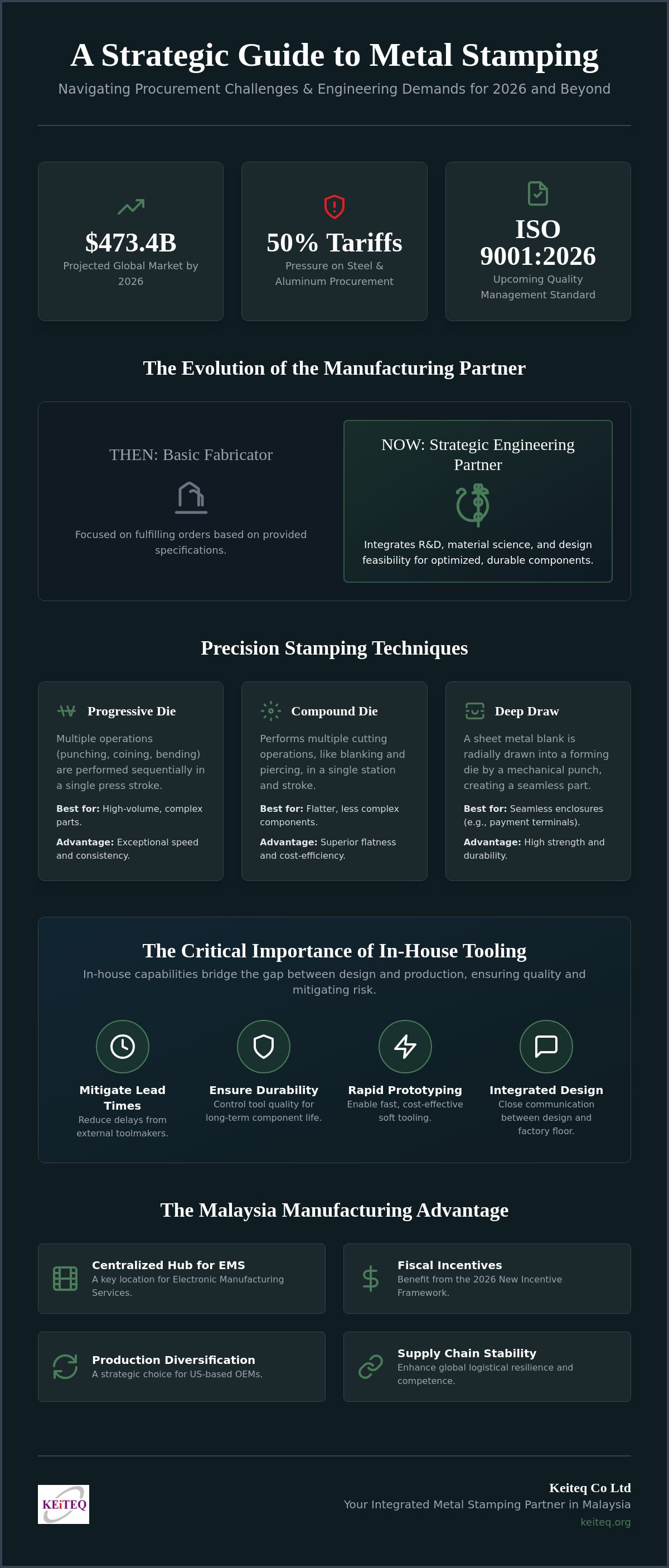
The global metal stamping market is projected to reach USD 473.4 billion by 2026, yet procurement leaders face unprecedented pressure from 50% tariffs on steel and aluminum. You likely recognize that high defect rates in high-volume runs and hidden tooling maintenance costs are no longer just operational hurdles; they're direct threats to your global supply chain's resilience. Identifying a metal stamping manufacturer that can bridge the communication gap between design and the factory floor is now a strategic imperative for any hardware-centric organization.
This article provides a framework for evaluating partners based on precision engineering, scalability, and logistical integration. We'll examine the critical role of in-house tooling and the strategic advantages of Malaysia's 2026 New Incentive Framework for US-based OEMs looking to diversify production. By the end of this guide, you'll understand how to secure high-durability components that withstand harsh environments while maintaining a cost-effective path from prototype to mass production. We'll also address the upcoming transition to the ISO 9001:2026 standard and its impact on quality management for global industrial hardware.
Table of Contents
The Strategic Role of a Metal Stamping Manufacturer in 2026
The industrial landscape in 2026 demands far more than basic fabrication. The metal stamping process has evolved into a complex engineering discipline where material science meets robotic precision. Tier 1 OEMs now prioritize a metal stamping manufacturer that offers integrated R&D, recognizing that the structural integrity of a final product is decided long before the first press stroke. This shift ensures that components can withstand the rigorous demands of harsh industrial environments while maintaining tight tolerances over millions of cycles. A metal stamping manufacturer is a strategic partner in the hardware value chain, providing the structural foundation and precision required for high-performance industrial components.
Engineering-Led Manufacturing: Beyond the Press
Early-stage R&D is the primary defense against manufacturing defects that often plague high-volume runs. By utilizing product design services during the prototyping phase, engineers identify potential stress fractures or material thinning before mass production begins. This synergy between design and stamping feasibility ensures that complex geometries don't compromise the component's life cycle. It's not just about hitting a piece of metal; it's about optimizing the geometry for maximum strength and minimum waste. Material selection strategies now focus on high-strength alloys that provide industrial-grade durability while remaining cost-effective for mass production.
Meeting Global Compliance and Quality Standards
Adhering to international benchmarks is a baseline requirement for any global metal stamping manufacturer. With the publication of ISO 9001:2026, organizations must adapt to updated quality management standards that emphasize risk-based thinking and digital traceability. Compliance with RoHs and REACH ensures that components are suitable for international export, particularly in the electronics and automotive sectors. Precise quality control protocols, such as automated optical inspection and coordinate measuring machines, guarantee that every part meets the specified tolerances. This level of rigor is vital for maintaining the reliability of complex assemblies in the global supply chain. For a comprehensive guide on transitioning to these new quality standards, visit Align Quality. Traceability in high-volume manufacturing isn't just a regulatory hurdle; it's a critical component of logistical competence and risk mitigation.
Precision Stamping Techniques for Complex Industrial Hardware
Selecting the appropriate fabrication method is a critical step in maintaining logistical competence and product reliability. An experienced metal stamping manufacturer utilizes specific techniques to balance speed, cost, and precision based on the hardware's intended application. The Precision Metalforming Association (PMA) emphasizes that technical proficiency in these methods is what separates a standard vendor from a strategic partner. Whether the goal is high-speed mass production or the creation of seamless deep-drawn enclosures, the choice of die technology determines the long-term viability of the component.
Progressive vs. Compound Die Stamping
Progressive die stamping is the preferred choice for high-volume mass production. This method utilizes a series of stations to perform multiple operations, such as punching, coining, and bending, within a single press stroke. It offers exceptional speed and consistency for complex parts. Compound dies perform multiple operations at a single station. While slower than progressive dies, they provide superior flatness and are more cost-efficient for flatter, less complex components. Calculating the break-even point for custom die investment is essential for maximizing tooling ROI. A metal stamping manufacturer will analyze your production volume to ensure the chosen method aligns with your budget and part complexity.
Precision stamping also plays a vital role in supporting zinc diecasting services. Stamped parts often serve as internal structural supports or mounting plates that interface with die-cast housings. This integration ensures that the final assembly meets the rigorous tolerances required for industrial hardware.
Deep Draw Enclosures for Outdoor Payment Terminals
Deep draw stamping is a specialized process used to create seamless, box-shaped enclosures from a single sheet of metal. This technique is non-negotiable for manufacturing weather-resistant hardware used in petrol stations and other harsh environments. By eliminating seams and welds, deep drawing significantly reduces the risk of water ingress and corrosion. This process is a core component of outdoor payment terminal assembly, where structural integrity and environmental protection are paramount. Engineers must carefully manage material stretching to prevent thinning at the corners, ensuring the enclosure remains durable under physical stress. If you're evaluating a project with complex enclosure requirements, you can contact our technical directors to discuss material feasibility and design optimization.
The Critical Importance of In-House Tooling and Design
A reliable metal stamping manufacturer understands that the die is the most critical asset in the production cycle. Outsourcing tool fabrication introduces variables that jeopardize lead times and part consistency. By maintaining an in-house tool room, a manufacturer retains absolute control over the engineering specifications and the metallurgical integrity of the dies. This vertical integration allows for immediate adjustments during the Design for Manufacturability (DFM) phase. DFM acts as a primary cost-saving mechanism; it identifies opportunities to reduce material scrap and simplify complex bends before any steel is cut. This proactive approach ensures that the final component is optimized for both structural performance and high-speed production.
From Prototype to Mass Production Management
Bridging the gap between a digital 3D model and a production-ready hard tool requires a methodical validation process. This is where soft tooling prototyping becomes indispensable. It allows engineers to test material flow and spring-back characteristics using temporary tools that mimic the final production environment. Iterative prototyping identifies potential failure points early in the R&D phase, preventing expensive modifications to permanent hard tooling later. Once validated, the transition to mass production management occurs seamlessly. This process ensures that the precision achieved in the prototype is replicated across millions of units without degradation.
Tooling Longevity and Maintenance Protocols
Tooling longevity is directly tied to the rigor of maintenance protocols. High-volume progressive dies undergo significant thermal and mechanical stress during operation. Predictive maintenance strategies, such as scheduled sharpening and lubrication of punch and die components, are essential for ensuring consistency across millions of strokes. Localized tool room support minimizes downtime by allowing for rapid on-site repairs. In-house re-engineering can also extend the life of existing tools by retrofitting components to handle updated part geometries or different material gauges. This level of technical oversight positions the manufacturer as a dependable pillar within your global supply chain, ensuring that production remains stable regardless of volume requirements.
Evaluating Global Partners: The Malaysia Manufacturing Advantage
Malaysia has emerged as a critical hub for global hardware production. As Tier 1 OEMs seek to diversify their supply chains away from high-tariff regions, a metal stamping manufacturer based in Malaysia offers a unique combination of technical expertise and fiscal incentives. Effective March 1, 2026, Malaysia implemented the New Incentive Framework (NIF). This outcome-based system ties manufacturing incentives to technology transfer and export performance, ensuring that local partners maintain international standards. Unlike regions focused solely on low-cost labor, Malaysia provides a sophisticated infrastructure that balances cost-efficiency with procedural accuracy.
The regulatory environment in Malaysia is characterized by strong intellectual property protection and a transparent legal framework. This stability is vital for OEMs sharing proprietary designs for complex industrial components. The country's logistics infrastructure supports timely global delivery, utilizing advanced port facilities to minimize transit times. These factors position Malaysia as a dependable pillar within the global supply chain, offering a "safe pair of hands" for complex engineering projects.
Supply Chain Resilience and Regional Expertise
Diversifying production is no longer optional; it's a necessity for mitigating global logistics risks. Partnering with a specialist in electronic manufacturing services in Malaysia allows for seamless integration between metal housings and electronic sub-assemblies. Proximity to major tech hubs in Southeast Asia reduces lead times and shipping costs. The availability of advanced plastic injection molding services in Malaysia enables OEMs to source hybrid components from a single geographic region. Under the 2026 budget, the Accelerated Capital Allowance provides a 60% deduction in the first year for qualifying capital expenditures on locally manufactured machinery. This incentive encourages manufacturers to invest in high-precision equipment, directly benefiting the quality of your stamped components.
Integrated Finishing and Secondary Services
A single-source partner reduces the complexity of managing multiple vendors. Leading manufacturers in the region combine precision stamping with specialized finishing, including industrial powder, ceramic, and enamel coatings. This integrated approach is particularly beneficial when coordinating between stamping and aluminium diecasting. Localizing these secondary operations within one facility eliminates the logistical delays and quality risks associated with transporting parts between different coating shops. This holistic methodology ensures that high-durability components for harsh environments are delivered with consistent quality and structural integrity. To explore how these regional advantages can optimize your production costs, you may contact us for further details regarding our Malaysian manufacturing capabilities.
Keiteq: Your Integrated Metal Stamping Partner in Malaysia
Keiteq Co Ltd operates as a comprehensive metal stamping manufacturer by providing a unique 'Design-to-Production' framework. This model directly addresses the communication gaps that often exist between independent design teams and the factory floor. By centralizing product R&D and design with mass production management, we ensure that technical specifications are strictly maintained throughout the manufacturing lifecycle. This holistic approach is essential for US-based procurement officers seeking to consolidate their vendor base while ensuring that precision and scalability remain uncompromised. Our role is to serve as a dependable pillar within your global supply chain, providing the logistical competence required for complex industrial projects.
Specialized Solutions for Petrol and Gas Stations
Industrial hardware for fuel retail environments requires exceptional resilience against environmental degradation. Keiteq Co Ltd specializes in outdoor payment terminal hardware assembly, where components must withstand prolonged UV exposure, extreme thermal shifts, and chemical contact. We integrate precision stamping with high-performance surface treatments, including enamel and ceramic coatings, to ensure extreme environment durability. Our engineering team focuses on creating seamless enclosures that protect sensitive internal electronics from water ingress and corrosion. Scaling these complex systems from the initial prototyping phase to mass production requires a deep familiarity with both mechanical engineering and the practical realities of the factory floor.
End-to-End Accountability in Manufacturing
We project the personality of a 'Safe Pair of Hands' by maintaining absolute accountability from the initial R&D phase to final shipping. This commitment to reliability is what defines our presence in the global market. Methodical project management ensures that every stage of production is transparent and aligned with your procurement needs. By leveraging our Malaysia-based manufacturing hub, you benefit from a strategic global alternative that prioritizes stability and procedural accuracy. We don't just provide a service; we offer a steady, professional partnership that values proven methodology and consistent results.
If you're looking to optimize your hardware production for the 2026 industrial landscape, our team is ready to assist. Please submit a Request for Quotation to begin your project with us. Alternatively, you may Request to contact us for further details regarding our specialized manufacturing and assembly services in Malaysia.
Optimizing Your 2026 Global Production Strategy
Navigating the complexities of industrial procurement requires a partner that prioritizes technical precision and logistical stability. Success in the 2026 manufacturing landscape depends on integrating engineering-led design with robust mass production management. As established, in-house tooling control and specialized finishing, such as advanced enamel and ceramic coating, are essential for component longevity in harsh environments. Selecting a seasoned metal stamping manufacturer in Malaysia allows you to leverage regional fiscal incentives while maintaining the high standards required by Tier 1 OEMs.
Keiteq Co Ltd provides the end-to-end accountability needed to bridge the gap between initial R&D and final hardware assembly. Our expertise in outdoor payment terminal assembly ensures that your products are engineered for structural integrity and environmental resilience. We invite you to utilize our centralized manufacturing hub to strengthen your global supply chain and reduce operational risks. We're ready to help you transition from prototype to high-volume production with absolute confidence in every press stroke.
Take the next step in securing a reliable production partner. Please submit a Request for Quotation for our Malaysia-based metal stamping services to discuss your specific technical requirements. We look forward to supporting your industrial growth through our proven manufacturing methodology.
Frequently Asked Questions
What should I look for when selecting a metal stamping manufacturer?
Prioritize a partner that offers integrated R&D, in-house tooling capabilities, and comprehensive mass production management. A reliable metal stamping manufacturer should demonstrate end-to-end accountability from initial design validation to final assembly. Look for evidence of technical expertise in handling complex geometries and a proven track record in your specific industrial sector. This ensures the partner can navigate the logistical challenges of a global supply chain while maintaining high quality standards.
How does in-house tooling affect the cost of custom metal stamping parts?
In-house tooling reduces the total cost of ownership by eliminating third-party markups and minimizing lead times for die fabrication. It allows for immediate on-site maintenance and rapid engineering adjustments during the Design for Manufacturability phase. This vertical integration prevents costly production delays and ensures that tools are optimized for maximum strokes. By controlling the tool room, the manufacturer maintains the metallurgical integrity of the dies, resulting in lower scrap rates and more predictable production costs.
What is the difference between progressive and compound die stamping for high-volume runs?
Progressive die stamping utilizes multiple stations to perform different operations in a single press stroke, making it the fastest method for complex components. It's ideal for high-volume runs where speed and consistency are paramount. Compound die stamping performs multiple cuts at a single station. While slower, it provides superior flatness and is more cost-effective for simpler, flatter parts. The choice depends on your specific part complexity and the required production throughput.
Can a metal stamping manufacturer handle secondary finishing like ceramic or powder coating?
Integrated manufacturers provide specialized secondary services, including industrial powder, ceramic, and enamel coating. This single-source approach is vital for ensuring the durability of components used in harsh environments. By managing the finishing process in-house or through a localized network, the metal stamping manufacturer reduces logistical risks and ensures that the final coating adheres to strict industrial specifications. This methodology streamlines the procurement process and guarantees consistent quality across the entire production run.
Why is Malaysia a strategic location for metal stamping and OEM assembly?
Malaysia offers a sophisticated manufacturing ecosystem supported by the New Incentive Framework (NIF) and robust intellectual property protections. The country's advanced logistics infrastructure and proximity to global tech hubs make it a dependable pillar for supply chain diversification. Fiscal incentives, such as the Accelerated Capital Allowance for locally manufactured machinery, encourage manufacturers to invest in high-precision technology. These factors provide global OEMs with a cost-effective, high-quality alternative to traditional manufacturing regions.
What materials are best suited for precision metal stamping in outdoor environments?
Stainless steel, high-strength aluminum alloys, and galvanized steel are the primary choices for outdoor durability. These materials offer inherent resistance to corrosion and mechanical stress. When paired with specialized enamel or ceramic coatings, they can withstand prolonged UV exposure and chemical contact in petrol station environments. Selecting the correct material grade during the R&D phase is essential for ensuring the structural integrity and long-term performance of the final hardware assembly.
How do I transition from a prototype to full-scale mass production management?
The transition begins with soft tooling prototyping to validate the part design and material flow before committing to expensive hard tooling. This iterative process identifies potential manufacturing defects early in the cycle. Once the design is finalized, the manufacturer implements a structured mass production management framework to scale output while maintaining tight tolerances. This methodical approach ensures that the precision achieved in the prototype phase is replicated consistently across millions of units.
What quality certifications are essential for an industrial metal stamping partner?
ISO 9001:2015 is the current baseline for quality management, though partners must prepare for the transition to ISO 9001:2026. Compliance with RoHs and REACH is also mandatory for components entering international markets, ensuring material safety and environmental standards. These certifications demonstrate a commitment to procedural accuracy and risk-based thinking. A qualified partner will maintain rigorous quality control protocols, including automated optical inspection, to guarantee that every component meets the specified industrial tolerances.


Comments