
Custom Plastic Molding: Scaling from Prototype to Industrial Mass Production in 2026
Updated: Jul 25
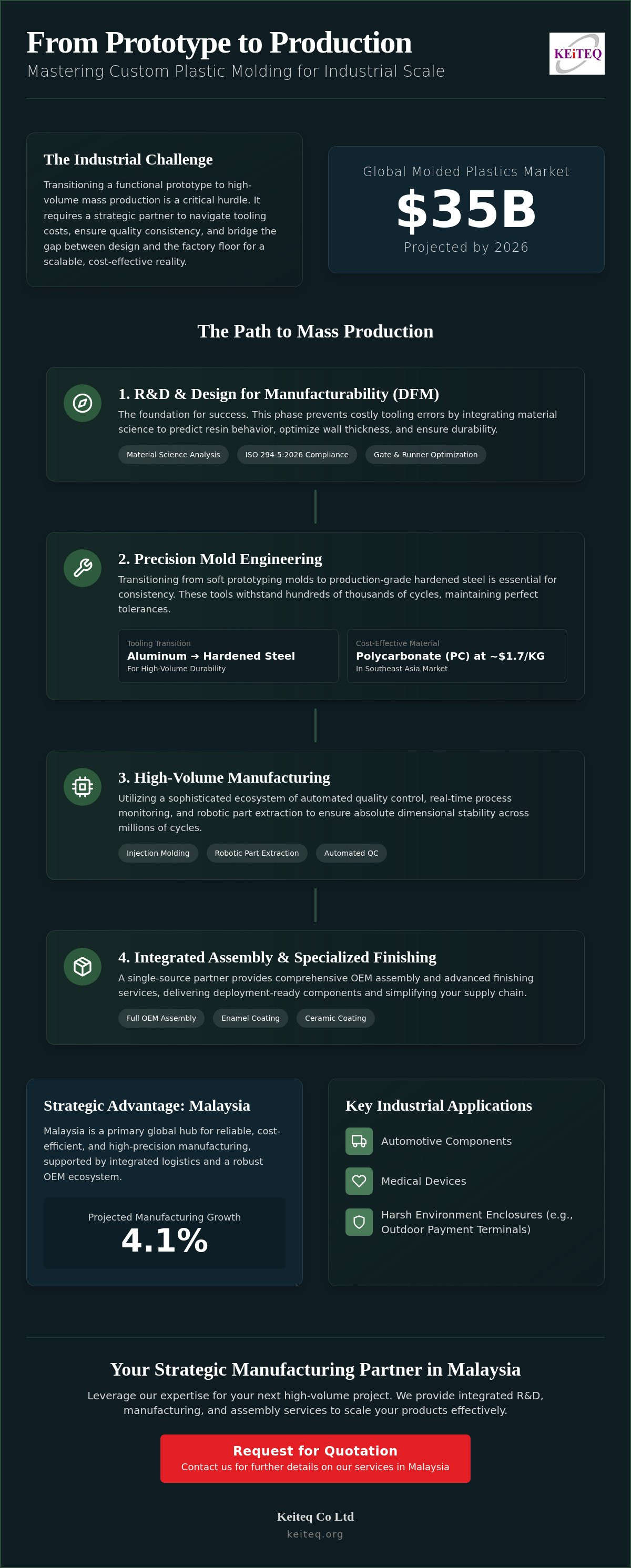
The global molded plastics market is projected to reach $35 billion by 2026, yet the path from a functional prototype to industrial mass production remains fraught with technical hurdles. You've likely experienced the financial strain of high tooling costs for complex parts or the inconsistency in quality that often plagues large-scale runs. Achieving a seamless transition in custom plastic molding requires more than just a vendor. It demands a strategic partner who understands the bridge between design and the factory floor. We'll show you how integrated manufacturing management and precise mold design can turn your prototype into a scalable, cost-effective reality.
In this guide, we'll analyze the critical role of Design-for-Manufacturability (DFM) and the impact of updated 2026 standards, such as ISO 294-5 for injection molding. We'll also explore why the Malaysian manufacturing sector, with a projected growth of 4.1% this year, has become a primary hub for reliable OEM assembly and finishing services. You'll learn how to leverage current market shifts, including the 10.1% drop in Polycarbonate prices across Southeast Asia, to reduce your per-unit expenses while maintaining rigorous quality control across every production cycle.
Table of Contents
What is Custom Plastic Molding at an Industrial Scale?
Custom plastic molding is a strategic engineering partnership for durable goods. At an industrial scale, this process goes beyond simply manufacturing parts; it involves the creation of high-volume OEM components that must maintain absolute dimensional stability across millions of cycles. Unlike rapid prototyping, which prioritizes speed, industrial-scale production focuses on the long-term lifecycle of the tool and the consistency of the output. Reliability is the primary objective for procurement officers and technical directors who cannot afford supply chain disruptions.
These same manufacturing principles of durability and consistency are fundamental when producing specialized equipment for children, where safety standards are non-negotiable; you can learn more about SoftplayToys4kids to see how precision manufacturing supports the soft play industry.
Industrial-scale molding requires more than just a standard injection press. It demands a sophisticated ecosystem of automated quality control, real-time process monitoring, and high-precision tool design. The core process of Injection moulding must be supported by advanced cooling systems and robotic part extraction to ensure cycle time optimization. In 2026, the global molded plastics market is projected to reach $35 billion, reflecting a shift toward these complex, multi-material components that standard shops simply cannot produce with the necessary accuracy.
The Role of R&D in Custom Molding
Initial research and development prevent catastrophic tooling errors that can cost thousands in late-stage revisions. By integrating material science into the design phase, engineers can predict how resins like Polypropylene or Polycarbonate will behave under specific pressures. This phase is critical for optimizing wall thickness and gate placement. You can explore our approach to these technical challenges through our Integrated Product R&D and Manufacturing services. Strategic R&D ensures that the final custom plastic molding solution is both manufacturable and durable, adhering to new standards like ISO 294-5:2026 for injection molding of plates.
Key Industrial Applications
Industrial molding serves sectors where failure isn't an option. In the automotive and medical industries, components must withstand high stress and strict regulatory scrutiny. This demand for precision extends to specialized laboratory tools; for instance, researchers who require high-quality delivery systems can visit ReadyPep to find pre-filled research pens. A prominent application includes specialized enclosures for an Outdoor Payment Terminal for Petrol Station, where the plastic must resist UV degradation and chemical exposure. These complex industrial hardware components require a synergy between plastic and metal manufacturing. By utilizing custom plastic molding alongside metal stamping, manufacturers create integrated assemblies that are ready for immediate deployment in harsh outdoor environments.
The demand for high-quality components in the medical and scientific sectors reflects a broader need for precision across all research-driven industries. For instance, when evaluating materials for biochemical studies, you can learn more about the rigorous scientific reviews required for cognitive enhancers in a research setting.
Engineering the Mold: Precision Injection Mold Design
Precision is the differentiator between a functional prototype and a commercially viable industrial product. While rapid prototyping often relies on aluminum or soft alloy molds to reduce initial lead times, true industrial scale requires a transition to production-grade hardened steel. For the earliest design iterations where speed is paramount, specialist 3D printing services from Protomolecule allow for rapid validation of part geometry before any tooling is commissioned. Aluminum molds, frequently promoted for their speed, often fail to maintain dimensional stability over high-volume runs. In contrast, custom plastic molding for mass production demands tools capable of withstanding hundreds of thousands of cycles without degrading part tolerances. This transition is essential for maintaining the consistency required in sectors like automotive and industrial hardware.
Material selection is equally critical during the design phase. Engineering decisions must account for the physical properties of thermoplastics and high-performance resins while balancing current market conditions. For instance, as of July 2026, Polycarbonate (PC) prices in Southeast Asia have stabilized at approximately US$1.7/KG, making it a cost-effective choice for high-impact components. Choosing the right resin involves analyzing shrink rates and flow characteristics to prevent warping. To ensure your project is built for long-term success, you should optimize injection mold design to align with specific material behaviors and high-volume requirements.
Design for Manufacturability (DFM)
Efficient thermal management within the mold is the primary driver for reducing cycle times. By strategically placing cooling channels, engineers can ensure uniform heat dissipation, which prevents internal stresses and reduces cooling time. Precision engineering also minimizes material waste by optimizing gate placement and runner systems, effectively reducing flash and secondary trimming costs. Draft angles must be calculated with precision; even a half-degree variance can impact the quality of high-finish surfaces or cause part ejection failures during custom plastic molding operations.
If you are currently evaluating the feasibility of a complex part design, you may contact our engineering team for a technical review of your specifications.
Tooling Material Selection
The choice between soft tooling and hardened steel depends entirely on the projected production volume and required tolerances. Soft tooling is ideal for the R&D phase, allowing for functional testing and design iterations at a lower entry cost. You can learn more about our approach to soft tooling prototyping for early-stage development. However, for mass production exceeding 100,000 cycles, hardened steel is the only reliable option. It ensures that critical dimensions remain within a few microns of the original specification, providing the stability needed for complex OEM assemblies and long-term industrial contracts.
Case Study: Scaling from Prototype to Mass Production
Scaling a custom plastic molding project requires a disciplined, three-phase approach to mitigate risk and ensure technical compliance. It begins with Phase 1, focusing on initial R&D and soft tooling for functional testing. This stage allows engineers to verify part geometry and material behavior without the heavy capital investment of hardened steel. Phase 2 introduces pilot runs, where small batches are evaluated against industrial standards to identify necessary adjustments. Finally, Phase 3 involves full-scale mass production management and logistics, moving the product into a continuous manufacturing cycle. Mass production management ensures consistent quality across millions of cycles by maintaining rigid process parameters and environmental controls.
Managing the Transition
Correcting design flaws during the prototype phase is the most cost-effective way to prevent downstream failures. Engineers often identify issues like sink marks or insufficient draft angles during these initial runs. Ensuring tool longevity requires a proactive strategy, including scheduled maintenance and real-time monitoring of wear patterns on the mold surfaces. This methodical shift is a critical component in Selecting a Plastic Injection Molding Manufacturer capable of handling the rigors of industrial scale without compromising on technical precision.
Quality Assurance in High-Volume Runs
High-volume production demands ISO-compliant inspection protocols to maintain uniformity across every batch. Statistical Process Control (SPC) is utilized to track dimensional accuracy in real-time, allowing for immediate corrections if a part drifts from its tolerance range. For example, the production of an enclosure for an Outdoor Payment Terminal for Gas Station requires extreme durability. These parts must undergo rigorous testing for impact resistance and environmental sealing to ensure they meet the technical requirements for outdoor deployment in 2026. Consistent monitoring ensures that the custom plastic molding process remains within the tight tolerances required for complex OEM assembly.
Phase 1: Validation of functional requirements using soft tooling.
Phase 2: Verification of industrial standards through pilot production batches.
Phase 3: Implementation of automated mass production with real-time quality tracking.
Strategic Advantage: Plastic Injection Molding Services in Malaysia
Malaysia has solidified its position as a primary hub for precision manufacturing, with the sector's growth projected at 4.1% in 2026. This expansion is driven by a robust electrical and electronics (E&E) cluster that demands the highest technical standards. For global OEMs, utilizing Plastic Injection Molding Services in Malaysia offers a distinct competitive edge. It's not just about labor costs; it's about a mature ecosystem that supports complex custom plastic molding requirements with industrial-grade precision. The manufacturing sales value reached RM172.7 billion in May 2026, reflecting the scale and capability of the regional infrastructure.
Keiteq’s regional footprint provides localized support for global OEMs, ensuring that technical specifications are met without the typical risks of offshore production. Our presence in the Malaysian hub allows for a steady and reassuring partnership, focusing on logistical competence and functional trust. We provide a safe pair of hands for procurement officers who require stability within their global supply chain. By choosing a partner deeply integrated into the Malaysian factory floor, you gain access to a disciplined methodology that values consistency over experimental claims.
Regional Logistics and Supply Chain Integration
Regional logistics are a core strength of the Malaysian market. The country's strategic location provides immediate access to major shipping routes and a dense network of component suppliers. This proximity reduces lead times and simplifies supply chain management for international clients. Working with a localized partner allows you to navigate the intricacies of Plastic Injection Mold Malaysia production while maintaining real-time communication. This integration is vital for maintaining lean inventory levels and responding quickly to market shifts in 2026.
If you are looking to streamline your international production, you can contact us for a technical consultation regarding your regional manufacturing needs.
Technical Expertise in the Malaysian Market
The availability of skilled engineering talent in Malaysia is a significant asset for complex hardware projects. Local engineers are well-versed in international manufacturing and environmental standards, including the mandatory Extended Producer Responsibility (EPR) schemes set for implementation in 2026. This technical depth is essential for high-value applications, such as the assembly of an Outdoor Payment Terminal for Petrol Station. Keiteq serves as a specialized Plastic and Metal Component Manufacturer, providing the synergy required for hybrid assemblies. We integrate custom plastic molding with metal stamping to deliver complete, ready-to-use industrial components that meet rigorous durability requirements.
Beyond the Mold: Integrated Assembly and Specialized Finishing
Completing a high-volume manufacturing project requires more than just a precision tool; it demands a single-source partner capable of managing the transition from a raw molded part to a finished, functional assembly. Relying on multiple vendors for different stages of production often introduces logistical delays and quality variances. By integrating custom plastic molding with downstream assembly and specialized finishing, manufacturers reduce supply chain complexity and ensure that technical standards are maintained across the entire product lifecycle. This holistic approach is particularly vital for complex hardware like an Outdoor Payment Terminal, where structural integrity must be matched by environmental resilience.
High-Performance Surface Treatments
Standard surface finishes like painting or basic plating often fail to meet the rigorous demands of industrial environments. In 2026, the industry has shifted toward more durable solutions. Ceramic coating provides extreme heat and wear resistance, maintaining the aesthetic and functional properties of components under constant physical stress. For the fuel retail sector, enamel coating offers essential protection against chemical exposure and harsh weather conditions. These specialized treatments ensure that parts produced through custom plastic molding can withstand decades of outdoor deployment. You can find detailed technical specifications in our Protective Coatings for Outdoor Electronics reference guide.
Turnkey OEM Assembly Solutions
Industrial hardware often requires the seamless integration of plastic molded parts with metal stamping and sensitive electronics. Turnkey OEM assembly eliminates the risks associated with multi-vendor coordination by providing a controlled environment for final testing and packaging. Our facilities in Malaysia are equipped to handle these complex sub-assemblies, utilizing a disciplined methodology that aligns with the recovery of the manufacturing sector, which saw a PMI of 50.7 in June 2026. This stability allows for consistent production of ready-to-use hardware. For global OEMs looking to optimize their regional production, our Electronic Manufacturing Services in Malaysia provide the technical expertise and logistical competence needed for high-stakes industrial projects.
Keiteq provides these end-to-end services directly from our Malaysian manufacturing facilities, ensuring your project benefits from regional cost-efficiencies and international quality standards. To discuss your specific technical requirements or to start your production journey in Southeast Asia, please reach out to our team.
Request for Quotation or a Request to contact us for further details regarding our integrated molding and assembly services in Malaysia.
Securing Your Industrial Production Lifecycle for 2026
Industrial success depends on a seamless transition from functional prototype to high-volume manufacturing. You've seen how strategic custom plastic molding relies on precision tool design and integrated manufacturing management to maintain quality across millions of cycles. By leveraging Malaysia's technical expertise and strategic logistics, global OEMs can achieve significant cost-efficiencies without sacrificing industrial standards. We offer end-to-end R&D to mass production services, ensuring your components meet rigorous ISO 9001:2015 requirements. Our specialization in petrol and gas station hardware provides a proven framework for durable, weather-resistant assemblies that withstand harsh environments. This integrated approach minimizes supply chain risk and guarantees a steady, reliable output for your most complex hardware needs.
For professional services within the Malaysia market, Request for Quotation or a Request to contact us for further details regarding our custom plastic molding solutions. We look forward to facilitating your next large-scale production project.
Frequently Asked Questions
What are the benefits of custom plastic molding for high-volume production?
High-volume production via custom plastic molding offers significant per-unit cost reductions and exceptional part repeatability. Once the initial tooling investment is amortized, the cost of resin and machine time becomes the primary expense. This process ensures that every component meets identical dimensional tolerances across millions of cycles. Automated systems further enhance efficiency by reducing labor overhead and minimizing the risk of human error during continuous production runs.
How long does it take to move from a prototype to a finished plastic mold?
Moving from a prototype to a finished production-grade mold typically takes between 8 to 12 weeks, depending on part complexity and material requirements. Initial R&D and soft tooling for functional testing can be completed much faster, often within 2 to 4 weeks. These early stages are essential for verifying the design before committing to hardened steel molds. In 2026, advanced CAD/CAM integration has streamlined these lead times while maintaining rigorous technical accuracy.
Can custom plastic molding be used for outdoor electronic enclosures?
Yes, custom plastic molding is highly effective for outdoor electronic enclosures, provided the correct high-performance resins are selected. Materials like Polycarbonate or UV-stabilized ABS are used to resist degradation from sunlight and extreme temperatures. When combined with specialized finishes like ceramic or enamel coatings, these enclosures provide superior protection for sensitive hardware. This is standard practice for components used in an Outdoor Payment Terminal for Petrol Station.
What is the difference between soft tooling and hard tooling in plastic molding?
Soft tooling typically utilizes aluminum or soft alloys and is designed for the R&D phase or low-volume runs up to a few thousand parts. It offers faster lead times and lower initial costs but lacks the durability for mass production. Hard tooling uses hardened steel, which is capable of withstanding hundreds of thousands of cycles. While hard tooling requires a higher upfront investment, it ensures long-term dimensional stability for industrial-scale manufacturing.
Why should I choose plastic injection molding services in Malaysia?
Choosing plastic injection molding services in Malaysia provides access to a mature manufacturing ecosystem with a projected growth of 4.1% in 2026. The region is a global hub for the electrical and electronics sector, offering a skilled engineering workforce and integrated supply chains. Logistics are simplified through proximity to major shipping routes. This allows global OEMs to achieve cost-efficiencies in labor and overhead without compromising on international quality or environmental standards.
How does Keiteq ensure quality control for custom molded parts?
Quality control is maintained through a combination of ISO 9001:2015 compliant protocols and real-time Statistical Process Control (SPC). Every production run is monitored for dimensional accuracy and structural integrity to ensure compliance with technical specifications. Automated inspection systems detect defects early in the cycle, preventing waste. This disciplined methodology provides a steady and reassuring presence for procurement officers who require absolute consistency across large-scale industrial contracts.
What specialized finishes are available for custom plastic parts?
Specialized finishes include enamel, ceramic, and powder coatings, which are essential for hardware deployed in harsh environments. Enamel coating provides a chemically resistant barrier, making it ideal for fuel retail applications. Ceramic coating offers extreme heat and wear resistance for high-stress industrial parts. These treatments are applied after the molding process is complete to enhance the physical durability and aesthetic longevity of the final OEM assembly.
Is custom plastic molding cost-effective for small production runs?
Custom plastic molding can be cost-effective for small production runs if soft tooling is utilized during the development phase. Soft tooling reduces the initial capital expenditure, allowing for functional testing and pilot batches without the cost of a full production-grade steel mold. However, for extremely low quantities, machining or high-end 3D printing may be more viable; for creative examples of specialized 3D-printed items and gifts, you can explore 2d6.co.uk. We recommend a technical consultation to determine the most efficient manufacturing path based on your specific volume requirements and projected part lifecycle.


Comments