
Turnkey Manufacturing Solutions: A Strategic Guide to Industrial Success in 2026
Updated: Aug 4
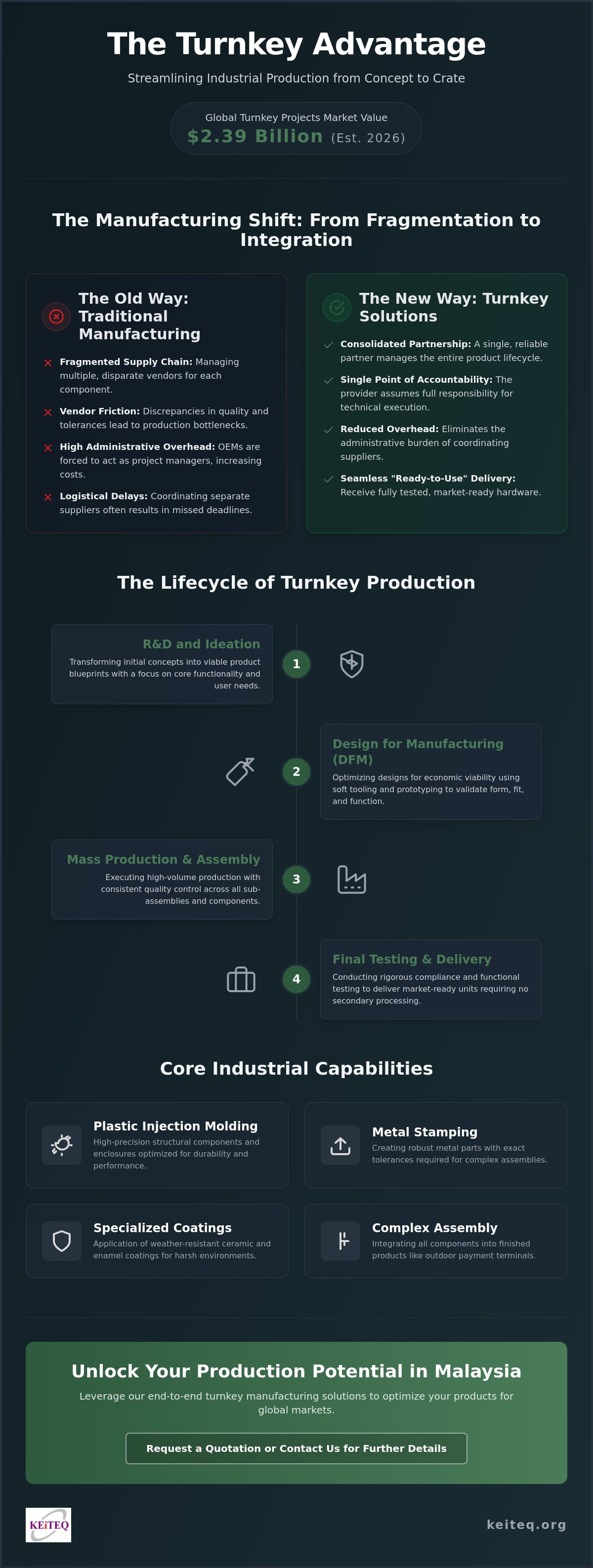
The global turnkey projects market is estimated to be valued at $2.39 billion in 2026, reflecting a massive shift toward consolidated industrial partnerships. For many procurement officers, the traditional model of managing multiple vendors for plastic molding, metal stamping, and assembly has become a liability rather than an asset. Integrating turnkey manufacturing solutions allows your organization to eliminate the friction between initial design and final delivery. This approach provides a steady, disciplined framework for complex assemblies; it ensures that technical specifications remain consistent from the first prototype to the final shipping container.
You've likely experienced how supply chain fragmentation leads to logistical delays and quality gaps that erode your bottom line. Industrial success requires more than just production. It demands a reliable partner that can navigate the practical realities of the factory floor with precision. This guide will demonstrate how turnkey manufacturing streamlines the journey from initial R&D to mass production through a single, reliable industrial partner. You'll discover the strategic advantages of lower overhead costs, faster time-to-market, and the precise execution required for high-stakes projects like outdoor payment terminal assembly.
Table of Contents
Defining Turnkey Manufacturing Solutions in 2026
In the industrial sector of 2026, efficiency is measured by the consolidation of responsibility. A turnkey project represents a comprehensive agreement where a single partner manages the entire lifecycle of a product, from initial ideation and R&D to final assembly. This model eliminates the logistical fragmentation that typically plagues complex hardware development. By utilizing turnkey manufacturing solutions, Original Equipment Manufacturers (OEMs) can bypass the administrative burden of coordinating disparate suppliers. The provider assumes full accountability for technical execution; they ensure that the transition from a digital design to a physical unit is seamless and technically accurate.
The "Ready-to-Use" concept is the defining characteristic of modern turnkey production. It shifts the focus from producing individual components to delivering fully tested, market-ready hardware. In 2026, this involves rigorous compliance checks and functional testing before the product ever leaves the factory floor. For a procurement officer, this means receiving a finished unit that requires no additional integration or secondary processing. It's a results-oriented approach that prioritizes immediate deployment over modular assembly. This methodology ensures that the final assembly meets every operational requirement from day one.
Turnkey vs. Traditional Contract Manufacturing
Traditional contract manufacturing often forces OEMs to act as their own project managers. You might source plastic enclosures from one vendor, metal components from another, and electronics from a third. This creates "vendor friction," where discrepancies in tolerances or quality standards lead to production bottlenecks. Turnkey providers solve this by taking responsibility for sourcing raw materials, managing quality control across all sub-assemblies, and executing the final build. This model is the preferred choice for complex industrial hardware. It provides a single point of contact, which drastically reduces administrative overhead and simplifies the reporting process; similarly, using tools like flowgres.pl can help small and medium enterprises streamline their internal sales and budget reporting.
The "Safe Pair of Hands" Philosophy in Production
Reliability is the core metric when evaluating an industrial partner. A "Safe Pair of Hands" philosophy means that your provider possesses the technical depth to navigate the practical realities of the factory floor without constant oversight. Industrial expertise isn't just about owning equipment; it's about logistical competence and stability within a global supply chain. This consolidated approach allows for a steady, disciplined production rhythm. It reduces the risk of quality discrepancies between prototypes and mass production, positioning the manufacturer as a dependable pillar for your business operations. When a single partner understands every technical detail of your assembly, the results are consistent and predictable.
The Lifecycle of Turnkey Production: From R&D to Mass Production
Successful industrial execution depends on a structured progression from concept to crate. Utilizing turnkey manufacturing solutions allows engineers to synchronize design intent with factory floor capabilities from the earliest stages of development. This lifecycle is not a linear path but a series of validated gates that ensure technical stability. By integrating R&D with production management, manufacturers can identify potential bottlenecks before they impact the bottom line. This end-to-end oversight ensures that every component is optimized for its specific role within the final assembly.
Bridging the Gap: Design for Manufacturing (DFM)
Design for Manufacturing (DFM) is the technical filter that ensures a product is economically viable. Creative concepts often fail during scale-up if they don't account for draft angles in plastic molding or specific bend radii in metal stamping. Implementing soft tooling prototyping allows for the validation of form, fit, and function without the capital investment of permanent molds. Research in modern turnkey manufacturing systems highlights that early design precision reduces material waste and energy consumption. This phase is critical for reducing the overall carbon footprint of the production cycle while maintaining high procedural accuracy.
Managing the Prototype to Mass Production Transition
The shift from validation to volume is where most industrial projects face their greatest risks. Scaling production requires a transition from soft tooling to durable hard tooling capable of maintaining tight component tolerances across thousands of units. Turnkey manufacturing solutions provide the necessary discipline to manage this ramp-up phase through established quality gates. These protocols verify that the mass-produced units match the performance metrics of the initial prototypes. If you're planning a complex industrial rollout, you can contact our technical team for a briefing on how to stabilize this transition.
The turnkey lifecycle is generally categorized into four distinct phases:
Phase 1: Initial Product R&D and Industrial Design focused on mass manufacturability.
Phase 2: Prototyping and soft tooling to validate the engineering of enclosures and internal structures.
Phase 3: Hard tooling development and mass production management to ensure consistent quality at scale.
Phase 4: Final OEM assembly, functional testing, and logistical deployment to the end market.
This methodical approach ensures that the final product is not just a collection of parts, but a cohesive, high-performance system. By maintaining a single point of accountability throughout these phases, manufacturers can achieve a faster time-to-market while reducing the administrative burden on their internal teams. Precision engineering at the design stage remains the most effective way to ensure long-term industrial success.
Beyond the factory floor, precision engineering also plays a vital role in the health and efficiency of the workforce; to see how ergonomic furniture can enhance your professional environment, visit EKOBOR.
Core Industrial Capabilities: Plastic, Metal, and Specialized Coatings
Industrial hardware requires a sophisticated multi-material approach to meet the rigorous demands of the 2026 market. Reliability in turnkey manufacturing solutions stems from the ability to control diverse production processes under a single technical framework. This integration involves the high-precision world of polymers and the high-strength requirements of metallurgy. By managing both plastic and metal production within a unified facility, manufacturers can eliminate the tolerance stacking issues that often occur when components are sourced from multiple specialized vendors. This synergy is essential for creating complex assemblies that are both physically durable and procedurally accurate.
Precision plastic injection molding services in Malaysia serve as the primary method for producing durable equipment enclosures. These processes allow for intricate internal geometries that secure sensitive electronics while providing a robust external shell. When these plastic components are integrated with structural metal elements, the resulting assembly benefits from both lightweight design and mechanical rigidity. A "Safe Pair of Hands" partner understands how to balance these material properties to ensure the final product survives the practical realities of the factory floor and the end-user environment alike.
Advanced Finishing: Enamel, Ceramic, and Powder Coatings
Surface finishing is a critical differentiator for product longevity, especially for hardware deployed in harsh conditions. Enamel and ceramic coatings provide a chemically bonded layer that resists high heat and corrosive environments. These specialized finishes are not merely aesthetic; they are functional barriers that prevent premature material failure. Powder coating remains a staple for industrial hardware due to its physical durability and aesthetic versatility. Within the turnkey process, applying these finishes in-house ensures that quality control standards remain consistent across the entire production run. This level of oversight is vital for outdoor hardware that must maintain its structural integrity over years of service.
Precision Metal Stamping and Diecasting
Structural integrity is often achieved through high-volume metal stamping and diecasting using aluminium or zinc. Aluminium and zinc diecasting enable the production of intricate, high-strength parts that offer superior thermal conductivity compared to plastics. Metal stamping supports the high-speed production of structural components, allowing for rapid scaling of assembly lines without a loss in precision. The ability to execute these processes in tandem with molding services provides a strategic advantage. It creates a seamless transition between different stages of the build, ensuring that every sub-assembly fits perfectly within the final industrial unit. This comprehensive capability is what defines a truly integrated manufacturing partner.
This commitment to structural integrity is a universal requirement in high-stakes engineering. For example, in the transport sector, ensuring that vehicles can safely manage increased loads requires expert GVM and GCM upgrades Darwin to maintain both mechanical reliability and legal certification.
Strategic Advantages of Consolidating Your Supply Chain
Consolidating the industrial supply chain is a strategic necessity for maintaining a competitive edge in 2026. Fragmented models rely on multiple vendors, which inevitably leads to uncoordinated quality standards. This leads to friction. By utilizing turnkey manufacturing solutions, OEMs establish a single point of accountability for the entire production lifecycle. This transition removes hand-off delays between design teams and the factory floor. It results in a faster time-to-market. Centralized management ensures that technical specifications are interpreted consistently across every sub-assembly.
Cost efficiency is a primary driver for this consolidation. A single-source partner achieves economies of scale in raw material procurement and logistics that individual specialized vendors cannot match. Centralized inspection and testing protocols enhance quality control. They ensure that every unit meets rigorous performance metrics before shipment. This disciplined approach reduces the administrative overhead associated with managing dozens of separate contracts and invoices. It allows your internal team to focus on market strategy rather than chasing production updates across different time zones, while ensuring that the resulting cost savings are maximized through the financial expertise of KHT Accounting & Wealth.
Risk Mitigation and Supply Chain Resilience
Turnkey solutions provide a robust defense against global supply chain disruptions. Managing production through one integrated partner enables better traceability and compliance through centralized data management. This is vital in 2026 as regulatory standards for industrial hardware continue to tighten. Working with a steady partner reduces the risk of intellectual property leakage. Your designs and proprietary processes remain within a secure, controlled environment rather than being distributed across multiple third-party facilities. This stability is essential for maintaining long-term industrial success.
Why Malaysia is the Strategic Choice for Global OEMs
Malaysia has emerged as a premier hub for industrial production in Southeast Asia. It offers a cost-effective alternative to traditional manufacturing hubs. It provides access to high-tier electronic manufacturing services in Malaysia and highly skilled engineering. The region's strategic geographic location facilitates efficient global distribution and logistics. Keiteq Co Ltd leverages this infrastructure to maintain high production standards without the inflated overhead of Western facilities. If you're looking to optimize your regional production, contact us for a consultation on our Malaysian industrial capabilities.
Implementing Turnkey Solutions for Outdoor Payment Terminals
The assembly of outdoor payment terminals represents the most demanding application of turnkey manufacturing solutions in 2026. These units are the ultimate test of industrial integration. They require the seamless combination of high-precision electronics, structural metal enclosures, and specialized weather-resistant finishes. For the fuel and gas retail sector, these terminals must function as unattended kiosks in environments that are often hostile to sensitive hardware. Managing this complexity through a single industrial partner ensures that the mechanical tolerances of the metal stamping align perfectly with the delicate requirements of the internal electronic components.
Durability is the primary metric for outdoor hardware. Every unit must undergo rigorous testing for resilience against UV radiation, moisture ingress, and extreme temperature fluctuations. In 2026, manufacturers must also adhere to updated security certifications, including standards for Secure Key Injection (SKI) to protect encryption keys during the production process. A turnkey approach allows for these security protocols to be integrated directly into the assembly line. This centralized oversight eliminates the risk of security gaps that can occur when hardware and software components are handled by separate, uncoordinated vendors. For organizations managing critical infrastructure, specialists such as otsec.co.uk can provide the necessary cyber security consultancy to safeguard these complex operational technology environments.
Engineering for the Fuel Retail Environment
Unattended payment kiosks in gas stations face specific operational requirements that go beyond standard industrial enclosures. They must be physically durable to prevent tampering while remaining accessible for user interaction. Managing the integration of payment hardware and security components requires a deep-seated familiarity with the fuel retail environment. Quality assurance protocols focus on long-term outdoor deployment; they ensure that the ceramic or enamel coatings discussed in previous sections provide the necessary barrier against corrosive fuel vapors and environmental wear. This level of specialized engineering is what separates a standard assembly service from a true turnkey industrial partner.
Your Turnkey Partner for Malaysia and Beyond
Leveraging specialized assembly lines in Malaysia provides global OEMs with a strategic advantage in both cost and technical execution. Keiteq Co Ltd facilities are designed to handle the intricate requirements of outdoor payment terminal assembly for the global fuel retail sector. Our local expertise in Malaysia facilitates efficient regional distribution while maintaining the high standards required for international markets. Consolidating your production with a proven industrial expert reduces the risk of quality discrepancies and ensures a steady, disciplined supply chain. It's the most reliable way to achieve industrial success in an increasingly complex global market.
Keiteq Co Ltd provides a comprehensive range of industrial services, including plastic injection molding, metal stamping, and specialized assembly from our facilities in Malaysia. To explore how our integrated approach can stabilize your production and reduce overhead costs, please reach out to our technical directors.
Request for Quotation or a Request to contact us for further details regarding our specialized manufacturing and assembly services in Malaysia.
Advancing Industrial Competitiveness Through Strategic Integration
Industrial success in 2026 is defined by the move toward consolidated, disciplined production. The shift from fragmented procurement to integrated execution eliminates the quality gaps and logistical friction that often compromise complex hardware. By leveraging high-performance enamel and ceramic coating capabilities alongside precision R&D, manufacturers ensure their products survive the most demanding outdoor environments. These technical synergies are essential for maintaining the structural integrity and functional reliability of your assemblies; to stay ahead of these trends, you can learn more about Construction Technology ConFeX KSA and its focus on the digital and sustainable transformation of the built environment.
Keiteq Co Ltd operates full-service R&D and mass production facilities in Malaysia; we are recognized specialists in outdoor payment terminal assembly for the fuel retail sector. Integrating these technical disciplines into your business strategy through turnkey manufacturing solutions provides the stability required for predictable global distribution. Our methodology prioritizes functional trust and procedural accuracy, positioning us as a steady pillar within your global supply chain. This results-oriented approach ensures that every unit meets rigorous industrial standards before leaving the factory floor.
We invite you to experience the reliability of a single-source industrial partner. For professional turnkey manufacturing solutions in Malaysia, Request for Quotation or Request to contact us for further details. We look forward to stabilizing your production journey and supporting your long-term growth.
Frequently Asked Questions
What exactly is included in a turnkey manufacturing solution?
A comprehensive turnkey solution includes every stage of the product lifecycle from initial R&D and industrial design to final mass production. It encompasses technical services such as plastic injection molding, metal stamping, and specialized surface finishing. The provider takes full responsibility for sourcing raw materials and managing the sub-assembly of complex components. This integrated approach ensures that you receive a fully tested, market-ready unit without the need for additional processing.
How does turnkey manufacturing reduce overall production costs?
Turnkey manufacturing solutions reduce costs by consolidating your supply chain and eliminating the administrative overhead of managing multiple vendors. You benefit from economies of scale in raw material procurement and logistics through a single industrial partner. By removing hand-off delays between design and the factory floor, you also minimize the risk of expensive technical errors. This streamlined model lowers overhead while accelerating your product's time-to-market.
Is turnkey manufacturing suitable for small-scale prototyping?
Yes, turnkey providers utilize prototyping and soft tooling to validate designs before committing to high-volume hard tooling. This phase is essential for identifying potential flaws in form, fit, or function at an early stage. It allows for functional testing without the capital investment required for mass production molds. This flexibility is critical for OEMs that need to refine their hardware before a full industrial rollout.
How do I choose the right turnkey manufacturing partner in Malaysia?
Choosing the right partner in Malaysia requires evaluating their technical depth in both plastic and metal production. Prioritize manufacturers with established assembly lines for complex hardware and specialized finishing capabilities like ceramic or enamel coating. A "Safe Pair of Hands" partner should demonstrate a clear understanding of global distribution and regional compliance standards. Stability and logistical competence are the primary metrics for evaluating a partner's reliability.
What industries benefit most from turnkey industrial solutions?
The fuel retail sector benefits significantly from these solutions, particularly for the assembly of outdoor payment terminals. Other industries include industrial hardware, medical devices, and complex electronics where physical durability is a non-negotiable requirement. Any sector requiring the integration of diverse materials and specialized surface finishes will find the turnkey model advantageous. It provides the necessary discipline for high-stakes, unattended hardware deployments.
Can I still own my IP when using a turnkey manufacturer?
Your intellectual property remains fully protected under a turnkey agreement. Working with a single provider reduces the risk of IP leakage because your designs aren't distributed across multiple third-party facilities. Reliable manufacturers use centralized data management to ensure that your proprietary processes and technical specifications remain secure. This centralized model provides a more controlled and disciplined environment for your sensitive industrial data.
What is the typical timeline for a turnkey project from design to mass production?
The timeline varies based on project complexity but generally moves through four distinct phases: R&D, prototyping, tooling, and mass production. Initial design and prototyping may take several weeks; hard tooling and ramp-up can extend over a few months. Consolidating these phases under one partner eliminates the delays associated with vendor transitions. This integrated approach ensures a steady and predictable progression toward your market launch date.
How does Keiteq Co Ltd ensure quality across different manufacturing processes?
Keiteq Co Ltd ensures quality through centralized inspection and functional testing protocols across every sub-assembly. We maintain strict adherence to industrial standards for complex hardware, ensuring that the mechanical tolerances of metal components align with the requirements of internal electronics. Our expertise allows us to maintain tight tolerances across diverse manufacturing processes. This disciplined oversight ensures that every unit meets the performance metrics required for long-term industrial deployment.
Keiteq Co Ltd provides a comprehensive range of industrial services from our facilities in Malaysia. For professional manufacturing support, please Request for Quotation or a Request to contact us for further details regarding our regional offerings.


Comments