
Precision Zinc Die Casting for Industrial OEMs: 2026 Guide
The survival of an industrial component in the field is determined months before the first metal is poured. For many industrial OEMs, the transition from a complex R&D prototype to durable mass production is where projects lose momentum. You likely understand the frustration of receiving parts that fail in harsh outdoor environments or dealing with inconsistent quality from a fragmented supply chain. Utilizing specialized zinc die casting services provides the precision necessary to maintain intricate details while ensuring structural integrity across thousands of units. Relying on multiple vendors for casting and finishing often leads to long lead times and assembly errors that jeopardize your production schedule.
This 2026 guide demonstrates how integrated manufacturing bridges the gap between engineering theory and functional reality. You'll discover how a unified approach to design and production ensures that tight tolerances remain consistent during large-scale manufacturing. We'll examine the strategic advantages of single-source accountability, specifically how combining precision casting with advanced coating technologies reduces assembly steps. This article provides a technical roadmap for sourcing components that meet strict durability standards while maintaining the logistical stability your global supply chain requires.
Table of Contents
What Are Zinc Die Casting Services and Why Do They Matter for Industrial OEMs?
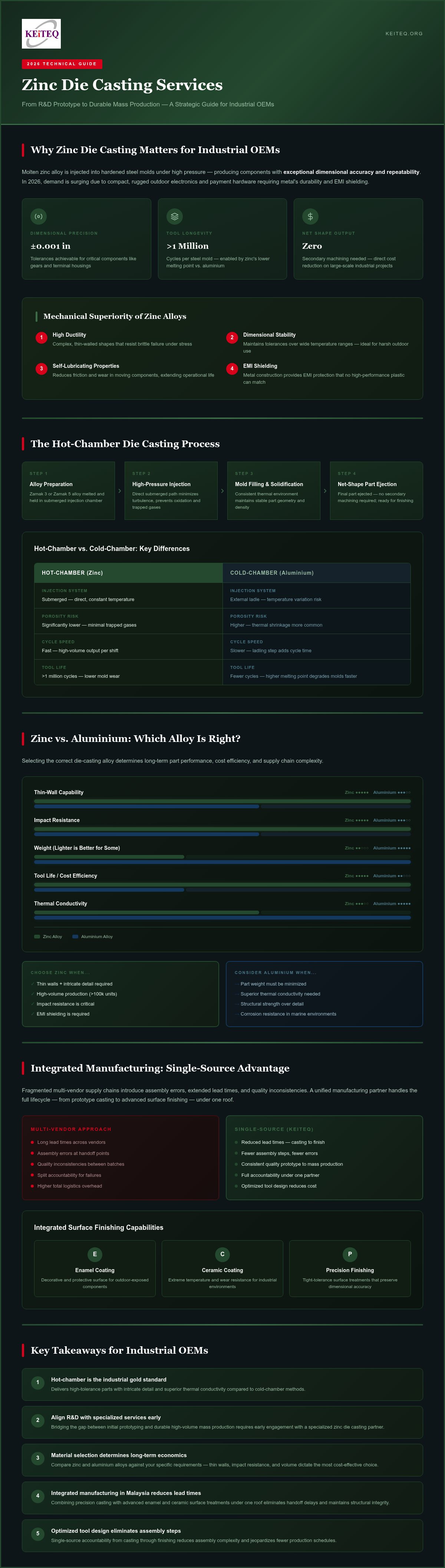
Zinc die casting services involve a precision manufacturing process where molten zinc alloy is injected into hardened steel molds under high pressure. This technique produces components with exceptional dimensional accuracy and repeatability. For industrial OEMs, this is not merely a production method; it's a strategic choice for high-performance applications. In 2026, the demand for zinc is surging due to the proliferation of compact, high-performance outdoor electronics and rugged payment hardware. These devices require the physical durability and EMI shielding that only metal can provide. Procurement officers typically choose between "Build-to-Print" models, where the vendor simply executes a drawing, and "Design-Integrated" models. The latter involves bridging the gap between initial R&D and mass production to ensure long-term component reliability.
The choice of a production partner in Malaysia often hinges on their ability to manage complex assemblies. High-performance components, such as those used in outdoor payment terminals, require a synergy between the casting process and specialized surface finishing. By integrating these services under one roof, OEMs reduce the risks associated with multi-vendor supply chains. This integrated approach ensures that the structural integrity of the part is maintained from the first prototype to the final mass-produced unit.
The Mechanical Superiority of Zinc Alloys
Zinc alloys offer a level of ductility that is rare among die-cast metals. This allows engineers to design complex, thin-walled shapes that resist brittle failure under stress. Unlike many high-performance plastics, zinc maintains its dimensional stability over a wide temperature range. This makes it ideal for harsh outdoor environments. Additionally, zinc’s natural self-lubricating properties reduce friction and wear in moving industrial components. This characteristic extends the operational life of the final assembly and reduces maintenance requirements for the end user.
Economic Benefits of High-Volume Zinc Casting
The economic case for zinc is built on speed and durability. Zinc has a lower melting point than aluminium, which significantly extends the life of the steel molds. It's common for a single tool to exceed 1 million cycles before requiring replacement. Fast cycle times allow for high-volume output with lower unit costs. Because the process achieves "net shape" precision, the need for secondary machining is often eliminated. This streamlines the supply chain and ensures that zinc die casting services remain a cost-effective solution for large-scale industrial projects.
The Zinc Die Casting Process: Engineering for Intricate Complexity
Engineering for industrial OEMs requires more than just pouring metal into a mold. High-precision zinc die casting services rely on the hot-chamber process to deliver components that meet the rigorous mechanical standards of 2026. In this setup, the injection mechanism is submerged directly in the molten zinc alloy. This proximity allows for rapid, high-pressure injection and minimizes the exposure of the alloy to ambient air, preventing oxidation. By utilizing high-grade alloys like Zamak 3 or Zamak 5, manufacturers can ensure that the finished parts deliver the necessary impact strength for heavy-duty applications. Critical components, such as internal gears or payment terminal housings, often demand tolerances as tight as +/- 0.001 inch. Achieving this level of accuracy consistently requires a stable thermal environment and sophisticated control over injection speeds.
Hot-Chamber vs. Cold-Chamber Casting
Hot-chamber casting is the preferred method for zinc because it minimizes metal turbulence by maintaining a direct, submerged path for the alloy. Unlike cold-chamber methods used for aluminium, the hot-chamber system allows the metal to stay at a constant temperature until the moment of injection. This reduces the risk of trapped gases and thermal shrinkage, which translates to significantly lower porosity in the final part. These zinc die casting services provide the structural density essential for components that must withstand high impact or mechanical stress in industrial environments.
Tooling Design and Mold Longevity
Effective tooling design begins with rigorous DFM (Design for Manufacturing) protocols. This involves optimizing draft angles, gating systems, and wall thicknesses before the first mold is ever cut. Keiteq manages tool maintenance through methodical inspection and cleaning cycles to ensure consistency across 100k+ units. Precision mold design prevents flash and reduces material waste by ensuring perfect alignment during the high-pressure injection cycle. This disciplined approach to tooling ensures that every part meets the reliability standards and logistical consistency that global OEMs expect.
Transitioning from design to production involves a structured validation process. Before committing to hardened steel production molds, many OEMs utilize soft tooling prototyping for early-stage R&D validation. This step allows for functional testing and design adjustments using the actual production material, providing a realistic assessment of the part's performance in real-world scenarios. It's a vital phase for ensuring the final product performs as intended in harsh outdoor conditions or high-cycle industrial applications.
If you're looking to refine your component specifications for a high-volume rollout, you can consult with our technical directors in Malaysia to discuss your specific project requirements.
Zinc vs. Aluminium: Selecting the Right Die Casting Alloy
Selecting the optimal alloy for industrial components requires a balance between mechanical performance and logistical efficiency. While aluminium is frequently cited for its low density, the density of zinc is often offset by its superior fluidity during the casting process. This fluidity allows engineers to design parts with significantly thinner walls than those achievable with aluminium. In many high-precision applications, a thin-walled zinc component provides the same structural integrity as a bulkier aluminium part while maintaining a comparable final weight. Utilizing professional zinc die casting services ensures that these complex geometries are executed without compromising the part's durability or increasing its footprint.
Zinc also serves as a superior substrate for high-performance protective coatings. While aluminium naturally forms a protective oxide layer, it is often more difficult to plate or coat for extreme outdoor use. Zinc’s surface chemistry is highly compatible with advanced finishes such as enamel, ceramic, and powder coating. These treatments are essential for components exposed to harsh weather or corrosive industrial environments. For procurement directors evaluating a broader range of metal solutions, referencing an aluminium diecasting manufacturer provides the necessary comparative context for large-scale material selection.
Mechanical Property Comparison
Zamak alloys generally exhibit higher tensile strength, yield strength, and hardness compared to standard A380 aluminium. This mechanical superiority is particularly evident in impact toughness. Zinc alloys absorb more energy before failure, making them the gold standard for security-critical enclosures like outdoor payment terminals. While aluminium offers slightly better thermal conductivity for high-heat dissipation, zinc’s ability to be cast into intricate, high-surface-area shapes makes it an effective choice for specialized heat-sink applications where space is at a premium. The dimensional stability of zinc ensures that these critical tolerances don't shift over the component's operational lifecycle.
Total Cost of Ownership (TCO) Analysis
Evaluating the total cost of ownership involves looking beyond the raw material price per kilogram. Zinc’s lower melting point extends tool life significantly, often allowing a single hardened steel mold to exceed 1 million cycles. In contrast, aluminium molds typically require replacement or major refurbishment after 100,000 cycles. Fast cycle times in hot-chamber casting further reduce unit costs during mass production. By eliminating secondary machining through "net shape" precision and utilizing integrated coating services in Malaysia, OEMs can achieve a lower landed cost per unit. Additionally, zinc is 100% recyclable, supporting corporate sustainability goals without sacrificing the physical performance of the industrial assembly.
From Design to Mass Production: Managing the Lifecycle
Managing the lifecycle of a component from initial concept to high-volume output requires a disciplined integration of engineering and production. Successful zinc die casting services don't start at the injection machine. They begin in the R&D phase where potential casting defects are identified and mitigated through simulation and design refinement. This proactive approach prevents costly downstream issues such as porosity or incomplete fill. As the design matures, transitioning from soft tooling prototypes to hardened steel production molds ensures that the structural integrity validated during testing is maintained throughout millions of cycles. This transition is a critical juncture where logistical competence determines the project's long-term viability.
Industrial compliance demands rigorous quality control protocols that go beyond visual inspection. Implementation of Coordinate Measuring Machine (CMM) inspection allows for micron-level verification of critical dimensions against the original CAD model. Pressure testing is equally vital for components like outdoor enclosures to ensure they remain hermetically sealed against environmental ingress. These steps are non-negotiable for achieving zero-defect targets in high-stakes industries where component failure is not an option. Centralizing these processes within a single manufacturing hub minimizes the risks associated with a fragmented supply chain.
Design for Manufacturing (DFM) for Zinc
Optimizing draft angles and wall thicknesses is essential to ensure clean part ejection and minimize cycle times. By integrating features like bosses and ribs directly into the cast, OEMs can significantly reduce the complexity of subsequent OEM assembly. This consolidation of parts simplifies the bill of materials and strengthens the overall assembly. Design for Manufacturing (DFM) is the bridge between engineering theory and factory-floor reality.
Scaling Production for Global OEMs
Scaling production for global OEMs involves more than just increasing machine hours. It requires a centralized manufacturing hub in Malaysia that operates under ISO-certified quality management systems. Keiteq manages this transition from initial design through to final outdoor payment terminal assembly. This dual-country support model combines regional manufacturing efficiency with US-focused global standards. The logistics of managing international distribution from Malaysia ensure that high-tolerance parts reach their destination without the delays common in less integrated supply chains.
If your project requires a seamless transition from prototype to mass production, Request to contact us for further details about our integrated lifecycle management.
Keiteq's Integrated Zinc Die Casting and Finishing in Malaysia
Malaysia has emerged as a strategic corridor for industrial OEMs seeking a balance of high-tech infrastructure and logistical efficiency. By 2026, the region's manufacturing landscape has matured into a primary hub for Western brands that require US-focused global standards within Southeast Asia. Keiteq leverages this regional strength to provide comprehensive zinc die casting services that consolidate design, casting, and advanced finishing under one roof. This centralized model eliminates the logistical risks and quality inconsistencies inherent in fragmented supply chains. Operating as a global facilitator, we manage the complexities of international production, ensuring that high-precision components are delivered with the stability and professional oversight that procurement officers demand.
High-Performance Coating Solutions
Standard industrial finishes often fall short in extreme environments. Components like outdoor payment terminals at petrol stations face constant exposure to volatile fuels, abrasive salt spray, and intense UV radiation. To address these challenges, we provide specialized ceramic coating industrial solutions that deliver exceptional heat resistance and chemical stability. For hardware requiring maximum surface hardness, enamel coating serves as a "safe pair of hands" to prevent corrosion in the harshest climates. We also offer industrial powder coating for projects that require a specific aesthetic balance without compromising physical protection. These integrated finishing capabilities ensure the zinc substrate remains functional throughout its intended lifecycle.
Regional Manufacturing Excellence in Malaysia
The manufacturing infrastructure in Malaysia supports complex, multi-material assemblies that go beyond simple casting. Keiteq's facility complements its metal expertise with plastic injection molding services in Malaysia, allowing for the production of hybrid industrial components. This dual capability is essential for OEMs that need to integrate metal housings with internal plastic carriers or aesthetic bezels. Our skilled labor force and ISO-certified management systems ensure that every part meets the rigorous tolerances defined during the R&D phase. By maintaining single-source responsibility from initial design to final assembly and coating, we reduce lead times and ensure that mass-produced units mirror the precision of the original prototype.
If you are looking to secure a reliable production partner for your high-performance industrial components, you can Request for Quotation or Request to contact us for further details regarding our integrated manufacturing services in Malaysia.
Optimizing Your Industrial Supply Chain for 2026
Industrial success depends on the seamless integration of engineering precision and logistical stability. Transitioning from complex R&D to durable mass production requires a partner that maintains accountability across every stage of the component lifecycle. By utilizing specialized zinc die casting services, OEMs can achieve the high-tolerance parts and intricate details necessary for high-performance components. This approach eliminates the inconsistencies of multi-vendor sourcing and ensures your hardware survives demanding outdoor environments. Keiteq provides end-to-end R&D to mass production support through our ISO 9001:2015 Certified Systems. We're specialized in outdoor payment terminal hardware, delivering the physical durability and procedural accuracy required for global deployment. Our facility in Malaysia serves as a centralized hub for precision casting and high-performance coating, providing a stable foundation for your production rollout.
For high-precision industrial components manufactured in Malaysia, please Request for Quotation or Request to contact us for further details regarding our integrated manufacturing solutions. We look forward to supporting your next project with consistency and expertise.
Frequently Asked Questions
What are the primary benefits of zinc die casting services for industrial parts?
Zinc die casting services provide superior thin-wall capability and high impact strength for critical industrial components. Unlike other metals, zinc allows for the creation of intricate, complex geometries with tight tolerances of +/- 0.001 inch. This precision reduces the need for secondary machining, which streamlines the production cycle. Additionally, zinc's lower melting point significantly extends tool life, often exceeding one million cycles, making it a highly reliable choice for long-term mass production projects.
How does zinc die casting compare to plastic injection molding in terms of durability?
Zinc die casting offers significantly higher physical durability and impact resistance compared to plastic injection molding. While high-performance plastics are lightweight, they often lack the dimensional stability and structural integrity required for heavy-duty industrial use. Zinc components resist brittle failure and maintain their shape across extreme temperature fluctuations. For outdoor hardware exposed to mechanical stress, metal substrates provide the necessary security and longevity that plastic materials don't match in high-wear environments.
What is the typical lead time for a custom zinc die cast project in Malaysia?
Lead times for custom zinc die casting projects in Malaysia are determined by the complexity of the initial R&D and the type of tooling required. The process typically moves from design validation and soft tooling prototyping to the fabrication of hardened steel production molds. By centralizing our zinc die casting services within a single facility, we minimize the delays associated with multi-vendor coordination. This integrated approach ensures a steady transition into mass production while maintaining strict adherence to global delivery schedules.
Can zinc die cast components be used in outdoor or high-heat environments?
Yes, zinc die cast components are exceptionally well-suited for outdoor and high-heat environments when paired with specialized surface treatments. Zinc naturally possesses high thermal conductivity, which is ideal for heat-dissipation applications. To protect against fuel exposure, salt spray, and UV radiation, we apply high-performance ceramic or enamel coatings. These finishes ensure that the underlying metal remains structurally sound and corrosion-resistant, even in the demanding conditions found at petrol and gas stations.
What types of surface finishes are available for zinc die cast parts?
Keiteq provides a comprehensive range of advanced surface finishes designed for extreme industrial durability. Our primary offerings include enamel coating for harsh-environment hardware, ceramic coating for superior heat resistance, and industrial powder coating for a balanced aesthetic and protective layer. These finishes are integrated directly into our manufacturing process in Malaysia. This single-source approach ensures that the coating adheres perfectly to the die-cast substrate, providing long-term protection against chemical and environmental degradation.
How does Keiteq ensure quality control during high-volume mass production?
Keiteq ensures quality control through ISO 9001:2015 certified management systems and rigorous technical inspections. We utilize Coordinate Measuring Machine (CMM) technology to verify that every component matches the original CAD specifications with micron-level precision. For outdoor enclosures, we implement pressure testing to confirm hermetic seals against environmental ingress. This disciplined methodology allows us to maintain zero-defect targets during high-volume mass production, providing industrial OEMs with a reliable and stable supply of high-performance parts.
Is zinc die casting cost-effective for low-volume prototyping?
Zinc die casting is made cost-effective for early-stage development through our prototyping and soft tooling services. While hardened steel molds are optimized for mass production, soft tooling allows engineers to validate designs using actual production materials at a lower initial investment. This step is critical for identifying potential casting defects before scaling. Once the design is finalized, the transition to high-volume production offers a lower total cost of ownership due to fast cycle times and minimal waste.
What industries benefit most from precision zinc die cast components?
Precision zinc die cast components are most beneficial to industries requiring rugged, high-tolerance hardware, such as the fuel retail and industrial electronics sectors. We specialize in the assembly of outdoor payment terminals for petrol stations, where durability and security are paramount. Other benefiting industries include automotive manufacturing, telecommunications, and heavy machinery. For professionals in the agricultural sector, Strong Machinery Srl offers a wide range of specialized machinery and essential consumables. Any sector that demands components with complex geometries, high impact resistance, and specialized protective coatings can leverage the strategic advantages of integrated zinc manufacturing.


Comments