
Manufacturing Quality Assurance Guide for Industrial OEMs
What if your manufacturing partner's final inspection is actually the first sign of a systemic failure? For many industrial OEMs, discovering a defect at the end of the line isn't a quality control win; it's a logistical disaster that triggers production delays and erodes client trust. True manufacturing quality assurance isn't a checkbox at the shipping dock. It's a disciplined engineering process that must be integrated during the initial R&D and design phases. When quality is baked into the product's DNA, you avoid the inconsistent finishing and durability issues that often plague outdoor hardware in harsh environments.
You understand that a seamless transition from prototype to mass production requires more than just a capable factory floor. It demands a partner who understands Design for Manufacturing (DFM) and maintains rigorous standards across every stage of assembly. This guide provides a strategic roadmap to mastering these complexities. You'll learn how to ensure industrial-scale reliability and achieve a zero-defect production run. We will examine the critical role of advanced coatings, precision diecasting, and end-to-end management in maintaining strict compliance and product longevity.
Table of Contents
What is Manufacturing Quality Assurance in 2026?
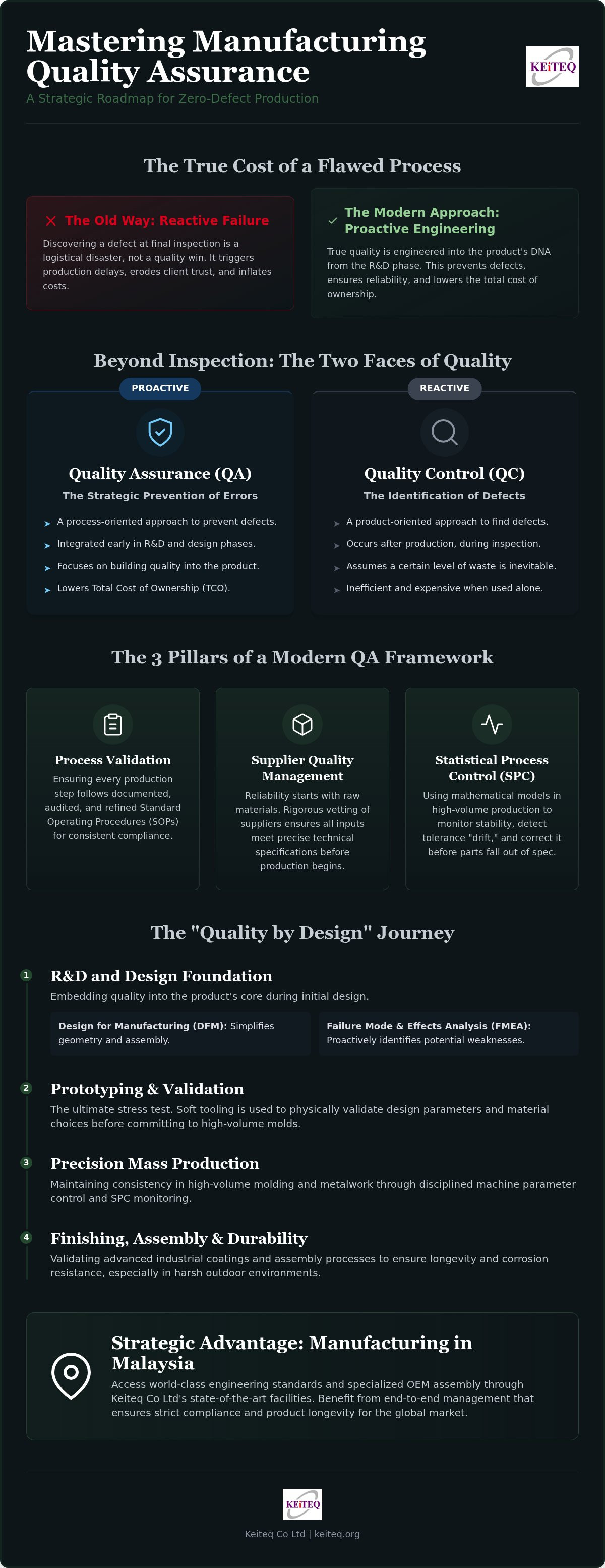
In 2026, manufacturing quality assurance has evolved from a secondary administrative function into a primary engineering discipline. For industrial OEMs, reliability is the only currency that matters. A robust QA framework ensures that every component, from a simple bracket to a complex outdoor payment terminal, performs consistently under stress. To understand the foundational concepts, one might ask: What is Quality Assurance? At its core, it's the systematic monitoring and evaluation of various aspects of a project to maximize the probability that standards of quality are being attained. This proactive approach is what separates market leaders from those struggling with constant recalls.
Modern standards prioritize Quality by Design (QbD). Instead of attempting to inspect quality into a product at the end of the line, engineers bake it in during the R&D phase. This shift drastically lowers the Total Cost of Ownership (TCO). When you eliminate failure points during the design stage, you reduce the long-term expenses associated with warranties, field repairs, and production downtime. High-precision manufacturing quality assurance doesn't just find mistakes; it renders them impossible through disciplined process engineering.
QA vs. QC: Moving Beyond Final Inspection
Quality Control (QC) is the process of identifying defects after they've occurred. It's inherently reactive. In contrast, Quality Assurance (QA) is the strategic prevention of those errors. Relying solely on QC is expensive and inefficient because it assumes a certain level of waste is inevitable. By implementing end-to-end product manufacturing strategies, OEMs can significantly reduce QC overhead. When the entire lifecycle is managed under one roof, from prototyping to mass production, the feedback loop between the factory floor and the design team closes. This integration ensures that the manufacturing quality assurance process identifies potential bottlenecks before the first unit is even stamped.
The Core Pillars of a Modern QA Framework
A functional QA framework rests on three critical pillars that ensure industrial-scale reliability:
Process Validation: Every step of the production run must follow documented Standard Operating Procedures (SOPs). These are not static documents; they are regularly audited and refined to maintain compliance.
Supplier Quality Management: Reliability starts with raw materials. Rigorous vetting of suppliers ensures that aluminum ingots, zinc alloys, or plastic resins meet technical specifications before they ever enter the facility.
Statistical Process Control (SPC): In high-volume environments like metal stamping or diecasting, SPC uses mathematical models to monitor production stability. It allows technicians to detect "drift" in machine tolerances and correct them before parts fall out of spec.
Quality by Design: The R&D Foundation of QA
Effective manufacturing quality assurance is not a reactive process that begins on the assembly line. It starts in the R&D lab. By embedding quality standards into the initial design phase, industrial OEMs eliminate systemic risks that final inspections often miss. Design for Manufacturing (DFM) serves as the primary tool for this integration. It allows engineering teams to simplify component geometry, reduce assembly complexity, and mitigate potential production defects. During this stage, we establish critical-to-quality (CTQ) parameters. These parameters define the non-negotiable tolerances and performance metrics required for the product's success. Utilizing soft tooling prototyping allows for the physical validation of these parameters before committing to expensive high-volume molds. It is a strategic step that ensures the design is robust enough for industrial-scale production.
Bridging the Gap from Prototype to Production
The transition from product R&D and manufacturing to full-scale operations requires a disciplined hand-off. A core component of this process is Failure Mode and Effects Analysis (FMEA). This methodology identifies potential weaknesses in the design or manufacturing process before they manifest as costly field failures. Material selection is equally vital. For hardware intended for harsh outdoor environments, durability and corrosion resistance are mandatory technical requirements. We validate that chosen materials meet both aesthetic standards and functional life-cycle expectations. If you are refining a complex assembly, you can contact our engineering team to discuss technical specifications and material compliance.
The Role of Prototyping in QA
Prototyping serves as the ultimate stress test for manufacturing quality assurance. It reveals how individual components interact within an assembly, highlighting issues like tolerance stack-up that digital simulations might overlook. High-fidelity prototypes allow for rigorous testing against environmental stressors, including thermal cycling and moisture ingress. This phase provides a vital feedback loop for the design team. Engineers refine specifications based on early-stage manufacturing results, ensuring the eventual mass production phase is stable and predictable. This methodical approach prioritizes reliability, ensuring that the final product meets the strict durability standards required by industrial clients.
QA Protocols for Precision Molding and Metalwork
Physical production is the stage where theoretical design meets the practical realities of material behavior. For industrial OEMs, manufacturing quality assurance at this level demands a granular focus on machine parameters and tool integrity. It isn't enough to simply inspect parts after they leave the machine. You must control the environment that creates them. This requires a shift from passive observation to active process stabilization, ensuring that every cycle produces a component identical to the approved master sample.
Dimensional accuracy in complex aluminium and zinc components relies on the stability of the diecasting or stamping environment. When dealing with high-volume runs, even minor fluctuations in pressure or temperature can lead to significant dimensional drift. A disciplined QA protocol monitors these variables in real-time, allowing technicians to make adjustments before parts fall out of tolerance. This level of control is essential for maintaining the tight fits required in complex industrial assemblies.
Plastic Injection Molding Quality Control
Consistency in plastic components starts with the molding cycle. Technicians monitor melt temperature, injection pressure, and cooling times to prevent common defects. If these variables deviate, the risk of flash, sink marks, or warping increases. Utilizing plastic injection molding services in Malaysia provides OEMs access to facilities that adhere to these global standards. We employ both visual and automated inspection systems to catch surface irregularities early. These systems ensure that every part meets the aesthetic and functional requirements established during the R&D phase.
Metal Stamping and Diecasting Standards
For OEMs seeking high-precision components, partnering with an experienced specialist like Agrohíd Ipari Kft. ensures that metal stamping and diecasting processes meet the most stringent industrial quality standards.
Metalwork presents unique challenges, particularly regarding material integrity and internal structure. In metal stamping manufacturer workflows, verifying the hardness and grain structure of the raw coil is the first step in a robust QA chain. For aluminium diecasting, porosity testing is vital to ensure structural strength. We use custom gauging and Coordinate Measuring Machine (CMM) verification to validate that every feature aligns with the CAD model. This technical rigor prevents assembly failures during the final OEM integration process.
Tool maintenance is the final, yet often overlooked, pillar of manufacturing quality assurance. High-pressure diecasting and high-speed stamping eventually wear down even the most durable tool steel. Without a scheduled maintenance program, tolerances will inevitably expand. We track stroke counts and tool wear patterns to perform preventative maintenance, ensuring that the millionth part is as precise as the first one produced.
Ensuring Durability: Finishing and Assembly QA
The final stages of production determine the long-term survival of hardware in the field. For industrial OEMs, manufacturing quality assurance must extend beyond dimensional checks into the technical validation of surface finishes and complex assembly integrity. Industrial components often face corrosive environments, UV exposure, and physical abrasion. Ensuring durability requires a methodical approach to coating application and rigorous testing of the final assembly. Surface finishing is a critical defense mechanism. We utilize advanced options like ceramic, enamel, and powder coating to provide specific protective properties. Ceramic coatings offer high thermal stability and chemical resistance. Enamel provides a glass-like, non-porous finish ideal for harsh chemical exposure. Powder coating remains a standard for impact resistance and aesthetic consistency.
Advanced Coating Performance Testing
Validation of these finishes involves standardized stress tests. Salt spray testing is mandatory for protective coatings for outdoor electronics to simulate years of exposure in coastal or industrial settings. We verify adhesion through cross-hatch testing and measure hardness to ensure the surface resists scratching and wear. For consumer-facing hardware, we implement color consistency checks using spectrophotometers to maintain brand alignment across mass production runs. These tests ensure the coating maintains its structural integrity and aesthetic appeal throughout the product's lifecycle.
Assembly Line Quality Gates
The transition to outdoor payment terminal assembly involves integrating precision metalwork with sensitive electronic modules. This process requires multiple quality gates to prevent latent failures. In-circuit testing (ICT) verifies the electrical integrity of PCBA modules before they are housed in ruggedized enclosures. This prevents the assembly of faulty electronics into finished units, reducing rework and waste.
Environmental sealing is a primary concern for outdoor payment terminals deployed in petrol stations. We conduct IP rating verification to ensure enclosures provide a reliable barrier against moisture and dust ingress. Final functional testing serves as the ultimate gate. Every unit undergoes a full operational cycle to confirm that software, hardware, and mechanical interfaces perform according to technical specifications. To ensure your hardware meets these rigorous standards, you can Request for Quotation for our assembly and finishing services.
By maintaining these strict protocols, we position ourselves as a dependable partner in the global supply chain. This disciplined approach ensures that the finished product isn't just assembled; it's engineered for industrial-scale reliability. Manufacturing quality assurance at the assembly level is the final step in delivering a zero-defect product run.
Strategic Advantage: Manufacturing QA in Malaysia
Malaysia has solidified its position as a global center for high-precision industrial production. For US-based OEMs looking to optimize their supply chains, the region offers a unique combination of technical expertise and logistical efficiency. A robust ecosystem of manufacturing quality assurance ensures that products manufactured here meet the same rigorous standards as those in Europe or North America. This reliability is built on decades of industrial development and a national commitment to engineering excellence. Choosing a Malaysian partner provides a strategic buffer against the rising costs and supply chain volatility found in other manufacturing hubs.
Compliance with international standards is a baseline requirement. Facilities in the region routinely maintain certifications such as ISO 9001, UL, and CE. This ensures that every component, from diecast enclosures to complex electronic assemblies, is ready for global distribution. The logistical advantages are equally significant. Malaysia's strategic position along major maritime routes facilitates efficient shipping to the United States and other Western markets, reducing lead times and total landed costs. It's a location that balances cost-effectiveness with uncompromising technical discipline.
Electronic Manufacturing Excellence in Malaysia
The region's success is rooted in its specialized talent pool. Industrial OEMs benefit from a workforce that is deeply familiar with electronic manufacturing services in Malaysia. This expertise isn't limited to simple assembly; it extends to complex process engineering and technical problem-solving. The local infrastructure supports high-tech production with stable power grids and a network of specialized sub-tier suppliers. This integrated environment allows for rapid scaling from prototype to mass production without sacrificing quality.
Partnering with Keiteq Co Ltd for Reliable QA
Keiteq Co Ltd operates as a "Safe Pair of Hands" within this vibrant industrial landscape. We provide an end-to-end management style that prioritizes functional trust and technical transparency. Our manufacturing quality assurance plans aren't generic templates. They are customized protocols tailored to the specific technical requirements of your hardware. We maintain open lines of communication, providing technical briefings and data-driven insights to keep your procurement and engineering teams informed throughout the production cycle.
Whether you require plastic injection molding, metal stamping, or the assembly of outdoor payment terminals, our Malaysian facilities are equipped to deliver world-class results. We invite you to engage with our regional experts to discuss your upcoming production requirements and quality standards. To begin the process, please Request for Quotation or Request to contact us for further details regarding our professional services in Malaysia.
Securing Industrial Reliability through Strategic QA
Success in industrial hardware depends on moving beyond end-of-line inspections. By prioritizing manufacturing quality assurance at every phase, from initial R&D through final finishing, OEMs can achieve a zero-defect production run. We have seen how precision in molding, durability in specialized coatings, and disciplined assembly standards create products capable of withstanding harsh outdoor conditions. These technical foundations ensure that industrial-scale reliability is not just a goal but a repeatable outcome that protects your brand's reputation and reduces total cost of ownership.
Keiteq Co Ltd provides the professional expertise and localized infrastructure needed to navigate these complexities from our specialized facilities in Malaysia. As a "Safe Pair of Hands" for complex assemblies and advanced coatings, we ensure your production meets strict global standards for durability and compliance. For high-precision industrial solutions in Malaysia, we invite you to Request for Quotation or Request to contact us for further details today. We are ready to help you transition seamlessly from prototype to mass production.
Frequently Asked Questions
What is the difference between QA and QC in a manufacturing context?
Quality Assurance (QA) focuses on the systematic prevention of defects through process design, whereas Quality Control (QC) identifies errors after production. In 2026, manufacturing quality assurance emphasizes "Quality by Design," ensuring that reliability is integrated during the engineering phase. This approach reduces the total cost of ownership by minimizing waste and rework. By stabilizing the production environment, we move beyond reactive final inspections toward a proactive, engineering-led framework.
How does Keiteq Co Ltd ensure quality during the transition from prototype to mass production?
Keiteq Co Ltd ensures a stable transition by utilizing soft tooling prototyping to validate designs before full-scale commitments. This phase allows our engineers to identify failure modes and refine technical specifications in a low-risk environment. By closing the gap between R&D and mass production, we ensure that the final assembly process is predictable and repeatable. This methodical hand-off preserves design integrity while preparing the project for industrial-scale reliability.
What types of industrial coatings does Keiteq Co Ltd offer for outdoor durability?
Keiteq Co Ltd provides high-performance finishes including ceramic, enamel, and powder coating. Ceramic coatings are selected for their thermal stability, while enamel provides a non-porous, chemically resistant surface. Powder coating remains a standard for impact resistance and aesthetic consistency across high-volume runs. These finishes are technically validated through adhesion and hardness testing to ensure that outdoor hardware can withstand corrosive industrial environments and intense UV exposure.
How do you maintain quality standards for plastic injection molding in Malaysia?
Maintaining standards for plastic injection molding in Malaysia involves rigorous machine parameter monitoring and a highly specialized workforce. We track melt temperatures and injection pressures to prevent defects like flash or warping. Our Malaysian facilities leverage robust local infrastructure to support high-tech production. By combining real-time data with skilled technical oversight, Keiteq Co Ltd delivers components that meet the strict dimensional tolerances required by global OEMs.
Can Keiteq Co Ltd manage the assembly of complex outdoor hardware like payment terminals?
Keiteq Co Ltd specializes in the complex assembly of outdoor payment terminals for petrol and gas stations. This involves integrating sensitive electronic modules into ruggedized, environmentally sealed enclosures. Our assembly process features multiple quality gates, including in-circuit testing and IP rating verification. We manage the entire integration sequence, ensuring that the final hardware performs reliably under constant use in demanding fuel retail settings and harsh outdoor conditions.
What quality certifications should I look for in a manufacturing partner?
When evaluating a manufacturing partner, look for ISO 9001 certification for quality management systems and UL or CE markings for safety compliance. These certifications indicate that the facility follows documented procedures and meets international safety standards. Keiteq Co Ltd adheres to these benchmarks in our Malaysian operations, providing a "Safe Pair of Hands" for complex assemblies. These credentials ensure that your products are ready for immediate global distribution.
How does Design for Manufacturing (DFM) impact the final quality of a product?
Design for Manufacturing (DFM) simplifies the production process by optimizing component geometry and assembly sequences during the design phase. It directly impacts manufacturing quality assurance by reducing the likelihood of production errors and material waste. By establishing critical-to-quality (CTQ) parameters early, we ensure that the design is robust enough for high-volume manufacturing. DFM results in more stable production cycles and higher overall product reliability.
What testing protocols are used for outdoor electronics enclosures?
Outdoor electronics enclosures undergo standardized testing protocols including salt spray exposure and IP rating verification. Salt spray testing simulates long-term corrosive environments to validate coating durability. IP rating tests ensure the enclosure provides a reliable barrier against moisture and dust ingress. These rigorous procedures confirm that the ruggedized housing protects internal electronics from environmental stressors, which is vital for hardware like outdoor payment terminals.
For high-precision industrial services in Malaysia, please Request for Quotation or Request to contact us for further details regarding our regional offerings.


Comments