
Mass Production Management: A Strategic Guide to Industrial Scaling in 2026
Updated: Sep 9
Scaling a successful prototype into a market-ready product is often the specific point where promising hardware ventures fail. You've likely experienced the frustration of quality degradation or fragmented supply chains when moving beyond the R&D phase. It's a common challenge for technical directors who see design integrity compromised by a lack of technical oversight in regional manufacturing hubs. Effective mass production management requires more than just factory space; it demands a disciplined, technical approach to lifecycle management and rigorous quality control.
This strategic guide provides the framework needed to master industrial scaling in 2026. You'll learn how to maintain a seamless design-to-production workflow that results in durable hardware capable of meeting industrial standards. We also explore the strategic advantages of Southeast Asian hubs. With Malaysia's manufacturing PMI reaching 50.2 in August 2026 and the implementation of the New Incentive Framework (NIF) on March 1, the region offers significant opportunities for cost-effective OEM assembly. From plastic injection molding to specialized enamel coatings, we preview the technical expertise required to secure your position in the global supply chain.
Table of Contents
Strategic Mass Production Management: Defining the 2026 Industrial Standard
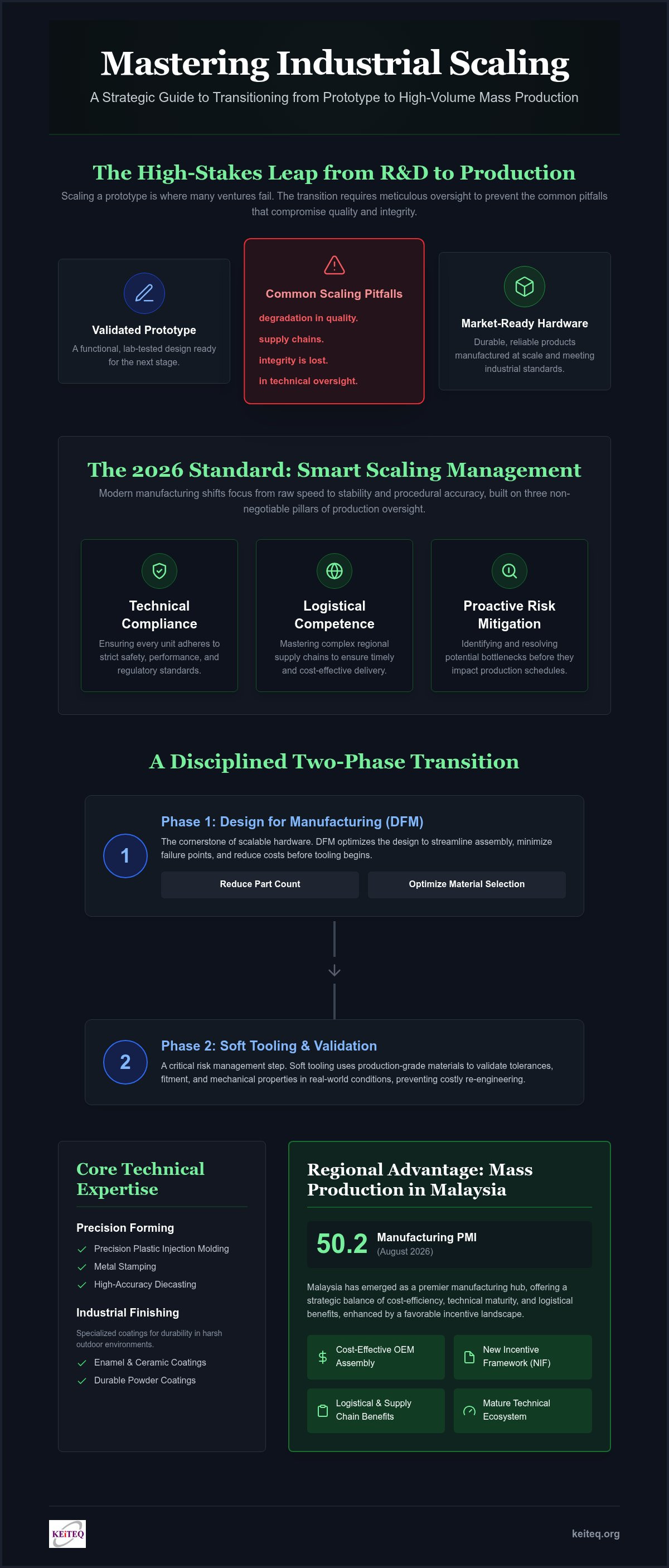
Effective mass production management is no longer just about maintaining a high-speed assembly line. In the 2026 industrial environment, it represents the comprehensive oversight of technical, logistical, and quality workflows. It's the essential bridge between a validated prototype and a market-ready fleet of hardware, including precision-engineered expandable tiny homes NZ. Transitioning to full-scale manufacturing involves high stakes; a single oversight in the supply chain can lead to catastrophic yield losses. By integrating R&D-led management early in the process, technical directors can prevent the mid-production design failures that typically plague fragmented workflows.
Scaling has shifted from simple volume to a philosophy of "Smart Scaling." This approach prioritizes stability and procedural accuracy over raw speed. Relying on a single-source management partner reduces the hidden costs associated with fragmented vendors, such as misaligned tolerances or communication gaps. Modern mass production management focuses on maintaining consistency while navigating the complexities of regional logistics. When one entity manages the design-to-production lifecycle, accountability remains clear. This integration ensures that technical specifications don't get lost in translation between different regional hubs.
The Evolution of High-Volume Manufacturing
While the history of mass production focused primarily on standardization to drive down unit costs, modern manufacturing demands integrated lifecycle management. We've moved beyond traditional silos. Today, data-driven oversight improves yield rates by identifying anomalies before they become systemic defects. This level of precision is essential in a globalized supply chain. It reduces material waste and ensures that every unit meets the same industrial standards as the initial prototype, regardless of the production volume.
Key Pillars of Modern Production Oversight
Reliable production requires three non-negotiable pillars. First, technical compliance ensures that products adhere to strict safety and performance regulations. Second, logistical competence is vital, especially when operating in regional manufacturing hubs like Malaysia. Malaysia has emerged as a strategic center for electronic manufacturing services, offering a balance of cost-efficiency and technical maturity. Finally, proactive risk mitigation during the ramp-up phase identifies bottlenecks before they halt production. Managing these pillars effectively allows for a seamless transition, ensuring that hardware is not only scalable but also physically durable for long-term industrial use.
Navigating the Transition: From Prototype to Mass Production
The transition from a lab-validated prototype to industrial scale is a high-risk phase. Successful mass production management begins with rigorous design validation. This isn't just about aesthetics; it's about structural integrity and repeatability. You must bridge the gap between creative design and the hard realities of the factory floor. Learn more about our prototyping and soft tooling services to understand how we facilitate this shift. By applying the foundational principles of mass production early, you ensure that every component is optimized for high-volume output without sacrificing durability.
Design for Manufacturing (DFM) Strategies
DFM is the cornerstone of scalable hardware. We focus on reducing part counts to streamline assembly and minimize potential failure points. Fewer parts mean fewer assembly errors and lower logistical overhead. Selecting the right materials is equally critical. You need to balance physical durability with production efficiency. For example, choosing a specific grade of resin for plastic injection molding can significantly impact cycle times and part consistency. Similarly, for hardware requiring rotary electrical interfaces, sourcing from TME Systems Pty Ltd ensures that these critical components meet industrial-grade standards. Identifying these variables before hard tooling is cut prevents costly re-engineering during the production ramp-up.
Soft tooling serves as a vital bridge between R&D and full-scale manufacturing. It allows you to validate tolerances and fitment in real-world industrial conditions using production-grade materials. This phase is essential for identifying mechanical issues that early-stage 3D prints might miss. It provides several strategic advantages:
Validates mold flow and cooling rates for plastic components.
Tests the functional performance of moving parts under stress.
Provides bridge units for early market testing and certification.
Soft tooling accelerates time-to-market for OEMs by allowing functional testing and pilot production to occur while permanent hard tooling is still being fabricated.
The Pilot Run is the final checkpoint. It's a limited production batch that tests the entire manufacturing workflow, from assembly protocols to quality control stations. This stage uncovers hidden inefficiencies in the manual or automated assembly steps. Successful completion of a pilot run provides the data necessary to commit to full-scale industrial deployment. If you're ready to discuss your specific scaling requirements, request to contact us for further details regarding our integrated management approach.
Managing Precision: Plastic, Metal, and Diecasting Workflows
Precision is the non-negotiable standard in high-volume industrial scaling. Effective mass production management ensures that technical specifications for complex enclosures and structural components remain consistent across millions of units. This requires deep expertise in material behavior and mechanical tolerances. Whether managing a fleet of plastic injection machines or high-speed stamping presses, the focus remains on procedural accuracy and physical durability. Integrating specialized material handling equipment from Quintec Conveyors helps maintain the steady flow of components between these high-speed production stages. Centralizing the oversight of these diverse processes prevents the dimensional drift that often occurs when parts are sourced from multiple, uncoordinated vendors.
Managing complex enclosures for industrial hardware demands a methodical approach to multi-cavity molds. While these molds increase high-volume efficiency, they introduce variables in cavity-to-cavity consistency. You must ensure resin consistency and thermal stability throughout long production runs to avoid warping or dimensional drift. High-performance polymers react to even minor temperature fluctuations, making active cooling management and precise cycle timing a priority. To achieve these standards, many technical directors explore our plastic injection molding services in Malaysia, where industrial maturity meets cost-effective scaling. For deeper insights on choosing the right partner, refer to our guide on Selecting a Plastic Injection Molding Manufacturer for Industrial Scale.
Metal Stamping and Diecasting Oversight
High-volume metal stamping requires constant vigilance regarding tool wear. Maintaining accuracy across millions of cycles is only possible through scheduled maintenance and rigorous inspection of the dies. When it comes to structural parts, the strategic selection between aluminium and zinc diecasting depends on the specific requirements of the hardware. Aluminum is often preferred for its thermal conductivity and lightweight properties, while zinc allows for thinner walls and more intricate details. Managing these workflows involves specific quality control checkpoints:
Material Purity: Verifying alloy composition to ensure structural integrity and corrosion resistance.
Dimensional Accuracy: Using precision measurement tools to confirm tolerances after the cooling phase.
Surface Uniformity: Inspecting for porosity or flash that could interfere with secondary finishing or assembly.
These protocols prevent the assembly of sub-standard components, ensuring the final product meets industrial-grade durability. By integrating the management of these metal and plastic workflows, you eliminate the technical fragmentation that often compromises high-volume hardware projects. This holistic approach ensures that every component fits perfectly within the final assembly, regardless of the material or production method used.
Industrial Finishing and Specialized OEM Assembly
Finishing is the final layer of physical defense for industrial hardware. In 2026, mass production management must treat finishing as a technical engineering discipline rather than a cosmetic afterthought. For hardware deployed in public spaces, durability is the primary metric of success. This is especially true for equipment that must withstand decades of service without structural degradation. Integrating finishing into the broader production workflow ensures that protective layers are applied with the same precision as the internal mechanical components.
High-Performance Surface Finishing Management
Coordinating enamel, ceramic, and powder coating workflows requires precise timing and strict environmental control. These processes often involve high-temperature curing that can become a significant production bottleneck if not integrated into the master schedule. Industrial ceramic finishes require rigorous testing for heat and wear resistance to survive the constant friction of high-traffic environments. Powder coating offers a balance of impact resistance and aesthetic flexibility for large-scale enclosures. We prioritize the synchronization of these workflows in our Malaysia-based facilities to ensure that finishing capacity matches assembly output. Refer to our Protective Coatings for Outdoor Electronics: An Industrial Reference Guide for a detailed technical breakdown of material compatibility.
Complex Hardware Assembly for Fuel Retail
Specialized OEM assembly for the fuel retail sector involves the complex integration of sensitive electronics into rugged, weather-resistant metal enclosures. Unattended payment terminals at petrol stations face extreme UV exposure, temperature fluctuations, and potential vandalism. Assembly protocols must include IP-rated sealing tests and structural integrity checks to prevent ingress. Precision assembly for gas station kiosks ensures that internal components remain isolated from moisture and corrosive fuel vapors. View the Technical specifications for outdoor payment terminal assembly to see how these standards are maintained at scale. Every unit must undergo automated functional testing before it leaves the facility to confirm that the hardware meets industrial safety standards.
Maintaining oversight of both the coating and the final assembly ensures that the aesthetics meet global brand standards while the hardware survives the field. This integrated approach is a core component of modern mass production management. To secure a technical partner for your next high-volume project in Southeast Asia, Request for Quotation regarding our specialized assembly and finishing services in Malaysia.
Regional Strategic Advantage: Mass Production in Malaysia
Malaysia has solidified its position as a premier industrial hub for electronic and mechanical manufacturing in 2026. The implementation of the New Incentive Framework (NIF) on March 1, 2026, replaced previous tax structures with an outcome-based system that rewards companies for increasing economic complexity and sustainability. For technical directors, this environment offers more than just fiscal benefits; it provides access to a mature industrial ecosystem. The manufacturing sector's sales value reached RM177.0 billion in June 2026, representing a 9.8% year-on-year increase. Integrating electronic manufacturing services in Malaysia into your global strategy allows you to leverage an Industrial Production Index (IPI) that grew by 6.5% in the same period. The New Industrial Master Plan 2030 (NIMP 2030) further underpins this growth by prioritizing high-value job opportunities and domestic supply chain linkages.
Logistics and Supply Chain Integration in Malaysia
The nation's logistical infrastructure is specifically designed to support high-volume export quality standards. With 2.4 million people employed in the manufacturing sector as of June 2026, there's a deep pool of specialized labor familiar with international compliance and precision engineering. Managing mass production management from this Southeast Asian base ensures proximity to critical component suppliers, particularly in the Electrical & Electronics sub-sector which drove significant growth in the first half of the year. The sales value per employee stood at RM73,127 in June 2026, reflecting the high efficiency of the local workforce. Malaysia’s robust logistics network and established industrial clusters provide the necessary framework for the seamless execution of complex OEM assembly projects.
Keiteq: Your Partner for Malaysian Production
Keiteq acts as the essential bridge between Western design standards and Malaysian manufacturing efficiency. We understand that industrial scaling requires more than just factory floor space; it requires a partner who can navigate regional nuances while maintaining absolute procedural accuracy. As a "Safe Pair of Hands," we provide the technical oversight necessary to ensure that your hardware meets industrial-grade durability. Our mass production management services cover the entire lifecycle, from soft tooling to the final assembly of outdoor payment terminals. We manage the intricacies of the local market and the NIF scorecard requirements, allowing you to focus on strategic growth while we handle the logistical and technical realities of the production line.
If you're ready to scale your hardware operations within a high-growth industrial hub, our team is prepared to facilitate your transition. For professional services tailored to the Malaysian market, Request for Quotation or send a Request to contact us for further details regarding our regional production offerings.
Securing Your Industrial Future through Technical Scaling
Industrial success in 2026 depends on the seamless integration of design, specialized finishing, and regional logistical advantages. Transitioning from a validated prototype to high-volume output requires a technical approach to mass production management that prioritizes physical durability and procedural accuracy. By leveraging Malaysia's mature manufacturing ecosystem and the New Incentive Framework, OEMs can achieve cost-effective scaling without compromising on engineering integrity. To ensure this increased capacity translates into market growth, a professional Lead Generation Solution can help identify new industrial opportunities. Keiteq serves as a dependable end-to-end Malaysian manufacturing hub. We provide the stability your supply chain requires. Our team specializes in rugged petrol and gas station hardware, utilizing deep expertise in high-performance enamel and ceramic coatings to protect critical outdoor electronics. This holistic oversight ensures that every unit meets strict global industrial standards from the initial pilot run through to full-scale deployment.
For professional manufacturing services within the Malaysian market, please Request for Quotation or Request to contact us for further details. We're ready to secure your production with the precision and discipline your project demands.
What are the key components of mass production management?
Key components include the oversight of technical, logistical, and quality workflows to ensure industrial durability. Effective mass production management integrates product R&D with manufacturing to prevent design failures. It involves managing supply chains, monitoring yield rates, and ensuring procedural accuracy across all production cycles. This holistic approach maintains consistency from the initial design phase through full-scale assembly.
How does Keiteq manage the transition from prototype to mass production?
Keiteq manages this transition through a structured lifecycle that begins with Design for Manufacturing (DFM) and functional prototyping. We utilize soft tooling to bridge the gap between R&D and hard tooling. This allows for validation of tolerances and material behavior in real-world conditions. Following successful validation, we conduct a pilot run to test assembly protocols and quality control stations before commencing full-scale industrial deployment.
What industrial finishing services are available for mass-produced parts?
We provide specialized high-performance finishing services including enamel coating, ceramic coating, and powder coating. These treatments are essential for hardware exposed to harsh environments, such as outdoor payment terminals. Our management process ensures these coatings meet global standards for heat and wear resistance. By coordinating finishing workflows with assembly, we prevent production bottlenecks and ensure consistent surface uniformity across high volumes of industrial components.
Why is Malaysia a strategic choice for mass production management in 2026?
Malaysia offers a mature industrial ecosystem with established supply chain linkages and specialized labor. In 2026, the New Incentive Framework (NIF) provides outcome-based rewards for projects that increase economic complexity. The manufacturing sector showed resilience with a PMI of 50.2 in August 2026 and RM177.0 billion in sales value in June. These factors make it a stable hub for mass production management and complex OEM assembly.
Can Keiteq manage both plastic and metal component manufacturing?
Keiteq provides integrated management for both plastic and metal manufacturing processes. Our capabilities include precision plastic injection molding, high-volume metal stamping, and both aluminium and zinc diecasting. We oversee these diverse workflows to ensure dimensional accuracy and structural integrity across all components. This unified oversight eliminates the technical fragmentation often found when sourcing parts from multiple uncoordinated vendors.
What specialized assembly services does Keiteq offer for petrol stations?
Keiteq offers specialized OEM assembly for outdoor payment terminals used in petrol and gas stations. These services focus on the complex integration of electronic components into durable, weather-resistant metal enclosures. Our protocols include IP-rated sealing tests and functional verification to ensure hardware survives harsh fuel retail environments. We manage the entire assembly process to deliver ready-to-use hardware that meets global safety and durability standards.
How does Design for Manufacturing (DFM) impact mass production costs?
DFM lowers mass production costs by optimizing designs for scalability and repeatability. By reducing the overall part count, we streamline assembly processes and minimize potential failure points. This optimization lowers material waste and reduces labor requirements during high-volume production. Identifying mechanical issues before hard tooling is cut prevents expensive re-engineering; it ensures that the production ramp-up remains within the established budgetary constraints.
What is the benefit of using soft tooling before full-scale production?
Soft tooling provides a critical validation phase that bridges the gap between R&D and mass production. It allows manufacturers to test production-grade materials and verify tolerances under industrial conditions without the high cost of permanent hard tooling. This process identifies mold flow issues and functional defects early. Utilizing soft tooling accelerates time-to-market for OEMs by enabling pilot production and functional testing while permanent tooling is still being fabricated.


Comments