
Custom Industrial Assembly: A Strategic Guide to Turnkey OEM Manufacturing
A fragmented supply chain isn't just a logistical headache; it's a primary driver of mechanical failure in high-stakes outdoor hardware. When you balance multiple vendors for plastic molding, metal stamping, and final finishing, the risk of inconsistent tolerances increases. You've likely experienced the frustration of components that fit perfectly on paper but fail in the field due to poor integration or inadequate coating. Precision requires a unified approach that a disjointed workflow simply cannot provide.
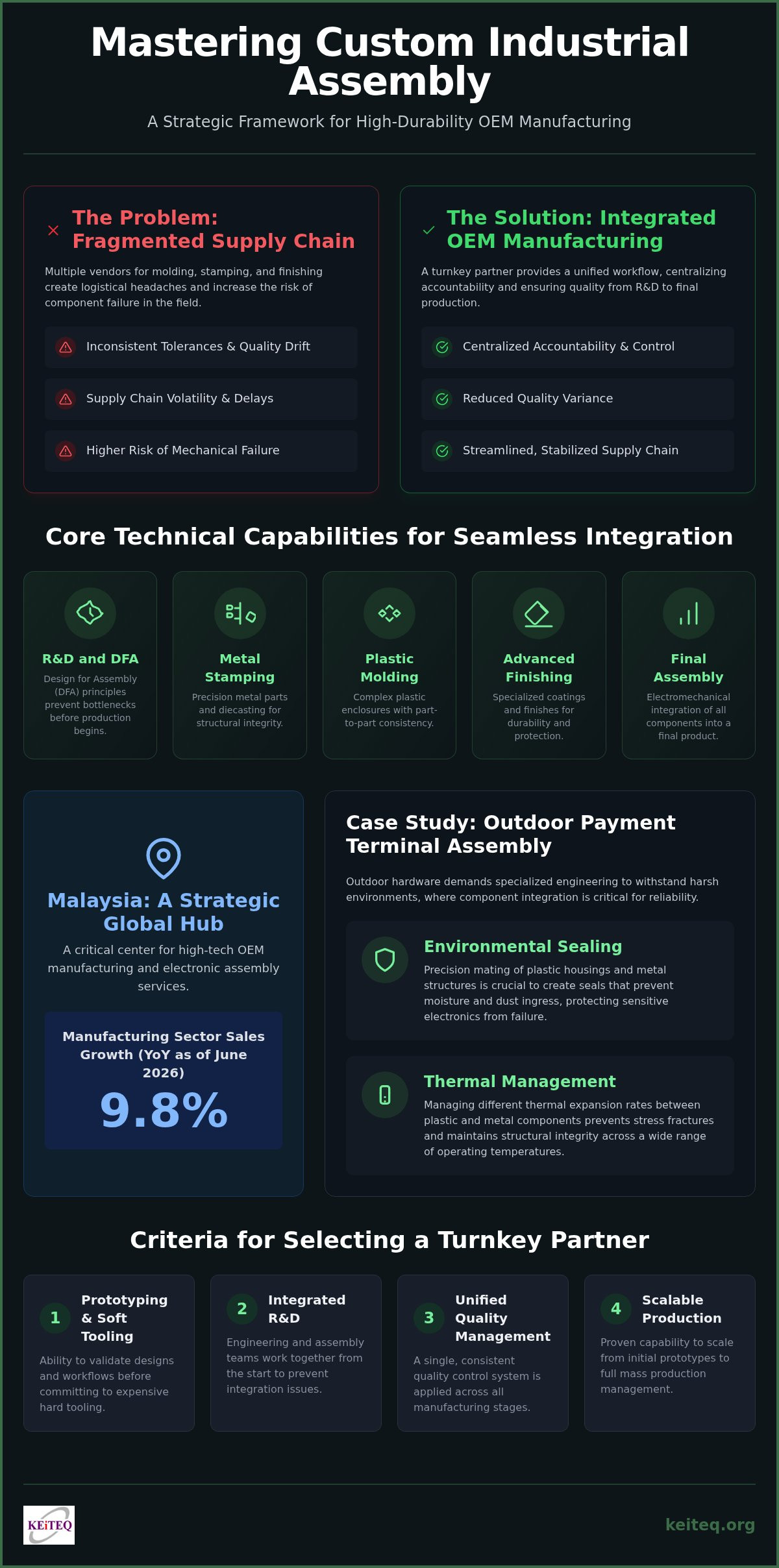
This guide provides a strategic framework for mastering custom industrial assembly. It ensures your components meet rigorous durability standards through integrated OEM manufacturing. With Malaysia's manufacturing sector seeing a 9.8% year-on-year sales growth as of June 2026, the region has solidified its position as a critical hub for high-tech production. We'll examine how single-source R&D and strategic regional hubs can eliminate lead time bottlenecks. We'll also explore the technical requirements for high-durability outdoor hardware. You'll learn how to transition from managing parts to overseeing a streamlined, turnkey production cycle that protects your bottom line.
Table of Contents
The Strategic Role of Custom Industrial Assembly in 2026
Custom industrial assembly is the process of integrating various multi-material components, ranging from precision metal parts to complex plastic enclosures, into a fully functional OEM product. In the 2026 manufacturing environment, procurement strategies have shifted significantly. Fragmented sourcing, once a standard for cost-cutting, now creates unacceptable risks regarding supply chain volatility and quality drift. Modern OEMs are moving toward Mass customization models that require high-precision integration at scale. This shift has turned assembly from a basic mechanical task into a sophisticated engineering discipline.
The industry is moving away from simple component kitting. Today, custom industrial assembly involves complex electromechanical integration that includes sensors, circuitry, and specialized coatings. To manage this complexity, Design for Assembly (DFA) has become a mandatory R&D pillar. DFA ensures that products are engineered for efficient, repeatable production. It reduces the likelihood of manual errors or structural failure during mass production. Precision requires a unified approach. When engineering and assembly are treated as separate silos, the final product often suffers from tolerance stack-up issues that lead to field failures.
Bridging the Gap Between R&D and Production
Successful assembly begins long before the factory floor. Integrating Product R&D and manufacturing early in the design phase prevents common assembly bottlenecks. Keiteq utilizes prototype development and soft tooling to validate workflows before committing to expensive hard tools. This iterative process identifies potential material conflicts and optimizes the sequence of operations. By managing the entire product lifecycle, we ensure the final mass-produced unit remains consistent with the original engineering intent. It's a method that prioritizes functional trust over theoretical design.
The Value of Single-Source OEM Assembly
Choosing a single-source partner provides measurable single-source manufacturing benefits. It centralizes accountability. When one partner handles metal stamping, plastic molding, and final assembly, the logistical overhead of managing multiple vendors disappears. This integration reduces quality variance. In industrial sectors, assembly quality is directly linked to brand reputation. A single failure in a harsh environment leads to costly recalls and lost trust. A turnkey approach mitigates these risks by ensuring every component is designed and assembled under a unified quality management system. It's a strategic move that stabilizes the supply chain while protecting the bottom line.
Technical Capabilities: Integrating Plastic, Metal, and Finishing
High-performance custom industrial assembly requires the seamless marriage of disparate materials. Achieving reliable results depends on the synergy between a metal stamping manufacturer and precision molding experts. When these processes are siloed, tolerance stack-up issues frequently emerge during final integration. By combining metal stamping with plastic injection molding under a single management structure, manufacturers maintain tighter control over mating surfaces. This integration is essential for high-strength industrial assemblies that utilize aluminium and zinc diecasting. These diecast components provide the structural integrity required for heavy-duty hardware while maintaining the complex geometries that stampings alone cannot achieve.
Precision Plastic and Metal Component Integration
Mating plastic housings with metal internal structures presents unique thermal and mechanical challenges. Plastic and metal expand at different rates. This discrepancy can compromise seals or cause stress fractures in harsh environments if not accounted for during the R&D phase. A plastic injection molding manufacturer must adhere to strict assembly-ready standards to ensure parts fit perfectly every time. Keiteq ensures part-to-part consistency across production runs by implementing rigorous quality control protocols at the source. This precision is a cornerstone of an effective supply chain strategy, as it eliminates the need for manual adjustments during the final assembly phase. You can contact our technical team to discuss specific tolerance requirements for your project.
Advanced Finishing for Assembly Durability
The longevity of a custom industrial assembly often depends on its surface treatment. While powder coating offers excellent impact resistance and aesthetic versatility, ceramic coating provides superior thermal protection and chemical resistance. For the most aggressive industrial environments, enamel coating remains the gold standard due to its extreme hardness and corrosion immunity. Integrating protective coatings for outdoor electronics directly into the assembly workflow prevents secondary handling damage. This sequence ensures that every internal and external surface is protected before the final components are mated.
Precision tolerances are not optional; they're the difference between a reliable product and a liability. Whether it's managing the fit of a diecast heat sink within a molded enclosure or ensuring a powder-coated finish doesn't interfere with mechanical fasteners, every detail counts. Consistency in these technical areas ensures that mass-produced units perform exactly like the initial prototypes. This methodical approach to material integration is what defines a truly turnkey OEM partner.
Outdoor Payment Terminal Assembly: A Specialized Case Study
Outdoor payment terminals represent one of the most demanding applications for custom industrial assembly. These units operate in volatile environments where they face constant exposure to UV radiation, moisture, and extreme temperature fluctuations. Successful outdoor payment terminal assembly requires a sophisticated understanding of Ingress Protection (IP) ratings. Seals must prevent dust and water from compromising sensitive internal electronics over years of service. This same level of environmental protection is required for critical remote monitoring systems, such as those provided by inTouch R&B, which must remain operational in harsh conditions to alert operators of equipment failure. Thermal management is equally critical. Enclosures must dissipate heat generated by internal processors while resisting external solar loading. This technical balance requires the precise integration of heat sinks, specialized gaskets, and ventilation systems within a ruggedized metal chassis. Safety compliance is paramount in petrol and gas station environments. Assembly protocols must strictly account for hazardous zone requirements to prevent any risk of electrical discharge in volatile atmospheres.
Engineering for Petrol and Gas Station Environments
Unattended hardware in fuel retail must withstand physical abuse and attempted tampering. Engineering outdoor payment terminals for 24/7 reliability involves more than selecting durable materials. It requires high-precision assembly of reinforced locking mechanisms and anti-vandalism features. Structural integrity is maintained through heavy-gauge metal stamping and reinforced weld points that protect internal components from external impact. These units function as the primary point of commerce for many fuel retailers. Reliability isn't just a technical metric; it's a financial necessity. We prioritize a design that ensures the terminal remains operational regardless of local weather conditions or heavy user traffic.
Component Consolidation for Turnkey Kiosks
Managing a complex Bill of Materials (BOM) is a central challenge in kiosk production. A single unit integrates card readers, thermal printers, touchscreens, and power management modules into a consolidated frame. Keiteq manages this consolidation by performing rigorous final testing and inspection on every fully assembled unit. We verify electrical continuity, seal integrity, and mechanical tolerances before any unit leaves the facility. This end-of-line verification ensures that the hardware is ready for immediate deployment. Terminal enclosure assembly is a fusion of precision metalwork and electronic integration. This holistic approach ensures that each component functions as part of a unified, high-performance system. By centralizing the assembly of these complex systems, we eliminate the integration errors that often occur when components are sourced from multiple, uncoordinated vendors.
Malaysia: The Strategic Hub for Custom Assembly and OEM Production
Malaysia has solidified its position as a global leader in electronic manufacturing services in Malaysia. The region's manufacturing sector achieved a sales value of RM177.0 billion in June 2026, reflecting a 9.8% year-on-year increase. This growth is largely fueled by the Electrical and Electronics (E&E) sub-sector, which saw a robust 18.7% expansion during the same period. For OEMs, these figures represent more than just economic data; they indicate a mature, stable environment for custom industrial assembly. Malaysia offers a sophisticated infrastructure designed for high-tech production, supported by a skilled engineering workforce of over 2.4 million professionals. This deep talent pool ensures that complex assembly projects are executed with procedural accuracy and technical discipline.
The logistical advantages of the region are a primary factor in global supply chain stability. With export-oriented industries accounting for 73% of total manufacturing sales in mid-2026, Malaysia is built for international trade. Its established ports and specialized industrial zones allow for efficient movement of raw materials and finished goods. This connectivity reduces lead times and mitigates the disruptions often seen in less developed manufacturing hubs. Choosing a partner in this ecosystem provides a strategic buffer against the volatility of modern global procurement.
Advanced Plastic and Electronic Assembly in Malaysia
Specialized plastic injection molding services in Malaysia provide the foundation for many complex assemblies. Local expertise in plastic injection mold Malaysia supports the production of high-tolerance components that are essential for precise integration. These facilities maintain rigorous quality control standards, ensuring that every molded part meets the exact specifications required for automated or manual assembly lines. By centralizing molding and assembly within the same regional hub, manufacturers eliminate the risks associated with shipping sensitive components across multiple borders before final integration.
Cost-Efficiency Without Quality Compromise
For US and European OEMs, Malaysia offers a compelling cost-benefit ratio. The established manufacturing ecosystem allows for competitive production costs without sacrificing technical standards or compliance. The ease of doing business in Malaysia, combined with a workforce that prioritizes functional trust and reliability, makes it an ideal destination for long-term OEM partnerships. Keiteq serves as a critical bridge in this process. We help companies leverage Malaysian manufacturing expertise to scale their production from initial prototypes to full mass production. You can contact us for further details regarding our regional assembly capabilities and how they can benefit your specific project.
Selecting a Turnkey Partner: From Prototype to Mass Production
Selecting a partner for custom industrial assembly is a strategic decision that impacts the entire product lifecycle. It's not enough to evaluate a vendor based on facility size or ERP systems alone. You need a partner capable of managing the technical transition from initial R&D to the factory floor. This bridge ensures that the functional requirements established during the design phase are maintained through high-volume output. A reliable partner acts as a single-source facilitator. They provide accountability for every component and integration point, preventing the fragmented communication that leads to production delays.
The Prototype to Production Roadmap
Before a full-scale launch, the assembly process must be validated through a rigorous roadmap. Keiteq manages this by overseeing prototype development using soft tooling. This phase allows us to refine assembly workflows without the prohibitive costs of permanent hard tools. It identifies potential interference issues or assembly bottlenecks early in the cycle. Establishing a feedback loop between the assembly floor and the R&D team is critical. These insights lead to design adjustments that improve manufacturing yield and reduce manual errors. Transitioning from soft tooling to mass production management requires a disciplined sequence of pilot runs and quality audits to ensure the process is repeatable at scale.
Ensuring Long-Term Scalability and Compliance
Mass production management is about maintaining consistency over thousands of units. It requires rigorous testing and quality assurance protocols that align with international industrial standards. A turnkey partner provides end-to-end visibility into the manufacturing process, from raw material inspection to final functional testing. This transparency is vital for OEMs operating in regulated sectors like fuel retail or outdoor electronics. By centralizing operations in Malaysia, Keiteq leverages a mature manufacturing ecosystem that prioritizes procedural accuracy and physical durability. We ensure that every unit leaving the facility meets the same exacting standards as the initial gold sample.
Our facilities in Malaysia are equipped to handle the most complex integration projects with precision and scale. If you are looking to streamline your supply chain and improve product reliability, we are ready to assist. Please submit a Request for Quotation or a Request to contact us for further details regarding our turnkey manufacturing and custom industrial assembly services in the region.
Optimizing Your Global Production Strategy
Mastering custom industrial assembly requires more than just mechanical skill; it demands a unified engineering approach that bridges the gap between R&D and mass production. By integrating precision metal stamping, plastic molding, and advanced protective coatings under a single-source partner, OEMs can eliminate the quality inconsistencies inherent in fragmented supply chains. This integrated methodology is especially critical for specialized hardware like outdoor payment terminals, where environmental sealing and thermal management are non-negotiable standards for 24/7 reliability. Keiteq provides the single-source responsibility needed to navigate these technical complexities from our strategic regional hub.
Malaysia remains a premier destination for high-tech manufacturing, offering the infrastructure and engineering talent necessary to scale complex industrial projects. Leveraging this regional expertise allows businesses to reduce logistical overhead while maintaining rigorous compliance with international standards. For high-quality manufacturing solutions in Malaysia, please Request for Quotation or Request to contact us for further details. We look forward to helping you stabilize your supply chain and bring your next industrial innovation to market with confidence.
Frequently Asked Questions
What is custom industrial assembly?
Custom industrial assembly is the engineering process of integrating multi-material components into a functional OEM product. It goes beyond simple mechanical kitting by incorporating precision metal stampings, plastic molded parts, and complex electronics into a unified system. This discipline focuses on Design for Assembly (DFA) to ensure that every unit is optimized for mass production. It provides a strategic framework for creating durable hardware that meets specific industrial performance requirements in the field.
Why should I choose Malaysia for industrial assembly services?
Malaysia offers a mature manufacturing ecosystem with a sales value of RM177.0 billion as of June 2026. The region's robust Electrical and Electronics sector provides the technical infrastructure required for high-precision custom industrial assembly. With over 2.4 million skilled employees, the country serves as a strategic hub for global supply chains. It delivers a competitive balance of cost-efficiency and procedural accuracy, making it an ideal choice for US and European OEMs seeking stability.
How does Keiteq handle the transition from R&D to mass production?
Keiteq manages this transition through a structured roadmap that begins with prototyping and soft tooling. This phase allows us to validate assembly workflows and identify potential technical bottlenecks without the high cost of permanent hard tools. We maintain active feedback loops between our R&D engineers and the assembly floor. This collaborative approach ensures that the final mass production process is repeatable, efficient, and remains completely consistent with the original engineering specifications and quality standards.
What types of finishes are best for outdoor industrial hardware?
The optimal finish depends on the specific environmental stressors the hardware will face. Enamel coating is the gold standard for extreme corrosion and chemical resistance in industrial settings. Ceramic coating provides superior thermal management and chemical protection for sensitive components. Powder coating offers excellent impact resistance and UV protection for general outdoor applications. We integrate these advanced finishing services directly into the assembly line to protect every surface before the final components are mated.
Can Keiteq manage complex electromechanical assemblies like payment terminals?
We specialize in the complex integration of electronic and mechanical components for outdoor payment terminals. Our expertise covers the assembly of card readers, printers, and displays within ruggedized metal enclosures designed for petrol and gas stations. We prioritize environmental sealing to meet strict Ingress Protection (IP) ratings and thermal management requirements. Our assembly protocols also ensure safety compliance for volatile environments, providing a turnkey solution for the fuel retail and industrial kiosk sectors.
What is the benefit of single-source manufacturing for OEM products?
Single-source manufacturing provides centralized accountability and eliminates the risks of managing fragmented supply chains. When one partner handles R&D, metal stamping, plastic molding, and final assembly, the likelihood of quality variance or vendor miscommunication is significantly reduced. This integration prevents tolerance stack-up issues that often occur when mating parts from different suppliers. It streamlines logistics, reduces total lead times, and ensures that the final product maintains structural integrity and functional reliability through custom industrial assembly.
How does Keiteq ensure quality control during high-volume assembly?
We utilize a comprehensive quality management system that includes end-of-line functional testing and rigorous inspection cycles. Our team verifies mechanical tolerances, electrical continuity, and seal integrity for every unit before it leaves the facility. These protocols are designed to maintain consistent quality over high-volume production runs of thousands of units. By centralizing these checks within our Malaysian facilities, we provide OEMs with end-to-end visibility and assurance that every product meets international industrial standards and compliance.
What materials does Keiteq specialize in for custom assembly?
Keiteq specializes in integrating precision metal stampings, aluminium and zinc diecastings, and high-performance plastic injection molded parts. Our technical capabilities extend to the application of specialized coatings like enamel, ceramic, and powder finishes. We focus on mating these disparate materials into durable assemblies that withstand harsh outdoor environments. This material expertise allows us to deliver complex, multi-component hardware that maintains its structural integrity and aesthetic quality throughout a long operational lifecycle in the field.
For high-quality custom industrial assembly and manufacturing solutions in Malaysia, please Request for Quotation or Request to contact us for further details.


Comments