
The Strategic Value of OEM Assembly Services for Industrial Hardware in 2026
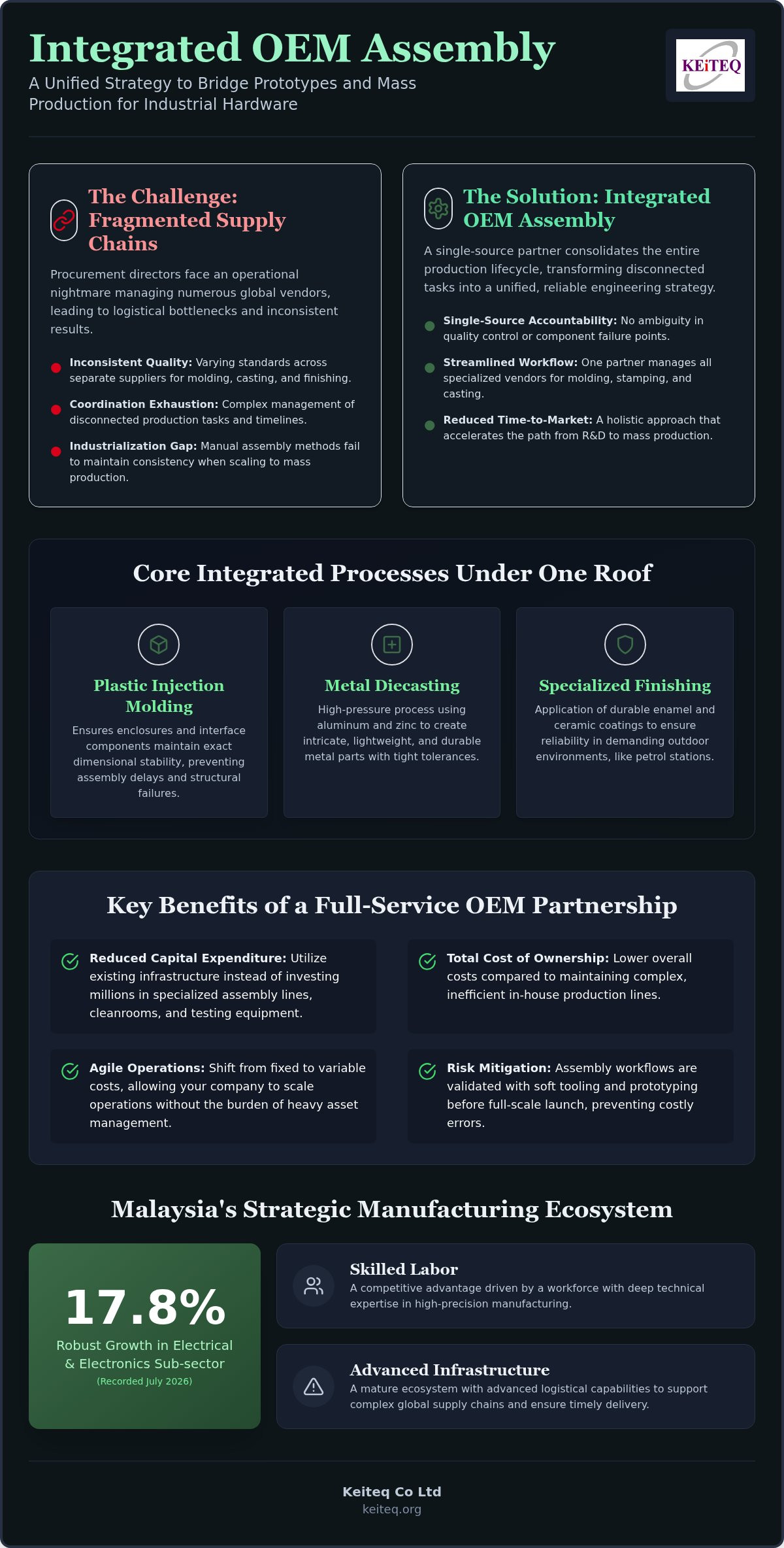
In July 2026, Malaysia's Electrical & Electronics sub-sector recorded a robust 17.8% growth, signaling a massive shift toward high-precision industrial manufacturing. Most procurement directors agree that managing a fragmented supply chain for complex hardware is an operational nightmare. You're likely dealing with inconsistent quality across global vendors and the exhaustion of coordinating separate suppliers for molding, casting, and finishing. Utilizing integrated OEM assembly services solves these logistical bottlenecks by consolidating the entire production lifecycle under one roof. This approach transforms manufacturing from a series of disconnected tasks into a unified engineering strategy.
You'll discover how a single-source partner in Malaysia can streamline your path from R&D to mass production while significantly reducing time-to-market for industrial terminals. We'll explore the technical advantages of specialized finishes like enamel and ceramic coatings that ensure durability in demanding outdoor environments. This guide provides a detailed briefing on leveraging regional expertise to secure a reliable, high-capacity production line for your 2026 hardware programs. We'll examine how integrated innovation and industrialization readiness now serve as the primary benchmarks for successful global sourcing.
Table of Contents
Understanding the Role of OEM Assembly Services in Modern Manufacturing
Integrating Precision Processes: Molding, Diecasting, and Finishing
Outsourced vs. In-House Assembly: A Strategic Cost-Benefit Analysis
Selecting a Partner for Electronic Manufacturing Services in Malaysia
Specialized Solutions: Turnkey Outdoor Payment Terminal Assembly
Understanding the Role of OEM Assembly Services in Modern Manufacturing
OEM assembly services represent the technical integration of diverse sub-components into a finalized, branded product ready for market deployment. This process goes far beyond simple kitting or logistics. It involves a systematic engineering approach where an Original Equipment Manufacturer (OEM) manages the complex interplay of mechanical parts, electronic systems, and industrial surface finishes. For industrial hardware, this integration ensures that every component performs reliably under specific environmental stresses and mechanical loads.
Moving from a prototype to mass production is the most critical phase in the industrial lifecycle. Many hardware brands struggle with the industrialization gap where manual assembly methods fail to maintain consistency at scale. Professional assembly services bridge this gap by establishing repeatable workflows and rigorous testing protocols during the initial ramp-up. This transition relies on single-source accountability. When one partner manages the entire assembly, there is no ambiguity regarding quality control or component failure points.
Leveraging external assembly expertise also significantly reduces capital expenditure. Hardware brands don't need to invest millions in specialized assembly lines, cleanrooms, or testing equipment. Instead, they utilize the existing infrastructure of a global facilitator. This shift from fixed costs to variable costs allows companies to remain agile while maintaining high production standards. It creates a stable foundation for scaling operations without the burden of heavy asset management.
The Evolution of Contract Manufacturing
Modern procurement strategies in 2026 have shifted away from seeking low-cost labor toward prioritizing technical depth. Assembly is no longer just a manual task; it's a high-tech engineering partnership. Industry 4.0 technologies now enable real-time precision monitoring and automated reporting during the assembly process, often integrated through specialized IoT solutions like captemp.com. This ensures that industrial terminals meet exact tolerances every time. Reliability is the new currency in global manufacturing. Strategic partners now provide the data and transparency required for complex supply chain audits.
Key Components of a Full-Service OEM Partnership
A comprehensive partnership integrates R&D, design, and mass production management into a single workflow. It starts with validating assembly workflows using soft tooling and prototyping before committing to a full-scale launch. This mitigates the risk of costly errors in the final hardware. Effective OEM assembly services also handle the complexities of global supply chains through localized manufacturing expertise, particularly in hubs like Malaysia. By managing specialized vendors for molding, stamping, and casting, the primary partner ensures that all inputs meet the final assembly's rigorous specifications. This holistic management reduces lead times and ensures the final product is ready for demanding outdoor environments.
Integrating Precision Processes: Molding, Diecasting, and Finishing
Industrial hardware requires the convergence of disparate material technologies. Successful OEM assembly services rely on the precise synchronization of plastic and metal fabrication. Integrating plastic injection molding services into the assembly line ensures that enclosures and interface components maintain exact dimensional stability. This precision prevents assembly delays and structural failures in the field. It's about more than just fitting parts together. It's about ensuring that a plastic bezel seats perfectly against a metal chassis every time to maintain environmental seals.
Metal components provide the structural backbone for heavy-duty terminals. Diecasting is a high-pressure process for creating intricate metal parts with tight tolerances. Using aluminium and zinc diecasting allows for complex geometries that remain lightweight yet incredibly durable. These processes are essential for components that must withstand physical impact or extreme vibration. The growth of the EMS market in Malaysia reflects a rising demand for these integrated material capabilities. Procurement officers now look for partners who can manage these high-pressure processes alongside final assembly to ensure logistical competence.
The Synergy of Plastic and Metal Components
Managing tolerances between injection-molded housings and metal-stamped internals is a core engineering challenge. Multi-material hardware requires a seamless fit-and-finish to maintain ingress protection (IP) ratings. Precise alignment is non-negotiable. Experienced metal stamping manufacturers support high-volume assembly lines by delivering high-precision internal brackets and shields. This coordination reduces manual rework and improves the overall structural integrity of the final unit. It eliminates the "stack-up" errors that often plague fragmented supply chains where parts are sourced from multiple, uncoordinated vendors.
Advanced Finishing for Extreme Environments
Industrial hardware often faces harsh atmospheric conditions. Standard finishes aren't enough for 2026 performance requirements. Applying enamel and ceramic coatings provides superior heat and chemical resistance for fuel retail environments. Industrial powder coating adds another layer of protection against corrosion while maintaining professional aesthetics. These high-performance surface treatments ensure compliance with international durability standards during the final assembly phase. Quality control teams verify coating thickness and adhesion to guarantee long-term field performance. You can consult with our technical team to determine the best finish for your specific application.
Outsourced vs. In-House Assembly: A Strategic Cost-Benefit Analysis
Deciding between in-house production and professional OEM assembly services requires a granular analysis of total cost of ownership (TCO). Many hardware brands underestimate the hidden expenses of internal lines. These include facility maintenance, specialized labor training, and the heavy capital investment required for industrial equipment like high-pressure diecasting units or enamel curing ovens. By outsourcing, companies convert these fixed assets into variable costs. This financial agility is critical in 2026 as manufacturers face rising electricity tariffs and skilled labor shortages. Accessing a partner's established infrastructure allows you to deploy advanced manufacturing technologies without the upfront financial risk.
Intellectual property (IP) protection remains a primary concern for hardware innovators. A professional facilitator manages this risk through formal compliance frameworks and strict non-disclosure protocols. These aren't just legal formalities; they're integrated into the physical security of the factory floor and the digital architecture of the ERP system. This "safe pair of hands" approach ensures that your proprietary designs remain secure while benefiting from global production scale. It's a strategic balance of protection and efficiency that in-house teams often struggle to maintain at a comparable cost.
Operational Efficiency and Resource Allocation
Outsourcing the assembly phase allows your internal teams to focus on core R&D and market expansion. You don't need to manage the granular details of the factory floor. This model significantly reduces warehouse and inventory overhead through just-in-time assembly workflows. Instead of stockpiling components, the partner coordinates the flow of sub-assemblies to meet specific order volumes. It mitigates the risks associated with labor management and the continuous training required for specialized industrial processes. Your resources are better spent on product innovation rather than managing assembly line turnover.
Risk Management in the Global Supply Chain
Diversifying production locations is a standard strategy to avoid regional disruptions. Utilizing a partner in Malaysia provides a stable manufacturing base with a mature ecosystem of suppliers. Quality consistency is maintained through standardized industrial component manufacturing protocols that apply across all production stages. Mass production management ensures that the thousandth unit off the line meets the same rigorous standards as the first. This systematic approach to quality control is essential for maintaining long-term hardware reliability in demanding environments like petrol stations or outdoor payment hubs. It provides the stability needed to scale production volumes rapidly as market demand fluctuates.
Selecting a Partner for Electronic Manufacturing Services in Malaysia
Malaysia has solidified its position as a premier destination for electronic manufacturing services. The country serves as a critical hub in the global semiconductor and electronics supply chain, contributing significantly to the assembly and testing of high-tech components. For hardware brands seeking reliable OEM assembly services, the Malaysian ecosystem offers a unique combination of technical depth and logistical stability. Proximity to advanced component manufacturers reduces lead times and simplifies the management of complex bills of materials (BOM). Malaysia's electrical and electronics (E&E) exports are forecasted to potentially exceed RM800 billion in 2026, reflecting the scale of its industrial capacity.
Regional expertise in plastic injection molds further supports the construction of intricate hardware. Having mold design and fabrication capabilities in the same region as final assembly minimizes the risk of dimensional errors and accelerates the prototyping phase. This integrated approach is a cornerstone of the Malaysian manufacturing sector, which saw sales values increase by 9.1% year-on-year in July 2026. Hardware OEMs benefit from a mature workforce of 2.4 million manufacturing professionals who understand the nuances of industrial-grade production and international quality standards. It's a "safe pair of hands" environment that prioritizes precision over simple labor arbitrage.
Technical Capability and Quality Standards
Evaluating a partner requires looking beyond basic assembly. You must assess their ability to handle integrated R&D and design within the production workflow. On-site finishing services, including specialized coatings and metal stamping, are essential for reducing transit damage between multiple vendors. A partner who manages these processes internally provides a single point of accountability. This ensures that every unit complies with international industrial standards before it leaves the facility. Consistency is maintained through rigorous testing and automated reporting systems that monitor every stage of the assembly. To optimize your production strategy, you can contact us for further details regarding our Malaysian facilities.
Logistics and Export Advantages
Malaysia's geographic location offers strategic advantages for global distribution. Navigating the shipping lanes from Southeast Asia to the United States is efficient thanks to well-established ports and a robust logistics infrastructure. Localized assembly in Malaysia allows for streamlined export processes, particularly with the trade agreement finalized in April 2026 that established reciprocal tariff rates and exemptions. A partner who understands both local production realities and international procurement needs is invaluable for managing a "China-plus-one" sourcing strategy. This ensures your supply chain remains resilient against regional disruptions while maintaining a competitive cost structure.
Specialized Solutions: Turnkey Outdoor Payment Terminal Assembly
The assembly of an outdoor payment terminal represents one of the most demanding applications for OEM assembly services. These units operate in environments where thermal fluctuations, moisture, and chemical exposure are constant. Unlike generic industrial kitting, terminal assembly requires the precise integration of sensitive electronics within ruggedized, multi-material enclosures. Every seal and gasket must maintain its integrity over years of service. It's a high-stakes engineering task where a single failure in the assembly workflow can lead to hardware downtime in critical fuel retail locations. Technical directors value a partner who understands that these terminals are the primary point of revenue for their clients.
Engineering for Fuel Retail Environments
Unattended payment kiosks at petrol and gas stations face unique security and safety challenges. These units must resist physical tampering while operating safely near flammable materials. Managing the assembly of these terminals involves coordinating high-precision metal stamping for secure enclosures with advanced electronic integration. Ensuring that protective coatings for outdoor electronics meet petrol station safety standards is a non-negotiable requirement. Precision metal stamping provides the necessary structural rigidity to protect internal components from both environmental stress and unauthorized access. This technical depth ensures that the final assembly is not just functional but resilient against the specific hazards of the fuel retail sector.
The Keiteq Advantage in Specialized Assembly
Keiteq provides a comprehensive solution by leveraging an integrated R&D team that optimizes terminal designs for mass production. We don't just assemble parts; we refine the manufacturing process to eliminate assembly bottlenecks and reduce field failures. Our specialized experience in the niche hardware sector allows us to handle the complexities of turnkey OEM assembly services with technical precision. This includes the application of durable aesthetics through advanced enamel and ceramic finishing, which provides the chemical resistance required for petrol station environments. These finishes ensure that the terminal maintains its professional appearance despite constant exposure to fuel vapors and UV radiation.
We maintain high-capacity production facilities in Malaysia that are specifically equipped for the rigorous demands of industrial terminal assembly. Our local expertise ensures that your hardware programs benefit from the mature Malaysian manufacturing ecosystem while meeting global distribution timelines. If you're looking for a disciplined partner to manage your next hardware launch, we invite you to Request to contact us for further details regarding our specialized terminal assembly capabilities in Malaysia. We are ready to serve as your safe pair of hands on the factory floor and in the boardroom.
Securing Your Industrial Supply Chain for 2026
The transition toward integrated manufacturing is a strategic necessity for hardware brands facing global market volatility. Consolidating R&D, plastic molding, and metal stamping under a single partner ensures your industrial hardware meets rigorous performance standards. High-durability finishes like enamel and ceramic coatings provide the protection required for fuel retail environments where generic solutions fail. By leveraging professional OEM assembly services, you eliminate the operational risks of fragmented sourcing and inconsistent quality control. This consolidation allows your team to focus on core innovation while we handle the complexities of the factory floor.
Malaysia's mature electronics ecosystem provides the logistical stability and technical depth required for complex builds. Our regional facilities offer end-to-end management from initial prototyping to mass production. We specialize in the assembly of outdoor payment terminals, ensuring every unit withstands environmental stress while maintaining secure operation. This "safe pair of hands" approach guarantees that your technical specifications are met with absolute precision across every unit. For high-precision manufacturing solutions in Malaysia, Request for Quotation today. We look forward to establishing a steady and productive partnership for your 2026 hardware programs.
Frequently Asked Questions
What are the main benefits of using OEM assembly services?
Integrated OEM assembly services provide a single point of accountability for complex hardware projects. This reduces the administrative burden of managing multiple vendors for molding, stamping, and finishing. Businesses benefit from reduced capital expenditure on specialized machinery while gaining access to high-precision manufacturing ecosystems. This consolidation shortens the supply chain and improves overall time-to-market for industrial terminals. It ensures that every component fits and functions as a unified system.
How does Keiteq manage the transition from prototype to mass production?
Keiteq manages this transition through a structured industrialization process that begins with R&D and design validation. We utilize prototyping and soft tooling to refine assembly workflows before committing to full-scale manufacturing. This methodical approach identifies potential production bottlenecks early in the lifecycle. Once validated, our mass production management protocols ensure consistent quality across high-volume runs. We maintain a safe pair of hands philosophy to ensure the final product matches the initial engineering intent.
Why is Malaysia a strategic location for electronic manufacturing services?
Malaysia offers a mature manufacturing ecosystem with a workforce of 2.4 million professionals as of July 2026. The country serves as a critical node in the global electronics supply chain, with electrical and electronics exports forecasted to potentially exceed RM800 billion in 2026. Strategic benefits include a robust logistics infrastructure and a China-plus-one sourcing advantage. This environment supports high-precision builds while offering stability against regional disruptions. It remains a premier destination for technical depth.
What types of industrial coatings are available for outdoor hardware?
We provide specialized industrial coatings including enamel, ceramic, and powder coating to ensure long-term durability in harsh environments. Enamel and ceramic finishes offer superior resistance to chemicals and high temperatures, making them ideal for petrol and gas station hardware. Powder coating provides a resilient aesthetic finish that protects against corrosion and UV exposure. These treatments are essential for maintaining the structural integrity and professional appearance of outdoor payment terminals subjected to constant atmospheric stress.
Can you handle both plastic injection molding and metal stamping in-house?
Yes, Keiteq provides integrated plastic injection molding and metal stamping as part of our core manufacturing offerings. Consolidating these processes allows us to manage tight tolerances between molded housings and stamped internal components more effectively. This integration reduces the risk of stack-up errors that occur when parts are sourced from uncoordinated vendors. It ensures a seamless fit-and-finish for multi-material industrial hardware while simplifying the procurement process and ensuring logistical competence for our clients.
What is the typical lead time for outdoor payment terminal assembly?
Lead times for outdoor payment terminal assembly are determined by the specific complexity of the hardware and the total production volume required. The timeline includes phases for design validation, component sourcing, and final assembly testing. We prioritize efficiency through localized manufacturing in Malaysia to minimize logistical delays. For a specific project timeline based on your technical requirements and production scale, please Request to contact us for further details or a formal Request for Quotation.
How do you ensure quality control for complex industrial assemblies?
Quality control is maintained through standardized industrial component manufacturing protocols and rigorous end-of-line testing. We utilize Industry 4.0 monitoring systems to track precision and reporting during the assembly process. Every unit must meet international durability standards for ingress protection and mechanical load before shipment. This systematic approach ensures that the thousandth unit off the line is as reliable as the first. Our quality assurance teams verify every seal, coating, and electronic integration for total compliance.
Do you provide R&D and design support for new hardware products?
Keiteq offers comprehensive product R&D and design support as the foundational stage of our manufacturing partnerships. Our engineering team works closely with clients to optimize hardware designs for mass production and durability. This includes selecting appropriate materials and finishes to meet specific environmental requirements. By integrating design with our OEM assembly services, we ensure that the product is engineered for manufacturability from the outset. This holistic approach reduces development costs and accelerates your path to market.


Comments