
ABS vs. Polycarbonate Injection Molding: Key Differences
A single material selection error during the R&D phase can compromise an entire product line's integrity in harsh industrial environments. You understand that balancing high impact resistance with cost-efficiency is a constant challenge for engineering and procurement teams. When evaluating ABS vs polycarbonate injection molding, the decision involves more than just comparing resin prices or surface aesthetics. It's about aligning mechanical properties with long-term functional demands and assembly complexity.
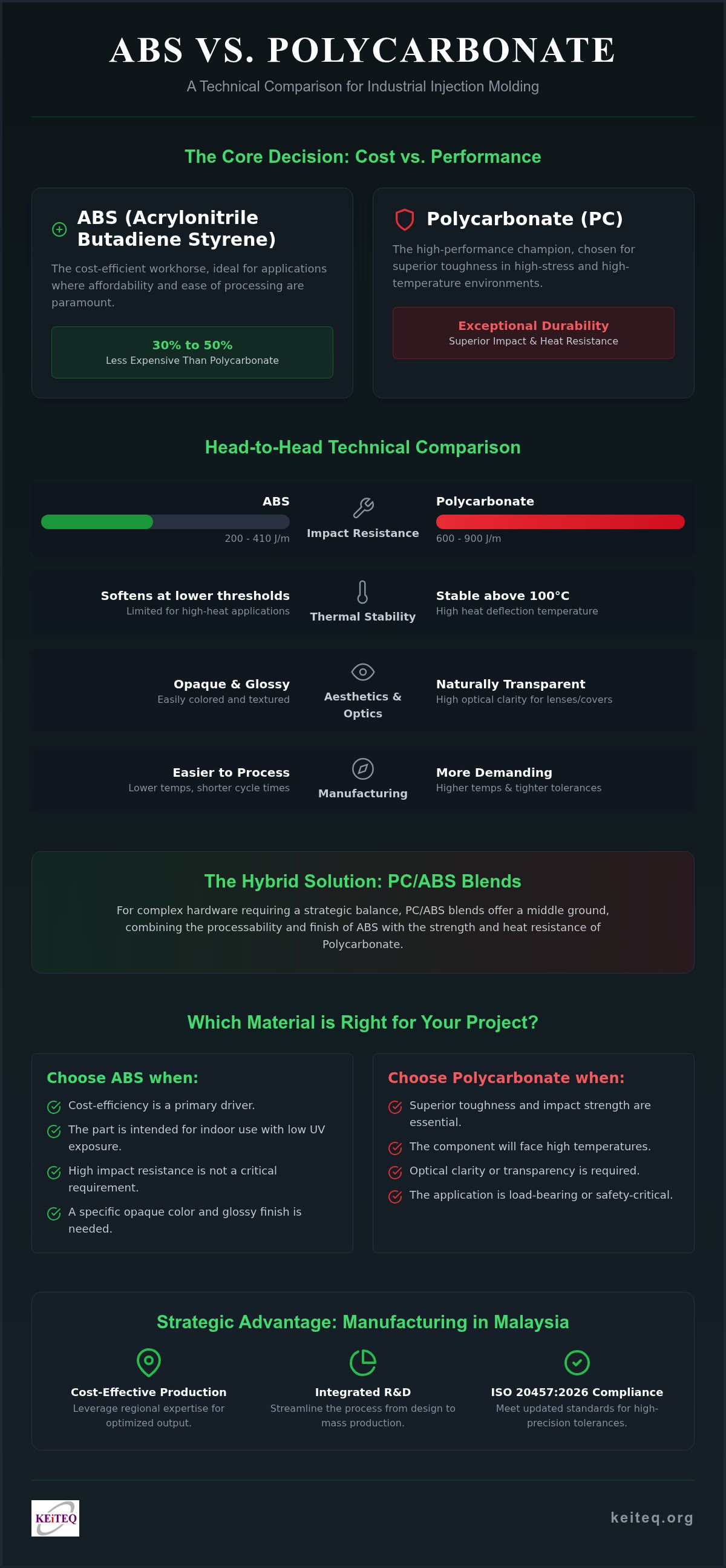
This technical comparison provides a clear decision framework to help you select the optimal thermoplastic for durability and industrial performance. We'll analyze the latest 2026 pricing trends, where ABS remains approximately 30% to 50% less expensive than polycarbonate, and examine how impact strength requirements dictate your tooling investment. You'll gain insights into managing complex geometries and why specialized R&D expertise is critical for successful mass production. We'll also highlight how leveraging manufacturing infrastructure in Malaysia offers a strategic advantage for cost-effective, high-precision output that meets the updated ISO 20457:2026 standards for molded part tolerances.
Table of Contents
Balancing Durability and Cost in Plastic Injection Molding
ABS and Polycarbonate are the primary workhorses for global OEMs. They dominate the market because of their versatile mechanical properties and reliability in high-volume production. The central challenge in ABS vs polycarbonate injection molding selection lies in balancing cost-efficiency against extreme performance requirements. ABS offers affordability and ease of processing. In contrast, Polycarbonate properties provide high impact resistance and thermal stability, making it the preferred choice for components facing high-stress environments. When analyzing ABS vs polycarbonate injection molding, the decision usually hinges on whether the application requires the transparency and heat resistance of PC or the cost-effective rigidity of ABS.
The Strategic Importance of Material R&D
Decisions made during the initial design phase determine the majority of total manufacturing costs. You shouldn't treat material selection as an afterthought. Engineers must validate material assumptions through prototyping and soft tooling to avoid failures in mass production. This stage also allows for the evaluation of PC/ABS blends. These blends combine the processability of ABS with the strength of polycarbonate, offering a strategic middle ground for complex hardware that requires both toughness and aesthetic appeal. Successful product development requires a partner who understands these nuances during the Strategic Product Design Services phase. Using regional expertise in Malaysia for these R&D stages can significantly reduce the lead time between initial concept and final mass production.
Acrylonitrile Butadiene Styrene (ABS) Overview
Acrylonitrile Butadiene Styrene is a terpolymer known for its structural integrity and versatility. The acrylonitrile component provides chemical resistance. Butadiene offers impact strength. Styrene gives the material its characteristic smooth, glossy finish. This combination makes it ideal for consumer electronics, automotive interior trims, and appliance housings. ABS is highly adaptable for coloring and texturing, allowing brands to achieve specific aesthetic goals without secondary finishing. Manufacturers often choose it for high-volume production where cost control is paramount. It remains the preferred choice for parts that don't face extreme UV exposure or high-heat environments. Since it's easier to mold than polycarbonate, it often results in shorter cycle times and lower tooling wear.
ABS vs. Polycarbonate: A Technical Comparison of Physical Properties
Selecting the right thermoplastic requires a granular understanding of how mechanical loads and environmental stressors affect part longevity. In the context of ABS vs polycarbonate injection molding, the differences in physical properties dictate everything from wall thickness to rib design. Polycarbonate (PC) is an amorphous engineering plastic known for its high impact strength and optical clarity. ABS is a versatile terpolymer that prioritizes rigidity and ease of processing. While both materials are common in industrial manufacturing, their performance under stress varies significantly.
Mechanical Strength and Impact Resistance
Polycarbonate is the industry standard for high-security and "bulletproof" applications because of its exceptional energy absorption. According to technical data, PC notched Izod impact strength ranges from 600 to 900 J/m. This is substantially higher than ABS, which typically falls between 200 and 410 J/m. While ABS offers excellent structural rigidity for consumer electronics, it doesn't match the toughness of PC in high-velocity impact scenarios. ABS also tends to become brittle in low-temperature environments, whereas PC maintains its ductile properties. For load-bearing parts, PC provides a higher tensile and flexural modulus, ensuring the component doesn't deform under constant pressure.
Thermal and Chemical Resilience
Thermal stability is a primary differentiator in ABS vs polycarbonate injection molding. PC features a higher glass transition temperature and heat deflection temperature (HDT), allowing it to maintain dimensional stability in environments exceeding 100°C. ABS is more limited, often beginning to soften at lower thresholds. However, ABS often shows superior resistance to certain oils and industrial cleaners that can cause stress cracking in standard polycarbonate. This chemical resilience is a vital consideration for petrol station hardware where exposure to fuels and harsh solvents is a daily occurrence. Manufacturers often use flame-retardant additives in both materials to meet specific UL94 flammability ratings for outdoor or electronic enclosures.
Optical properties and shrinkage also play a role in material selection. PC is naturally transparent, making it ideal for light pipes, lenses, and protective covers. ABS is opaque and better suited for parts where internal components must be hidden. Regarding precision, PC has a lower shrinkage rate during the cooling process, which supports the tight tolerances required by the ISO 20457:2026 standard. If you're struggling to balance these technical requirements with your budget, you can contact our engineering team for a material compatibility analysis.
Performance in Outdoor and Industrial Environments
Environmental stressors are the primary cause of material failure in field-deployed hardware. When evaluating ABS vs polycarbonate injection molding, engineers must account for UV radiation and extreme temperature fluctuations. Standard ABS lacks inherent UV stability. Prolonged exposure to direct sunlight causes photo-oxidation. This leads to surface yellowing and a significant loss in impact strength over time. For long-term outdoor reliability, polycarbonate is the superior choice. Its molecular structure allows it to maintain transparency and structural integrity under constant UV exposure, provided the resin is correctly specified.
Weathering and UV Protection Strategies
Manufacturers often integrate UV stabilizers into polycarbonate resins to extend the lifespan of exposed surfaces. This is critical for components like payment terminal screens and lenses. While pure PC is robust, PC/ABS blends are frequently used for enclosures because they handle fluctuating outdoor temperatures without cracking. These blends offer the thermal stability of PC with the stress-crack resistance of ABS. Effective enclosure design also plays a role. It must prevent moisture ingress while allowing for the thermal expansion common in tropical climates like Malaysia. Our R&D team in Malaysia focuses on these design nuances to ensure internal electronics remain protected throughout the product lifecycle.
Chemical Exposure in Industrial Settings
The industrial environment introduces aggressive chemical stressors that can compromise thermoplastic integrity. In petrol stations, hardware is regularly exposed to petrol, diesel, and high-concentration cleaning solvents. Polycarbonate is vulnerable to certain hydrocarbons, which can lead to crazing or environmental stress cracking (ESC). To mitigate this, we utilize Protective Coatings for Outdoor Electronics, such as ceramic or powder coating. These advanced finishing services provide a secondary barrier against chemical degradation.
For specialized outdoor payment terminal assembly, the choice in ABS vs polycarbonate injection molding involves a multi-layered protection strategy. Using high-grade PC for the main housing provides the necessary weatherability. Secondary finishing ensures the unit remains resistant to industrial chemicals. This integrated approach is essential for hardware deployed in high-traffic fuel retail environments. Our facility in Malaysia manages this entire process, from material selection to final assembly, ensuring that every unit meets the rigorous demands of the global supply chain.
Manufacturing Implications: Mold Design and Processing
Processing temperatures define the primary equipment requirements for ABS vs polycarbonate injection molding. Polycarbonate is a high-heat material, typically requiring melt temperatures between 280°C and 320°C. This necessitates the use of robust, heat-treated steel molds capable of withstanding significant thermal stress over long production cycles. ABS is more forgiving, processing at 220°C to 260°C. These temperature differences directly influence energy consumption and machine selection. Designers must also account for different shrinkage rates. PC has a lower shrinkage rate than ABS, which is beneficial for maintaining the tight tolerances required by the ISO 20457:2026 standard during high-precision assembly.
Optimizing Injection Mold Design
The high viscosity of molten polycarbonate impacts gate and runner design. Gates must be larger to ensure even cavity filling and to prevent premature freezing of the material. Improper design leads to internal stresses, which cause parts to fail or crack under mechanical load. Managing these stresses is a core component of plastic injection mold design in Malaysia. Our engineers prioritize uniform wall thickness to prevent sink marks and warping. We also specify generous draft angles to facilitate part removal. While ABS is relatively easy to eject, PC requires precise mold finishes and larger draft angles to avoid surface marring or drag marks during the ejection phase.
Scaling to Mass Production
Moving from soft tooling prototyping to mass production involves significant economic considerations. ABS generally offers faster cycle times because it cools more quickly than polycarbonate. This speed reduces the cost per part in high-volume runs, making it the preferred choice for cost-sensitive consumer goods. However, for complex hardware like outdoor payment terminals, the durability and thermal stability of PC often justify the longer cooling requirements.
Quality control protocols are strictly enforced at our Malaysia facility to ensure consistency across high-volume OEM components. We utilize real-time sensor data to monitor injection pressures and melt temperatures, ensuring that dimensional accuracy remains within the ±0.02 mm to ±0.05 mm range for specialized applications. This level of precision is vital for maintaining a stable global supply chain and ensuring every unit meets professional standards. To discuss your specific production requirements, you should contact our technical directors for a manufacturing feasibility review and a detailed ABS vs polycarbonate injection molding analysis.
Strategic Procurement: Optimizing Production in Malaysia
Malaysia has solidified its position as a premier destination for high-precision manufacturing. For global OEMs, the region offers a mature ecosystem that combines technical expertise with robust logistical infrastructure. When finalizing the choice between ABS vs polycarbonate injection molding, having a partner with deep regional roots ensures that material sourcing and production management align with international quality standards. The ability to navigate complex international production cycles makes Malaysia a strategic choice for high-volume hardware projects requiring both scale and precision.
Efficiency in mass production often depends on the integration of multiple manufacturing disciplines. Keiteq provides a holistic solution by combining plastic injection molding with metal stamping, diecasting, and advanced finishing services. This multi-material capability is essential for products that require both structural metal frames and durable plastic enclosures. By managing these processes under one roof, we eliminate the logistical friction associated with multiple vendors and significantly reduce the time-to-market for complex hardware assemblies.
Integrated Electronic Manufacturing Services
High-performance hardware requires more than just a molded shell. Our facility specializes in combining precision-molded enclosures with intricate electronic assembly. This integrated approach is particularly valuable for outdoor payment terminal production, where sensitive electronics must be shielded from harsh environmental stressors. Leveraging EMS in Malaysia allows OEMs to benefit from a specialized workforce and a supply chain optimized for electronic components and hardware assembly, ensuring every unit meets rigorous operational standards.
The Keiteq Advantage: Design for Manufacturability (DFM)
Our R&D team applies rigorous Design for Manufacturability (DFM) principles to every project. This stage is where the final decision on ABS vs polycarbonate injection molding is solidified through data-driven analysis. We evaluate the product lifecycle, environmental exposure, and assembly complexity to ensure the chosen material supports seamless mass production. This proactive management minimizes the risk of material failure and optimizes the total cost of ownership. We provide the stability and logistical competence required to manage your global supply chain needs from our specialized Malaysian facilities.
Our Malaysian operations are equipped to handle demanding production schedules while maintaining the highest precision standards. Please submit a Request for Quotation to initiate a technical review of your project. You may also Request to contact us for further details regarding our integrated manufacturing and assembly services in Malaysia.
Optimizing Material Selection for Industrial Scalability
The technical evaluation of ABS vs polycarbonate injection molding is a critical step in securing your product's operational future. While ABS provides an excellent balance of rigidity and cost-efficiency for many applications, polycarbonate is the definitive choice for components requiring extreme impact resistance and thermal stability. Selecting the right material is only the first stage. Successful deployment depends on a partner that can bridge the gap between initial R&D and high-volume mass production.
Keiteq specializes in the assembly of outdoor payment terminals for petrol stations, where durability is non-negotiable. Our end-to-end management services ensure that your design is optimized for manufacturability and scaled with precision. By utilizing our strategic manufacturing hub in Malaysia, you secure a reliable partner capable of managing complex hardware requirements within a global supply chain. We provide the technical expertise needed to navigate the nuances of high-precision molding and integrated assembly.
For high-precision manufacturing and technical R&D support in Malaysia, please Request for Quotation today. We're ready to help you achieve a cost-effective and durable production strategy for your global operations.
Frequently Asked Questions
Is ABS or Polycarbonate better for outdoor use?
Polycarbonate is the superior choice for outdoor applications because of its inherent UV resistance and weatherability. Standard ABS tends to yellow and become brittle when exposed to direct sunlight over time. For specialized hardware like outdoor payment terminals for petrol stations, we specify polycarbonate to ensure long term structural integrity. This material handles extreme temperature fluctuations without the cracking risks associated with lower grade thermoplastics.
Which material is more cost-effective for high-volume injection molding?
ABS is typically the more cost-effective option for high-volume production. It's generally 30% to 50% less expensive than polycarbonate resins. The material also processes at lower temperatures, which leads to faster cycle times and reduced energy consumption. When evaluating ABS vs polycarbonate injection molding for non-critical consumer housings, ABS provides significant logistical and financial advantages without compromising the required aesthetic finish or structural rigidity.
Can I blend ABS and Polycarbonate for better performance?
Yes, PC/ABS blends are a strategic solution for OEMs who need to balance performance and cost. These blends combine the high impact strength and heat resistance of polycarbonate with the superior chemical resistance and processability of ABS. We often recommend these blends for complex electronic enclosures that require durability and a high-quality surface finish. This material choice is a core part of our R&D and design process in Malaysia.
What are the main differences in mold shrinkage between ABS and PC?
Polycarbonate generally exhibits lower and more predictable mold shrinkage compared to ABS. PC shrinkage rates typically fall between 0.5% and 0.7%, while ABS can range from 0.4% to 0.9% depending on the specific grade. This dimensional stability makes polycarbonate the preferred material for high-precision assemblies. It ensures compliance with the ISO 20457:2026 standards for molded part tolerances, which is critical for complex industrial hardware components.
How does Polycarbonate handle high-temperature environments compared to ABS?
Polycarbonate handles high-temperature environments much better than ABS. It maintains its structural integrity at temperatures where ABS would begin to soften or deform. PC has a glass transition temperature of approximately 147°C, whereas ABS typically softens around 105°C. This thermal stability is vital for components housed near heat-generating electronics or those deployed in tropical climates. Our Malaysia-based engineering team validates these thermal requirements during the initial prototyping phase.
What industries typically prefer PC over ABS for enclosures?
Industries that prioritize safety, transparency, and impact resistance typically prefer polycarbonate. This includes medical device manufacturing, where companies like Jett Medical Canada rely on high-performance materials, as well as automotive lighting and the fuel retail sector. We specifically utilize PC for outdoor payment terminal for gas station assemblies because of its toughness and clarity. While ABS is popular for consumer electronics and interior trims, PC is the industrial standard for protective covers, high-security enclosures, and any component facing aggressive physical or thermal stress.
Keiteq provides comprehensive prototyping and soft tooling services for both ABS and polycarbonate components. Our R&D facility in Malaysia allows us to validate material performance before moving to full-scale mass production management. We use these initial runs to test mechanical properties, fitment, and surface finish. This ensures that the final mass-produced parts meet your exact specifications and functional requirements, reducing the risk of costly material failures during the deployment phase.
How does chemical resistance differ between these two thermoplastics?
Chemical resistance profiles differ significantly between these materials. ABS offers better resistance to oils, fats, and some industrial cleaners. Polycarbonate is more sensitive to certain hydrocarbons and solvents, which can cause environmental stress cracking. To ensure your testing protocols are supported by high-quality materials, you can discover RMR Reagents for industrial-grade chemicals and laboratory supplies. However, we mitigate these risks by applying advanced finishing services. We offer ceramic coating and powder coating in Malaysia to provide a robust chemical barrier, ensuring that ABS vs polycarbonate injection molding decisions are supported by a complete protection strategy.
For high-precision manufacturing and specialized R&D in Malaysia, please submit a Request for Quotation to our team. You may also Request to contact us for further details regarding our integrated assembly and production management services for the global market.


Comments