
Industrial Powder Coating Services: The 2026 Guide to Durable OEM Finishing
In today's rapidly evolving manufacturing landscape, where global supply chains are the norm, original equipment manufacturers (OEMs) are fundamentally rethinking surface finishing. No longer merely an aesthetic final step, it's now a core engineering requirement critical for product longevity and performance. You've likely experienced the high costs of corrosion failure in outdoor environments or the logistical headaches caused by inconsistent quality across massive production runs. These challenges often stem from fragmented supply chains where manufacturing and finishing happen in different facilities. Utilizing professional industrial powder coating services is, therefore, no longer just about color; it's about ensuring structural integrity and reliability in the most demanding conditions.
This guide explores how specialized finishing techniques enhance product durability and why an integrated approach to production, especially with strategic global partners, is the most efficient path to long-term reliability for US-based OEMs. We'll show you how to achieve superior wear resistance through advanced coating technologies while maintaining compliance with international standards, including navigating complex environmental regulations like the March 2026 reporting deadlines for hazardous chemicals relevant to global supply chains. You'll also learn why choosing a single-source expert like Keiteq Co Ltd in a key manufacturing region provides the strategic advantage needed for high-volume OEM projects. We’ll cover everything from intelligent manufacturing trends to the technical benefits of combining services such as metal stamping and diecasting with high-performance finishing to secure and optimize your global supply chain.
Key Takeaways
Understand the mechanical bonding science of electrostatic spray deposition to ensure long-term hardware durability and structural integrity.
Learn the critical multi-stage pre-treatment protocols, including phosphating and degreasing, necessary for uniform finish quality on complex diecast parts.
Evaluate performance benchmarks between powder, ceramic, and enamel coatings to select the optimal finish for specific chemical or thermal environments.
Discover why integrating industrial powder coating services within a Malaysian manufacturing hub reduces supply chain fragmentation and improves total cost of ownership.
Gain insights into drafting precise technical specifications that ensure vendor consistency and compliance with 2026 international industrial standards.
Table of Contents
Why Industrial Powder Coating is Essential for Hardware Longevity
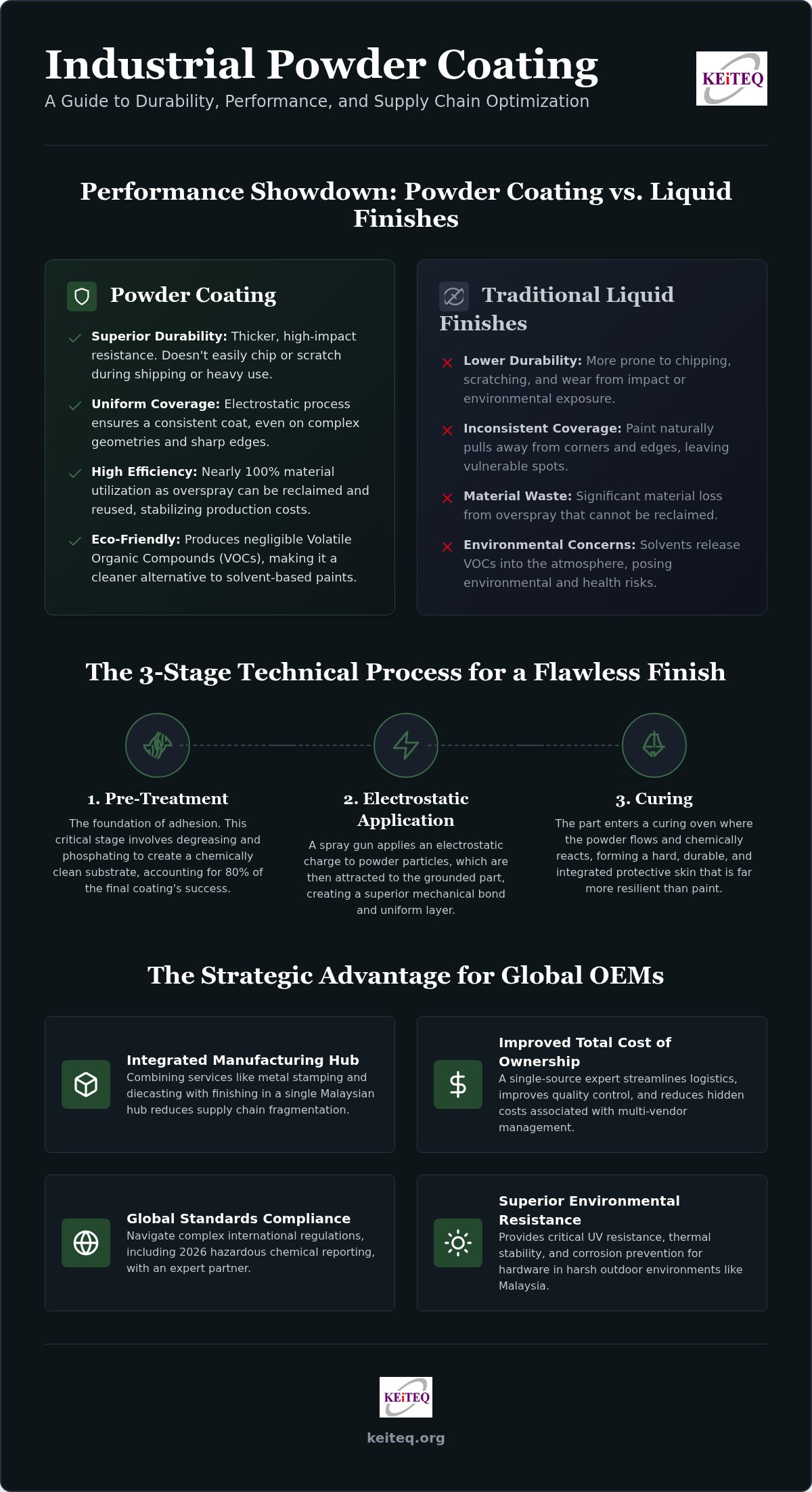
Industrial powder coating services represent a sophisticated dry finishing process that utilizes polymer resin systems. These systems are combined with curatives, pigments, and flow modifiers, which are melted, cooled, and ground into a uniform powder. Unlike traditional liquid paint, this method doesn't require a solvent to maintain the binder and filler parts in a liquid suspension. The result is a high-performance finish that provides a thicker, more resilient layer than conventional spray-on alternatives.
The core of the technology involves electrostatic spray deposition (ESD). During this process, a spray gun applies an electrostatic charge to the powder particles, which are then attracted to the grounded metal part. This creates a superior mechanical bond before the component enters a curing oven. In the oven, the powder flows and chemically reacts to form a hard, durable skin. This specific application of powder coating ensures that the finish is not just a surface layer but an integrated protective barrier.
For global OEMs, the shift toward powder is often driven by environmental and operational efficiency. The process produces negligible Volatile Organic Compounds (VOCs), making it a cleaner alternative to solvent-based paints. Additionally, facilities can reclaim and reuse overspray, which leads to nearly 100% material utilization. This efficiency is critical for maintaining stable production costs in high-volume manufacturing environments, especially when managing complex hardware lifecycles.
The Role of Durability in Outdoor Environments
Outdoor hardware, particularly outdoor payment terminals used in petrol stations, faces constant exposure to harsh UV radiation and extreme thermal fluctuations. In high-humidity regions like Malaysia, untreated metal surfaces are highly susceptible to rapid oxidation and corrosion. Professional industrial powder coating services provide the UV resistance and thermal stability required to prevent surface degradation. This protection is vital for maintaining the structural integrity of the enclosure over years of service. Beyond functional defense, a consistent finish enhances the aesthetic perception of the product, reinforcing a brand's reputation for quality and reliability.
Powder Coating vs. Traditional Liquid Finishes
Traditional liquid finishes often suffer from inconsistent thickness and poor edge coverage. Liquid paint naturally tends to pull away from sharp corners and complex geometries during the drying phase, leaving those areas vulnerable to the elements. In contrast, the ESD process ensures a uniform coating across the entire part. Cured powder coatings offer significantly higher impact resistance compared to air-dried liquid paints, meaning they won't chip or scratch during shipping or heavy field use. For technical directors overseeing sensitive hardware, understanding these differences is as essential as reviewing protective coatings for outdoor electronics to ensure total system reliability.
The Technical Process: From Surface Preparation to Curing
Precision in industrial powder coating services starts long before the spray gun is triggered. The process is a highly regulated sequence of chemical and thermal events designed to ensure a permanent bond between the polymer and the substrate. Adhering to safety and regulatory guidelines is non-negotiable for maintaining facility integrity and ensuring that every batch meets global OEM standards. Keiteq Co Ltd maintains these rigorous standards across its Malaysian facilities to provide global OEMs with predictable, high-performance results.
Pre-Treatment: The Foundation of Adhesion
Surface preparation accounts for roughly 80% of the final coating's success. Without a chemically clean substrate, even the highest quality resin will fail to adhere; this leads to delamination or premature corrosion under environmental stress. A standard industrial pre-treatment line managed by Keiteq Co Ltd involves a multi-stage process:
Degreasing: This stage utilizes alkaline or acidic cleaners to remove fabrication oils, lubricants, and shop dirt from the metal surface.
Rinsing: Multiple rinse stages with deionized water ensure no chemical surfactants or cleaning residues remain on the part.
Phosphating: This chemical reaction creates a conversion coating on the metal, providing a microscopic texture that improves adhesion and acts as a secondary corrosion barrier.
For aluminium and zinc diecasting, chemical etching is the preferred method to achieve a uniform surface profile. Mechanical etching, such as sandblasting, is often reserved for heavier steel components where a more aggressive profile is required. This integrated approach is why working with a plastic and metal component manufacturer like Keiteq Co Ltd-who manages both the casting and the finishing-provides a significant quality advantage over fragmented supply chains.
Precision Application and Curing Parameters
The electrostatic application relies on the workpiece being properly grounded. This grounding creates the electrical potential necessary to attract the charged powder particles into every crevice and recessed area of complex diecast parts. This attraction ensures a consistent wrap-around effect that liquid paints cannot replicate. Once the powder is applied, the parts move to the curing oven where the real transformation occurs.
Curing is the most critical thermal phase. At temperatures typically ranging from 160°C to 200°C, the powder particles melt and undergo a chemical reaction called cross-linking. This creates a high-density polymer network that is significantly more durable than the original powder. Improper management of oven dwell time can lead to under-cured finishes that lack impact resistance or over-cured finishes that become brittle and prone to cracking.
The "Orange Peel" effect is a common surface irregularity where the finish appears textured rather than smooth; professional industrial powder coating services eliminate this through precise control of powder chemistry, application voltage, and heating rates.
Post-curing quality control is rigorous. Technicians perform cross-hatch testing to verify adhesion, salt spray testing to simulate long-term environmental stress, and gloss measurement to ensure aesthetic consistency across the production run. For technical teams looking to optimize these parameters for their specific OEM parts, you can consult with our engineering team for detailed process specifications.
Performance Analysis: Comparing Powder, Ceramic, and Enamel
Selecting the optimal surface finish requires a technical evaluation of the operating environment and mechanical requirements. While industrial powder coating services provide excellent versatility for most OEM applications, certain specialized environments demand the extreme properties of ceramic or enamel. Technical directors must weigh the cost-to-performance ratios carefully to ensure product longevity without inflating production budgets. This decision-making process is most effective when integrated early with a metal stamping manufacturer during the design phase. Keiteq Co Ltd facilitates these engineering consultations to account for substrate compatibility and surface geometry before mass production begins.
When to Specify Ceramic or Enamel Over Powder
Standard powder coatings are suitable for temperatures up to approximately 200°C. In high-heat zones, such as industrial exhaust systems or specific engine components, ceramic coatings are the superior choice. Ceramic finishes maintain structural integrity at much higher thermal thresholds where polymers would otherwise degrade. Conversely, enamel coating is the premier selection for extreme chemical resistance. In petrol station environments, where hardware is exposed to fuel vapors and aggressive cleaning agents, the glass-like surface of enamel provides an impermeable barrier. This durability is essential for the high-traffic surfaces of an outdoor payment terminal. According to the Powder Coating Institute, selecting a finish based on ASTM and ISO durability standards ensures that the component meets specific salt spray and impact resistance benchmarks required for global deployment.
Industrial Coating Selection Framework
A methodical selection framework balances several critical factors. Technical teams must evaluate the specific stressors the hardware will face throughout its lifecycle. Key criteria include:
Environment: Exposure to UV radiation, salt air, or corrosive industrial chemicals.
Substrate Material: Compatibility with aluminium, zinc diecasting, or steel alloys.
Budget: The total cost of ownership, balancing initial application costs against field maintenance.
Aesthetic: Specific requirements for gloss levels and color consistency across high-volume batches.
Keiteq Co Ltd facilitates this selection process by bridging the gap between R&D and the factory floor. By offering electronic manufacturing services in Malaysia alongside finishing capabilities, we ensure the chosen coating doesn't interfere with the assembly or thermal management of internal electronics. This holistic approach prevents common failure points where the coating and the underlying hardware are treated as separate entities. Our engineering teams provide the technical briefing necessary to select a finish that aligns with both functional requirements and logistical constraints.
Strategic Procurement: Specifying Coatings for Global Supply Chains
Consolidating manufacturing and finishing is a strategic move to secure global supply chains and mitigate production risks. When industrial powder coating services are integrated into the primary production hub, OEMs avoid the logistical friction of transporting raw parts between multiple vendors. This approach minimizes the risk of surface contamination and handling damage that occurs during transit. In the 2026 manufacturing environment, procurement officers prioritize partners who offer a steady, experienced presence by managing the entire lifecycle from casting to final finish. Keiteq Co Ltd provides this single-source accountability, ensuring that quality management is maintained from the initial R&D phase through to final logistics.
The Malaysia Advantage for Industrial Finishing
Malaysia provides a unique combination of established industrial infrastructure and a highly skilled technical workforce. This makes it a strategic choice for high-volume finishing projects that require strict adherence to international standards. The cost benefits of the Southeast Asian market allow for competitive pricing on large-scale runs while maintaining high precision. For OEMs managing plastic injection mold Malaysia projects, regional integration ensures that finishing is completed under the same quality management system as the molding process itself. Keiteq Co Ltd utilizes this geographical advantage to simplify logistics and provide a more transparent production timeline for global clients.
Ensuring Quality in High-Volume Production
Maintaining batch-to-batch color consistency is a primary challenge in high-volume production. To address this, professional coating facilities utilize spectrophotometers to measure color values against technical LAB coordinates, ensuring that every part matches the master sample. Technical directors should draft specifications that include clear Delta E tolerances and specific gloss levels to prevent aesthetic drift over time. First Pass Yield in the context of industrial coating is the percentage of components that successfully clear all quality inspections immediately following the curing stage without the need for rework. Keiteq Co Ltd maintains high yield rates as a direct indicator of process stability and technical competence.
Integrating finishing into the broader manufacturing process is critical for complex projects like outdoor payment terminal assembly. When the coating facility is located within the assembly hub, lead times are reduced and communication between engineering teams is instantaneous. This synergy allows for rapid troubleshooting and ensures that the final product meets the durability requirements of the fuel retail sector. To optimize your regional supply chain and secure a reliable finishing partner, you can Request for Quotation to discuss your specific OEM requirements.
Keiteq Co Ltd’s Integrated Manufacturing and Powder Coating Services in Malaysia
Keiteq Co Ltd operates as a specialized partner for global OEMs. We provide end-to-end R&D, design, and mass production management from our manufacturing hubs. Unlike standalone finishing shops, we integrate industrial powder coating services directly into our production workflow. This single-source accountability eliminates the risks associated with fragmented supply chains. We act as a Global Facilitator, ensuring that the engineering intent established during the design phase is executed perfectly on the factory floor. Our role is to serve as a steady, experienced partner for companies requiring disciplined production and logistical competence.
Our expertise is particularly evident in the production of outdoor payment terminals for the fuel retail sector. These units require extreme durability against environmental stressors and heavy public use. By managing the full assembly and coating in-house, we ensure that every enclosure meets rigorous mechanical and aesthetic standards before deployment. This integrated approach provides a "Safe Pair of Hands" for complex projects where failure isn't an option.
From Prototype to Mass Production
We use the prototype phase to validate coating specifications before moving to high-volume runs. Testing at this stage allows our engineers to refine pre-treatment protocols and curing parameters specific to your part's geometry. This methodical transition ensures that mass production maintains the same precision as the initial sample. Scaling finishing processes without sacrificing durability requires the structured sequences we've perfected over years of operation. For a deeper look at our holistic process, refer to our guide on end-to-end product manufacturing.
Request to contact us for further details
Leveraging our facility in Malaysia provides OEMs with a cost-effective, high-quality solution for complex industrial finishing. Our regional presence serves as a dependable pillar for international supply chains, offering stability and logistical competence. We invite you to engage with our technical team to discuss your project requirements and how our integrated services can improve your product lifecycle. Our team is ready to provide the professional guidance needed for your next industrial project in the Southeast Asian market.
Securing Long-Term Hardware Reliability with Integrated Finishing
Achieving superior durability for industrial components requires a shift from viewing finishing as an afterthought to treating it as a strategic engineering priority. This guide has detailed how technical precision in pre-treatment and curing directly influences the longevity of hardware in harsh environments. By choosing a partner that integrates industrial powder coating services within a broader manufacturing ecosystem, OEMs gain single-source accountability and streamlined logistics.
Keiteq provides the stability and technical expertise necessary for complex global supply chains. Our facility in Malaysia serves as a strategic hub, combining end-to-end R&D and design integration with specialized outdoor payment terminal expertise. This holistic approach ensures that every part meets rigorous international standards while maintaining cost-efficiency for high-volume production. We understand the intricacies of the factory floor and the requirements of the boardroom, positioning us as a dependable pillar in your production cycle. We invite you to leverage our regional presence to secure a reliable, high-performance finish for your next project.
Frequently Asked Questions
What are the primary benefits of industrial powder coating over liquid paint?
Industrial powder coating services provide significantly higher resistance to chipping, scratching, and fading compared to liquid paint. The electrostatic application ensures a uniform, thick protective layer even on sharp edges and complex geometries. Because the process uses dry powder instead of solvent-based liquids, it emits negligible volatile organic compounds (VOCs). This method allows for nearly 100% material utilization through reclaimed overspray, making it a sustainable and cost-effective choice for mass production.
How does Keiteq ensure coating consistency for high-volume OEM orders?
Consistency is maintained through integrated mass production management and rigorous quality control protocols. We utilize spectrophotometers to measure color values against technical coordinates, ensuring batch-to-batch uniformity across high-volume runs. By managing both the component fabrication and the finishing process in our Malaysia facility, we eliminate the variables introduced by third-party vendors. This single-source approach guarantees that every unit meets precise aesthetic and functional specifications throughout the entire manufacturing lifecycle.
Can powder coating be applied to both plastic and metal components?
Keiteq provides powder coating primarily for metal components like aluminium and zinc diecastings. For plastic parts, we offer specialized plastic injection molding services. While some heat-stable plastics can be powder coated using specialized low-cure resins, we typically recommend selecting the finishing process that best matches the substrate material. Our engineering team assists in determining whether powder, enamel, or ceramic coatings are most appropriate for your specific metal or plastic hardware requirements.
What is the typical lead time for industrial powder coating services in Malaysia?
Lead times are highly dependent on batch volume, part complexity, and current production schedules. However, integrating industrial powder coating services within our Malaysian manufacturing hub significantly reduces total turnaround time by eliminating the need for transit between separate fabrication and finishing facilities. Our streamlined process from prototyping to mass production ensures efficient throughput. For a precise timeline based on your project specifications, we recommend direct consultation with our logistics and production management teams.
How do I choose between powder, enamel, and ceramic coatings for outdoor hardware?
The choice depends on specific environmental stressors and thermal requirements. Powder coating provides excellent general durability and UV resistance for most outdoor applications. Ceramic coatings are specified for extreme high-heat zones where standard polymers would degrade. Enamel coating is the premier choice for hardware requiring maximum chemical resistance, such as surfaces exposed to fuel vapors at petrol stations. Our R&D team evaluates these factors during the design phase to recommend the optimal cost-to-performance ratio.
What surface preparation standards does Keiteq follow for diecast parts?
We adhere to rigorous industrial pre-treatment standards to ensure maximum coating adhesion on aluminium and zinc diecast components. This involves a multi-stage process including alkaline degreasing to remove fabrication oils, followed by multiple deionized water rinses. We then apply a chemical conversion coating, such as phosphating, to create a microscopic surface profile. This preparation is critical for preventing oxidation and ensuring that the final finish remains stable in high-humidity or corrosive outdoor environments.
Are the powder coating services in Malaysia compliant with US and EU environmental standards?
Yes, our operations comply with international environmental and safety standards. We manage hazardous chemical reporting in strict accordance with Malaysian CLASS Regulations, including the 2026 submission deadlines for the Chemical Information Management System (CIMS). Our powder coating process is inherently more environmentally friendly than liquid alternatives because it's solvent-free and minimizes waste. This compliance ensures that components finished in our Malaysia facility are ready for seamless integration into global supply chains serving US and European markets.
How does powder coating improve the lifespan of petrol station payment terminals?
Powder coating provides a resilient physical barrier that protects petrol station hardware from constant exposure to UV radiation and thermal cycling. The cured polymer skin is highly resistant to the impacts and abrasions common in high-traffic retail environments. By preventing moisture and oxygen from reaching the underlying metal, the coating stops the oxidation process that leads to structural failure. This durability ensures that outdoor payment terminals maintain their functional integrity and aesthetic appearance over years of continuous field service.


Comments