
Guide to Flame Retardant Plastic Injection Molding
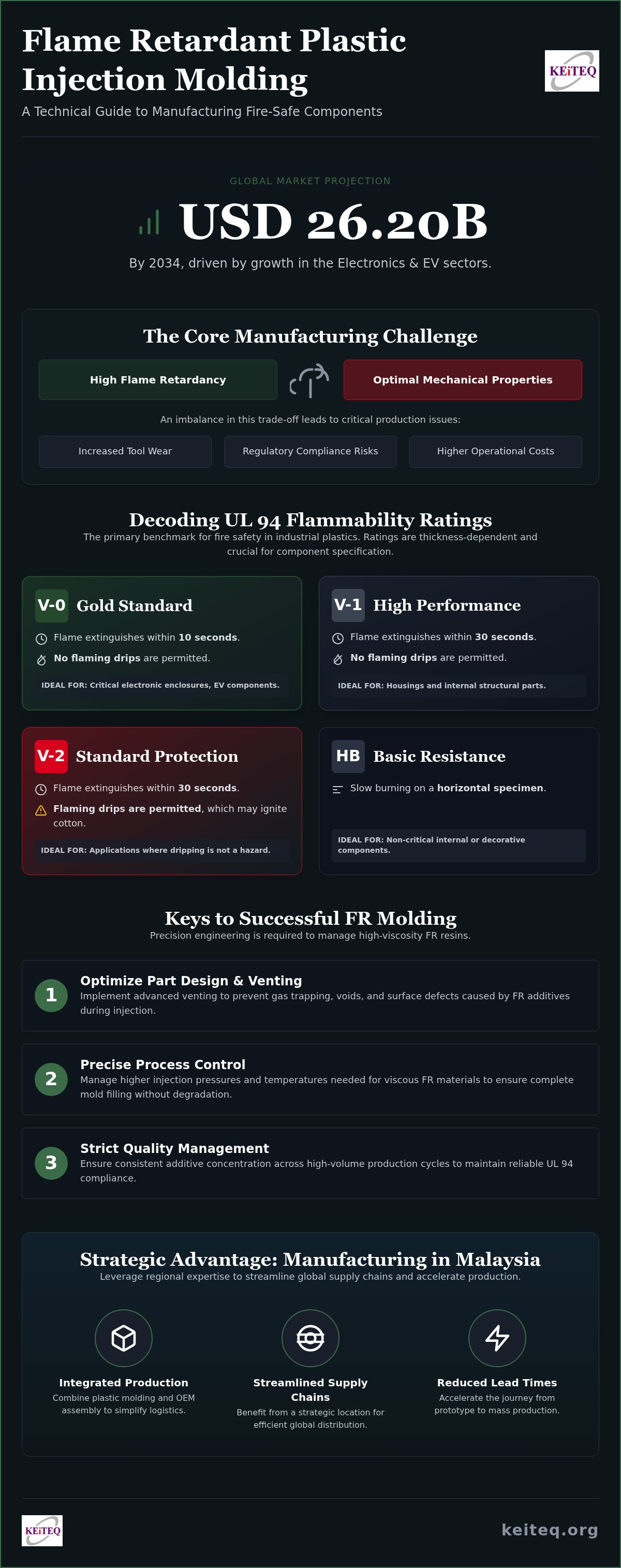
The global flame retardant plastic market is projected to reach USD 26.20 billion by 2034, driven largely by the rapid growth of the electronics and EV sectors in Malaysia. This expansion places immense pressure on manufacturers to master flame retardant plastic injection molding without sacrificing the structural integrity of their components. As regulatory bodies tighten fire safety requirements, engineers must adapt to increasingly complex material standards to remain competitive.
You likely understand the frustration of balancing abrasive flame retardant additives against the necessary mechanical properties of your resin. It's a difficult trade-off that often leads to high tool wear and concerns about regulatory compliance for global markets. These technical hurdles can stall your production timelines and increase long-term operational costs if they aren't managed with engineering precision.
This guide shows you how to master the technical requirements and manufacturing strategies for fire-safe plastic components in 2026. We provide a clear framework for selecting the right FR-grade polymers while ensuring verified compliance with UL 94 Edition 7 and IEC TR 60695-11-40:2026 standards. You'll also learn how to leverage regional production expertise in Malaysia to reduce lead times from prototype to mass production.
Table of Contents
Understanding Flame Retardant Plastic Injection Molding for Industrial Safety
Flame retardant plastic injection molding is a specialized manufacturing process that utilizes thermoplastic resins enhanced with fire-inhibiting additives. These additives, which include phosphorus-based compounds or halogenated chemicals, are engineered to delay ignition, slow flame propagation, and reduce smoke toxicity during a fire. For global OEMs, this process is a foundational element of Integrated Product R&D and Manufacturing. It ensures that sensitive electronic assemblies remain safe under extreme thermal stress or electrical failure conditions.
Industrial safety requirements have evolved. It's no longer sufficient to simply house electronics in a durable casing; that casing must actively resist combustion. This is especially critical for equipment installed in high-traffic or hazardous environments. By utilizing flame retardant plastic injection molding, manufacturers can produce components that meet rigorous safety certifications while maintaining the complex geometries required for modern hardware design. For those developing high-performance hardware, you can visit E-Circles LLC to learn more about their AI infrastructure and GPU server solutions.
The Role of FR Plastics in Modern Hardware
In sectors such as EV charging infrastructure, aerospace, and outdoor payment terminal assembly, the enclosure acts as the first line of defense. High-performance FR plastics are essential for protecting internal circuitry from external ignition sources and containing internal electrical fires to prevent catastrophic spread. These materials are vital for public-facing equipment, such as kiosks and petrol station terminals, where fire safety directly impacts liability and user protection. Adherence to UL 94 standards provides a verified benchmark for flammability, ensuring that materials are tested for performance at specific wall thicknesses and orientations.
Why Material Choice Dictates Manufacturing Strategy
Selecting a flame retardant resin fundamentally alters the production cycle. FR additives change the physical and chemical behavior of the molten plastic, often increasing viscosity and requiring higher injection pressures. There's a documented trade-off between achieving a high fire rating and maintaining mechanical properties like impact resistance. Engineers must account for these variables during the design phase to avoid brittle parts or aesthetic defects. Utilizing experienced plastic injection molding services in Malaysia allows OEMs to navigate these material complexities through precise process control and advanced tooling strategies. The core purpose of FR molding in industrial safety is to provide a predictable thermal barrier that inhibits combustion while preserving the structural integrity of critical electronic enclosures.
Navigating Flame Retardant Materials and UL 94 Standards
Selecting the right polymer for flame retardant plastic injection molding requires a deep understanding of the 2026 regulatory landscape. In January 2026, the European Chemicals Agency initiated a call for evidence regarding restrictions on non-polymeric aromatic brominated flame retardants under REACH. This shift compels manufacturers to account for the environmental and health impacts of their material choices. Most industrial OEMs are now transitioning toward non-halogenated, phosphorus-based additives to ensure long-term compliance and global market access.
Decoding the UL 94 Fire Safety Ratings
The UL 94 Edition 7 standard, published in July 2026, remains the primary benchmark for fire safety in industrial plastics. Procurement teams must specify the exact rating required for their application, as these ratings are thickness-dependent. A material that achieves a V-0 rating at 1.5 mm may fail at thinner dimensions. The primary vertical burn ratings include:
V-0: This is the gold standard for electronics. It requires flames to extinguish within 10 seconds and prohibits flaming drips.
V-1 and V-2: These ratings allow for burn durations up to 30 seconds. V-2 is distinct because it permits flaming drips to ignite surgical cotton during testing.
HB: This horizontal burn rating is typically reserved for non-critical internal components or decorative parts where fire risk is minimal.
Common Resins Used in FR Injection Molding
Material performance varies significantly when fire-inhibiting additives are introduced. PC/ABS blends are widely used for enclosures in outdoor payment terminals because they combine the heat resistance of Polycarbonate with the excellent processability of ABS. For mechanical components requiring high tensile strength, FR-grade Polyamides (Nylon) are preferred. Specialty high-performance polymers, such as glass-fiber reinforced PBT, are essential for extreme environments where UV stability and chemical resistance are mandatory. Mastering flame retardant plastic injection molding involves balancing these fire ratings with the physical durability required for the field.
Material selection isn't just about safety; it's a strategic manufacturing decision that impacts your entire supply chain. Keiteq assists clients during the Product Design Services phase to identify resins that meet UL 94 Edition 7 standards without compromising part geometry or cycle times. This collaborative approach ensures your components are both fire-safe and cost-effective to produce. If you need assistance identifying the best resin for your specific application, you can contact our engineering team for expert guidance.
Critical Design Considerations for Molding Flame Retardant Resins
Flame retardant plastic injection molding isn't a standard "plug-and-play" process. The chemical additives that provide fire resistance also fundamentally alter the polymer's flow properties. Most FR resins exhibit significantly higher viscosity than their non-FR counterparts. This requires higher injection pressures and temperatures, which can strain the mold and the injection machine. If the mold isn't engineered for these specific rheological behaviors, the final parts will suffer from incomplete fills or internal stresses that compromise long-term durability.
Venting and Gas Management
FR materials outgas aggressively during the heating phase as the fire-inhibiting additives begin to activate. If these gases aren't evacuated from the cavity, they become trapped and compressed. This leads to the "diesel effect," where compressed gas ignites and leaves permanent burn marks on the part surface. Effective injection mold design must include strategically placed, high-capacity vents. These vents are often deeper and wider than standard designs but must be precisely toleranced to prevent flash. Our engineering teams use flow simulation to identify where these gas traps are likely to occur before the first steel is cut.
Managing Shrinkage and Warpage
Additives like glass fibers or mineral fillers are often added to FR resins to recover mechanical strength lost to the fire retardant chemicals. These fillers create non-uniform cooling rates within the part. This often leads to differential shrinkage and warpage, especially in large enclosures for outdoor payment terminals. Designers should prioritize the following best practices:
Maintain uniform wall thicknesses to ensure consistent cooling across the part geometry.
Utilize generous radii on all corners to mitigate internal stress concentrations.
Incorporate ribbing for structural support instead of increasing wall thickness.
The presence of glass fibers or minerals in many FR-grade resins turns the molten plastic into an abrasive slurry. This slurry erodes the gate areas and runner systems of the mold over time. To maintain part quality through thousands of cycles, we utilize high-chromium or hardened tool steels. Our manufacturing hub in Malaysia specializes in these complex setups, providing the necessary precision for industrial-scale production. We recommend using soft tooling during the R&D phase to test how specific FR resins behave under pressure before finalizing the permanent mold design. This methodical approach ensures that the final mass-produced components meet strict tolerances and safety standards.
Ensuring Compliance and Quality in High-Volume Production
High-volume manufacturing of fire-rated components requires a level of procedural discipline that goes beyond standard molding. The primary challenge in flame retardant plastic injection molding at scale is maintaining lot-to-lot consistency. If the concentration of FR additives varies even slightly between material batches, the fire safety of the entire production run is compromised. This is why Keiteq implements a rigorous Mass Production Management framework. It ensures that every component, from the first to the ten-thousandth, meets the exact flammability specifications defined during the R&D phase.
Quality Control Protocols for FR Molding
Consistent quality begins before the resin ever reaches the hopper. FR resins are notoriously hygroscopic; they absorb moisture from the air, which can cause hydrolytic degradation during molding. We enforce strict moisture control and material verification protocols to prevent brittle parts. During the cycle, our engineers monitor melt temperature and injection pressure in real-time. Overheating FR additives can lead to chemical breakdown, which reduces fire resistance and releases corrosive gases. Post-production, we conduct regular burn tests and mechanical stress evaluations to verify that parts meet UL, RoHS, and REACH requirements. This comprehensive documentation is essential for global OEMs navigating international trade regulations.
From Prototype to Mass Production
Transitioning from a functional prototype to a high-volume assembly is a complex engineering task. This is especially true for outdoor payment terminal assembly, where the enclosure must integrate seamlessly with internal electronics and secondary hardware. To enhance durability in harsh environments, we often integrate protective coatings for outdoor electronics directly into the production workflow. We also focus on tool longevity. Abrasive FR resins can erode mold surfaces quickly. We use specialized tool coatings and a proactive maintenance schedule to ensure dimensional stability remains within tolerance throughout the life of the project. This methodical approach minimizes downtime and keeps your supply chain moving at a steady pace.
If you are ready to scale your fire-safe hardware production, you can contact us for a detailed consultation on our mass production capabilities.
Strategic Manufacturing in Malaysia: Scaling FR Production with Keiteq
Malaysia has emerged as a premier destination for global OEMs seeking high-precision manufacturing. The nation's plastics market, valued at USD 4.19 billion in 2026, supports a mature ecosystem of specialty compounders and technical experts. For companies requiring flame retardant plastic injection molding, the region offers a unique combination of technical proficiency and logistical efficiency. By sourcing from this hub, US-based organizations can diversify their supply chains while maintaining strict adherence to international safety standards.
The Malaysian Manufacturing Advantage
The industrial infrastructure in Malaysia is built for scale and precision. A highly skilled engineering workforce provides the technical oversight necessary for complex FR projects. Unlike many emerging markets, Malaysia maintains a stable trade environment and established logistics corridors that facilitate seamless exports to North America and Europe. These plastic injection molding services in Malaysia provide a competitive cost structure without compromising the quality of the final product. The region's focus on high-value applications, such as 5G infrastructure and EV components, ensures that local facilities stay at the forefront of material science.
Keiteq’s End-to-End Solutions in Malaysia
Keiteq operates as a steady, experienced partner for OEMs needing integrated production. Our facilities provide more than just molding; they offer a comprehensive suite of electronic manufacturing services in Malaysia. This includes everything from initial R&D and design to the final assembly of outdoor payment terminal units. By consolidating these services under one roof, we eliminate the communication gaps that often occur when managing multiple vendors across different regions.
Our Malaysian operations are specifically geared toward the complexities of flame retardant plastic injection molding and fire-rated hardware. We manage the entire lifecycle of your product, including tool design, material validation, and secondary finishing. This integrated approach ensures that your components arrive ready for the field, fully compliant with UL 94 standards and RoHS directives. Whether you are developing a new kiosk enclosure or scaling an existing line of industrial hardware, our regional expertise provides a direct path to market with reduced lead times.
To begin your next project with an experienced manufacturing partner, you can submit a Request for Quotation to our team. We are ready to assist with your specific production requirements in the Malaysian market. If you have technical questions regarding material selection or assembly logistics, please Request to contact us for further details.
Advancing Industrial Safety with Precision Molding
Achieving fire safety in industrial hardware requires a methodical approach that balances material chemistry with engineering precision. Successful flame retardant plastic injection molding depends on selecting the right FR-grade resins and implementing advanced mold designs to manage outgassing and tool wear. By aligning your production with the latest UL 94 Edition 7 standards, you ensure global compliance and operational reliability for your most critical components.
Keiteq serves as a steady, experienced partner for these complex processes. We offer a holistic approach that includes comprehensive R&D and design through to mass production management. Our specialized capabilities in outdoor payment terminal assembly and advanced industrial finishing ensure that your products are durable, compliant, and ready for the global market. We prioritize functional trust and logistical competence in every project we undertake.
For high-precision industrial manufacturing, Request for Quotation or Request to contact us for further details regarding our services in Malaysia. We look forward to securing your supply chain with proven manufacturing methodologies and a commitment to technical excellence.
Frequently Asked Questions
What are the most common flame retardant plastics used in injection molding?
Common materials include Polycarbonate/ABS blends, Polyamides, and Polybutylene Terephthalate (PBT). These resins are frequently used in flame retardant plastic injection molding for their balance of thermal stability and mechanical strength. For high-performance applications, specialty blends with glass fiber reinforcement are preferred. Non-halogenated additives are increasingly favored to meet global environmental regulations like REACH. Keiteq validates these material choices during the initial design phase to ensure they meet your specific industrial requirements.
How does UL 94 V-0 differ from V-2 in practical applications?
UL 94 V-0 is the preferred standard for critical electronic enclosures. It requires the plastic to stop burning within 10 seconds without producing flaming drips. In contrast, a V-2 rating allows the material to drip flaming particles that may ignite surgical cotton during testing. While V-2 is acceptable for some internal components, V-0 provides the highest level of safety for public-facing equipment like outdoor payment terminals where fire containment is mandatory.
Can flame retardant additives affect the appearance of the final molded part?
Yes, FR additives often alter the visual quality of the part. Increased viscosity can lead to flow marks or splay, while outgassing may cause surface pitting if venting is insufficient. To address these aesthetic challenges, Keiteq provides advanced industrial finishing services. We offer powder coating, enamel, and ceramic coatings to ensure that your fire-rated enclosures maintain a professional appearance and physical durability even in harsh outdoor environments.
Why is moisture control critical when molding flame retardant resins?
Moisture control is essential because most FR resins are hygroscopic. If moisture is present during the molding process, it causes hydrolytic degradation, which breaks down the polymer chains. This results in brittle components and significantly reduced flame retardancy. Keiteq implements strict material drying and verification protocols in our Malaysian facilities. We ensure that resins reach the target moisture content before entering the hopper to maintain the structural integrity of the final part.
How do flame retardant additives impact the lifespan of an injection mold?
FR additives, particularly mineral fillers and glass fibers, are highly abrasive. They accelerate the erosion of gates, runners, and cavity surfaces within the mold. Additionally, the outgassing of fire-inhibiting chemicals can cause corrosive wear on tool steels. Keiteq manages this by utilizing high-chromium, hardened steels and specialized tool coatings. Our proactive maintenance schedules in Malaysia ensure that molds retain their dimensional precision throughout high-volume mass production cycles.
What regulatory certifications are necessary for fire-rated plastic enclosures in the USA?
Fire-rated enclosures sold in the USA must primarily comply with UL 94 flammability standards. Depending on the industry, they may also require RoHS and REACH certifications to verify the absence of hazardous substances. For equipment used in public spaces, such as petrol station terminals, additional evaluations like glow-wire testing may be necessary. Keiteq provides the necessary documentation and quality control management to ensure your products meet these global compliance benchmarks.
Does Keiteq provide prototyping for flame retardant plastic parts in Malaysia?
Keiteq provides comprehensive prototyping and soft tooling services within our Malaysian manufacturing hub. We specialize in bridging the gap between initial R&D and mass production for complex FR components. Our team manages the entire lifecycle, from design validation to material testing, ensuring that your prototypes accurately reflect the performance of the final mass-produced part. This regional focus allows for rapid iteration and reduced lead times for global OEM partners.
What is the average lead time for mass production of FR plastic components?
Lead times for mass production vary based on mold complexity and material availability. However, Keiteq utilizes an integrated manufacturing approach in Malaysia to streamline the transition from design to full-scale production. By managing R&D, tooling, and assembly in a single regional hub, we significantly reduce the logistical delays associated with multi-vendor supply chains. We provide detailed timelines during the initial consultation to ensure your project stays on schedule for market launch.


Comments