
Choosing a Plastic and Metal Component Manufacturer for Complex Industrial Hardware in 2026
Updated: Jul 7
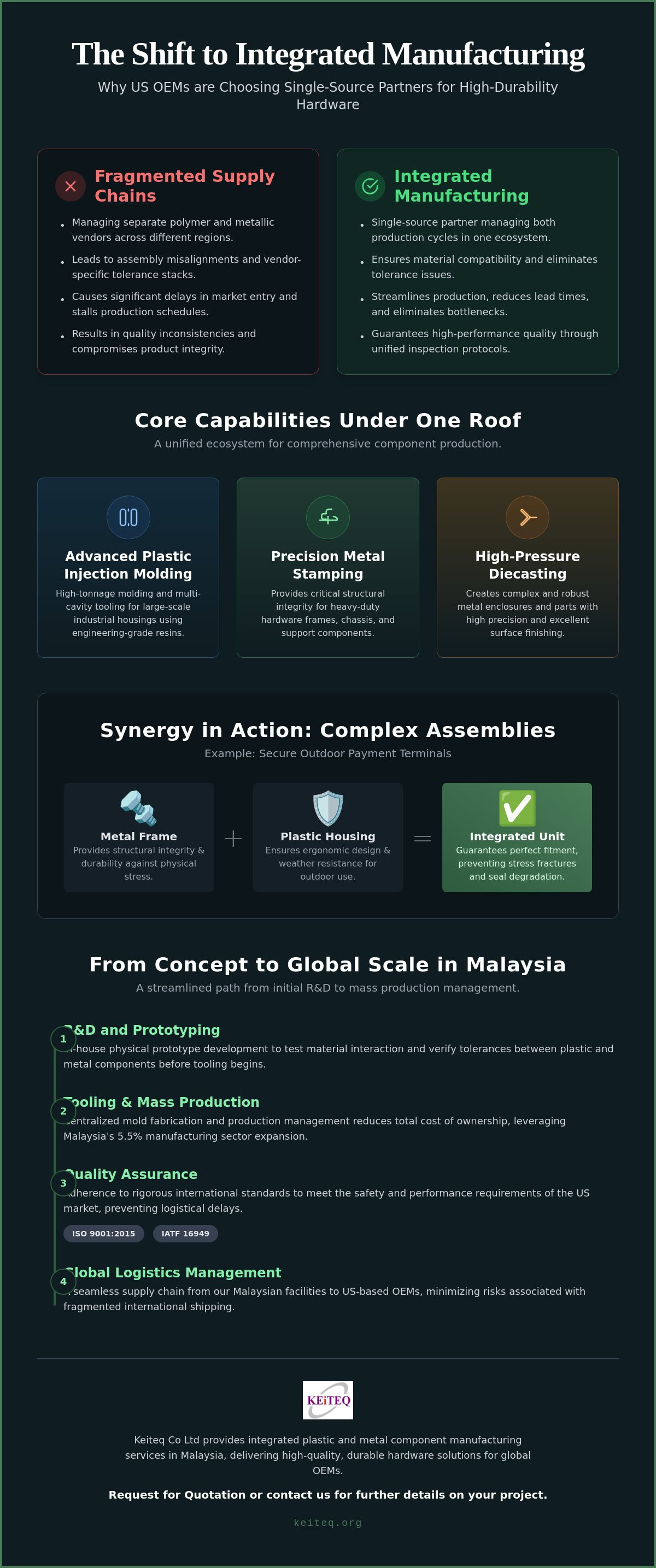
Fragmented supply chains represent the most significant hidden cost in modern industrial hardware production. For US-based OEMs, the logistical burden of managing separate polymer and metallic vendors often results in assembly misalignments and delayed market entry. Partnering with an integrated plastic and metal component manufacturer is now a fundamental requirement for companies aiming to meet the rigorous durability standards of 2026. This shift reflects a broader industry move toward single-source procurement to eliminate the quality inconsistencies that often plague complex, multi-material assemblies.
You've likely encountered the frustration of a precision metal frame that doesn't quite seat within its plastic housing due to vendor-specific tolerance stacks. It's a preventable issue that compromises the integrity of high-stakes hardware. This article demonstrates how integrated manufacturing streamlines production, reduces lead times, and ensures high-performance component quality for global OEMs. We'll examine the technical synergy of dual-material production, the requirements for secure outdoor payment terminals, and the path from initial prototyping to high-volume mass production.
Table of Contents
What is an Integrated Plastic and Metal Component Manufacturer?
An integrated plastic and metal component manufacturer is defined by its capacity to manage both polymer and metallic production cycles within a single engineering ecosystem. Historically, technical directors for US-based OEMs sourced these parts from separate facilities, often across different time zones. By 2026, the industry standard has shifted toward single-source procurement to meet the sophisticated demands of high-durability industrial hardware. This integration isn't just a logistical convenience; it's a technical necessity that ensures the structural integrity of the final product. Unified material synergy is the primary driver of durability for components that must endure decades of operational stress.
Working with a single partner reduces the logistical friction that typically stalls production schedules. Instead of coordinating disparate quality control standards, you benefit from a unified inspection protocol that covers the entire assembly. This oversight ensures that the thermal expansion of a metal frame is accounted for in the design of the plastic housing, preventing stress fractures in the field. This level of technical synchronization optimizes material compatibility and eliminates the friction that occurs when components from different vendors fail to interface correctly during final assembly.
The Evolution of Multi-Material Manufacturing
The industry has transitioned from siloed production to integrated R&D-led manufacturing hubs. Modern hardware, such as IoT devices and secure kiosks, requires a sophisticated blend of structural metal frames and ergonomic plastic housings. Success in these projects depends on early-stage collaboration. Utilizing integrated product R&D and manufacturing allows engineers to select materials based on their interaction rather than their individual properties. This foresight prevents common failures in the field, such as seal degradation or fitment issues between dissimilar materials.
Key Processes Under One Roof
A comprehensive plastic and metal component manufacturer maintains diverse technical capabilities, including Advanced Plastic Injection Molding, precision metal stamping, and high-pressure diecasting. Consolidating these processes allows for the immediate verification of tolerances. Developing a physical prototype in-house is critical for testing how plastic bezels seat into metal enclosures. Integrated planning also extends to surface treatments. When specialized finishes like enamel or ceramic coatings are required, having the metal fabrication and coating lines in the same facility ensures procedural accuracy across the entire assembly.
Advanced Plastic Injection Molding Services for US Industrial Hardware
Securing high-precision plastic injection molding services is a priority for US-based OEMs managing complex hardware portfolios. A plastic and metal component manufacturer must offer high-tonnage molding and multi-cavity tooling to handle the scale of heavy-duty industrial housings. This technical capacity is supported by a 5.5% expansion in the manufacturing sector as of March 2026, providing the industrial ecosystem needed for large-scale deployments. These machines allow for the production of large-scale parts using engineering-grade resins while maintaining strict consistency across thousands of cycles, ensuring that every unit meets the same mechanical standard.
Optimizing plastic injection mold production is essential for long-term cost efficiency and supply chain stability. Adhering to international quality standards, such as ISO 9001:2015 and IATF 16949, ensures that components meet the rigorous safety and performance requirements of the US market. This procedural accuracy prevents the logistical delays associated with non-compliant parts, allowing for a seamless transition into mass production. By centralizing mold fabrication and production management, you reduce the total cost of ownership and minimize the risks associated with fragmented international logistics.
Precision and Scale in Polymer Production
Industrial enclosures require tight tolerances to ensure seamless integration with sensitive internal electronics. Achieving these specifications depends on advanced mold design that accounts for material shrinkage and flow dynamics. Transitioning from soft tooling to high-volume mass production is a critical phase where engineering expertise prevents costly failures. Complex geometries, common in modern payment terminals, require sophisticated cooling systems within the mold to maintain structural integrity and part stability. If you're looking to optimize your assembly for high-volume output, you can contact us for a technical review of your current specifications.
Material Selection for Industrial Durability
Precision Metal Stamping and Diecasting for Heavy-Duty Applications
Metal componentry provides the structural backbone for industrial hardware. While previous sections detailed the protective role of polymers, a plastic and metal component manufacturer must equally excel in metal fabrication to ensure total unit reliability. Metal stamping is the primary method for creating high-strength structural frames designed to withstand physical stress and environmental pressures. These frames provide the necessary structural integrity for outdoor kiosk hardware, ensuring the unit remains rigid and secure against physical impact or heavy usage. Achieving this level of durability requires a deep understanding of metal behavior under high-speed production conditions.
Dimensional accuracy is paramount when executing high-speed stamping for thin-gauge parts. Even a minor deviation in a metal bracket can prevent a plastic bezel from seating correctly, which often leads to moisture ingress or assembly failure. Integrated manufacturers avoid these issues by cross-verifying metal and plastic tolerances in real-time during the design phase. Selecting the right diecasting process is also a critical decision for weight and complexity management. Aluminium and zinc offer distinct advantages depending on the mechanical requirements of the component and its intended operating environment.
High-Volume Metal Stamping Capabilities
Mass production efficiency is achieved through progressive die stamping. This process allows for the rapid creation of custom metal stamping parts, including internal electronic chassis and EMI/RFI shielding components. Maintaining quality control for these high-stress industrial components involves rigorous inspection of material hardness and precision bending angles. These measures ensure that every frame produced in Malaysia meets the strict mechanical requirements of global OEMs, providing a stable foundation for the entire assembly.
Specialized Diecasting for Intricate Components
Diecasting is essential for components that require intricate internal geometries and high physical durability. Aluminium diecasting is the preferred choice for lightweight enclosures that must dissipate heat generated by internal processors. Zinc diecasting is utilized for smaller, high-precision mechanical parts where dimensional stability is the primary concern. After the initial casting, post-casting machining and finishing steps are applied to meet OEM standards for surface smoothness and fitment. This methodical approach ensures that every diecast part integrates perfectly with its plastic counterparts.
The Synergy of Integrated Manufacturing for Complex Assemblies
The primary objection to single-source manufacturing often stems from a perceived lack of specialization. However, integrated partners consistently outperform multi-vendor strategies by eliminating the technical gaps that occur between disparate components. When a single plastic and metal component manufacturer manages the entire bill of materials, the risk of assembly failure is virtually zero. This synergy is most evident in the production of an outdoor payment terminal. These units require a precision-stamped metal enclosure for security and a high-impact plastic bezel for user interaction and signal transparency.
Managing the intersection of these materials requires advanced techniques like overmolding services for electronics. This process creates a seamless, watertight seal between the polymer and metal interfaces, protecting the sensitive electronic manufacturing services (EMS) housed within the chassis. Without this integrated oversight, achieving consistent ingress protection (IP) ratings becomes a significant logistical challenge. If you're ready to consolidate your assembly process and reduce supply chain friction, contact us for an integrated production plan.
Outdoor Payment Terminal Assembly for Fuel Retail
Engineering for petrol and gas station environments involves meeting strict safety and durability standards. These units must integrate card readers, touchscreens, and secure metal housings while remaining operational in extreme temperatures. Vandal resistance is a critical design requirement, achieved through a combination of heavy-gauge metal stamping and reinforced plastic components. Every assembly undergoes rigorous testing for IP ratings and physical impact resistance to ensure internal electronics remain dry and functional in high-humidity environments.
Industrial Finishing: The Final Layer of Protection
Industrial hardware requires more than just structural strength; it needs environmental resilience. Protective coatings like powder coating, ceramic, and enamel provide the final layer of defense against corrosion and chemical exposure. Utilizing protective coatings for outdoor electronics is non-negotiable for hardware deployed in tropical or coastal climates where salt spray and high moisture are constant threats. An integrated plastic and metal component manufacturer ensures aesthetic consistency across these different substrates, delivering a uniform finish that reflects the brand's professional standards.
Scaling from R&D to Mass Production in Malaysia with Keiteq
Transitioning from a finalized design to high-volume output requires a partner that understands the technical nuances of both materials and logistics. Keiteq serves as a strategic facilitator for global OEMs, operating as a specialized plastic and metal component manufacturer that bridges the gap between initial R&D and industrial-scale execution. By leveraging design-led production management, Keiteq ensures that technical specifications are preserved as a project moves from the laboratory to the factory floor. This integrated oversight is essential for maintaining the single-source manufacturing benefits that modern, lean supply chains demand in 2026.
Risk mitigation is built into the Keiteq process through the use of soft tooling and high-fidelity prototyping. These stages allow engineers to validate mechanical tolerances and material interactions without the immediate financial commitment of hard tooling. For hardware requiring sophisticated internal logic, Keiteq integrates electronic manufacturing services in Malaysia directly into the mechanical production flow. This parallel development ensures that the electronic chassis, metal frame, and plastic housing function as a singular, cohesive unit upon final assembly.
End-to-End Lifecycle Management
Effective lifecycle management begins with moving design concepts into the prototyping phase to identify potential mechanical conflicts. Keiteq utilizes continuous DFM (Design for Manufacturing) feedback loops to refine component geometries for better yield rates and lower cycle times. Once the prototype is validated, the project shifts into mass production management. This phase encompasses the entire supply chain, including rigorous quality audits and global shipping coordination. By maintaining control over every stage, Keiteq eliminates the quality drift that often occurs when production is handed off between multiple uncoordinated vendors.
Partnering with Keiteq for Malaysian Production
International OEMs benefit from Malaysia's mature industrial ecosystem, which saw manufacturing sales values reach RM175.0 billion in April 2026. Partnering with Keiteq provides direct access to world-class facilities for plastic molding and metal stamping within this high-growth corridor. The Malaysian manufacturing sector offers a stable environment for long-term production, supported by a skilled workforce and robust infrastructure. Keiteq’s presence in Johor allows for efficient logistics and rapid scaling to meet global demand. If you're looking to streamline your industrial hardware production, submit a Request for Quotation to start your next project with a proven Malaysian partner. Request to contact us for further details regarding our integrated manufacturing services in Malaysia.
Optimizing Your Industrial Hardware Supply Chain in 2026
Integrated manufacturing isn't just a matter of convenience; it's a strategic necessity for maintaining high-performance standards in 2026. By consolidating polymer molding and metallic stamping under a single management structure, you eliminate the technical drift that frequently compromises complex industrial assemblies. This unified approach ensures that every interface, from plastic bezels to structural metal frames, meets precise tolerances. Choosing a reliable plastic and metal component manufacturer like Keiteq provides immediate access to ISO 9001 compliant facilities and specialized expertise in complex hardware like petrol station payment terminals.
Our end-to-end R&D to mass production management allows for rapid scaling while maintaining the durability required for harsh outdoor environments. This results in a simplified supply chain that prioritizes quality and logistical efficiency. For professional integrated manufacturing services in Malaysia, please Request for Quotation or submit a Request to contact us for further details. We look forward to securing your global production needs with proven Malaysian expertise and disciplined technical oversight.
Frequently Asked Questions
What are the benefits of using a single manufacturer for both plastic and metal parts?
Using a single partner eliminates the technical drift that occurs between disparate components. It ensures that mechanical tolerances for metal frames and plastic housings are synchronized during the design phase. This unified approach reduces logistical friction and simplifies quality control. Managing one point of contact for a complex bill of materials improves speed-to-market and reduces the risk of assembly failure during full-scale mass production.
How does Keiteq ensure quality across different manufacturing processes?
Quality is maintained through a centralized management system and adherence to international standards like ISO 9001:2015. Every production cycle, whether it's plastic injection molding or metal stamping, undergoes rigorous inspection against a unified set of assembly specifications. We use real-time process monitoring to detect deviations early. This ensures that every part meets the strict durability and performance requirements expected by global OEMs in every shipment.
Can Keiteq handle the assembly of complex outdoor payment terminals?
We specialize in the complete assembly of outdoor payment terminals, including those for petrol and gas stations. Our process integrates structural metal enclosures with precision-molded plastic bezels and internal electronics. We conduct extensive testing for ingress protection and vandal resistance to ensure reliability in harsh environments. This turnkey service covers everything from initial design verification to final mass production management and global shipping from our Malaysian facilities.
What types of industrial coatings do you offer for metal components?
We provide a range of advanced industrial coatings designed for environmental resilience. Our offerings include powder coating, ceramic coating, and enamel coating. These finishes are selected based on the component's operating environment, such as high-humidity or coastal areas. These coatings prevent corrosion on metal substrates while maintaining aesthetic consistency across the entire industrial hardware assembly, ensuring a professional finish that lasts for years in the field.
Why should I choose a manufacturer based in Malaysia for my OEM projects?
Malaysia offers a robust manufacturing ecosystem with a 5.5% expansion in the manufacturing sector recorded in early 2026. Choosing a plastic and metal component manufacturer in this region provides cost-efficient production without sacrificing technical quality. The country permits 100% foreign ownership and maintains a skilled workforce familiar with international OEM standards. Strategic proximity to global shipping lanes further reduces lead times for international delivery and logistical coordination.
What is the typical transition time from prototyping to mass production?
The transition time depends on the project's complexity and the required tooling. Utilizing soft tooling for initial prototypes allows for rapid validation of mechanical designs. Once the design is finalized through DFM feedback loops, hard tooling fabrication begins. We prioritize efficiency to move from initial R&D concepts to full-scale mass production as quickly as technical requirements allow, typically spanning several weeks for complex assemblies and multi-part projects.
Does Keiteq provide design and R&D services before manufacturing?
Yes, we provide comprehensive product R&D and design-led production management. Our engineering team works with you at the early stages to optimize material selection and component geometry. This proactive approach identifies potential manufacturing issues before full-scale investment. By integrating R&D with our manufacturing capabilities, we ensure that every design is fully optimized for mass production efficiency and long-term durability, reducing the likelihood of costly mid-production changes.


Comments