
Design for Manufacturing Services: A Guide to Scalable Industrial Hardware
Updated: Jul 18
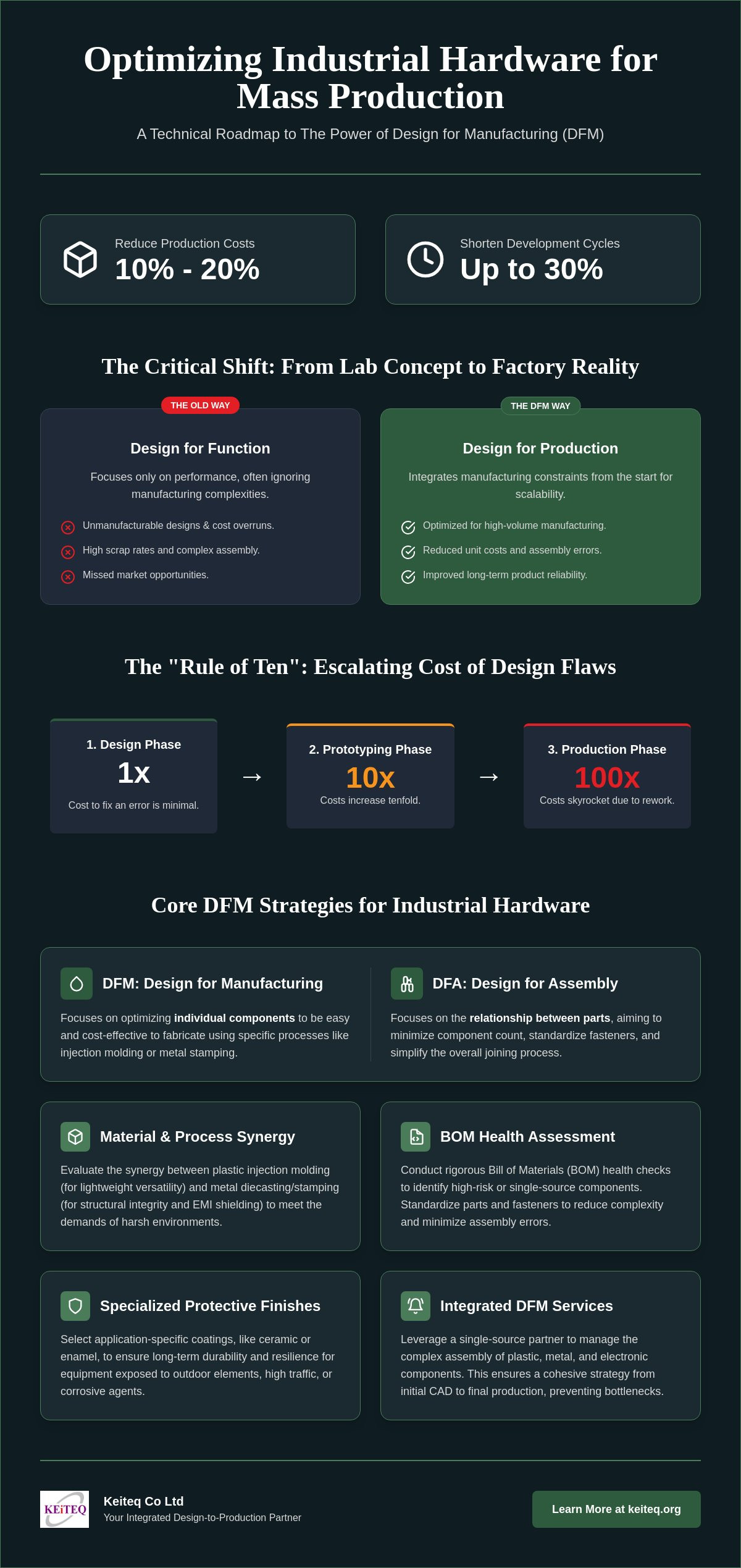
Manufacturers implementing design for manufacturing services typically realize a 10% to 20% reduction in total production costs while shortening development cycles by up to 30%. These figures represent more than just efficiency; they are the difference between a successful product launch and a project stalled by un-manufacturable designs. You likely recognize the frustration of a high-precision assembly that performs well in a lab but causes frequent failures or cost overruns on the factory floor. It is a common bottleneck that often leads to product failure in harsh outdoor environments and missed market opportunities.
This guide provides a technical roadmap for optimizing complex industrial hardware for mass production. You'll learn how to leverage expert DFM strategies to reduce unit costs, accelerate your time-to-market, and improve the long-term reliability of your equipment. We will examine the critical role of material science, assembly simplification, and advanced protective coatings in building hardware that is both scalable and resilient. This structured approach ensures your designs meet the rigorous standards of global production environments while maintaining peak functional performance.
Table of Contents
Understanding Design for Manufacturing (DFM) for Industrial OEMs
Industrial OEMs often struggle with the transition from a functional prototype to a scalable product. Design for manufacturability (DFM) is the engineering practice of designing products so they're easy to manufacture. This approach moves beyond "design for function," where the primary goal is ensuring the device works. It prioritizes "design for production," focusing on how the product will be built at scale. By integrating manufacturing constraints early, companies avoid the wall that exists between R&D teams and factory floor realities.
For technical directors and procurement officers seeking design for manufacturing services, the objective is to bridge the gap between high-level engineering and the practicalities of mass production. Without this intervention, industrial hardware often suffers from an excessive Total Cost of Ownership (TCO). High TCO is typically driven by complex tooling requirements, high scrap rates, and labor-intensive assembly processes that weren't addressed during the design phase. Professional DFM ensures every screw, bracket, and housing is optimized for the specific machinery on the production line. To complement these efficiencies, sourcing industrial-grade labeling solutions from OptiMediaLabs Canada ensures that product identification is integrated seamlessly into the manufacturing workflow.
DFM vs. DFA: Optimizing for Both Parts and Assembly
While often grouped together, DFM and DFA serve distinct roles in the production cycle. DFM focuses on individual components, ensuring a specific part is easy to fabricate using processes like plastic injection molding or metal stamping. Design for Assembly (DFA) focuses on the relationship between these parts, aiming to minimize the total number of components and simplify the joining process. Keiteq Co Ltd integrates both disciplines to streamline outdoor payment terminal assembly, ensuring that metal stamped parts and plastic molded housings align perfectly every time. Effective product R&D and manufacturing strategies involve assessing these factors during the initial CAD phase to prevent downstream bottlenecks that delay market entry.
The Economic Impact of Early DFM Intervention
The "Rule of Ten" illustrates why early intervention is essential; the cost of correcting a design flaw increases tenfold at each subsequent stage of production. A simple change in the design phase costs cents, but that same change during mass production costs thousands in reworked tooling and lost time. Manufacturers using comprehensive design for manufacturing services report ROI improvements of 15% to 25% within 12 to 24 months. By consolidating parts and reducing Bill of Materials (BOM) complexity, companies lower their overhead and material waste. Design for manufacturing services act as a critical checkpoint for 2026 industrial standards, ensuring hardware is compliant, durable, and cost-efficient from day one.
Beyond immediate cost savings, DFM strategies can shorten development cycles by 20% to 30%. This speed is vital in competitive industrial sectors where being first to market with a reliable product is a major strategic advantage. To complement this speed, Cornerstone Marketing Solutions helps manufacturers build a robust online presence that ensures their new innovations gain immediate traction. Reducing the number of fasteners and standardizing components doesn't just lower costs; it also reduces the likelihood of human error during assembly, leading to a more reliable finished product. It's a disciplined methodology that transforms complex engineering into a repeatable, high-quality manufacturing process.
Evaluating Material and Process Synergy in Hardware Design
Selecting the right material is a fundamental pillar of professional design for manufacturing services. Industrial hardware often requires a hybrid approach where plastic injection molding and metal stamping work in tandem to balance structural rigidity with complex internal geometries. While plastic offers lightweight versatility and corrosion resistance, metal components provide the necessary EMI shielding and mechanical strength for high-traffic environments. Adhering to established DFM guidelines ensures these materials are used efficiently, reducing scrap and secondary machining requirements that otherwise inflate the unit cost.
The choice of material directly impacts surface finishing and the product's long-term survival in the field. For instance, aluminium diecasting provides superior thermal conductivity for outdoor payment terminals, helping dissipate heat from internal electronics. However, this material choice dictates the coating strategy; powder coating is ideal for general weatherproofing, but ceramic coatings may be necessary for components exposed to corrosive chemicals at petrol stations. If you're planning a complex hardware rollout, you should consult with an engineering partner like Keiteq Co Ltd who understands these material interactions to avoid premature product failure.
Optimizing Plastic Injection Molding for Scale
Effective plastic design requires strict adherence to wall thickness uniformity to prevent sink marks and warping during the cooling phase. Draft angles, typically between 1 and 3 degrees, are essential for clean part ejection from the mold, preventing surface scuffing that can compromise the enclosure's aesthetics. Strategic ribbing adds structural strength without adding excessive mass, ensuring the part remains cost-effective for high-volume runs. When selecting a plastic injection molding manufacturer, verify their ability to transition from soft tooling prototypes to high-volume mass production molds without losing dimensional accuracy.
Precision Metal Stamping and Diecasting Considerations
Metal stamping design must account for minimum bend radii to prevent material cracking during the fabrication process. Material utilization is a key cost driver in metal production; nesting parts efficiently within a sheet can reduce waste by up to 20% in large-scale orders. Zinc diecasting is particularly effective for intricate payment terminal parts that require high impact resistance and complex internal threads that are difficult to achieve through stamping alone. Managing tolerances in hybrid assemblies is critical, as plastic parts expand and contract at different rates than metal. Comprehensive design for manufacturing services must account for these thermal expansion differentials to maintain a weatherproof seal in harsh outdoor environments.
How to Optimize Your Product Design for Mass Production
Optimizing for mass production requires a systematic audit of the initial design. This begins with a Bill of Materials (BOM) health assessment to identify components that are nearing end-of-life or present high supply chain risks. Manufacturers who implement these design for manufacturing services often see ROI improvements of 15% to 25% within two years by catching these risks early. Standardizing fasteners and internal components is another critical step. It reduces the number of unique tools required on the assembly line and minimizes the chance of operator error. Reducing part counts through consolidation directly lowers material waste and inventory management overhead.
Simplifying the assembly sequence is essential for modern OEM assembly. Incorporating Poka-Yoke (error-proofing) features directly into the part geometry ensures components can only be joined in the correct orientation. Asymmetrical mounting tabs or keyed connectors prevent costly assembly mistakes before they happen. This level of precision aligns with the broader National Strategy for Advanced Manufacturing, which emphasizes efficiency and technological leadership in industrial production. These physical constraints make the assembly process intuitive, allowing for faster technician training and higher production throughput.
Step-by-Step Design Refinement
During refinement, engineers analyze the prototype for manufacturing bottlenecks like "impossible" geometries that require expensive 5-axis machining. Utilizing professional product design services allows for aesthetic improvements without compromising the part's manufacturability. It's also the stage where designs are validated against updated 2026 regulatory standards. This includes ensuring compliance with ISO 14001:2026 for environmental management systems and the ISO/TR 20470-1:2026 benchmarks for weatherable fluoropolymer topcoat performance, ensuring the product is ready for global distribution.
Prototyping as a DFM Validation Tool
Soft tooling serves as a vital bridge between R&D and full-scale mass production. It allows teams to test fit and function in real-world scenarios without the high capital expenditure of permanent steel molds. Feedback from the factory floor is prioritized here. If a technician finds a specific component difficult to seat or a cable route too tight, the design is iterated before mass production management begins. This creates a closed feedback loop that ensures the final hardware is as reliable as it is scalable. It's much more efficient to catch a minor design error in a soft tool than to face a major production halt once hardened molds are already in place.
This concept of early visualization is also transforming consumer design; for instance, diykbdesign.com uses AI to help homeowners see potential kitchen and bathroom outcomes before any physical changes are made.
Bridging the Gap: Protective Coatings and Environmental Durability
Surface finishing is a critical component of professional design for manufacturing services, particularly for hardware deployed in high-traffic or outdoor settings. For an outdoor payment terminal for a petrol station, the coating is the primary defense against environmental degradation. It is not an aesthetic afterthought; it is a functional requirement. If the housing geometry doesn't account for the physical behavior of the coating material, you risk uneven thickness, "orange peel" textures, or exposed edges where corrosion begins. Every radius and recessed corner must be engineered to ensure a uniform protective layer that adheres to the substrate through years of thermal cycling.
The choice of finish is dictated by the operational environment and the substrate materials identified in earlier design phases. While powder coating is a standard for many industrial applications, extreme conditions often require more specialized solutions. These finishes don't just protect the metal; they safeguard the internal electronics from moisture ingress and chemical exposure. To ensure your hardware survives the field, you should request a technical consultation on industrial coating specifications before finalizing your tooling design.
Enamel and Ceramic Coatings for Extreme Conditions
Ceramic coatings are specified when hardware requires exceptional heat and wear resistance. They provide a dense, non-porous barrier that is nearly impervious to scratches and chemical attacks. In fuel-rich environments, such as a gas station, enamel coating is often the superior choice due to its high resistance to petroleum-based solvents and corrosion. These high-performance finishes are essential for maintaining the structural integrity of zinc and aluminium diecast components. For more detailed technical data, refer to our protective coatings for outdoor electronics reference guide.
Powder Coating: Efficiency Meets Industrial Protection
Powder coating remains the most efficient choice for mass production due to its rapid application and minimal environmental impact. To optimize for this process, part geometry must allow for "electrostatic wrap," where the charged powder particles naturally move toward the grounded part. Sharp internal corners can create a Faraday cage effect, preventing the powder from reaching deep recesses. Ensuring your designs are compliant with the ISO/TR 20470-1:2026 standard for weatherable topcoat performance is vital. This standard provides the benchmarks for UV resistance and long-term durability, ensuring that the finish doesn't chalk or peel when exposed to direct sunlight for extended periods.
Properly applied powder coatings provide a resilient shield that balances aesthetic requirements with the need for chemical and impact resistance. When integrated into design for manufacturing services, this process reduces the need for secondary touch-ups and lowers the overall scrap rate. The result is a finished product that maintains its professional appearance and functional reliability throughout its intended service life, even in the most demanding industrial environments.
Maintaining this professional standard also extends to product identification and safety labeling; to ensure your labels are as resilient as your hardware enclosures, you can visit DuraFast Label Company for specialized industrial printing solutions.
Implementing an Integrated Design to Production Strategy with Keiteq Co Ltd
Successful hardware deployment requires more than a functional blueprint; it demands a unified execution strategy. Fragmented supply chains often lead to communication gaps between designers and factory floors, resulting in costly delays and component mismatches. By utilizing design for manufacturing services through a single-source partner like Keiteq Co Ltd, OEMs can synchronize R&D, prototyping, and mass production under one management framework. This integrated approach ensures the original design intent is preserved while the hardware is optimized for high-volume throughput and industrial-grade durability.
A key component of this unified strategy is the implementation of a certified quality management system; you can learn more about Align Quality to see how they help businesses achieve the certifications needed for large-scale industrial success.
Keiteq Co Ltd manages the complex integration of plastic, metal, and electronic components with a focus on logistical competence. This expertise is particularly evident in the assembly of an outdoor payment terminal for a petrol station, where precision metal stamping must align perfectly with plastic molded housings and sensitive electronic interfaces. For technology providers like SkySoft Teknoloji, managing these multi-material assemblies with disciplined mass production management and rigorous testing protocols is essential to ensure every unit meets the environmental resilience standards required for 2026. This safe pair of hands methodology minimizes technical risk and positions the product for a stable, long-term lifecycle.
End-to-End Manufacturing Solutions
Keiteq Co Ltd’s global facilitator approach reduces the logistical friction often found in international production. By providing a comprehensive suite of services, including diecasting, powder coating, and final OEM assembly, we eliminate the need for multiple vendors. Technical directors benefit from the single-source manufacturing benefits that streamline procurement and technical support. This model is especially effective for 2026 OEMs who require seamless coordination alongside high-scale production capabilities. Centralizing these processes allows for tighter quality control and a faster response to engineering change orders.
Next Steps: From Concept to Scalable Hardware
Initiating a transition to mass production begins with a structured DFM review. Our engineering team conducts a granular analysis of your current documentation to identify potential manufacturing bottlenecks or material inefficiencies. To prepare for a technical manufacturing briefing, ensure your CAD files and Bill of Materials are updated with current specifications. This documentation serves as the foundation for a scalable production roadmap that prioritizes reliability and cost-efficiency. Leveraging professional design for manufacturing services ensures your hardware isn't just a prototype, but a durable industrial asset ready for the global market. Contact Keiteq Co Ltd today to secure your production schedule and validate your hardware for industrial-scale deployment.
Securing Your Path to High-Volume Hardware Success
Transitioning from a technical prototype to a market-ready asset requires a disciplined approach that balances mechanical strength with environmental resilience. Prioritizing material synergy and standardized assembly early in the design phase allows OEMs to reduce total cost of ownership while accelerating their time-to-market. These strategic adjustments ensure that industrial equipment can withstand harsh field conditions without compromising production efficiency. It's the difference between a prototype that works and hardware that scales. This same focus on durability is essential in sports performance gear, where athletes often explore Figure 8 Lifting Straps to ensure reliability under extreme physical loads.
Ready to optimize your hardware? Contact Keiteq for a Professional DFM Review and Manufacturing Quote to ensure your next product launch is stable and successful. We look forward to facilitating your transition from concept to high-volume production with precision and reliability.
Frequently Asked Questions
What is the difference between DFM and DFA in industrial manufacturing?
DFM optimizes individual components for fabrication, while DFA simplifies the assembly of those components into a final product. DFM focuses on factors like wall thickness in plastic molding or bend radii in metal stamping. DFA prioritizes reducing the total number of parts and fasteners. Integrated design for manufacturing services combine both disciplines to streamline the entire production lifecycle from the factory floor to the shipping dock.
How early should I involve a manufacturing partner in the design process?
You should engage a manufacturing partner during the initial CAD and R&D phase. Waiting until a design is finalized often leads to the "Rule of Ten," where the cost of design changes increases tenfold at every subsequent production stage. Early involvement allows engineers to identify "impossible" geometries and material risks before you commit to expensive tooling or mass production schedules. It's a proactive step that secures your path to scalability.
Can DFM help reduce the cost of existing hardware products?
DFM is highly effective for cost-reducing existing hardware by identifying component consolidation opportunities. Manufacturers implementing these principles typically see a 10% to 20% reduction in production costs. This process involves conducting a BOM health assessment to replace high-risk or obsolete parts with standardized, more affordable alternatives. It's a proven strategy for improving the ROI of mature product lines without sacrificing functional quality or industrial durability.
What are the best materials for outdoor payment terminal enclosures?
Aluminium and zinc diecasting are the industry standards for high-strength outdoor payment terminal enclosures. These materials offer the thermal conductivity needed to dissipate heat from internal electronics while providing excellent impact resistance. For components requiring complex geometries and lower weight, UV-stabilized plastics used in injection molding provide a durable, corrosion-resistant alternative. The choice depends on the specific environmental stressors and structural requirements of the deployment site.
How does design for manufacturing impact product time-to-market?
Utilizing design for manufacturing services can cut development cycles by 20% to 30%. This acceleration is achieved by eliminating the "design-fail-redesign" loop that occurs when un-manufacturable designs reach the production line. By validating manufacturability early, you ensure a seamless transition from prototype to mass production. This allow you to capture market opportunities faster than competitors who use traditional, siloed design methods that ignore factory floor realities.
What is the role of prototyping in the DFM process?
Prototyping and soft tooling act as the final validation checkpoint for the DFM process. They allow technical teams to test fit, function, and assembly sequences in real-world conditions without the high capital expenditure of permanent molds. This stage provides a critical feedback loop between R&D and the factory floor. It ensures that any minor design errors are corrected before the hardware enters high-volume mass production, reducing technical risk and waste.
Does DFM compromise the quality or aesthetics of a product?
DFM doesn't compromise quality; it improves it by reducing the complexity that leads to assembly errors and part failure. While DFM may require simplifying certain geometries for production efficiency, expert design refinement ensures that aesthetics remain a priority. The goal is to create hardware that's visually professional while remaining easy to produce at scale. Reliability and consistency are the primary outcomes of a well-executed DFM strategy for industrial hardware.
What specialized coatings are recommended for petrol station environments?
Petrol station environments require specialized enamel or ceramic coatings to resist petroleum-based solvents and corrosive chemicals. These finishes provide a non-porous barrier that prevents moisture ingress and substrate degradation. For general weatherproofing and UV protection, high-grade powder coatings are also effective. These coating choices are essential for maintaining the long-term durability of outdoor payment terminals and other industrial hardware in fuel-rich or high-traffic settings.


Comments