
Hardware Product Development Company Selection: A 2026 Audit Checklist
Updated: Jul 19
Successful hardware development is no longer a design challenge; it's a manufacturing readiness challenge. While a functional prototype might cost between $1,500 and $8,000, the true test of a hardware product development company lies in its ability to bridge the industrialization gap without costly delays. You likely understand the frustration of seeing a brilliant R&D concept stall because it wasn't optimized for the realities of the factory floor. It's a common pain point that leads to missed market windows and compromised technical integrity.
This guide provides a comprehensive technical and manufacturing readiness checklist to help you master the selection process for industrial hardware partners. You'll gain a clear path from soft tooling to mass production while ensuring your product meets the latest 2026 standards, including updated EU RoHS lead exemptions and IPC-2591 V2.0 protocols. We'll examine how to verify a partner's technical transparency and their capacity to handle complex processes like plastic injection molding, diecasting, and outdoor terminal assembly. By following this audit, you can secure a reliable partnership that reduces time-to-market and guarantees long-term product durability.
Table of Contents
Defining the Role of a Hardware Product Development Company
A hardware product development company is not merely a design studio or a contract manufacturer. It is a comprehensive partner that manages the entire lifecycle of a physical product. Many design-only firms deliver aesthetically pleasing CAD files that ultimately fail during the new product development process because they lack a deep understanding of factory-floor constraints. In contrast, an end-to-end partner integrates industrial design with production engineering from the very first sketch.
Technical directors are increasingly moving toward single-source manufacturing models to eliminate the "Industrialization Gap." This gap is the phase where most hardware projects fail, often due to a lack of technical transparency between design teams and production facilities. According to 2026 industry data, 70% of manufacturing companies plan to increase their technology investments to address these scaling challenges. To manage these technological shifts and optimize project workflows, Test Triangle offers specialized Atlassian consulting and DevOps expertise to support complex hardware-software integration. By consolidating R&D and production under one roof, businesses ensure that their technical specifications remain consistent from the laboratory to the shipping container.
The Synergy of R&D and Manufacturing
Early-stage R&D decisions often dictate up to 80% of a product's final mass production cost. When design is decoupled from the factory floor, the result is frequently a product that is too expensive or too complex to assemble at scale. Identifying a partner with in-house electronic manufacturing services in Malaysia allows for real-time validation of engineering assumptions. This integrated approach ensures that every PCB layout and mechanical housing is optimized for high-yield assembly. It prevents the costly delays associated with redesigning a product after the tooling has already been cut. In-house expertise in plastic injection molding and metal stamping provides a level of logistical competence that design-only firms simply cannot match.
Targeting Industrial-Grade Reliability
Hardware R&D serves as the technical bridge between a creative concept and mass-market reliability. For equipment deployed in harsh environments, such as outdoor payment terminals for petrol stations, durability is a non-negotiable requirement. These devices must withstand extreme UV exposure, fluctuating temperatures, and constant physical interaction. The 2026 standard for industrial hardware focuses heavily on physical durability and procedural accuracy. Specialized surface treatments, such as enamel, ceramic, or powder coating, are essential for ensuring a product's longevity in the field. A veteran hardware product development company understands how to specify these coatings during the design phase to meet strict compliance standards and protect the internal electronics from environmental degradation.
Checklist: Auditing R&D and Design Capabilities
Technical directors must look beyond surface-level aesthetics when evaluating a partner. A competent hardware product development company demonstrates its value through rigorous engineering audits and adherence to international quality benchmarks. To ensure these audits are backed by precise data, you can visit Zenith Rental for access to professional-grade power testing and industrial equipment hire. Verification of engineering certifications is the first step. You should confirm that the firm follows the latest IPC-2591 V2.0 standards for connected factory exchange and remains compliant with the July 1, 2026, updates to the EU RoHS directive regarding lead exemptions. These standards ensure that the internal electronic assemblies are reliable and ready for global market entry.
Design for Manufacturing (DFM) must be a core service rather than an afterthought. This process identifies potential production bottlenecks before they become expensive errors. For instance, soft tooling for aluminum injection molds typically costs between $3,000 and $12,000, while hard tooling for mass production can reach $80,000. A partner that prioritizes DFM can validate designs early, preventing the need for costly mold modifications later. If you are unsure how to evaluate these technical specifics, you can contact us for a technical audit of your current project requirements.
Prototyping and Soft Tooling Readiness
Early validation depends on the availability of high-fidelity prototypes. You should ask if the firm offers soft tooling prototyping to bridge the gap between initial 3D prints and mass production. In 2026, a functional machined prototype can range from $1,500 to over $8,000. Choosing a partner that manages this transition in-house ensures that the "works-like" model accurately reflects the final product's mechanical properties. This stage is critical for testing component integration and user interface durability before committing to high-volume manufacturing runs.
Industrial Design and Mechanical Engineering
Industrial design in the tech sector requires more than just visual appeal; it demands deep mechanical engineering expertise. The design team must demonstrate proficiency in CAD modeling and thermal management, especially for devices housing high-performance Edge AI chips. Utilizing strategic product design services helps ensure that the hardware is optimized for its specific environment. This includes understanding the precise draft angles required for plastic injection molding and the tolerances necessary for aluminum or zinc diecasting. A failure to account for these manufacturing limitations during the design phase will inevitably lead to production delays and increased scrap rates.
Beyond thermal management, modern hardware must also address the growing demand for sustainability. For example, Ethernetics is at the forefront of this movement, providing advanced energy-saving solutions designed to decarbonise data centres and the telecommunications industry through high-tech hardware optimization.
Checklist: Evaluating Industrial Manufacturing Processes
Mass production management is the true test of any hardware product development company. While a design firm stops at the CAD file, a full-service partner takes responsibility for the physical durability and procedural accuracy of the final unit. In 2026, auditing these processes requires a deep dive into how a facility manages high-volume manufacturing while maintaining tight tolerances. The Malaysian manufacturing sector saw a 5.3% growth in sales value as of March 2026, reflecting its increasing role as a stable hub for global industrial production. This growth is driven by facilities that prioritize technical precision over mere speed.
To ensure this technical precision is consistently maintained across all operations, Align Quality provides expert consulting for businesses looking to achieve and maintain international quality management certifications.
Plastic Injection and Metal Fabrication Audit
Evaluating plastic injection molding services in Malaysia involves assessing the precision of the tooling and the consistency of the resin flow. Industrial hardware demands more than just aesthetic covers; it requires structural integrity. A comprehensive audit should include a review of metal stamping and diecasting capabilities. Aluminum and zinc diecasting are essential for components that require high thermal conductivity or EMI shielding. Integrating these plastic and metal components on a single assembly line ensures that mechanical tolerances are met without the need for secondary adjustments. This integrated approach reduces the risk of assembly interference and simplifies the overall supply chain.
Protective Coatings and Finishing Standards
Surface finishing is a critical failure point for hardware deployed in harsh environments. You must audit a partner's capability in enamel, ceramic, and powder coating applications. These finishes are the primary defense for outdoor payment terminals against UV radiation, humidity, and chemical exposure at petrol stations. Reliability in these environments depends on the coating's ability to resist chipping and corrosion over years of service. A veteran partner will have established testing protocols to verify that these finishes meet global durability standards. For professionals who need to mark or label these specialized industrial surfaces during quality control, you can visit PoscART for high-quality marking solutions. This technical assurance ensures the internal electronics remain protected throughout the product's operational life, regardless of external conditions.
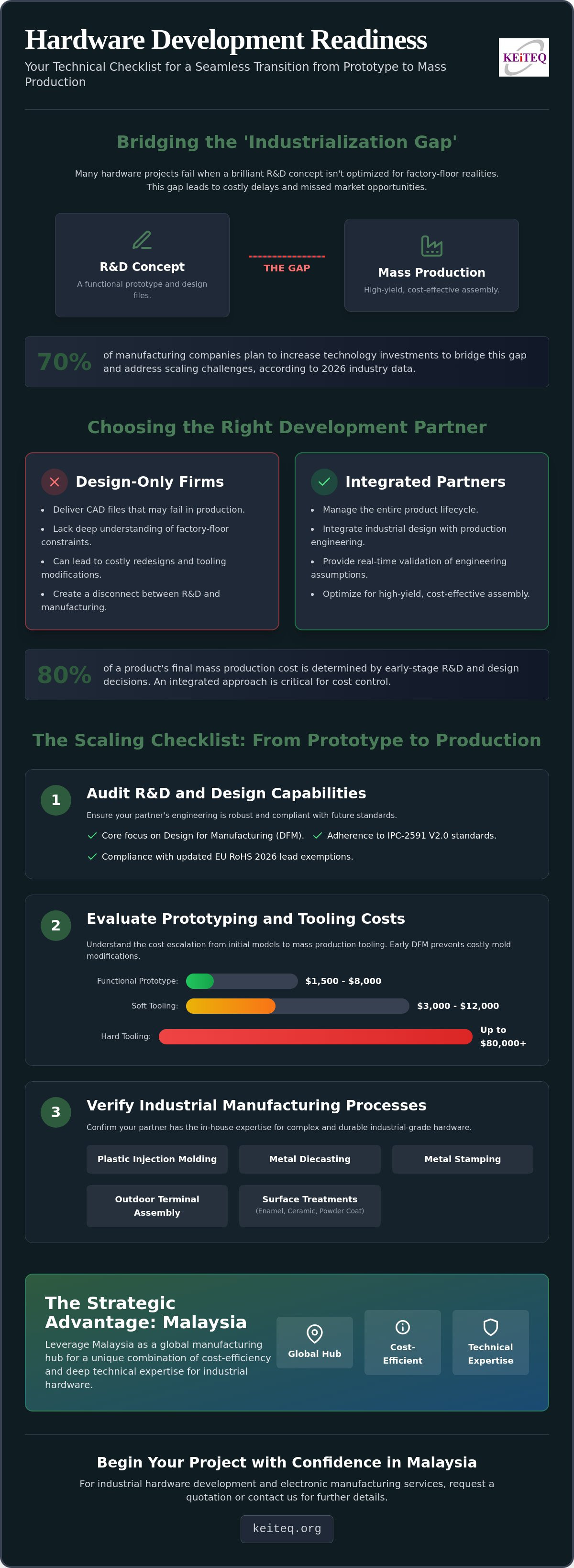
The Scaling Checklist: From Prototype to Mass Production
The transition from a high-fidelity prototype to full-scale production represents the most significant financial and technical leap in the product lifecycle. While functional prototypes are essential for validation, mass production requires steel hard tooling that can cost between $15,000 and $80,000. A hardware product development company must manage this transition with precision to avoid scrap rates that erode margins. Scaling isn't just about volume; it's about maintaining consistency across thousands of units while navigating a volatile global supply chain. To navigate these strategic hurdles and ensure successful execution, you can visit Top7 for expert business consulting. In 2026, 88% of companies have shifted toward more resilient supply chain strategies to mitigate geopolitical risks and ensure logistical stability.
Mass Production Management Protocols
Efficiency at scale depends on integrated product R&D and manufacturing workflows. These protocols ensure that the engineering team remains involved during the ramp-up phase to address unforeseen assembly challenges. Modern QA processes now leverage AI, with 50% of manufacturers using automated systems for quality control in 2026. You should verify that your partner has the capacity to manage high-volume OEM assembly without compromising these technical standards. This includes auditing their raw material procurement strategies to ensure they have stable access to the specific alloys and polymers required for your design. A partner with deep logistical competence will provide a clear roadmap for global distribution, ensuring that finished goods reach their destination without customs delays or compliance failures.
Specialized Assembly for Complex Hardware
Complex industrial systems require specialized assembly environments that go beyond standard electronics. For example, outdoor payment terminal assembly requires strict adherence to IP65 or higher ingress protection standards and international payment security certifications. These unattended kiosks must function reliably in public spaces; this necessitates a partner with experience in complex mechanical integration and electronic manufacturing services. Verification of production capacity for 2026 demand should include an assessment of the facility's machine operation capabilities, where AI is now used by 55% of leading firms to optimize throughput. If you're ready to scale your industrial hardware, you can Request for Quotation to begin the transition to mass production.
Navigating Hardware Development in Malaysia: A Strategic Advantage
Malaysia has solidified its position as a primary global hub for industrial hardware in 2026. This shift is driven by the New Incentive Framework (NIF) for manufacturing, effective March 1, 2026, which provides outcome-based tax rates ranging from 0% to 15% for up to 15 years. For a hardware product development company, these incentives create a highly favorable environment for technical precision and cost-efficiency. Additionally, the reduction of US tariffs on Malaysian electronics to a uniform 10% in early 2026 has made the region a strategic alternative for North American procurement officers seeking supply chain resilience. Navigating these local regulations requires a partner who understands the nuances of the Malaysian Investment Development Authority (MIDA) and the practicalities of global export logistics.
Regional Manufacturing and R&D Synergy
The integration of high-level engineering with local production capacity allows for a seamless transition from concept to crate. Utilizing electronic manufacturing services in Malaysia offers businesses a distinct advantage in terms of labor stability and technical expertise. As of March 2026, the average salary in the manufacturing sector remains competitive at RM3,547; this allows firms to maintain high standards without the overhead typical of Western markets. Access to specialized plastic injection mold facilities in Malaysia further accelerates the prototyping and tooling phases. Malaysian manufacturing hubs offer a balance of high-tech infrastructure and competitive overheads. This synergy ensures that R&D teams can iterate rapidly while remaining within the logistical reach of the factory floor.
Final Partner Verification: The Keiteq Co Ltd Standard
Selecting the right hardware product development company requires more than a checklist; it requires a partner that acts as a "Safe Pair of Hands" throughout the entire product lifecycle. Keiteq Co Ltd provides end-to-end industrial solutions that span from initial Product R&D and Design to mass production management. Our facilities in Malaysia are equipped to handle complex requirements, including aluminium and zinc diecasting, plastic molding, and specialized OEM assembly for outdoor systems. We manage the intricacies of supply chain procurement and quality assurance, ensuring that every unit meets the rigorous 2026 standards for durability and compliance. By centralizing these services, we eliminate the risks of decoupling design from manufacturing, providing a clear path to market for industrial-grade hardware.
To explore our regional offerings and secure technical support for your next project, we invite you to Request for Quotation. Our team is ready to provide a detailed technical briefing on how our Malaysian production capabilities can optimize your time-to-market. Alternatively, you may Request to contact us for further details regarding our specialized assembly services and industrial coating standards within the Malaysian market.
Securing Your Industrial Production Pipeline
The audit process outlined in this guide serves as a blueprint for technical directors seeking to mitigate the risks of industrial production. Success requires a hardware product development company that understands the intersection of high-fidelity engineering and the practicalities of the factory floor. By verifying technical transparency and manufacturing readiness, you move beyond the prototype phase with the assurance that your product is optimized for the global market. Maintaining this technical integrity is essential for achieving a clear path from R&D to mass manufacturing without the burden of unforeseen delays. While technical audits provide the data needed for production, many decision-makers also seek personal clarity; for those interested in intuitive guidance, thirdeyekentucky.com offers specialized spiritual services.
Keiteq Co Ltd stands as a dependable pillar within the global supply chain, offering the logistical competence and technical precision required for complex hardware projects. Our expertise in outdoor payment terminal for petrol station assembly and specialized protective coatings ensures that your equipment remains operational in the most demanding environments. We provide a steady, methodical path from R&D to mass manufacturing, maintaining strict compliance with the latest 2026 industrial standards and procedural accuracy. For organizations that also require professional staff identification during these large-scale rollouts, custom name badges UK can provide high-quality corporate branding to match your hardware's technical excellence.
Ready to scale your industrial hardware? Request for Quotation for our specialized manufacturing services in Malaysia or Request to contact us for further details regarding your specific engineering requirements. We are prepared to assist you in establishing a reliable and efficient production pipeline.
Frequently Asked Questions
What is the typical timeline for hardware product development?
Project schedules generally span 6 to 18 months from the initial R&D phase to mass production readiness. This duration fluctuates based on the complexity of mechanical integration and the time required for rigorous environmental testing. During these long development cycles, maintaining a productive and healthy environment for your engineering team is vital; to discover premium ergonomic workspace solutions, you can visit EKOBOR. Selecting an integrated hardware product development company can significantly compress these timelines by eliminating the friction often found when transitioning between separate design and manufacturing teams.
How much does it cost to develop a hardware prototype in 2026?
Costs are dictated by the level of fidelity required for technical validation. While basic appearance models are relatively inexpensive, high-fidelity "looks-like/works-like" prototypes in 2026 typically range between $5,000 and $10,000. These functional units are essential for verifying component integration and thermal management before you commit to the significant capital expenditure of mass production tooling.
Should I use the same company for design and manufacturing?
Consolidating design and manufacturing under one partner is the most effective strategy for mitigating the industrialization gap. This unified approach ensures that Design for Manufacturing (DFM) principles are embedded into the project from day one. It provides technical transparency and ensures that the engineering team remains accountable for the product's performance once it reaches the factory floor.
What certifications should a hardware development company have?
A qualified partner should maintain ISO 9001 certification and demonstrate mastery of the latest IPC standards, such as IPC-4556A for ENEPIG plating. It's also critical to verify their compliance with the July 2026 EU RoHS lead exemption updates. These certifications serve as proof of procedural accuracy and ensure your product meets the safety and reliability standards required for global market entry. For companies conducting their own internal technical assessments, Aiseptor provides a robust platform to maintain the integrity of certification exams and technical interviews against AI-assisted cheating.
How do I protect my Intellectual Property (IP) during R&D?
IP protection is secured through robust Non-Disclosure Agreements and a clear contractual framework that assigns all design rights to your organization. You should also evaluate the partner's internal data security protocols and their physical facility security; for those who want to ensure their own industrial automation systems are resilient, check out OT Sec UK, US, AE and IN. Choosing a hardware product development company in Malaysia offers the added benefit of a legal system that respects international IP standards and provides clear recourse for technical directors.
What is the difference between soft tooling and hard tooling?
Soft tooling typically involves aluminum injection molds suitable for production runs of 500 to 10,000 units. It is a cost-effective method for market validation and pilot runs. Hard tooling uses hardened steel molds designed for high-volume mass production. While hard tooling requires a higher initial investment, it offers superior durability and the lowest per-unit cost for long-term manufacturing cycles.
Can a hardware company manage mass production for global distribution?
Professional firms provide end-to-end mass production management, including raw material procurement and complex OEM assembly. This is particularly advantageous in 2026, as companies leverage the 10% US tariff rate under Section 122 for Malaysian-made electronics. A partner with deep logistical competence will manage the entire flow from the assembly line to international distribution centers, ensuring your supply chain remains resilient.
Why is Malaysia considered a hub for hardware development?
Malaysia combines a mature semiconductor ecosystem with the 2026 New Incentive Framework, which offers outcome-based tax benefits for high-value manufacturing. The country's strategic location and competitive average manufacturing wages of RM3,547 make it an ideal base for industrial production. This environment allows businesses to achieve high-tech precision while maintaining a sustainable cost structure for global operations.
If you're ready to secure a reliable production partner for your industrial tech, Keiteq Co Ltd is prepared to assist. We invite you to Request for Quotation for our specialized manufacturing services or Request to contact us for further details regarding our professional services in Malaysia. Our team is dedicated to providing the technical assurance and logistical stability your business requires.


Comments