
OEM Metal Stamping Services: A Comprehensive Guide for Industrial Procurement in 2026
Updated: Jul 5
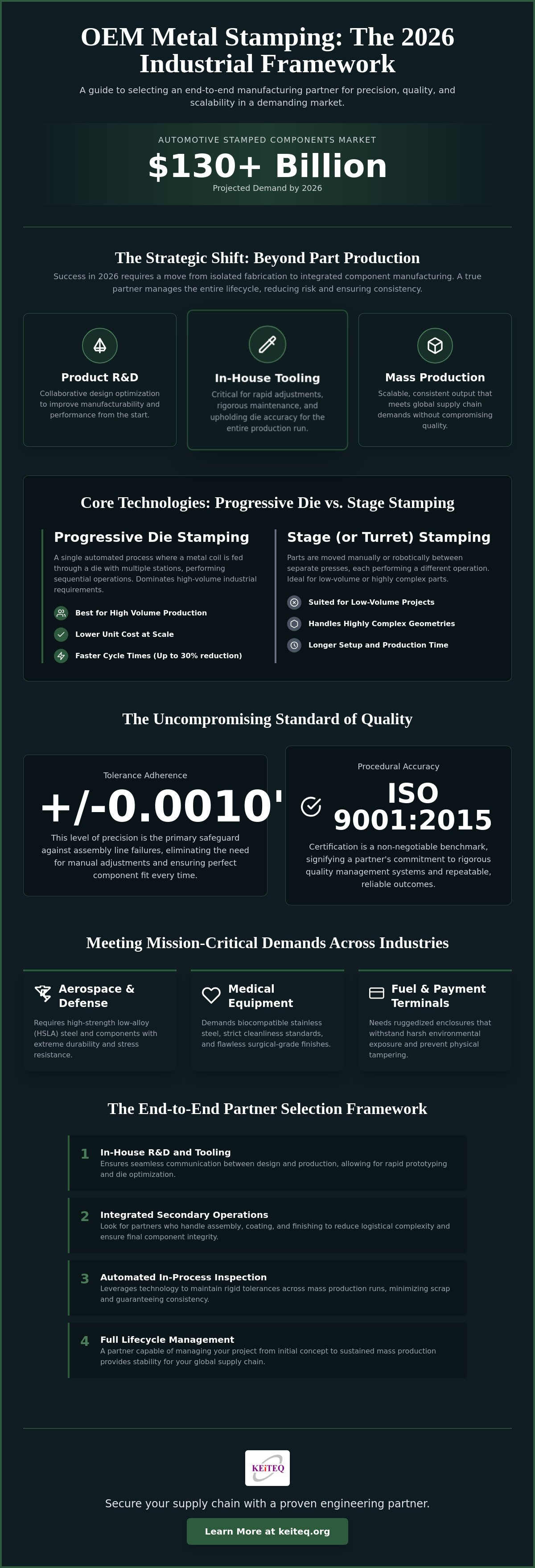
In a global market where the automotive sector alone is projected to demand over $130 billion in stamped components by 2026, the difference between a high-performing assembly and a costly recall often rests on a single micron. You understand that procuring oem metal stamping services isn't just about finding a press; it's about securing a partner who can navigate supply chain volatility while maintaining rigid tolerances across mass production runs. Inconsistent part quality and the logistical headache of managing separate stamping and specialized coating vendors can stall even the most robust production schedules.
This guide provides the technical framework you need to evaluate partners for precision, scalability, and their ability to integrate into your existing global operations. We'll examine the essential quality standards for 2026, the impact of automated in-process inspection, and strategies to reduce lead times for complex industrial hardware. By the end, you'll have a clear methodology for selecting a steady, experienced partner that values consistency and proven engineering methodology.
Table of Contents
What are OEM Metal Stamping Services and Why Do They Matter?
OEM metal stamping services represent a dedicated contract manufacturing model where specific hardware components are produced to a brand's proprietary specifications. Unlike generic part production, this process involves the conversion of flat metal sheets into complex shapes using specialized tooling and dies. In 2026, the industry has shifted away from isolated part fabrication toward integrated component manufacturing. This evolution means partners no longer just strike metal; they provide a holistic service that includes product R&D, design optimization, and full-scale production management. Industrial procurement directors prioritize partners with in-house tool rooms because these facilities allow for immediate adjustments and rigorous maintenance of the dies that define part accuracy.
The foundational mechanics of Stamping (metalworking) involve processes like blanking, punching, and bending, but the OEM context adds a layer of strategic alignment. Precision stamping directly influences the total cost of ownership (TCO). While the initial tooling investment is a factor, the long-term savings gained from reduced scrap rates and seamless assembly integration outweigh the upfront expense. When you partner with a manufacturer that handles both the design and the mass production, you eliminate the communication gaps that typically lead to dimensional errors and project delays.
The Strategic Importance of Precision in OEM Parts
Precision is the primary safeguard against assembly line failures. When tolerances are held to +/-0.0010 inch, components fit perfectly every time, eliminating the need for manual adjustments or secondary machining. Material consistency is equally vital. If a partner can't guarantee the structural integrity of the alloy, the brand's reputation suffers. Choosing a "Safe Pair of Hands" means selecting a manufacturer with the engineering discipline to handle mission-critical hardware where failure isn't an option. It's about ensuring that every part in a 100,000-unit run is identical to the verified prototype.
Key Industries Relying on Custom Metal Stamping
Several sectors require the specialized capabilities found in modern oem metal stamping services:
Aerospace and Defense: These projects demand high-strength low-alloy (HSLA) steel and extreme durability under stress.
Medical Equipment: Manufacturers require stainless steel components that meet strict biocompatibility standards and surgical-grade finishes.
Fuel Retail and Payment Terminals: There's a rising demand for ruggedized enclosures. These outdoor payment terminal assemblies for petrol and gas stations must withstand environmental exposure and physical tampering while maintaining internal electronic alignment.
By focusing on these industry-specific requirements, a qualified OEM partner ensures that the final product meets both functional and regulatory benchmarks.
Core Technologies: Progressive Die vs. Stage Stamping
Choosing the right production method is a technical decision that dictates both unit price and speed. In 2026, oem metal stamping services utilize advanced automation to reduce cycle times by up to 30%, allowing for faster response to supply chain shifts. The primary choice lies between progressive die systems and stage stamping. While stage stamping serves low-volume projects or those with highly complex geometries that require manual handling between presses, progressive dies dominate high-volume industrial requirements. Professionals at the Precision Metalforming Association emphasize that selecting the correct method early in the design phase prevents costly re-tooling later. Mechanical presses remain the industry standard, holding up to a 50% market share due to their reliability in these high-speed environments.
Material selection dictates the structural integrity of the final part. Aluminum is favored for its strength-to-weight ratio in automotive applications. Brass and copper are essential for electrical components requiring high conductivity. Stainless steel remains the preferred choice for medical and food-grade hardware due to its corrosion resistance. Each material responds differently to the stamping press. Harder alloys might require specialized coatings on the dies to prevent premature wear and maintain procedural accuracy throughout the production run. For projects requiring high-volume output, our mass production management capabilities ensure your supply chain remains stable.
Progressive Die Stamping for Mass Production
Progressive die stamping integrates multiple operations, including blanking, bending, and piercing, into a single continuous pass. This multi-station approach ensures repetitive accuracy at high speeds. While the initial tooling investment is higher than other methods, the piece-price savings during mass production are substantial. It's the standard for components requiring tight tolerances across millions of units. To optimize high-speed runs, engineers focus on material feed precision and die cooling systems. The blanking process alone accounts for 42% of the market share, highlighting its foundational role in modern hardware fabrication.
Deep Draw and Complex Forming Capabilities
Deep draw stamping is necessary when the part depth exceeds its diameter, such as in cylindrical enclosures or battery housings. Shallow draw is sufficient for flatter panels or simple structural brackets. Managing material thinning at the corners is a technical challenge that requires precise die geometry and material flow analysis to prevent structural failure. Coining is a precision stamping process that uses extreme pressure to displace metal, creating high-detail features and crisp edges on industrial components. This method is often used when surface finish and dimensional stability are paramount for the final assembly.
Evaluating Quality and Procedural Accuracy in 2026
Quality assurance in 2026 has evolved from a final inspection step into an integrated, data-driven methodology. For industrial procurement, ISO 9001:2015 certification is the baseline requirement, but it isn't the only benchmark. Leading providers of oem metal stamping services now undergo rigorous, industry-specific audits to ensure their processes withstand the demands of global supply chains. Organizations like the Precision Metalforming Association (PMA) provide the framework for these standards, ensuring that contract manufacturers maintain the technical discipline required for high-stakes industrial projects. When a partner manages quality in-house rather than outsourcing it, they provide a level of supply chain stability that third-party labs can't match.
Automated optical inspection (AOI) represents the gold standard for modern stamping facilities. These systems utilize high-resolution cameras and AI-driven software to validate parts in real-time as they exit the press. This technology catches dimensional deviations that the human eye misses, especially during high-speed runs exceeding 400 strokes per minute. Digital traceability is equally critical. In regulated industries like aerospace or medical manufacturing, every stamped component must have a digital paper trail. This record links the finished part back to the specific raw material coil and the production shift, ensuring full accountability if a field failure occurs.
The Role of the In-House Tool Room
In-house tool rooms provide a strategic advantage by keeping die maintenance and repair under one roof. When a die wears down or requires adjustment, internal technicians can address the issue immediately, preventing the days of downtime associated with shipping tools to external vendors. These facilities also house engineers who specialize in design for manufacturability (DFM). By optimizing the part geometry during the R&D phase, these experts ensure the design is compatible with mass production. This proactive approach reduces the lead times for soft tooling, allowing for rapid prototyping before committing to expensive hard tooling.
Material Science and Compliance Standards
Verifying raw material certifications (MTRs) is the first line of defense against structural failure. These reports confirm the chemical composition and mechanical properties of the alloy, ensuring it meets your specific engineering requirements. In 2026, compliance with global environmental standards like REACH and RoHS is non-negotiable for international trade. For a deeper look at the technical benchmarks governing these processes, you can explore our guide on precision metal stamping. Maintaining these rigorous compliance standards ensures your components are reliable, safe, and ready for integration into any global market.
Beyond Stamping: Integration, Assembly, and Finishing
Stamped components represent only one phase of the manufacturing lifecycle. For industrial OEMs, the value lies in how these parts integrate into a larger, functional assembly. High-performance oem metal stamping services must account for secondary operations like precision welding, threading, and mechanical fastening. There is a significant technical synergy between metal stamping and zinc diecasting services. While stamping provides the outer structural panels, diecasting offers the intricate internal geometries required for mounting electronics and internal hardware. This multi-process approach ensures that complex assemblies remain durable while meeting tight dimensional requirements across mass production runs.
Surface treatments are the final safeguard against environmental degradation. In 2026, industrial hardware requires more than just basic paint. Powder coating provides a hard finish that resists chemicals and UV exposure. For extreme thermal or corrosive environments, ceramic and enamel coatings are utilized to maintain material integrity. These treatments are essential for achieving IP-rated protection in sensitive electronic enclosures. If your project requires these integrated finishing steps, explore our OEM assembly solutions to streamline your procurement process.
Specialized Coating for Harsh Environments
Enamel and ceramic coatings provide superior heat and wear resistance for industrial tech components. These coatings create a non-porous barrier that prevents oxidation in high-moisture areas. In contrast, powder coating is the standard for outdoor kiosks, offering aesthetic longevity and impact resistance. By precisely applying these finishes to stamped metal enclosures, manufacturers can guarantee that internal electronics remain shielded from the elements. This level of protection is vital for maintaining the operational life of hardware deployed in the field.
Turnkey OEM Assembly for Payment Terminals
Selecting an End-to-End Partner for Mass Production
Selecting a partner for oem metal stamping services requires a shift from vendor-based thinking to a lifecycle partnership model. In 2026, the complexity of global supply chains means you can't afford a partner who only strikes metal. Stability is the priority. A "Safe Pair of Hands" manufacturer is one that demonstrates logistical competence, financial stability, and a deep-seated familiarity with complex industrial processes. Keiteq Co Ltd acts as a global facilitator by housing all technical competencies, from tool design to final assembly, within a single organizational structure. This holistic approach reduces procurement friction by providing a unified point of accountability for your entire hardware project.
Evaluating a partner's ability to scale is a technical requirement for any industrial project. You need to know that your partner can handle the transition from initial prototyping to millions of units without a drop in procedural accuracy. This requires a manufacturer with the discipline to manage mass production through every stage. By overseeing the entire lifecycle, Keiteq Co Ltd ensures that the precision established during the design phase is maintained throughout the full production run, protecting your brand reputation and assembly line efficiency.
The Transition from R&D to Mass Production
The path to market begins with technical validation. Utilizing soft tooling allows for physical testing and market feedback before you commit the significant capital expenditure required for progressive hard dies. The synergy between product R&D and manufacturing allows engineers to identify and resolve potential production bottlenecks during the design phase, which significantly speeds up time-to-market. Consolidating production under a single-source partner eliminates the communication gaps and logistical fragmentation that often result in misaligned tolerances or assembly failures.
Final Checklist for Procurement Officers
Before finalizing a partnership for oem metal stamping services, procurement officers must conduct a structured audit. It's not enough to check the equipment list; you must verify the operational methodology. Consider these benchmarks:
Production Capacity Audits: Confirm the facility can handle demand surges and has redundant systems to prevent downtime.
Communication Transparency: Ensure the partner provides real-time project management updates and clear technical documentation.
Comprehensive RFQ Analysis: A valid quote must include the cost of secondary finishing, quality verification, and assembly to provide an accurate total cost of ownership.
Prioritizing these factors ensures you select a partner capable of delivering consistent, high-quality industrial components that integrate seamlessly into your global operations.
Securing Your Industrial Supply Chain for 2026
Modern industrial manufacturing in 2026 demands more than just press capacity; it requires a partner who can navigate the technical nuances of a global supply chain. Selecting oem metal stamping services today means prioritizing a partner that offers end-to-end R&D to mass production capabilities. This integration ensures that the precision established in the tool room is maintained through every secondary operation and final assembly. By consolidating stamping, specialized coating, and component integration, you eliminate the fragmentation that leads to production delays and inconsistent tolerances.
Keiteq Co Ltd provides this stability through ISO 9001:2015 certified manufacturing and a proven track record in complex projects, such as specialized outdoor payment terminal assembly. We manage the entire product lifecycle, allowing your team to focus on market growth while we handle the logistical realities of the factory floor. Our methodical approach guarantees that your hardware meets the rigid standards required for high-stakes industrial applications. Request a Technical Briefing for Your OEM Stamping Project to see how our expertise can streamline your next production run. We're ready to facilitate your global production goals.
Frequently Asked Questions
What is the difference between custom metal stamping and standard stamping?
Custom metal stamping focuses on proprietary designs that meet the specific performance or aesthetic requirements of an OEM, while standard stamping involves producing generic parts from existing dies. Standard components are typically catalog items available to multiple buyers. Custom oem metal stamping services involve dedicated tooling created specifically for your brand's hardware, ensuring a precise fit and functional alignment that off-the-shelf parts can't provide.
How do I determine if my project requires progressive die stamping?
High production volumes and multi-stage part geometries generally dictate the use of progressive die stamping. If your project requires millions of units and involves several operations like blanking, bending, and piercing, this method is the most cost-effective. The initial tooling investment is higher, but the repetitive accuracy and high-speed output significantly lower the piece-price compared to stage stamping or manual press operations.
What materials are best for outdoor OEM metal components in 2026?
Stainless steel alloys and high-strength aluminum are the primary choices for outdoor industrial components in 2026. These materials provide natural corrosion resistance, which is vital for hardware exposed to environmental stress. For ruggedized applications, manufacturers often utilize galvanized steel or aluminum paired with advanced powder or ceramic coatings. This combination ensures physical durability and prevents structural degradation in high-moisture or high-salinity environments.
Can Keiteq Co Ltd handle both metal stamping and final product assembly?
Keiteq Co Ltd provides fully integrated production that includes both precision metal stamping and complete OEM assembly. Our facility is designed to move components seamlessly from the press line to the assembly station, reducing the logistical risks associated with multiple vendors. This turnkey approach allows us to manage the integration of stamped panels with internal electronics and plastic molded parts, delivering a finished product ready for deployment.
What are the typical lead times for custom metal stamping parts?
Lead times typically depend on the complexity of the initial tooling phase and the scale of the production run. Designing and building a progressive die can take several weeks, while the subsequent mass production phase moves much faster. Standard production cycles often range from four to eight weeks after tooling approval. We focus on optimizing this timeline through in-house tool maintenance and automated production management to ensure your supply chain remains on schedule.
How does industrial coating affect the precision of stamped parts?
Industrial coatings add a measurable layer of thickness that engineers must account for during the design for manufacturability (DFM) phase. If a part requires enamel or powder coating, the stamping tolerances are adjusted to ensure the final dimensions remain within specification. Ignoring this coating thickness can lead to assembly failures. Professional oem metal stamping services integrate these calculations early to maintain procedural accuracy across the entire manufacturing lifecycle.
What quality certifications should an OEM metal stamping manufacturer hold?
Procurement officers should prioritize manufacturers holding ISO 9001:2015 certification to ensure a baseline of quality management. Depending on the industry, additional benchmarks like IATF 16949 for automotive or AS9100 for aerospace are necessary. These certifications verify that the manufacturer maintains rigorous procedural accuracy and traceability. Holding these standards demonstrates a commitment to disciplined production and the ability to meet the technical requirements of regulated global markets.
Does Keiteq Co Ltd offer prototyping services before mass production?
Keiteq Co Ltd provides comprehensive prototyping and soft tooling services to validate designs before committing to mass production. This phase allows you to test functional fit and material performance without the high upfront cost of permanent hard dies. Prototyping is a critical step in our R&D process, helping to identify potential manufacturing bottlenecks early. Once the prototype is verified, we manage the transition to full-scale production using high-speed progressive tooling.


Comments