
Outdoor Payment Terminal Assembly: Engineering Durable Hardware for Fuel Retail
Updated: Jul 25
With contactless outdoor payment terminal adoption surging by 58% in 2025, the pressure on hardware reliability has never been higher. For fuel retailers, a single hardware failure caused by tropical humidity or physical tampering doesn't just halt transactions; it erodes customer trust and disrupts operations. You likely understand that maintaining uptime in harsh forecourt environments requires more than just standard electronics; it demands a specialized approach to outdoor payment terminal assembly that prioritizes physical durability and security compliance.
This article provides a technical overview of the material standards and assembly processes essential for manufacturing high-reliability hardware. You'll learn how to navigate the transition from R&D to mass production while ensuring your enclosures meet strict IP and IK ratings. We'll also examine how to optimize your supply chain for regional deployment in Malaysia, focusing on end-to-end OEM solutions that bridge the gap between complex engineering and stable, large-scale output.
Table of Contents
Engineering for the Forecourt: Challenges in Outdoor Payment Terminal Assembly
The Technical Core: Precision Manufacturing and Component Integration
Surface Protection: Industrial Coatings for Forecourt Longevity
Operational Excellence: Quality Control and Compliance in OPT Assembly
Strategic OEM Partnership: Outdoor Payment Terminal Assembly in Malaysia
Engineering for the Forecourt: Challenges in Outdoor Payment Terminal Assembly
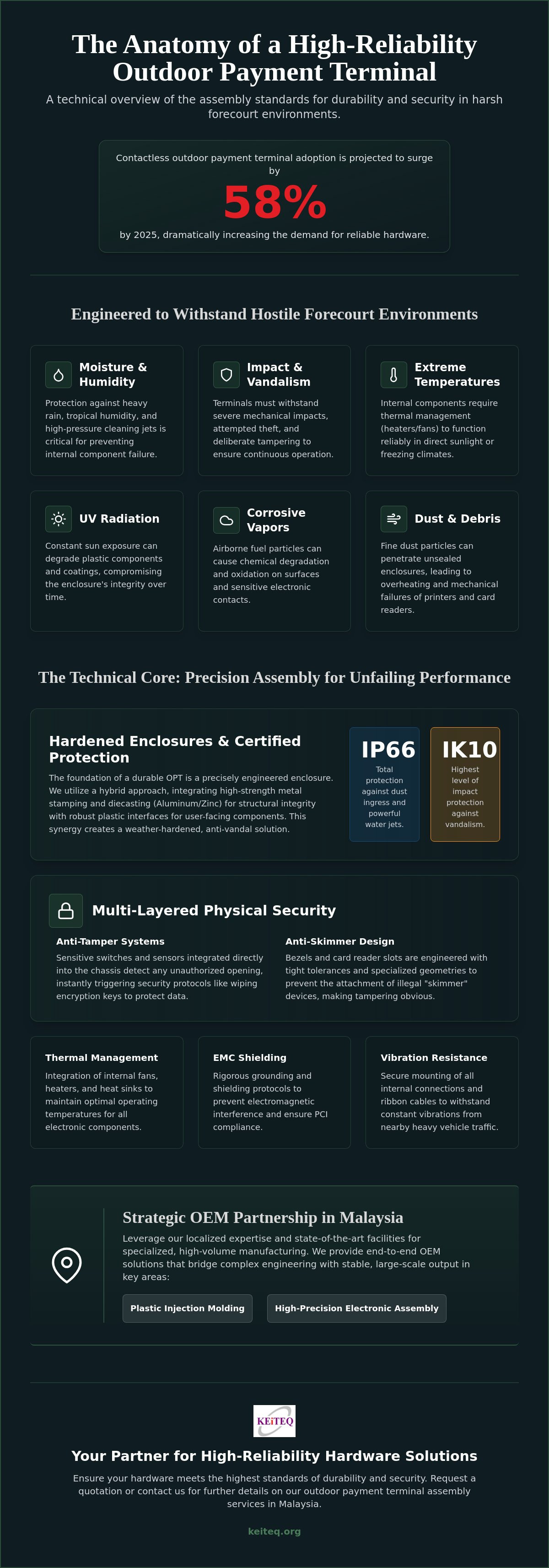
Outdoor payment terminal assembly represents the critical intersection of electronic security and mechanical engineering. It involves the precise integration of a Payment terminal into a weather-hardened, anti-vandal enclosure. Within a fuel retail environment, the forecourt acts as a hostile laboratory. Hardware must endure constant UV exposure, extreme temperature fluctuations, and the presence of corrosive fuel vapors. These factors dictate every aspect of the assembly process, from the choice of gaskets to the tolerances of the metal stamping. Standard indoor payment hardware lacks the structural fortifications and environmental seals necessary for these unattended settings, making specialized assembly a functional necessity rather than a luxury.
Environmental Resilience and IP Ratings
IP ratings serve as the primary standard for environmental defense in the fuel retail sector. An IP65 or IP66 rating confirms that the internal electronics are shielded from fine dust and powerful water jets; this is essential for maintaining uptime during heavy rain or station cleaning. Effective thermal management systems, such as internal fans, heaters, or heat sinks, are integrated during the assembly process to prevent component overheating in direct sunlight or freezing in cold climates. High-reliability hardware requires an IK10 impact rating to ensure the enclosure remains intact and operational after severe mechanical impact or attempted vandalism.
Physical Security and Anti-Tamper Design
Physical security is a core component of the assembly lifecycle. Manufacturers must integrate sensitive anti-tamper switches and sensors directly into the chassis during the production phase. These components detect unauthorized enclosure opening and can immediately trigger a security response, such as wiping encryption keys to protect consumer data. Enclosure design also focuses on preventing "skimmer" installation. Bezels are engineered with tight tolerances and specialized geometries to make any external attachments obvious to users and station operators. For businesses scaling these deployments, utilizing proven Outdoor Payment Terminal Solutions ensures that these security features are consistently applied across every unit produced. This "Safe Pair of Hands" approach to physical security protects the retailer's reputation and the customer's financial information from sophisticated physical attacks.
The Technical Core: Precision Manufacturing and Component Integration
Precision is the non-negotiable baseline for outdoor payment terminal assembly. While the previous section detailed the environmental challenges of the forecourt, the technical core of the device relies on the seamless synergy between metal structural elements and plastic interface components. Bridging the gap between a functional prototype and a field-ready unit requires a disciplined transition into mass production management. This phase ensures that every unit maintains the tight tolerances necessary for water resistance and physical security. Successful assembly integrates complex electronics, including touchscreens, encrypted pin pads, and thermal printers, into a unified system that functions reliably under constant use; for those looking to source high-quality computer hardware from a dedicated provider, you can visit Computech-Solutions to browse their extensive online inventory.
Electronic component integration within a metal housing presents unique challenges, particularly regarding electromagnetic compatibility (EMC). Metal enclosures provide excellent physical protection but can interfere with internal wireless signals or suffer from electrical noise if not properly grounded. Assembly teams must implement rigorous shielding and grounding protocols to ensure the hardware complies with global PCI Security Standards and regional electrical codes. Every internal connection and ribbon cable must be secured against vibration, as the mechanical stress from heavy vehicle traffic near fuel pumps can lead to premature component failure if the internal architecture is not sufficiently robust.
Metal Stamping and Diecasting for Structural Integrity
The structural "skeleton" of the terminal often utilizes high-strength aluminium or zinc diecasting for intricate internal brackets and external frames. These materials offer a superior strength-to-weight ratio and natural corrosion resistance. Precision metal stamping is employed for the main enclosure panels, providing the consistency required for high-volume production. For a deeper look at the mechanical requirements for these systems, consult our Gas Station Kiosk Manufacturer Guide. These processes ensure that the unit can withstand the IK10 impact forces required for vandal resistance.
Advanced Plastic Injection Molding for Interface Components
Interface components, such as bezels and card reader entries, require advanced plastic injection molding. We utilize UV-stabilized polymers to prevent material degradation and brittleness caused by constant sun exposure. Managing the tolerances between these plastic parts and the metal chassis is critical for maintaining waterproof seals. Our specialized Plastic Injection Molding Services in Malaysia facilitate the production of these high-precision components at scale. If you are ready to move from design to physical production, you may contact our engineering team to discuss your specific hardware requirements.
Surface Protection: Industrial Coatings for Forecourt Longevity
Standard liquid paints fail rapidly in fuel retail environments because petrol and diesel act as aggressive solvents. These chemicals dissolve standard pigments and binders, leading to surface peeling and eventual substrate exposure. In outdoor payment terminal assembly, surface protection isn't merely an aesthetic choice; it's a functional requirement for achieving a 10-year service life. Industrial coatings provide a robust barrier against oxidation and the corrosive effects of constant fuel vapor exposure. While maintaining a clean brand image is important for customer trust, the engineering priority remains long-term durability. We utilize automated application techniques to ensure consistent coating thickness across complex geometries. This precision prevents weak points on edges and corners where corrosion typically begins.
The application process follows a strict sequence of cleaning, etching, and coating to ensure maximum adhesion. If the coating thickness varies by even a few microns, it can compromise the fitment of gaskets or interfere with the assembly of precision-stamped panels. Maintaining this level of accuracy requires a deep familiarity with the chemical properties of both the coating material and the underlying metal substrate. This methodical approach ensures the hardware survives the daily mechanical stress of a high-traffic petrol station.
Enamel and Ceramic Coatings for Chemical Resistance
Enamel and ceramic coatings offer specialized protection for high-traffic and high-friction environments. Enamel coating provides a glass-like hardness that resists scratches and prevents chemical penetration from fuel spills. Ceramic coating applications are preferred for components requiring superior heat resistance and surface hardness, protecting the terminal from both environmental heat and physical wear. For a comprehensive look at these materials, refer to our Protective Coatings for Outdoor Electronics reference guide. These finishes ensure the terminal remains functional and visually professional despite constant exposure to harsh industrial chemicals.
High-Performance Powder Coating for UV Protection
We select polyester-based powder coatings for components that face direct, prolonged sunlight. These coatings offer maximum UV stability and color retention, preventing the chalking and fading that affects standard finishes. The pre-treatment process is vital; it involves multi-stage chemical baths to ensure proper adhesion on aluminium and steel substrates. Powder coating provides a more durable barrier than liquid paint for OPTs because the electrostatic application and thermal curing process create a thick, uniform, and chemically bonded layer. This process is integral to a successful outdoor payment terminal assembly, providing the physical toughness required for unattended retail hardware.
Operational Excellence: Quality Control and Compliance in OPT Assembly
Operational excellence in outdoor payment terminal assembly requires a transition from theoretical design to measurable factory-floor performance. A "Safe Pair of Hands" approach integrates rigorous quality management systems directly into the production line. This ensures every unit leaving the facility meets the exact specifications established during the prototyping phase. We maintain full traceability throughout the supply chain, documenting every component from its arrival as raw material to its integration into the final assembly. This level of oversight is essential for maintaining the integrity of high-reliability fuel retail hardware, especially when scaling to regional deployments.
Adherence to global standards for unattended payment terminals (UPT) involves more than just software updates. It requires a physical assembly process that respects the delicate balance between accessibility and security. End-of-line testing serves as the final gatekeeper, verifying that payment electronics and wireless connectivity modules are fully functional before the chassis is sealed. This methodical verification prevents the high costs associated with field repairs and hardware recalls in remote petrol station locations. It's about providing a finished product that station operators can trust to run without intervention for years.
Adhering to PCI and EMV Security Standards
Physical assembly must comply with PCI PTS (Pin Transaction Security) requirements. This involves the integration of tamper-responsive enclosures and secure component mounting that prevents unauthorized physical access to the internal card reader. Secure Key Injection (SKI) is a critical step; it's handled in certified, high-security environments to ensure that encryption keys are never compromised during the manufacturing process. For those evaluating potential partners, our Unattended Payment Terminal Manufacturer Selection guide details the necessary security certifications for 2026. These protocols ensure that the hardware remains a secure point of interaction for the end consumer.
While these manufacturing standards protect the terminal, comprehensive site safety is further enhanced by partnering with specialists like Scaitec Security Solutions Ltd for the design and maintenance of integrated electronic security and fire systems.
Testing Protocols for Unattended Hardware
End-of-line testing is non-negotiable for hardware intended for unattended use. Environmental Stress Screening (ESS) simulates years of forecourt exposure by subjecting terminals to rapid temperature cycling and extreme humidity. Because these units are often installed in high-traffic fuel dispensers, they must endure rigorous vibration and shock testing to prevent mechanical fatigue in the solder joints or connectors. Our Electronic Manufacturing Services in Malaysia include these comprehensive testing suites to ensure electronic stability across the entire production run. If you require a partner to manage these complex compliance requirements, you can request to contact us for further details regarding our industrial quality protocols.
Strategic OEM Partnership: Outdoor Payment Terminal Assembly in Malaysia
Malaysia has established itself as a pivotal hub for global industrial manufacturing, offering a sophisticated infrastructure that supports complex outdoor payment terminal assembly. For global OEMs, the region provides a strategic advantage by centralizing the production of mechanical components and electronic integration. This proximity between plastic injection molding facilities and metal fabrication plants significantly reduces lead times and logistics costs. By leveraging localized supply chains, manufacturers can maintain tighter control over tolerances and material quality, ensuring the final hardware meets the rigorous demands of international fuel retailers. Malaysia's regulatory environment also ensures that payment service technology adheres to high standards of operational resilience.
Keiteq Co Ltd acts as a Global Facilitator in this landscape, providing a steady and disciplined approach to manufacturing. we understand the intricacies of international production and help partners navigate the logistical challenges of the Southeast Asian market. Our presence in the region allows for a seamless flow of information and materials, positioning Keiteq Co Ltd as a "Safe Pair of Hands" for companies looking to deploy durable hardware at scale. This centralized model ensures that every stage of the assembly process, from raw material sourcing to final end-of-line testing, is managed with professional precision.
Scalable Production at Keiteq Co Ltd’s Malaysia Facilities
Our facilities in Malaysia offer a comprehensive suite of precision manufacturing capabilities. we integrate high-tolerance plastic molding and metal stamping under one roof, which minimizes the risks associated with multi-vendor supply chains. A distinct advantage of our localized operations is the availability of integrated finishing services, including powder, ceramic, and enamel coatings. This allows businesses to transition efficiently from Prototype to Mass Production Services without compromising on surface durability or structural integrity. This holistic approach ensures that the finished outdoor payment terminal for petrol station use is ready for immediate regional deployment.
End-to-End R&D and Mass Production Management
Successful hardware deployment depends on early-stage collaboration during the product R&D phase. Keiteq Co Ltd focuses on Design for Manufacturability (DFM) to optimize enclosures for both security and assembly efficiency. Managing the complex Bill of Materials (BOM) for a multi-component payment kiosk requires a high level of logistical competence to ensure that every sensor, screen, and specialized fastener arrives on schedule. For a deeper understanding of the regional manufacturing landscape, consult our Petrol Station Hardware OEM Guide. This methodical management style guarantees that large-scale production runs maintain the same quality as the initial gold standard prototype.
As the project nears completion, our team provides the technical oversight necessary to ensure compliance with regional technology requirements. we invite you to explore how our specialized facilities in Malaysia can support your next hardware rollout. To discuss your project requirements or to receive a detailed proposal, please submit a Request for Quotation or a Request to contact us for further details regarding our regional manufacturing services.
Secure Your Fuel Retail Infrastructure with Industrial-Grade Assembly
Engineering hardware for the forecourt requires a disciplined approach to material science and security compliance. Successful outdoor payment terminal assembly hinges on protecting internal electronics from corrosive vapors and physical tampering through specialized finishing and rigorous quality control. By leveraging a single-source partner, you ensure that every unit maintains structural integrity from the first prototype to full-scale mass production. This methodical process guarantees that your hardware remains operational in the most demanding unattended environments.
Our facilities in Malaysia provide end-to-end support for regional and global deployments. We specialize in petrol and gas station terminal assembly, utilizing advanced finishing techniques such as enamel and ceramic coating to guarantee long-term durability. This localized expertise allows for efficient mass production management while adhering to strict international standards. We position ourselves as a dependable pillar in your supply chain, delivering hardware that withstands the practical realities of the factory floor and the forecourt alike.
For professional outdoor payment terminal assembly services in Malaysia, please Request for Quotation or Request to contact us for further details. We're ready to facilitate your next hardware deployment with technical precision and logistical reliability.
Frequently Asked Questions
What is the typical lead time for outdoor payment terminal assembly?
Lead times for outdoor payment terminal assembly generally range from 12 to 20 weeks for mass production runs, depending on the complexity of the internal electronics and current component supply. Initial prototyping phases at our regional facilities typically require 4 to 6 weeks. Keiteq Co Ltd utilizes a disciplined production schedule to ensure a seamless transition from the design phase to the final manufacturing lifecycle.
How do you ensure IP65 ratings are maintained during mass production?
Maintaining IP65 ratings requires absolute precision during the metal stamping and plastic injection molding stages to ensure perfect alignment of all mating surfaces. we use automated gasket dispensing systems and conduct rigorous water-ingress testing on the assembly line to verify seal integrity. These structured sequences prevent the seal failures that can occur when tolerances aren't strictly managed during high-volume production.
Can Keiteq Co Ltd handle the integration of third-party payment controllers and readers?
Keiteq Co Ltd specializes in the integration of diverse third-party payment controllers, card readers, and NFC modules into custom-engineered enclosures. Our OEM assembly process accommodates various hardware architectures, ensuring that all internal components are securely mounted and shielded against electromagnetic interference. This flexible approach allows retailers to deploy their preferred payment technology—such as the banking infrastructure provided by Gemba for non-banks to launch branded financial services—within a high-reliability chassis.
What materials are best for outdoor payment terminal enclosures in coastal areas?
Aluminium and zinc diecasting, paired with specialized ceramic or enamel coatings, are the most effective materials for terminals in coastal fuel stations. These materials provide a natural resistance to oxidation and salt-spray corrosion. we prioritize high-performance industrial finishes to ensure the enclosure maintains its structural integrity and professional appearance even in high-salinity environments where standard paints fail.
Does Keiteq Co Ltd provide prototyping services before full-scale assembly begins?
Keiteq Co Ltd provides comprehensive prototyping and soft tooling services as part of our end-to-end product R&D and design process. This allow clients to verify the physical fitment and functional performance of the hardware before committing to mass production; you can also visit Protomolecule to learn more about how specialist 3D printing and rapid prototyping can support your initial R&D phases. Our Malaysia-based facilities are equipped to handle rapid iterations, ensuring the final design is optimized for durability and manufacturability before the first production run.
How does enamel coating compare to powder coating for petrol station hardware?
Enamel coating provides superior chemical resistance to petrol and diesel vapors, making it ideal for high-contact surfaces near fuel pumps. Powder coating offers better UV stability and color retention for larger enclosure panels facing direct sunlight. we often recommend a hybrid approach, using enamel for interface components and polyester-based powder coatings for the main housing to maximize the hardware's overall longevity.
What security certifications are required for outdoor payment terminal assembly?
Hardware intended for unattended payment must comply with PCI PTS (Pin Transaction Security) requirements; these are required for outdoor payment terminal assembly to ensure physical tamper resistance. Additionally, the system must support EMV-compliant card readers and kernels to meet global financial standards. Keiteq Co Ltd manages the integration of these security features within certified environments to protect consumer data.
How does Keiteq Co Ltd manage quality control for electronics manufactured in Malaysia?
Keiteq Co Ltd utilizes rigorous quality management systems at our Malaysia-based operations, including environmental stress screening (ESS) and vibration testing. we implement full traceability for all components, managing the bill of materials from initial R&D through to final assembly. This "Safe Pair of Hands" approach ensures that every unit meets the precision and reliability standards required for the global fuel retail market.
For professional services and high-reliability hardware solutions, you may submit a Request for Quotation or a Request to contact us for further details regarding our specialized manufacturing and assembly services in Malaysia.


Comments