
Overmolding Services for Electronics: A Strategic Buying Guide for 2026
Updated: Jul 4
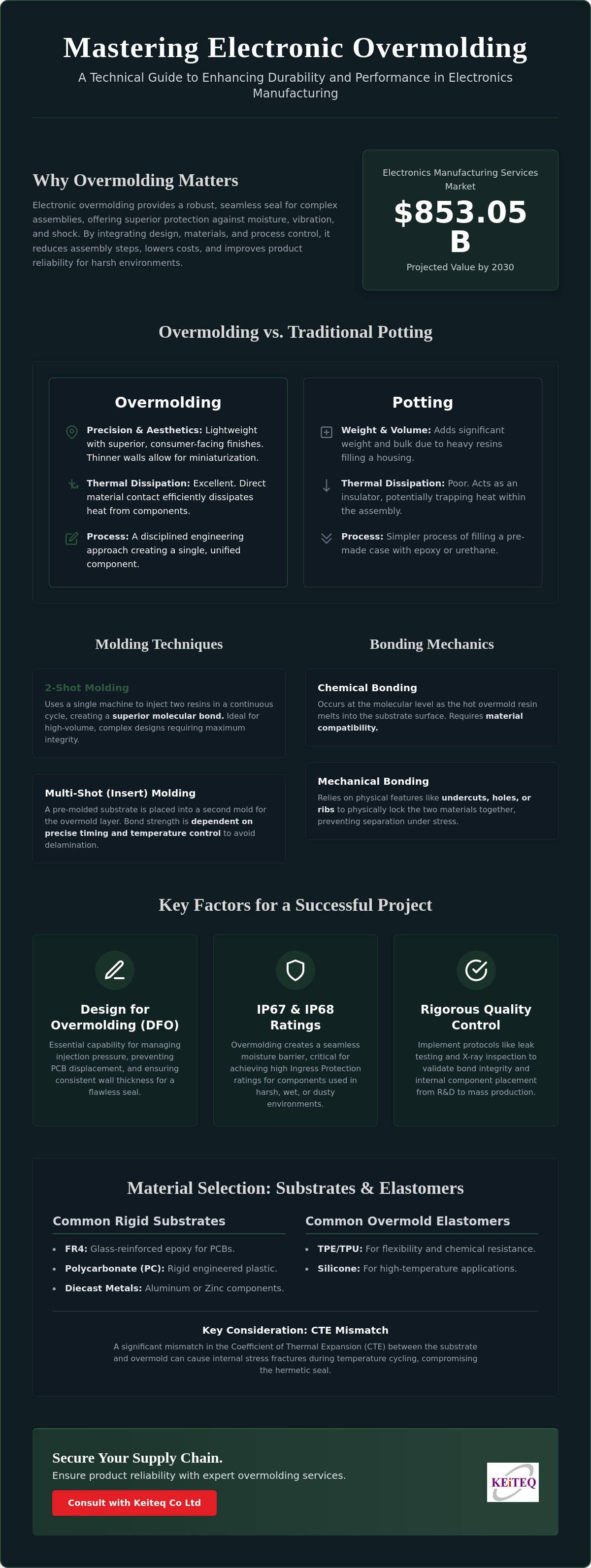
Achieving a perfect seal on a complex printed circuit board assembly requires more than just high-quality resin; it demands a disciplined engineering approach that accounts for thermal sensitivity and chemical bonding. Selecting the right overmolding services for electronics involves balancing the immediate benefits of ruggedization against the risks of delamination and manufacturing defects. As the electronics manufacturing services market is projected to reach 853.05 billion dollars by 2030, the pressure to deliver reliable, high-performance components has never been greater.
It's a common frustration for technical directors to see high-quality designs fail during mass production due to inconsistent material adhesion or thermal damage to sensitive PCBs. This guide provides the technical and strategic criteria needed to master the selection of a manufacturing partner, ensuring your assemblies achieve superior durability and enhanced IP-rated protection. You'll learn how to navigate the critical distinctions between 2-shot and insert molding, material compatibility requirements, and the AI-driven manufacturing trends that are defining production standards for 2026. By aligning your procurement strategy with proven engineering methodologies, you can reduce assembly steps and secure a stable position in the global supply chain.
Table of Contents
Understanding Electronic Overmolding: Beyond Simple Protection
Electronic overmolding is the precision application of a secondary thermoplastic or elastomer layer directly onto a pre-existing substrate, such as a printed circuit board assembly (PCBA) or a metal connector. Unlike standard injection molding, Overmolding requires a nuanced understanding of material compatibility and thermal management to protect sensitive internal components. Professional overmolding services for electronics utilize this process to create a single, unified component that combines the rigidity of the substrate with the protective qualities of the overmold material.
The choice between two-shot and multi-shot molding depends on production volume and design complexity. Two-shot molding uses a single machine to inject two different resins in a continuous cycle, which ensures a superior molecular bond. Multi-shot or insert molding involves placing a pre-molded substrate into a second mold for the final layer. Timing is the critical factor here. If the substrate cools too much before the second injection, the bond strength diminishes, leading to delamination under mechanical stress or thermal cycling.
The strategic benefits of this technology are quantifiable and extend beyond simple aesthetics. It provides high-level vibration dampening and shock resistance, which are essential for automotive and aerospace hardware. Additionally, it facilitates the achievement of IP67 and IP68 ratings by creating a seamless moisture barrier. By consolidating parts, manufacturers eliminate secondary assembly steps like gasket installation or mechanical fastening. This reduction in assembly labor lowers the total cost of ownership while improving the overall reliability of the product within the global supply chain.
The Mechanics of Material Bonding
Achieving a reliable bond requires a dual approach. Chemical bonding occurs at the molecular level when the overmold resin melts into the substrate surface. Mechanical bonding relies on physical features like undercuts, holes, or ribs to lock the materials together. Surface preparation, including plasma treatment or specialized primers, is often necessary to prevent delamination over time. Maintaining a precise substrate temperature during the cycle is the only way to ensure a truly hermetic seal that protects sensitive circuits from environmental contaminants.
Overmolding vs. Potting for Electronics
Manufacturers often compare overmolding services for electronics to traditional potting methods. Potting uses heavy resins that add significant weight and volume to the assembly. Overmolding offers a lightweight alternative with superior aesthetic finishes for consumer-facing industrial tech. While potting provides excellent insulation, overmolding allows for thinner walls and better thermal dissipation through direct material contact. This makes it the preferred choice for miniaturized electronics where space and weight are the primary engineering constraints.
Evaluating Material Combinations for Electronic Overmolding
Selecting materials for overmolding services for electronics requires a deep understanding of the interactions between the substrate and the overmold resin. While the previous section addressed the mechanics of bonding, the actual material choice determines the assembly’s long-term survival in the field. Common substrates include FR4 glass-reinforced epoxy for PCBs, rigid engineered plastics like Polycarbonate (PC), and diecast metal components made from aluminum or zinc. Each substrate presents a unique surface energy profile that dictates the selection of the overmold elastomer.
Elastomer selection usually involves choosing between TPU, TPE, or Silicone. For high-voltage connectors and precision sensors, dielectric strength is a non-negotiable metric. The overmold must act as a secondary insulator, preventing signal interference or electrical leakage. Engineers must also calculate the Coefficient of Thermal Expansion (CTE) for both materials. A significant mismatch between the rigid substrate and the flexible overmold leads to internal stress fractures during temperature cycling; this eventually compromises the hermetic seal. When planning complex assemblies, consulting with experts in plastic injection molding can prevent costly material mismatches during the R&D phase.
Thermoplastic Polyurethane (TPU) for Industrial Tech
TPU is the industry standard for ruggedized outdoor electronics due to its exceptional abrasion resistance and load-bearing capacity. In high-traffic environments like gas stations, TPU provides the necessary resistance to oils, fuels, and harsh cleaning chemicals. For outdoor payment terminal enclosures, UV-stabilized TPU grades are essential to prevent yellowing or embrittlement caused by prolonged sun exposure. This material ensures that sensitive internal components remain protected from both physical impact and environmental degradation. Its versatility makes it a staple in the production of durable industrial interfaces.
Material Compatibility Matrix
Successful integration requires a precise pairing of soft-touch materials with rigid plastic housings. For example, TPE bonds effectively to Polypropylene but requires specialized grades for adhesion to ABS or PC. Avoiding material contamination is vital; even trace amounts of mold release agents can cause total bonding failure. Looking toward 2026, the industry is shifting toward sustainable elastomers, including recyclable TPEs and bio-based urethanes, to meet increasing corporate ESG requirements. These advancements allow overmolding services for electronics to deliver high-performance results while reducing the overall environmental footprint of the manufacturing process.
The Engineering Challenge: Design for Overmolding (DFO)
Design for Overmolding (DFO) is the most critical phase in the product lifecycle. It moves a concept from a theoretical design to a manufacturable reality. The R&D phase is where the most significant manufacturing risks are mitigated. When selecting overmolding services for electronics, procurement teams must evaluate a partner's ability to manage high injection pressures. Excessive pressure causes "washout," a phenomenon where the incoming molten resin physically displaces surface-mount devices (SMDs) or delicate wire bonds. This results in immediate electrical failure or latent defects that only appear after the product enters the field.
Strategic gate placement is the primary defense against washout. Engineers must position gates to ensure resin flow is distributed evenly without impacting sensitive circuitry directly. This requires a sophisticated understanding of fluid dynamics and mold design. Additionally, the choice of tooling dictates both the precision and the longevity of the production run. Professional overmolding services for electronics utilize a tiered tooling strategy to balance cost and performance.
Soft Tooling: Used for low-volume validation, functional testing, and refining the DFO process.
Hardened Steel Tooling: Essential for the dimensional stability and high-cycle durability required in mass production.
Mechanical Interlocks: Integrated into the substrate design to ensure long-term adhesion between materials, especially when chemical bonding is insufficient.
Prototyping and Soft Tooling in R&D
The use of soft tooling prototyping allows for the rapid validation of design assumptions. It provides a cost-effective method to test the physical and electrical integrity of an overmolded assembly before committing to expensive hardened steel molds. This stage significantly accelerates time-to-market by identifying potential delamination or component interference early. Functional testing in simulated environments ensures the final product survives the rigors of its intended application, providing a safe path toward full-scale manufacturing.
Thermal Simulation and Analysis
Predicting how heat moves through a mold is essential for protecting a PCBA. Mold flow analysis identifies potential hotspots that could reflow solder joints or damage sensitive semiconductors. Cooling rate optimization is equally important. Uneven cooling creates internal stresses that lead to warping or micro-cracks in the overmold material. By conducting a detailed thermal analysis, overmolding services for electronics maintain the signal integrity of the device. This rigorous engineering approach ensures that the final assembly meets the strict performance standards required for modern industrial hardware.
Durability in Extreme Environments: Overmolding for Outdoor Tech
Hardware intended for outdoor deployment faces environmental stressors that standard indoor assemblies never encounter. Professional overmolding services for electronics provide the primary defense against moisture, particulate matter, and chemical exposure. Unlike traditional enclosures that rely on mechanical seals, overmolded components create a monolithic barrier that is inherently more reliable. This transition from multi-part housings to unified, overmolded structures is a strategic move for manufacturers targeting high-reliability sectors.
The implementation of protective coatings for outdoor electronics often complements the molding process to address specific environmental threats. While overmolding provides structural and moisture protection, specialized coatings can add a layer of dielectric insulation or thermal dissipation. This holistic approach to ruggedization ensures that the device remains functional even when subjected to the most demanding industrial conditions.
Outdoor Payment Terminal Case Study
Integrating overmolded gaskets and seals into an outdoor payment terminal assembly is essential for long-term field performance. These terminals must manage extreme temperature fluctuations ranging from -40°C to +85°C without material fatigue. The overmolding process ensures that the keypad and display interfaces remain sealed against driving rain and humidity. By using high-performance TPU or Silicone, manufacturers guarantee that the user interface remains responsive and durable throughout the product's operational lifecycle.
Secondary Finishing and Coating
Combining overmolding services for electronics with secondary finishes like ceramic or powder coating provides maximum durability for metal-plastic hybrids. These industrial finishes enhance the aesthetic of ruggedized hardware while providing additional UV and corrosion resistance. Using powder coating on the diecast metal base before overmolding ensures a superior bond and prevents oxidation at the material interface. This layered defense strategy ensures compliance with global industrial standards for outdoor equipment. For organizations requiring specialized production, exploring comprehensive mass production management ensures these durability standards are met at scale.
Scaling Your Electronic Product: From Prototype to Mass Production
Transitioning from low-volume R&D to high-volume mass production management requires a fundamental shift in engineering focus. While the prototype phase prioritizes design validation, mass production demands a stable and repeatable process that maintains signal integrity across thousands of units. Professional overmolding services for electronics integrate advanced quality control protocols directly into the manufacturing cycle to detect defects that are invisible to the naked eye.
X-ray inspection is a non-negotiable requirement for complex electronic assemblies. It allows technicians to verify that internal wire bonds and surface-mount devices remained in place during high-pressure injection cycles. Additionally, automated leak testing ensures that every unit meets the stringent IP67 or IP68 ratings required for outdoor hardware. These rigorous testing phases prevent the high costs associated with field failures and product recalls. By catching issues early in the production line, manufacturers maintain the stability and reliability of the global supply chain.
Managing multi-material assemblies involves complex supply chain logistics. Partnering with a single-source provider who handles design, molding, and OEM assembly reduces logistical friction and improves accountability. This integrated approach ensures that material batches remain consistent and that the final assembly meets all technical specifications without the risks inherent in multi-vendor handoffs. It's a strategic decision that simplifies procurement while ensuring that every overmolded part meets the exact standards established during the R&D phase.
Mass Production Quality Assurance
Maintaining tight tolerances at scale requires the implementation of Statistical Process Control (SPC). This methodology allows manufacturers to monitor production variables in real-time and correct deviations before they lead to scrap. Standardized testing for adhesion strength and environmental sealing is conducted on a per-batch basis to ensure long-term reliability. The process concludes with comprehensive functional testing of the complete unit, ensuring that the overmolding services for electronics haven't compromised any electrical performance or signal clarity.
Selecting the Right Manufacturing Partner
Securing Your Electronics for the 2026 Industrial Landscape
Success in ruggedized hardware depends on a disciplined integration of material science and mechanical engineering. You've seen how critical the initial R&D phase is for preventing component displacement and ensuring long-term adhesion. Mastering overmolding services for electronics requires a partner who understands the complexities of thermal management and environmental sealing. As industrial standards for outdoor equipment become more stringent, your choice of manufacturing partner becomes a strategic pillar of your supply chain.
Keiteq Co Ltd provides the technical expertise necessary to navigate these challenges. Our capabilities extend from specialized outdoor payment terminal assembly for petrol stations to end-to-end R&D and mass production management. We leverage deep proficiency in high-performance industrial coatings and precision molding to ensure every assembly survives demanding field conditions. This holistic engineering approach maintains signal integrity while providing the physical durability required for the global market. Partner with Keiteq Co Ltd for Your Electronic Overmolding Needs to stabilize your supply chain and secure your product's future. We look forward to providing the steady, experienced hand your next project requires.
Technical FAQs: Overmolding for Electronic Assemblies
What is the difference between overmolding and insert molding for electronics?
Insert molding is a specific subset of the overmolding process where a pre-manufactured component, such as a PCB or connector, is placed into a mold cavity before resin is injected. Overmolding is a broader term that also includes two-shot molding, where two resins are injected in a single cycle. In electronics, insert molding is the primary method used to encapsulate substrates that cannot withstand the temperatures of a multi-shot process.
Can overmolding damage sensitive PCB components during the injection process?
Yes, high injection pressures can cause component displacement, commonly known as washout, while excessive heat can reflow solder joints. Professional overmolding services for electronics mitigate these risks through mold flow analysis and precise gate placement. Utilizing low-pressure molding techniques and optimizing cooling rates ensures that delicate surface-mount devices remain intact and functional throughout the manufacturing cycle.
Which materials are best for overmolding electronics used in outdoor environments?
Thermoplastic Polyurethane (TPU) and Silicone are the most effective materials for outdoor deployment. TPU provides exceptional abrasion resistance and survives exposure to oils and fuels, making it ideal for gas station hardware. Silicone offers superior UV stability and remains flexible across extreme temperature ranges from -40°C to +85°C. The choice depends on the specific chemical exposure and mechanical stress the device will encounter.
How does overmolding improve the IP rating of an electronic device?
Overmolding improves IP ratings by creating a monolithic, hermetic seal around the internal components. This process eliminates the seams and gaps found in traditional mechanical enclosures, which often rely on gaskets that degrade over time. By encapsulating the entry points of cables and connectors, overmolding ensures a permanent barrier against moisture and dust ingress, facilitating reliable IP67 and IP68 performance.
Is overmolding cost-effective for low-volume electronic production?
Overmolding is typically most cost-effective at higher volumes due to initial tooling investments. However, the use of soft tooling or aluminum molds can reduce entry costs for production runs between 1,000 and 5,000 units. While the per-part cost is higher than traditional assembly at low volumes, the reduction in secondary assembly steps and improved product durability often justify the strategic investment.
What are the typical lead times for overmolding tooling and mass production?
Tooling design and fabrication generally require 4 to 8 weeks depending on the complexity of the mold and the choice of material. Once the tool is validated through first article inspection (FAI), mass production lead times typically range from 2 to 4 weeks. These timelines include rigorous quality control protocols such as X-ray inspection and leak testing to ensure every unit meets industrial specifications.
How do you ensure a strong bond between the overmold and the electronic substrate?
Achieving a reliable bond requires a combination of chemical adhesion and mechanical interlocks. Chemical bonding is optimized through surface preparation techniques like plasma treatment or specialized primers that increase surface energy. Mechanical interlocks, such as undercuts or through-holes in the substrate, provide physical locking points. Maintaining a precise substrate temperature during the injection cycle is also critical for ensuring long-term adhesion without delamination.
Can overmolding be used for EMI/RFI shielding in electronics?
Standard overmolding resins are insulators and don't provide shielding. To achieve EMI/RFI protection, manufacturers can use specialized resins loaded with conductive fillers like stainless steel fibers or carbon. Alternatively, the overmolding process can encapsulate a pre-installed metal shield. This approach provides a ruggedized, waterproof exterior while maintaining the electromagnetic integrity of the internal circuits, which is essential for sensitive communication hardware.


Comments