
Unattended Payment Terminal Manufacturer: A Strategic Buying Guide for 2026
Updated: Jul 22
A payment terminal's software is irrelevant if the hardware fails under the stress of a July heatwave or a winter storm. You likely understand that while digital interfaces drive the user experience, the physical enclosure and internal assembly determine the long-term ROI of your fleet. Selecting a partner for payment terminal contract manufacturing requires more than just checking a box for price; it demands a deep dive into industrial durability and technical precision. Reliability is non-negotiable when hardware failure in harsh outdoor conditions leads to unsustainable maintenance costs.
This guide provides the technical framework to evaluate hardware manufacturing quality and OEM assembly capabilities for unattended payment solutions. You'll learn how to audit a partner's ability to scale from a prototype to mass production without sacrificing quality or compliance. We'll examine critical IP and IK ratings, the hardware implications of PCI DSS 4.0, and how to identify a manufacturer that acts as a stable, professional partner in your global supply chain for 2026.
Table of Contents
What Defines a High-Performance Unattended Payment Terminal?
High-performance unattended payment terminals are defined by their ability to facilitate secure transactions reliably without human intervention. In a self-service environment, the hardware must function as both the interface and the primary security layer. A payment terminal is a complex assembly where mechanical engineering meets electronic security. It's not just a card reader; it's a integrated system designed to operate 24/7 in public spaces.
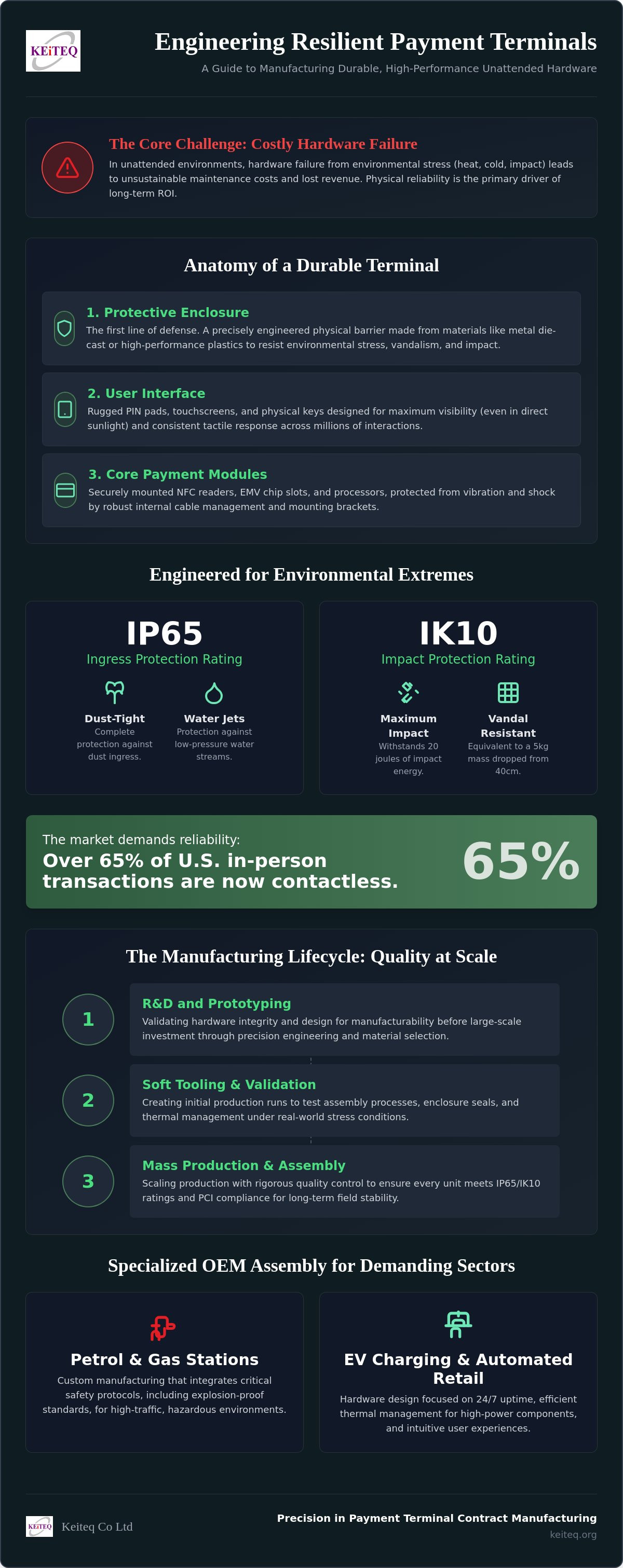
The hardware hierarchy consists of three critical layers. At the core are the payment modules, including NFC readers for contactless transactions and EMV chip slots. These are supported by the user interface, typically a PIN pad or touchscreen. Surrounding these is the protective enclosure, which serves as the physical barrier against environmental stress. Manufacturing quality directly dictates the Total Cost of Ownership (TCO). While software issues can often be patched remotely, physical hardware failure requires on-site technician intervention, which is the primary driver of operational expenses. High-quality payment terminal contract manufacturing focuses on reducing these field service events through superior component selection and assembly precision.
These systems are essential in sectors where throughput and uptime are critical. Petrol stations and EV charging hubs rely on these terminals to process payments in high-traffic, outdoor settings. Automated retail kiosks use them to enable 24-hour service without the overhead of staffing. With over 65% of in-person transactions in the U.S. now being contactless, the hardware must be engineered to support rapid, reliable NFC data exchange in every interaction. To complement these robust hardware solutions, Strictly provides options to explore Trust as a Payment Processor for integrated transaction and lending management.
The Core Components of Unattended Hardware
The physical housing is the first line of defense. It protects internal electronics from UV exposure, moisture, and deliberate vandalism. User interface elements like touchscreens and physical keys must remain tactile and visible even in direct sunlight. Internal integration is equally vital. This includes specialized mounting brackets and robust cable management systems that ensure internal modules remain seated and functional despite vibration or impact. Every internal connection is a potential point of failure that must be mitigated during the payment terminal contract manufacturing process.
The Shift Toward Custom OEM Solutions
Off-the-shelf terminals often fail because they aren't built for the specific thermal or mechanical stresses of specialized industrial sites. Standard units may lack the necessary impact resistance or thermal dissipation required for high-volume use. Custom outdoor payment terminal design allows brands to maintain a consistent visual identity while meeting specific rugged requirements. This approach balances professional aesthetic design with the structural integrity needed for mass production and long-term durability in the field.
Engineering for Resilience: Enclosures and Industrial Coatings
Resilience isn't a feature; it's a requirement for unattended systems. In payment terminal contract manufacturing, the enclosure material choice determines the unit's resistance to both environmental and mechanical stress. Manufacturers must select between metal diecasting and high-performance plastics based on the specific deployment site. While plastic offers design flexibility, metal housings provide the structural density needed to survive high-traffic public areas.
Achieving IP65 and IK10 ratings requires precision engineering of every seam and interface. An IP65 rating ensures the terminal is dust-tight and protected against water jets, while an IK10 rating signifies the highest level of protection against external mechanical impacts. These physical standards are vital for maintaining the security expectations established by the PCI Security Standards Council. Every seal and gasket is a focus during payment terminal contract manufacturing to ensure long-term field stability and prevent internal component failure.
Thermal management is another critical factor in enclosure design. Engineering teams must create housings that handle extreme temperature fluctuations, often ranging from sub-zero winters to high-heat summers. This involves designing internal airflow paths and heat sinks that dissipate processor heat while insulating sensitive electronics from solar gain. Proper thermal design prevents system throttling and extends the overall life of the internal payment modules.
Advanced Finishing and Surface Treatments
Surface treatments provide the final layer of defense against the elements. Powder coating is the industry standard for creating a durable, impact-resistant exterior finish that resists chipping and scratching. For more aggressive environments, ceramic and enamel coatings offer superior resistance to chemical corrosion and high heat. Utilizing specialized protective coatings for outdoor electronics ensures the terminal maintains its functional integrity and professional appearance throughout its service life.
Precision Manufacturing Processes
High-performance terminals utilize a strategic mix of manufacturing processes to balance strength and complexity. Plastic injection molding is used for intricate internal brackets and user interface components where repeatability is essential. For the outer shell, aluminium and zinc diecasting provide high-strength, vandal-proof protection. Metal stamping is typically utilized for cost-effective internal shielding and structural supports. If you're designing a new system, you can consult with our engineering team to determine the optimal material mix for your specific environment.
Evaluating a Payment Terminal Contract Manufacturing Partner
Selecting a partner for payment terminal contract manufacturing requires a rigorous audit of their physical infrastructure and procedural discipline. A reliable partner serves as a global facilitator, providing end-to-end capability from initial R&D and industrial design through to mass production management. This vertical integration is critical. It eliminates the communication gaps found in fragmented supply chains and ensures that the engineering intent established during the design phase is preserved during high-volume assembly. You need a manufacturer that understands the nuances of industrial production rather than just a simple assembly house.
Quality management systems on the factory floor are the backbone of hardware reliability. Adherence to IPC electronics manufacturing standards provides a necessary technical benchmark for assembly precision and component integrity. For OEMs in the fuel retail sector, specialized expertise in petrol station environments is essential. This includes familiarity with safety protocols and the specific mechanical tolerances required for seamless fuel dispenser integration. A partner must demonstrate the ability to scale production seamlessly; they should transition from initial low-volume runs to high-capacity output without compromising quality control or procedural accuracy.
Design and Prototyping Capabilities
The transition from a concept to a functional unit relies heavily on prototyping and soft tooling. This phase allows engineering teams to test physical integrity, component fit, and thermal performance before investing in expensive hard tooling. A capable manufacturer integrates third-party payment modules into custom enclosures with precision, ensuring that the final assembly meets all security and durability requirements. Reviewing a manufacturer's portfolio of payment terminal enclosure manufacturing projects provides insight into their ability to handle complex geometries and varied material requirements.
Supply Chain and Production Management
Transparency in raw material sourcing is a non-negotiable requirement for global supply chain stability. Manufacturers that maintain in-house processes for plastic molding, metal stamping, and diecasting reduce reliance on external sub-suppliers. This integration minimizes the risks of material inconsistencies or lead-time delays. Logistical competence is the final piece of the evaluation. A manufacturer must manage international distribution and customs compliance with the same methodical precision applied to the factory floor. This ensures that finished unattended solutions reach their global destination on schedule and in compliance with local regulations.
The Manufacturing Lifecycle: From R&D to Mass Production
The lifecycle of an unattended solution is a methodical progression from abstract engineering concepts to high-volume output. Successful payment terminal contract manufacturing relies on a structured four-phase approach. Phase one focuses on R&D and industrial design. Here, engineers optimize the hardware for both the end-user experience and the practicalities of the factory floor. Phase two involves rigorous prototyping. This stage tests the physical integrity of the enclosure and the precise fit of internal components under real-world conditions.
Once a prototype is validated, the project moves to phase three: tooling and molding. This is the stage where the physical infrastructure for scale is created through the development of high-precision molds and stamping dies. Finally, phase four is mass production and assembly. During this stage, the manufacturer must ensure absolute consistency across thousands of units. Every terminal leaving the line must meet the exact same mechanical and electronic specifications as the initial gold standard unit. This consistency is the foundation of fleet reliability.
Bridging the Gap Between Design and Production
Design for Manufacturing (DfM) is a critical bridge that reduces long-term costs and assembly errors. By simplifying the assembly sequence and reducing the number of unique fasteners, engineers can minimize the risk of human error on the production line. Utilizing end-to-end product manufacturing ensures that quality control is maintained through every handoff. This holistic approach is especially important during the final assembly stage. It's during this time that firmware must be securely flashed and hardware integration must be verified for 100% functionality before the unit is sealed.
Quality Assurance in Mass Production
Maintaining standards at scale requires a mix of automated and manual inspection points. Automated Optical Inspection (AOI) identifies surface defects or assembly misalignments that a human eye might miss. Environmental stress testing is equally vital for unattended hardware. Manufacturers simulate years of outdoor exposure in just a few days by subjecting units to extreme thermal cycling and vibration tests. This process ensures the terminal survives the harsh realities of the field without premature component fatigue. If you're ready to move your project from design to delivery, contact our production team to discuss your payment terminal contract manufacturing requirements.
Specialized OEM Assembly for Petrol and Gas Station Environments
Petrol and gas station forecourts present a unique set of engineering hurdles that go beyond standard outdoor durability. Assembly must account for hazardous zone classifications where volatile vapors are present. Keiteq Co Ltd understands these complexities, integrating specific safety protocols into the payment terminal contract manufacturing process. This specialized assembly ensures that electronic components are sealed not just against moisture, but against the ingress of corrosive fuel fumes that can degrade internal circuitry over time. Reliability in this sector is a matter of both operational uptime and site safety.
The evolution of fuel retail toward multi-energy hubs, including EV charging and hydrogen, requires hardware that can handle diverse power requirements and user interactions. As these stations transition into 24/7 automated kiosks, the demand for high-reliability hardware assembly increases. Keiteq Co Ltd manages this complexity by providing a stable production environment that adheres to the strict safety standards required for fuel retail infrastructure. This methodical approach to payment terminal contract manufacturing allows OEMs to deploy units in high-risk environments with total confidence in their physical integrity.
Forecourt-Specific Hardware Requirements
Hardware deployed at the pump must withstand constant exposure to gasoline, diesel, and abrasive chemical cleaning agents. Enclosures require specialized materials and gaskets that won't swell or degrade when in contact with these substances. Displays must feature high-nit ratings and anti-glare treatments to ensure legibility in direct sunlight, which is critical for maintaining the high adoption rates of contactless payments in the US fuel retail market. Engineering teams should consult the gas station kiosk manufacturer quality checklist to ensure every environmental benchmark is met during the assembly phase.
Partnering with Keiteq Co Ltd for Outdoor Solutions
Keiteq Co Ltd delivers custom outdoor payment terminal solutions tailored to the unique demands of the fuel retail industry. Our expertise in outdoor kiosk hardware assembly ensures that your terminals are built for maximum enclosure lifespan and operational stability. We utilize advanced industrial finishing to protect against corrosion and physical wear, which is essential for hardware that operates in public, unsupervised spaces. Our petrol station hardware OEM services provide the precision required for seamless integration with existing fuel dispensers. Contact Keiteq Co Ltd for a technical briefing on your next unattended hardware project.
Optimizing Your Hardware Strategy for 2026
A superior unattended solution requires a precise balance of mechanical engineering and logistical stability. Durable enclosures and specialized coatings are non-negotiable for outdoor reliability, ensuring that hardware survives environmental stress while protecting sensitive internal electronics. Managing the transition from R&D to mass production with a single, experienced partner reduces supply chain risk and ensures procedural accuracy across every unit in your fleet. This methodical approach is the only way to maintain the security and durability standards required for modern self-service environments.
As businesses look to maximize the value of these physical deployments, platforms like the STO Foundation are enabling companies to tokenize real-world assets and launch compliant investment offerings using blockchain technology.
Beyond digital tokenization, traditional real estate investment in specialized sectors remains a cornerstone of the economy; for instance, the Assisted Living Real Estate Group facilitates the buying, selling, and leasing of senior care facilities for operators and investors.
Selecting the right partner for payment terminal contract manufacturing is the most critical step in securing your hardware's future and optimizing the total cost of ownership. Keiteq Co Ltd brings deep expertise to petrol and gas station hardware assembly, offering comprehensive end-to-end management from initial design to final delivery. Our facility provides advanced industrial coating capabilities in enamel, ceramic, and powder finishes to maximize enclosure lifespan in corrosive or high-traffic environments.
Consult with Keiteq Co Ltd for your custom unattended payment terminal project to begin a technical briefing on your specific requirements. Your vision for a reliable, self-service infrastructure is within reach.
Frequently Asked Questions
What is the difference between an unattended payment terminal and a standard POS?
Unattended terminals are self-service hardware interfaces designed for 24/7 public operation without staff assistance. Unlike standard POS systems found in retail stores, these units require ruggedized enclosures, tamper-proof internal components, and weather-resistant interfaces to survive outdoor environments and vandalism. They are specialized hardware solutions for petrol stations, parking kiosks, and automated retail environments where physical security is a primary concern.
How do IP and IK ratings affect the longevity of an outdoor payment terminal?
IP and IK ratings define the physical protection levels against environmental ingress and mechanical impact. An IP65 rating signifies the unit is dust-tight and protected against water jets, while an IK10 rating indicates the highest level of resistance to external physical blows. Higher ratings directly extend terminal longevity by preventing internal component damage from moisture, dust, and vandalism, reducing the frequency of costly field maintenance.
Can a manufacturer customize the enclosure to match my brand identity?
Yes, manufacturers utilize custom plastic injection molding and metal diecasting to align enclosures with specific brand aesthetics. This includes integrating custom colors, logos, and unique geometric shapes into the housing design. Professional payment terminal contract manufacturing ensures that these aesthetic modifications don't compromise the structural integrity or industrial durability standards required for the terminal's specific deployment site.
What materials are best for outdoor payment terminal enclosures?
Aluminium and zinc diecasting are the preferred materials for high-strength, vandal-proof outer shells. For internal brackets and intricate user interface elements, high-grade polymers used in plastic injection molding offer excellent durability and design flexibility. These materials are often treated with industrial powder, enamel, or ceramic coatings to resist UV degradation and chemical corrosion in environments like petrol stations and EV charging hubs.
How does the R&D process work for a new payment hardware project?
The R&D process begins with industrial design and engineering to optimize both user experience and manufacturability. This phase involves creating detailed CAD models and selecting appropriate materials based on the deployment environment. Once the design is finalized, the manufacturer moves to prototyping and soft tooling to validate the physical integrity and component fit. This testing phase is essential before investing in the hard tooling required for mass production.
What security standards must an unattended payment terminal manufacturer follow?
Manufacturers must adhere to the current PCI DSS 4.0 standards, which became mandatory for assessments as of April 1, 2024. These standards mandate specific hardware security features, including tamper-responsive circuitry and secure component mounting. Compliance ensures the terminal can securely handle sensitive cardholder data while resisting both physical and logical attacks in unattended public spaces, maintaining the integrity of the global payment ecosystem.
Why is it better to use a single-source manufacturer for both molding and assembly?
Using a single-source partner for molding and assembly eliminates the logistical risks associated with a fragmented supply chain. It ensures that the precision of the enclosure manufacturing aligns perfectly with the internal electronic assembly requirements. This integrated approach improves quality control, reduces lead times, and provides a unified point of accountability for the entire payment terminal contract manufacturing lifecycle, from raw material to finished unit.
What are the typical lead times for moving from prototype to mass production?
Typical industry lead times range from several weeks for prototyping to several months for hard tooling and mass production setup. The prototyping phase often takes four to six weeks using soft tooling to validate the design. Moving to mass production requires an additional eight to twelve weeks for the creation of high-precision injection molds and diecasting tools, followed by the initial assembly run and quality assurance testing.


Comments