
ABS Injection Molding Malaysia: Quality OEM Solutions
Updated: Sep 3
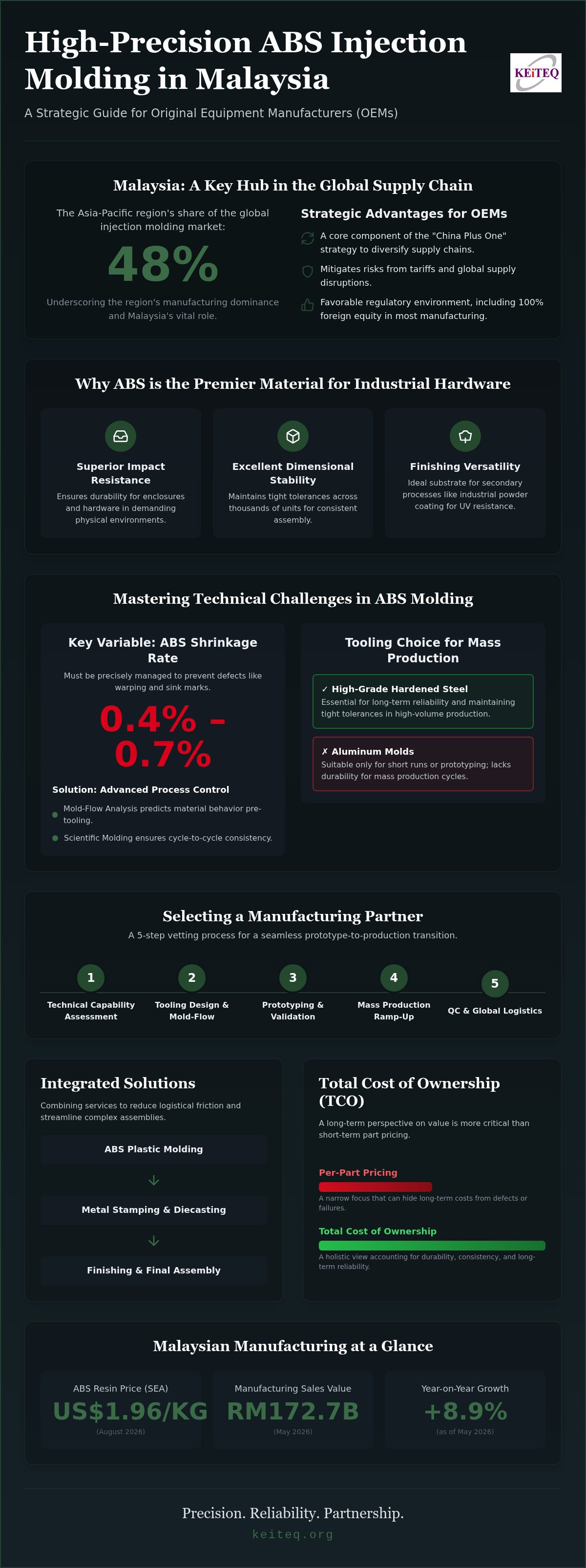
The Asia-Pacific region commanded a 48% share of the global injection molding market in 2025, a statistic that underscores Malaysia’s role as a vital link in the international supply chain. For many OEMs, the primary challenge isn't finding a factory, but securing a partner capable of maintaining industrial-grade durability across high-volume production cycles. You likely recognize the frustration of inconsistent quality or the friction that occurs when moving a project from R&D to the factory floor. High-precision ABS injection molding Malaysia provides a strategic solution to these logistical hurdles, especially as global supply chain shifts demand more reliable regional alternatives.
This article details how integrated design-to-production services ensure your plastic and metal components align perfectly. We'll examine the technical advantages of Malaysian manufacturing, including specialized coating options and the synergy between plastic molding and metal stamping. By the end, you'll understand how to reduce per-unit costs while upholding the rigorous standards required for complex industrial enclosures. We'll provide a clear overview of the regional manufacturing landscape and the procedural accuracy necessary for seamless OEM assembly.
Table of Contents
The Strategic Advantage of ABS Injection Molding in Malaysia for 2026
Mastering ABS Material Challenges: Precision and Tooling Standards
Malaysia as a Global Manufacturing Hub: Cost, Quality, and Logistics
Selecting a Manufacturing Partner: From Prototype to Mass Production
Keiteq’s Integrated ABS Molding and Assembly Solutions in Malaysia
The Strategic Advantage of ABS Injection Molding in Malaysia for 2026
Global supply chains require a level of stability that few regions can consistently provide. As OEMs seek to mitigate risks associated with trade shifts, Malaysia has solidified its position as a primary destination for high-precision manufacturing. The country's infrastructure is built for scale, offering a "Safe Pair of Hands" for companies that cannot afford production delays or quality variances.
At the center of this industrial growth is Acrylonitrile Butadiene Styrene (ABS), a thermoplastic polymer recognized for its exceptional toughness and heat resistance. It serves as the premier material for industrial hardware because it balances cost-efficiency with high-performance physical properties. Utilizing ABS injection molding Malaysia allows manufacturers to leverage a mature local ecosystem that understands the technical demands of automotive components, consumer electronics, and complex payment hardware.
The "China Plus One" strategy has moved beyond a simple trend into a fundamental operational requirement. Malaysia leads Southeast Asia in this transition due to its established engineering talent and favorable regulatory environment. As of 2026, the Malaysian Investment Development Authority (MIDA) permits 100% foreign equity in most manufacturing sectors, while requiring a manufacturing license for companies with shareholders' funds of RM2.5 million or more. This structured oversight ensures that the ABS injection molding Malaysia sector operates with high levels of compliance and professional accountability.
Why ABS is the Material of Choice for Industrial Hardware
Reliability in outdoor environments starts with material selection. ABS provides superior impact resistance, ensuring that enclosures for devices like outdoor payment terminals remain intact under physical stress. The material exhibits excellent dimensional stability during high-volume injection molding cycles, which is critical for maintaining tight tolerances across thousands of units. Its chemical structure also makes it an ideal candidate for secondary finishing, such as industrial powder coating, which enhances UV resistance and aesthetic appeal for exposed hardware.
Malaysia’s Industrial Infrastructure and Logistics in 2026
Efficiency in production is closely tied to the availability of raw materials and logistical reach. In August 2026, the price for ABS resin in Southeast Asia was recorded at approximately US$1.96/KG, providing a stable cost basis for procurement officers. Malaysia’s manufacturing sector recorded a sales value of RM172.7 billion in May 2026, a year-on-year increase of 8.9% that highlights the country's growing output capacity. With the New Incentive Framework in effect since March 1, 2026, international firms benefit from a streamlined investment process and robust port logistics, facilitating seamless global distribution to North American and European markets.
Mastering ABS Material Challenges: Precision and Tooling Standards
Success in high-precision manufacturing depends on controlling physical variables that occur during the phase transition from molten resin to solid part. While ABS is prized for its toughness, its behavior during cooling presents specific challenges for high-volume production. A primary technical consideration is the shrinkage rate, which typically ranges from 0.4% to 0.7% for most industrial grades. In Malaysia's manufacturing sector, facilities utilize advanced mold-flow analysis to predict these behaviors before steel is ever cut. This level of technical foresight is what distinguishes a professional partner from a standard vendor.
Thermal management within the mold is the most critical factor in preventing defects like warping and sink marks. Professional ABS injection molding Malaysia operations employ scientific molding techniques to monitor pressure and temperature in real-time. This methodology ensures that every cycle produces a part with consistent weight and dimensional accuracy. For long-term mass production reliability, high-grade hardened steel tooling is a requirement. While cheaper aluminum molds might suffice for short runs, they lack the durability needed to maintain tight tolerances over hundreds of thousands of cycles.
Optimizing Injection Mold Design for ABS
The injection mold design process must account for the high viscosity of ABS resins. Strategic gating and venting are essential to prevent gas traps and burn marks, which can compromise both the structural integrity and aesthetic of the component. During the R&D phase, engineers often utilize soft tooling to validate designs and test fitment. However, the transition to hard tooling must be managed with precision to ensure that the final mass-produced parts mirror the validated prototypes exactly. If you're currently managing a complex enclosure project, you can contact our technical team for a detailed review of your tooling specifications.
Surface Finish and Aesthetic Requirements
ABS is unique in its ability to achieve a wide range of textures, from high-gloss automotive finishes to sophisticated matte surfaces for consumer electronics. Achieving these finishes requires precise control over mold temperatures; lower temperatures often result in visible "knit lines" or weld marks where flow fronts meet in complex geometries. Post-molding inspections are a non-negotiable part of the workflow. Every unit must be checked against industrial standards to ensure that the ABS injection molding Malaysia process delivers a product that meets both functional and cosmetic benchmarks. This disciplined approach to quality control guarantees that the final assembly is seamless and professional.
Malaysia as a Global Manufacturing Hub: Cost, Quality, and Logistics
Selecting a production base requires a deep analysis of the Total Cost of Ownership (TCO) rather than a simple comparison of per-part pricing. While neighboring markets like Vietnam or Thailand may offer lower raw labor rates, Malaysia provides a more mature industrial framework and higher yield consistency. For ABS injection molding Malaysia, the value lies in the technical proficiency of the workforce and strict adherence to international quality standards, including ISO 9001 and IATF 16949. These certifications aren't just badges; they represent a procedural commitment to precision that reduces long-term costs associated with scrap, rework, and field failures. The presence of sophisticated electronic manufacturing services in Malaysia further simplifies the procurement process for OEMs managing multi-component assemblies.
Mitigating Global Supply Chain Risks
Establishing a manufacturing footprint in Malaysia serves as a critical buffer against single-source dependencies. The country's geographical position and mature shipping lanes ensure predictable lead times to North American and European ports, bypassing many of the bottlenecks seen in other regions. Local R&D and design teams play a vital role here. They can troubleshoot production variances or material issues on the factory floor in real-time. This capability eliminates the need for international engineering travel, which often delays project timelines and inflates budgets. By maintaining a localized engineering presence, OEMs can transition from design to mass production with significantly less friction.
The Synergy of Plastic and Metal Manufacturing
Industrial enclosures rarely rely on a single material. Most complex hardware, such as outdoor payment terminals, requires a precise marriage of plastic housings and metal structural components. Working with an integrated metal stamping manufacturer that also manages ABS injection molding Malaysia creates significant logistical advantages. This single-source model ensures that the tolerances for a plastic bezel and a metal chassis are coordinated under one roof. It removes the risk of component mismatch that often occurs when sourcing from separate vendors. A unified quality control system across different material types ensures that every finished unit meets the same industrial-grade durability standards, regardless of the complexity of the assembly.
Selecting a Manufacturing Partner: From Prototype to Mass Production
The transition from a conceptual design to a physical product is where most OEM projects encounter friction. A reliable partner in ABS injection molding Malaysia must act as a technical extension of your engineering team rather than a simple service provider. This relationship requires a rigorous 5-step vetting process: evaluating design and R&D capabilities, assessing tooling and production capacity, verifying material-specific expertise, auditing quality management protocols, and confirming logistical integration. By following this sequence, procurement officers can identify a "Safe Pair of Hands" capable of managing the complexities of industrial-scale production.
Prototyping serves as a critical safety check in this lifecycle. Before committing to the significant capital investment of hard tooling, utilizing prototype and soft tooling allows for the physical validation of part fitment and aesthetic. This phase identifies potential failure points early, preventing costly modifications once mass production begins. Product R&D and design must be the foundation of any manufacturing agreement to ensure that the final output aligns with the original engineering intent.
Step 1: Evaluating Design and R&D Capabilities
You must determine if a potential partner can optimize your CAD files for Design for Manufacturing (DFM). DFM is the process of refining designs to reduce molding defects and production costs. A partner with experience in complex industrial hardware will recognize structural risks that a general consumer-goods molder might overlook. Verify their history with high-precision components to ensure they can handle the tight tolerances required for professional applications.
Step 2: Assessing Tooling and Production Capacity
Mass production requires robust infrastructure for both output and maintenance. Inquire about in-house tool room capabilities to ensure that mold maintenance and repairs don't cause long-term production halts. You should also evaluate the range of injection molding machine tonnages available to confirm the facility can handle your specific part sizes. Finally, check for established mass production management protocols to ensure consistency across thousands of units.
Transparent communication and disciplined project management are essential during the scale-up phase. Project managers should provide data-driven reports and regular updates to maintain visibility over the production timeline. This methodical approach ensures that any technical hurdles are addressed before they impact the delivery schedule. If you're ready to move your project to the factory floor, you can contact our technical team to begin a formal project review.
Keiteq’s Integrated ABS Molding and Assembly Solutions in Malaysia
Keiteq Co Ltd operates as a specialized facilitator for global OEMs navigating the complexities of the Malaysian manufacturing landscape. While many vendors provide isolated services, our value lies in the seamless integration of ABS molding with metal stamping and zinc or aluminium diecasting. This holistic approach is particularly vital for the production of outdoor payment terminals, where structural integrity and electronic housing must align with absolute precision. By consolidating these disparate processes under one management framework, we provide the stability and logistical competence required for high-stakes industrial projects.
End-to-End Management from R&D to Assembly
Bridging the gap between initial R&D and high-volume mass production requires a disciplined methodology. Keiteq assumes a single point of accountability for both plastic and metal components, ensuring that the assembly process is devoid of the tolerance stacking issues often found in multi-vendor supply chains. This "Safe Pair of Hands" approach extends to complex hardware logistics, where we manage the transition from design to factory floor with methodical accuracy. Our R&D foundation allows us to troubleshoot engineering challenges before they impact the production schedule, maintaining the steady pace necessary for global distribution.
Specialized Finishing for Harsh Environments
Industrial durability in harsh environments depends on advanced surface finishing. Keiteq provides specialized enamel, ceramic, and powder coatings designed to protect molded and stamped parts from extreme weather and high-traffic wear. These protective layers are essential for fuel retail hardware and petrol station terminals that face constant exposure to UV rays and corrosive elements. Our expertise in ABS injection molding Malaysia ensures that the base substrate and the final coating work in synergy to provide long-term physical resilience. Every finished unit undergoes rigorous quality control to confirm compliance with the professional standards expected by procurement officers and technical directors.
To discuss your project requirements or to learn more about our integrated manufacturing capabilities in the region, please reach out to our team.
Request to contact us for further details regarding our specialized services in Malaysia.
Securing Your Industrial Supply Chain with Precision
Malaysia's mature manufacturing landscape provides a stable foundation for OEMs navigating the complexities of the 2026 global market. Success in this environment depends on a partner that bridges the gap between initial R&D and high-volume mass production. By prioritizing technical accuracy and integrated assembly, you can reduce the Total Cost of Ownership while maintaining the industrial-grade durability your hardware requires. This methodical approach ensures that every component meets rigorous performance standards before reaching the end user.
Choosing a partner for ABS injection molding Malaysia ensures your project benefits from established logistical lanes and a high-yield engineering workforce. Keiteq Co Ltd offers specialized expertise in Outdoor Payment Terminal Assembly and advanced protective finishes, including enamel, ceramic, and powder coatings. This end-to-end approach guarantees that your components are built to survive harsh environments and high-traffic use. We provide the stability needed to scale your production without sacrificing procedural accuracy.
For expert ABS injection molding and integrated assembly services in Malaysia, Request for Quotation or contact us for further details. We look forward to facilitating your next industrial project with the reliability and precision your brand demands.
Frequently Asked Questions
Why is ABS used for injection molding in industrial applications?
ABS is selected for its high impact resistance and toughness, making it the premier thermoplastic for industrial hardware. It provides the dimensional stability required for high-volume cycles, ensuring that tight tolerances are maintained across thousands of units. Its chemical compatibility also allows for high-performance secondary finishes like powder coating. This combination of physical durability and aesthetic flexibility makes it the standard for complex enclosures used in demanding outdoor environments.
What are the typical lead times for ABS injection molding in Malaysia?
Lead times for ABS injection molding Malaysia depend on the complexity of the mold design and specific production volumes. Generally, the region's mature infrastructure and established raw material suppliers allow for predictable manufacturing schedules. By leveraging local engineering talent and streamlined port logistics, we ensure that project timelines are managed with professional accuracy. Procurement officers should consult with our technical team during the R&D phase to establish a firm delivery schedule.
How does Keiteq Co Ltd handle the transition from prototype to mass production?
Keiteq Co Ltd utilizes a design-first approach to bridge the gap between initial concepts and mass production. We employ prototyping and soft tooling to physically validate part fitment and aesthetic before committing to hard steel molds. This methodical sequence identifies potential failure points early, preventing costly modifications during the scale-up phase. Our mass production management protocols ensure that every unit produced mirrors the validated prototype with procedural accuracy.
Can Malaysia-based molders meet US and European quality standards?
Malaysian facilities consistently meet US and European quality standards by adhering to international certifications such as ISO 9001 and IATF 16949. The country's manufacturing sector is built on a foundation of technical proficiency and strict compliance. These standards guarantee that components produced in the region meet the rigorous durability and safety requirements of global OEMs. This commitment to quality positions Malaysia as a reliable hub for high-precision industrial manufacturing.
What is the advantage of combining plastic molding and metal stamping?
Integrating plastic molding and metal stamping under one roof ensures that tolerances for complex multi-material assemblies are coordinated with absolute precision. This single-source model eliminates the risk of component mismatch that often occurs when sourcing from separate vendors. It provides a single point of accountability for the entire enclosure, from the plastic housing to the internal metal chassis. This synergy reduces logistical friction and ensures uniform quality control across the finished product.
How do tariffs affect ABS injection molding services in Malaysia?
Malaysia serves as a strategic alternative for OEMs navigating the US-China trade shift, offering a tariff-efficient environment for industrial production. By adopting a "China Plus One" strategy, firms can mitigate the risk of supply chain disruptions and cost increases. The favorable regulatory environment and stable trade agreements in Malaysia provide a secure base for long-term manufacturing agreements. This makes ABS injection molding Malaysia a resilient choice for global procurement directors.
Does Keiteq Co Ltd provide specialized coatings for ABS components?
Yes, Keiteq Co Ltd provides specialized enamel, ceramic, and powder coating for both molded and stamped components. These finishes are engineered to protect industrial hardware from extreme weather, UV exposure, and high-traffic wear. Our expertise in advanced surface finishing ensures that components used in harsh environments, such as fuel retail hardware, maintain their integrity over time. These treatments are essential for meeting the durability benchmarks required for professional outdoor applications.
What industries does Keiteq Co Ltd serve in Malaysia?
We serve a variety of industries requiring high-precision manufacturing, with a focus on automotive, electronics, and payment hardware. For those in the automotive sector looking beyond physical hardware to software-driven performance optimization, EcuFilesMarket provides professional ECU file modifications. Keiteq Co Ltd is particularly specialized in the assembly of outdoor payment terminals for petrol and gas stations. Our integrated solutions manage the complex requirements of these sectors, from initial design to final mass production. We act as a steady partner for global firms seeking reliable manufacturing and logistical competence within the Malaysian market.
For professional manufacturing support and integrated assembly within the region, please engage with our technical team. Request for Quotation for our specialized ABS injection molding Malaysia services or Request to contact us for further details regarding our regional production offerings.


Comments