
ABS Plastic Parts Manufacturing: An Industrial Guide to Scale and Precision
Updated: Aug 28
The global ABS resins market reached a value of USD 17.7 billion in 2026, yet many OEMs still struggle to bridge the gap between a successful prototype and a flawless mass-production run. You've likely experienced the frustration of inconsistent part quality or found that a design that worked in the lab fails under the pressure of high-volume output. Transitioning from initial R&D to full-scale ABS plastic parts manufacturing requires more than just a molding machine; it demands a disciplined, end-to-end strategy that accounts for material volatility and environmental durability.
We understand that stability in your supply chain is non-negotiable. This guide provides the technical and strategic framework needed to master high-volume production while maintaining the precision your brand requires. You'll learn how to optimize part designs for cost-effective manufacturing and select the high-performance finishes necessary for protection in harsh outdoor environments. We'll also preview how a specialized manufacturing partner in Malaysia can streamline your transition from soft tooling to global distribution, ensuring your project remains on schedule and within budget.
Table of Contents
Understanding ABS Plastic: Properties and Industrial Applications
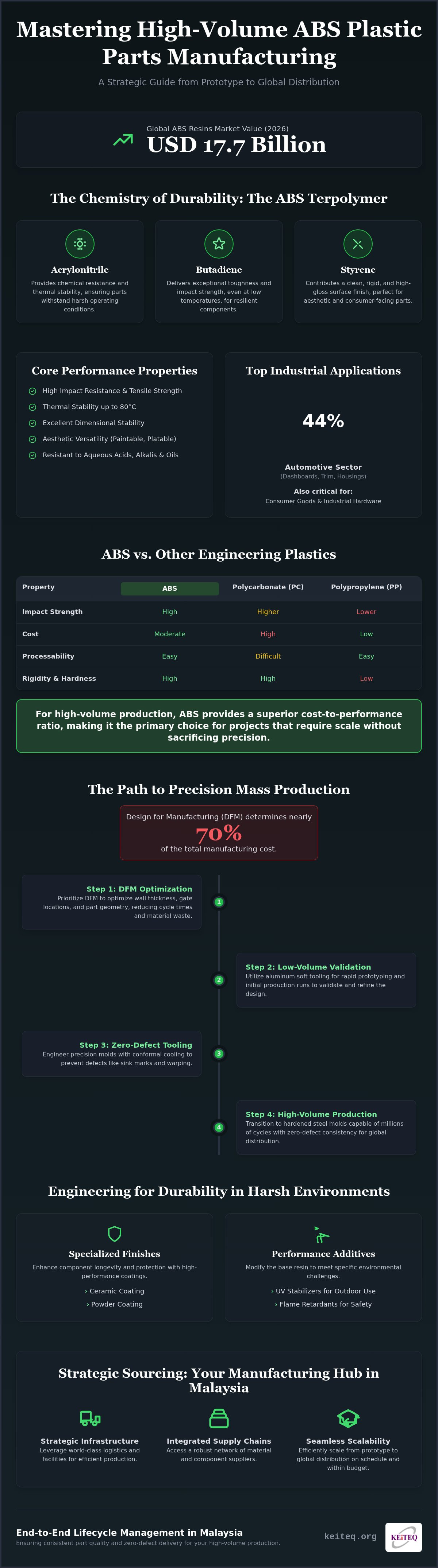
Acrylonitrile Butadiene Styrene (ABS) is a high-performance engineering thermoplastic. It serves as a foundational material in modern industrial production. Manufacturers favor this terpolymer because it combines structural rigidity with significant impact resistance. In the context of ABS plastic parts manufacturing, the material's ability to maintain dimensional stability under mechanical stress makes it indispensable for precision engineering. It's a versatile choice. The global ABS resins market reached a value of USD 17.7 billion in 2026; this growth reflects its critical role across multiple sectors.
Mechanical performance drives material selection. ABS possesses high tensile strength and excellent thermal stability, allowing components to withstand operating temperatures up to 80°C without losing structural integrity. Its aesthetic versatility is equally vital. The material supports high-gloss finishes and deep textures, making it the preferred choice for consumer-facing hardware. It's easily paintable and accepts electroplating, which is essential for achieving premium finishes in automotive and electronics industries. For specialized manual marking or detailing on these surfaces, high-quality paint markers from PoscART offer a durable solution that adheres effectively to the ABS substrate.
Automotive: Dashboards, trim components, and mirror housings (accounting for over 44% of global consumption).
Consumer Goods: Power tool housings, protective headgear, and ergonomic furniture (you can explore I-Easy dual motors Electric Standing Desk to see how these materials are applied in premium workspace designs).
Industrial Hardware:Outdoor payment terminal enclosures and complex internal chassis.
The Chemistry of Durability
The performance of ABS stems from its three-monomer composition. Acrylonitrile provides chemical resistance and thermal stability. Butadiene contributes toughness and impact strength even at low temperatures. Styrene gives the final part a clean, rigid surface finish. This combination ensures parts remain resistant to aqueous acids, alkalis, and many vegetable oils. For outdoor hardware applications, high-grade ABS provides the structural resilience required to protect internal electronics from physical tampering and environmental stress. Beyond traditional resins, manufacturers can also explore Sale of certified recycled plastic pellets and re-granulate to find sustainable alternatives for various industrial applications.
ABS vs. Other Engineering Plastics
Selecting the right polymer involves balancing cost and performance. While Polycarbonate (PC) offers higher impact strength, it's often more expensive and harder to process. Polypropylene (PP) is a lower-cost alternative but lacks the rigidity and surface hardness of ABS. For high-volume industrial components, ABS provides a superior cost-to-performance ratio. This efficiency makes it the primary choice for global ABS plastic parts manufacturing projects that require scale without sacrificing precision. Engineers often utilize additives like UV stabilizers or flame retardants to enhance the base resin. These modifications allow ABS to perform reliably in harsh outdoor environments where standard polymers might degrade.
Precision ABS Injection Molding: From Design to High-Volume Production
Industrial-scale production requires a rigorous approach to Design for Manufacturing (DFM). In the field of ABS plastic parts manufacturing, the design phase determines nearly 70% of the total manufacturing cost. High-volume success depends on optimizing wall thickness and gate locations before the first mold is cut. We prioritize DFM to reduce cycle times and minimize material waste. This proactive engineering ensures that complex components meet the mechanical and physical properties of ABS without incurring unnecessary overhead. It's a strategic necessity for global OEMs.
Optimizing mold design is the primary defense against common defects. Sink marks occur when thick sections cool slower than the surface; warping results from non-uniform cooling rates across the part. Precision mold engineering utilizes conformal cooling channels to maintain thermal equilibrium throughout the tool. Transitioning from initial concepts to market-ready products involves a clear scaling path. We utilize aluminum soft tooling for low-volume validation and invite you to Learn about our prototyping services to refine part geometry. Once the design is locked, we transition to hardened steel molds capable of producing millions of cycles with zero-defect consistency. If you have a complex design ready for review, you can discuss your project specifications with our engineering team.
The Injection Molding Process Cycle
The production cycle follows a methodical sequence: clamping, injection, cooling, and ejection. High-precision machines control the melt temperature and injection pressure to ensure consistent part weight. Cooling accounts for the largest portion of the cycle time. Efficient thermal management is essential for maintaining tight tolerances in ABS components. Our facilities in Malaysia integrate advanced automation to handle part removal and secondary operations. This reduces human error and maintains a steady production rhythm for high-volume orders.
Custom Plastic Molding for Complex Geometries
Industrial hardware often requires intricate internal structures that challenge standard molding techniques. We manage undercuts through the use of side-actions and collapsible cores. Insert molding allows us to integrate metal threaded inserts or electrical contacts directly into the ABS part during the injection phase. This synergy between plastic molding and metal stamping creates robust, multi-functional assemblies. When Selecting a plastic injection molding manufacturer, OEMs must evaluate the partner's ability to manage these complex geometric requirements at scale. This integrated approach ensures the final component is ready for immediate assembly into larger systems, such as outdoor payment terminals.
Engineering for Durability: Custom ABS Parts in Harsh Environments
Outdoor hardware must survive relentless environmental stress. UV radiation, extreme temperature fluctuations, and high-impact physical contact are constant threats to component integrity. In the field of ABS plastic parts manufacturing, engineering for durability isn't optional; it's a technical requirement. We design components that resist photo-degradation and maintain structural strength across a wide thermal range. This resilience is vital for high-stakes applications where equipment failure leads to significant downtime and maintenance costs. Our engineering team focuses on material stability to ensure long-term performance.
Success in harsh environments often requires a hybrid material approach. We leverage the synergy between precision plastic molding and metal stamping to create rugged assemblies. For instance, an outdoor payment terminal utilizes a metal internal chassis for rigidity and an ABS enclosure for user interface durability. This combination ensures the device is tamper-resistant while remaining lightweight and cost-effective. These integrated methods align with global standards for Advanced Materials and Manufacturing, positioning our production as a reliable choice for international OEMs seeking stability.
Advanced Surface Finishing for ABS
Surface treatments extend the lifespan of ABS components significantly. We apply industrial powder coating and ceramic coating to enhance wear resistance and chemical shielding. These finishes are essential for meeting strict IP ratings, ensuring that internal electronics remain isolated from moisture and dust. Our reference guide on protective coatings details how these layers prevent material fatigue. Precision in finishing is just as critical as the initial molding phase for maintaining the functional trust of your end users.
Reliability in Fuel Retail Environments
Fuel retail environments present unique challenges for polymers. Components at petrol and gas stations face frequent exposure to oils, fuels, and abrasive cleaning agents. We engineer ABS parts with specific chemical resistance profiles to prevent cracking or discoloration over time. Longevity in unattended payment kiosks depends on durable surface textures that hide scratches and resist staining. By managing the full lifecycle from R&D to mass production in Malaysia, we ensure every part meets these rigorous environmental standards. This methodical approach guarantees that your hardware remains operational in the most demanding commercial settings.
Strategic Sourcing: Why Malaysia is the Hub for ABS Manufacturing in 2026
Malaysia's manufacturing sector demonstrated resilient growth in 2026, with gross value-added increasing by 5.9% in the first quarter to reach RM101.3 billion. This expansion solidifies the nation's position as a premier global leader in precision engineering and electronics assembly. For global OEMs, Malaysia has become the primary hub for ABS plastic parts manufacturing due to its unique combination of technical expertise and logistical efficiency. The region's proximity to major shipping lanes ensures that components move through the global supply chain with minimal transit delays. It's a strategic advantage that reduces lead times for international markets.
Achieving high-tier industrial standards at competitive price points is a hallmark of the Malaysian manufacturing ecosystem. While the price of ABS in Southeast Asia was recorded at US$1.96/KG in August 2026, the real cost-efficiency stems from integrated supply chains. Manufacturers here don't just mold plastic; they provide holistic solutions that include metal stamping and complex hardware assembly. This synergy reduces the complexity of managing multiple vendors. You can explore our plastic injection molding services in Malaysia to see how we maintain these rigorous standards while optimizing your production budget.
Technical Infrastructure in Malaysia
The nation's infrastructure supports the most demanding industrial requirements through advanced machinery and a highly specialized workforce. The median wage in the manufacturing sector rose by 4.0% in 2025, reflecting the increasing technical proficiency of the local engineering talent. Our facilities maintain strict compliance with international quality standards, including ISO 9001 and ISO 14001, ensuring that every part meets global safety and performance benchmarks. This technical maturity extends to electronic manufacturing services in Malaysia, allowing for the seamless integration of plastic enclosures with complex internal circuitry.
Operational Stability and Supply Chain Resilience
Navigating global production challenges requires a partner that offers consistency and long-term stability. Malaysia provides this through the New Industrial Master Plan 2030 (NIMP 2030) and the New Outcome-Based Incentive Framework (NIF) launched in March 2026. These policies create a predictable environment for large-scale investment and production. We adopt a "Safe Pair of Hands" approach, managing your mass production runs with disciplined accuracy and logistical competence. Malaysia serves as a critical strategic corridor for OEM mass production by providing a stable political climate and a mature manufacturing ecosystem. If you're ready to secure your production lines, contact us for further details regarding our regional capabilities.
End-to-End Lifecycle Management for Custom ABS Components
Successful production begins long before the first injection cycle. It starts with Integrated Product R&D and Manufacturing. We move beyond the factory floor by aligning design intent with industrial constraints. This alignment is critical in ABS plastic parts manufacturing to prevent costly redesigns during the scale-up phase. We manage the entire transition from initial soft-tooling prototypes to hardened steel mass production. This methodical process ensures a zero-defect delivery schedule that protects your brand's reputation in the global market. It's about precision at every stage.
Holistic OEM assembly represents the final stage of lifecycle management. We integrate precision plastic components with metal stamping and complex electronics. This multi-disciplinary approach is essential for products like outdoor payment terminals. By managing every interface between materials, we eliminate the tolerance stack-up issues that often plague fragmented supply chains. This integrated strategy provides the structural integrity and functional reliability required for industrial-grade hardware.
The Value of Single-Source Manufacturing
Consolidating your production with a single partner reduces logistical complexity. We handle molding, stamping, and assembly under one quality management system. This provides a clear audit trail and ensures consistent quality control across all production phases. Our end-to-end product manufacturing guide outlines the strategic benefits of this consolidation. It's a "Safe Pair of Hands" approach that maintains a steady, reliable output for your global distribution networks. You don't have to manage multiple vendors across different time zones.
Procurement and Quotation Strategy
Preparing a technical brief for a precision ABS manufacturing quote requires specific data. You should include 3D CAD files, material grades, and expected annual volumes. We look for contract manufacturers that offer transparent KPIs, such as yield rates and cycle time efficiency. This transparency is vital for finalizing a roadmap for industrial scale-up. A well-prepared brief allows us to provide an accurate assessment of your project's technical and financial requirements.
Our facilities in Malaysia are equipped to handle your most complex ABS plastic parts manufacturing requirements. We offer specialized assembly for petrol station hardware and outdoor terminals within a stable, high-tech manufacturing corridor. To secure a dependable production partner in the Southeast Asian market, please Request for Quotation or Request to contact us for further details regarding our Malaysian regional offerings.
Securing Your Industrial Production Roadmap
Industrial success in 2026 depends on more than just high-volume output; it requires a disciplined integration of material science and logistical precision. It's about reliability. Mastering ABS plastic parts manufacturing involves a rigorous commitment to Design for Manufacturing (DFM) and the application of advanced finishes like ceramic or powder coatings to ensure environmental durability. By consolidating R&D, plastic molding, and metal stamping with a single-source partner, OEMs eliminate the technical risks associated with fragmented supply chains. This synergy is essential for complex hardware.
Malaysia offers a unique strategic advantage for those seeking operational stability and high-tier manufacturing standards. Our facilities provide specialized assembly for outdoor petrol station terminals and comprehensive mass production management within a mature technical ecosystem. We invite you to leverage our end-to-end expertise to bring your hardware to market with confidence. For high-precision industrial solutions and expert manufacturing support, please Request for Quotation or Request to contact us for further details regarding our specialized services in Malaysia. We look forward to facilitating your next production scale-up.
Frequently Asked Questions
What are the main advantages of using ABS for industrial plastic parts?
ABS provides high impact resistance, dimensional stability, and a clean surface finish, making it a versatile engineering thermoplastic. Its unique composition allows it to maintain structural integrity under mechanical stress and temperatures up to 80°C. These properties are essential for ABS plastic parts manufacturing in the automotive and electronics sectors. The material's ease of processing supports complex geometries while ensuring that protective housings remain durable and functionally reliable throughout their industrial lifecycle.
How does the cost of ABS injection molding compare to CNC machining for parts?
Injection molding offers a superior cost-to-performance ratio for high-volume production compared to CNC machining. While custom cnc cutting services are suitable for low-volume prototyping due to lower upfront costs, injection molding significantly reduces the per-unit price at scale. The initial investment in steel molds is offset by rapid cycle times and minimal material waste. For industrial components requiring millions of cycles, the efficiency of molding remains the standard for cost-effective manufacturing.
Standard ABS requires specific modifications or finishes to survive long-term UV exposure in outdoor environments. UV stabilizers can be integrated into the resin during the ABS plastic parts manufacturing process to prevent material fatigue and discoloration. Additionally, applying secondary protective layers like ceramic or powder coatings provides an effective barrier against photo-degradation. These engineering choices allow ABS components to function reliably in harsh settings, such as outdoor payment terminals at petrol stations.
What is the typical lead time for custom ABS injection mold manufacturing?
The timeframe for custom injection mold manufacturing depends on the complexity of the part geometry and the choice between soft and hard tooling. Soft aluminum tools for prototyping are generally completed faster than hardened steel molds intended for high-volume production. Precision machining, heat treatment, and mold fitting require a methodical approach to ensure tool longevity. We establish specific production timelines during the initial R&D phase to align with your global distribution schedule.
Why is Malaysia considered a strategic location for ABS plastic manufacturing?
Malaysia serves as a strategic corridor due to its advanced technical infrastructure and its position within global shipping routes. The nation's manufacturing sector demonstrated significant growth in 2026, reflecting a mature ecosystem capable of handling complex industrial projects. Regional stability and a highly skilled engineering workforce provide the necessary foundation for long-term OEM partnerships. This combination of logistical efficiency and technical maturity makes Malaysia an ideal hub for high-precision production and global distribution.
What finishing options are available for ABS plastic parts to improve durability?
We offer several finishing options to enhance the durability of ABS parts, providing resistance against UV and chemicals:
Powder coating and ceramic coating for wear resistance.
Enamel coating for chemical shielding.
Electroplating for premium aesthetic finishes.
These treatments ensure that components meet specific IP ratings and maintain functional trust. Selecting the appropriate finish is critical for hardware deployed in harsh or unattended outdoor settings.
How do you ensure quality consistency in high-volume ABS production runs?
We maintain quality consistency through automated process monitoring and strict adherence to international standards like ISO 9001. Our facilities utilize precision sensors to control melt temperatures and injection pressures in real-time, preventing common defects such as sink marks or warping. Regular tool maintenance and statistical process control (SPC) ensure that tolerances remain tight across high-volume production runs. This disciplined approach guarantees that every component meets the zero-defect requirements of a global supply chain.
Does Keiteq offer assembly services for complex parts involving both plastic and metal?
Keiteq provides comprehensive OEM assembly services that integrate precision plastic molding with metal stamping and electronics. We manage the full product lifecycle, from initial R&D to the assembly of complex industrial hardware. This single-source approach eliminates the logistical complexity of managing multiple vendors and prevents tolerance stack-up issues. Our Malaysian facilities are optimized for delivering fully integrated, tested, and ready-to-deploy systems, ensuring consistent quality across all material interfaces.


Comments