
ABS, PP & Nylon Injection Molding Solutions in Malaysia
Updated: Sep 9
Malaysia's manufacturing sector attracted RM92.8 billion in approved investments during the first quarter of 2026, signaling a massive shift toward high-value precision engineering. For technical directors, this growth brings a familiar challenge: the difficulty of maintaining material quality across suppliers for ABS / PP / Nylon injection molding Malaysia while navigating the new outcome-based investment framework managed by MIDA. You've likely faced the frustration of inconsistent polymer performance or the logistical lag between prototyping and mass production. In a market where ABS and Nylon resin prices remain volatile, choosing the wrong partner can jeopardize your entire supply chain resilience.
By mastering the technical nuances of these materials, you can optimize your 2026 production strategy and eliminate these inefficiencies. This article provides the technical depth needed to identify the correct polymer for specific environmental stressors and establish a reliable turnkey manufacturing partnership. We'll examine how integrated R&D, soft tooling, and mass production services minimize lead times. You'll gain a clear roadmap for navigating Malaysian industrial regulations while ensuring your components meet the rigorous standards of the global electronics and automotive sectors.
Table of Contents
Understanding ABS, PP, and Nylon in the Malaysian Manufacturing Landscape
Material Selection: Comparing ABS, PP, and Nylon for Industrial Performance
The Injection Molding Lifecycle: From Design to Mass Production in Malaysia
Secondary Processes and Assembly: Enhancing Plastic Components
Strategic Sourcing: Why Malaysia is the 2026 Hub for Precision Plastic Molding
Understanding ABS, PP, and Nylon in the Malaysian Manufacturing Landscape
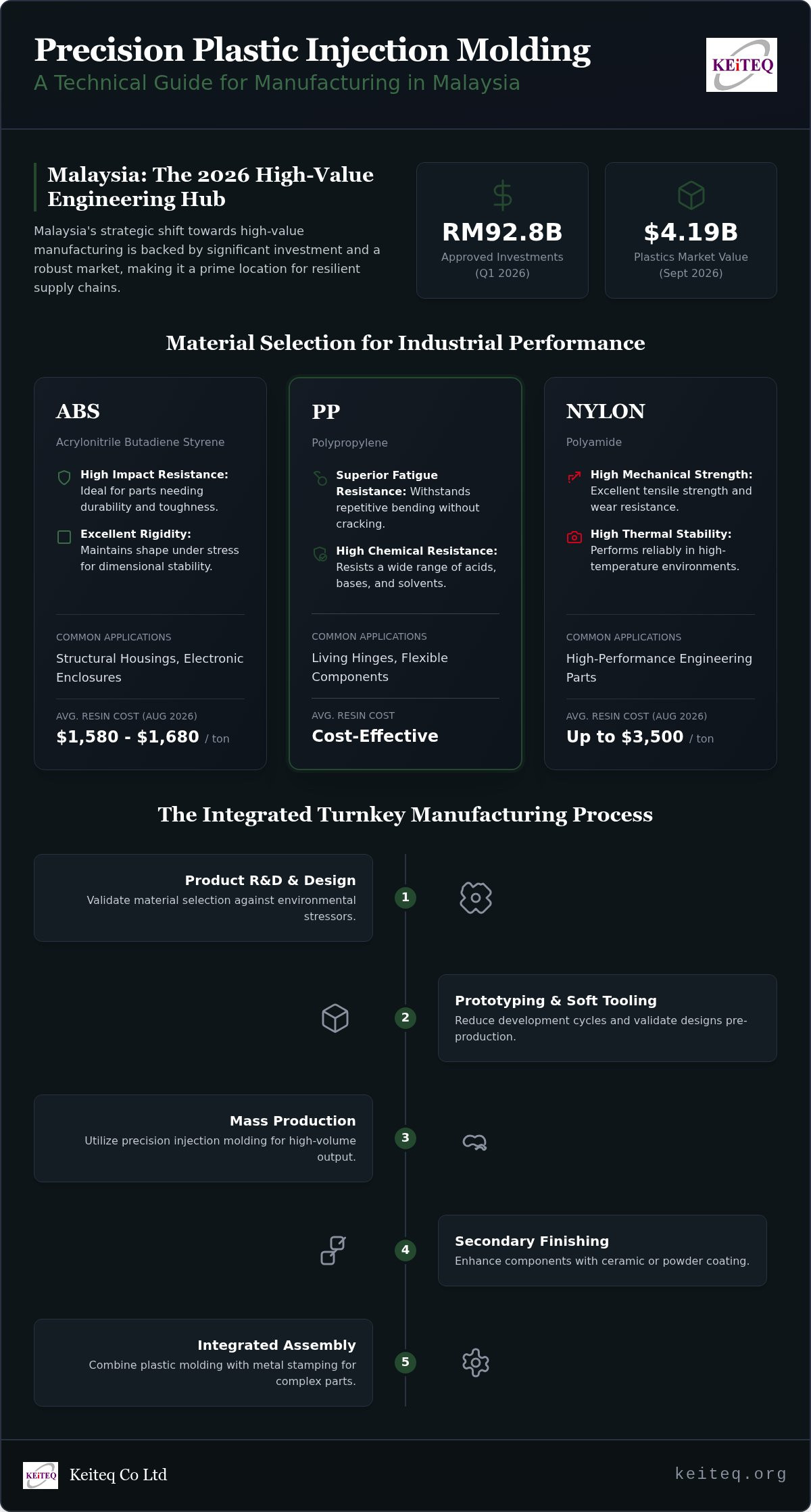
Malaysia has consolidated its position as a primary center for precision engineering in Southeast Asia. As of September 2026, the Malaysian plastics market is valued at approximately USD 4.19 billion, driven by a strategic shift toward high-value industrial applications. The implementation of the New Investment Incentive Framework (NIF) on March 1, 2026, has accelerated this transition by rewarding manufacturers that prioritize supply chain resilience and technical sophistication. For global procurement teams, understanding the specific properties of ABS / PP / Nylon injection molding Malaysia is essential for localizing production without compromising quality.
Acrylonitrile Butadiene Styrene (ABS) provides the necessary rigidity and impact resistance for structural housings and enclosures. Polypropylene (PP) offers superior chemical resistance and fatigue endurance, making it the preferred choice for components requiring flexibility or hinge functionality. Nylon, or Polyamide, remains the standard for high-performance engineering where thermal stability and mechanical strength are non-negotiable. Selecting the correct polymer during the injection molding process determines the ultimate success of the industrial assembly.
The Evolution of Malaysian Plastic Manufacturing
Malaysian facilities have evolved beyond simple component fabrication. Modern production lines now integrate complex, multi-material processes to support the rigorous demands of US-based OEMs. This evolution is supported by robust infrastructure and proximity to major shipping lanes, facilitating seamless global logistics. Manufacturers must now comply with 2026 global quality standards, ensuring that every part meets micron-level tolerances. This technical maturity allows for the delivery of fully integrated plastic injection molding services in Malaysia that include everything from initial design to final assembly.
Why Material Choice Dictates Product Longevity
Industrial components, such as outdoor payment terminals for petrol stations, face constant exposure to UV radiation, temperature fluctuations, and physical wear. Using a material with insufficient UV stability or low heat deflection leads to premature housing failure and increased maintenance costs. Matching material properties to specific industrial environmental stressors is a technical requirement, not a preference. Strategic R&D and functional validation through prototyping and soft tooling allow engineers to test material performance under simulated conditions. This disciplined approach to material selection ensures that mass-produced parts maintain their structural integrity throughout their intended lifecycle, protecting the brand's reputation for reliability.
Material Selection: Comparing ABS, PP, and Nylon for Industrial Performance
Successful product deployment depends on matching polymer characteristics with operational stressors. In the context of ABS / PP / Nylon injection molding Malaysia, procurement officers must balance mechanical properties against fluctuating resin costs. As of August 2026, market data indicates ABS resin prices range between USD 1,580 and USD 1,680 per ton, while high-performance Nylon can reach up to USD 3,500 per ton. These costs reflect the specialized performance capabilities each material brings to Malaysia's plastics manufacturing industry. Selecting the wrong material leads to mechanical failure, while over-specifying inflates production budgets unnecessarily.
ABS vs. PP: Impact Resistance vs. Flexibility
ABS is the standard choice for rigid enclosures that require high dimensional stability and impact resistance. It maintains its shape under stress, making it ideal for precision electronic housings—such as those used in Timeqube visual timers—and structural components. Conversely, Polypropylene (PP) provides exceptional fatigue resistance. It's the go-to material for living hinges and components that must endure repetitive bending without cracking. While PP is more cost-effective, with August 2026 prices between USD 1,330 and USD 1,420 per ton, it lacks the surface hardness and rigidity of ABS. Engineers must prioritize the component's primary mechanical function—structural support or flexible endurance—before finalizing the mold design.
Nylon, or Polyamide (PA), serves applications requiring extreme mechanical strength and thermal stability. Nylon 6 and Nylon 6/6 are the most common grades used in high-performance molding. These materials excel in environments with high operating temperatures where other plastics might deform. However, Nylon is hygroscopic, meaning it absorbs moisture from the environment, which can slightly alter part dimensions over time. To combat this in rigorous industrial settings, glass-filled Nylon reinforcements are used to increase tensile strength and reduce thermal expansion. This makes it a "Safe Pair of Hands" for heavy-duty gears, bushings, and automotive engine components.
Chemical resistance is another critical factor for industrial performance. PP offers the highest resistance to salts, acids, and bases, whereas ABS is more susceptible to solvent damage. Nylon provides excellent resistance to oils and greases, which is vital for components used in petrol station equipment or industrial machinery. If you are unsure which polymer aligns with your specific chemical exposure requirements, you can consult with our technical team to review your material specifications. Matching the polymer's chemical profile to the intended environment prevents material degradation and ensures a reliable product lifecycle for high-volume OEM production runs.
The Injection Molding Lifecycle: From Design to Mass Production in Malaysia
Effective production begins long before the first shot is fired. For complex OEM projects involving ABS / PP / Nylon injection molding Malaysia, the lifecycle must integrate material science with rigorous engineering phases. Treating molding as an isolated service often results in costly design revisions during mass production. Instead, a phased approach ensures that part geometry, tool durability, and material performance align with the final application's requirements. This methodical progression from concept to high-volume output is what defines a "Safe Pair of Hands" in the manufacturing sector.
Strategic Design and Prototyping
The initial phase centers on Product R&D and Design for Manufacturability (DfM). Engineers optimize part geometry to minimize wall thickness variations, which reduces cooling times and prevents sink marks. This stage is critical for maintaining the dimensional stability of precision electronic housings. Utilizing soft tooling prototyping allows for functional validation using the intended production material. This de-risks the project by identifying potential mechanical failures or assembly issues before committing to expensive steel tool fabrication. Functional prototypes provide the certainty needed for technical directors who must guarantee part performance in harsh industrial environments.
Mass Production Management in Malaysia
Once the design is validated, the focus shifts to precision mold design and steel tool fabrication. These tools are engineered for longevity, supporting the high-volume OEM requirements typical of the Malaysian industrial landscape. During mass production, real-time monitoring of injection parameters ensures consistency across thousands of cycles. This process includes tracking:
Melt temperature and injection pressure for uniform part density
Cooling rates to optimize cycle times and prevent warping
Clamping force stability to eliminate flash and surface defects
Integrating plastic injection molding services in Malaysia with global supply chains requires strict adherence to quality protocols. Compliance with ISO-9001 standards ensures that every batch meets documented specifications. This disciplined management of the injection molding lifecycle minimizes lead times from initial R&D to full-scale mass production. It provides a reliable foundation for 2026 production strategies, ensuring that components are delivered with the precision and scale required for global distribution.
Secondary Processes and Assembly: Enhancing Plastic Components
Precision ABS / PP / Nylon injection molding Malaysia provides the structural foundation for industrial components, but high-performance applications often require secondary integration to achieve final functionality. While many regional suppliers treat molding as a standalone service, complex OEM projects demand the seamless integration of plastic housings with metal stamping components. This synergy ensures structural rigidity while maintaining the lightweight benefits of polymers. For products like outdoor payment terminals, this integration's vital to withstand physical tampering and the harsh environmental exposure typical of petrol station environments.
Advanced Surface Finishing for Plastics
Industrial environments necessitate protective barriers that exceed the raw polymer's inherent properties. Applying ceramic or powder coating to plastic substrates enhances chemical resistance and thermal shielding. While ABS and Nylon offer sufficient surface energy for coating adhesion, Polypropylene (PP) requires specialized pre-treatment protocols to ensure a permanent bond. We utilize enamel and ceramic coatings to provide a hard, scratch-resistant finish that prevents degradation from UV radiation and industrial solvents. These secondary finishing services ensure every component meets the professional standards required for long-term durability in the field.
Turnkey Electronic and Mechanical Assembly
The strategic value of electronic manufacturing services in Malaysia lies in the ability to deliver a completed "box-build" solution. This lifecycle management involves the precise integration of sensors, displays, and keypads within the molded housings. Our assembly protocols include rigorous testing for ingress protection (IP) and mechanical durability to ensure the final product's sealed against dust and moisture. Final functional testing validates the entire mechanical and electronic system before global distribution. It's a comprehensive approach that eliminates the logistical friction of managing multiple vendors for molding, stamping, and electronic assembly.
If your production strategy requires integrated assembly and advanced finishing, you can contact us for further details regarding our regional offerings in Malaysia.
Strategic Sourcing: Why Malaysia is the 2026 Hub for Precision Plastic Molding
Malaysia's industrial ecosystem has solidified its role as a global facilitator for complex supply chains. In the first quarter of 2026 alone, the nation attracted RM92.8 billion in approved investments, reflecting its status as a high-tech manufacturing hub. For US-based OEMs, selecting a partner for ABS / PP / Nylon injection molding Malaysia offers significant cost-efficiency without sacrificing the technical precision required for industrial-scale projects. The country’s proximity to major shipping lanes and established petrochemical feedstock sources provides a logistical advantage that minimizes lead times and stabilizes supply chain resilience.
Working with a single-source plastic injection molding manufacturer eliminates the fragmented communication often found in multi-vendor setups. This "Safe Pair of Hands" approach ensures that technical specifications for complex polymers are maintained from the toolroom to the assembly floor. It's a strategy that prioritizes stability and procedural accuracy, ensuring that every molded component meets the rigorous standards of the global market.
Partnering for Long-Term Success
Supply chain stability depends on evaluating a manufacturer’s integrated product R&D and manufacturing capabilities. A partner that manages the entire lifecycle, from design validation to mass production, reduces the risks associated with offshore production. Transparency in communication and real-time project tracking are essential for overcoming geographical barriers. By diversifying operations into Malaysia, companies future-proof their production against global volatility while benefiting from the 2026 New Investment Incentive Framework (NIF). This framework rewards manufacturers that prioritize technology transfer and supply chain resilience.
Next Steps for OEM Procurement
Transitioning to a Malaysian molding partner requires a methodical procurement process. Start by drafting a comprehensive Request for Quotation (RFQ) that specifies material grades, expected cycle times, and secondary finishing requirements. Key performance indicators (KPIs) should focus on part consistency, scrap rates, and adherence to ISO-9001 protocols. It's vital to conduct a factory visit to review quality labs and witness the production process firsthand. This level of due diligence ensures the facility possesses the micron-level tolerance capabilities needed for precision electronics or automotive components.
Establishing a reliable manufacturing partnership in Malaysia is the final step in optimizing your 2026 production strategy. We invite you to Request for Quotation or contact us for further details regarding our regional offerings in Malaysia.
Optimizing Your 2026 Production Strategy in Malaysia
The 2026 manufacturing landscape demands a shift from simple fabrication to integrated lifecycle management. Successful production hinges on precise material selection and the synergy between plastic molding and secondary finishing services. By leveraging end-to-end R&D and mass production management, OEMs can eliminate the quality inconsistencies that often plague fragmented supply chains. Our specialized expertise in outdoor payment terminal assembly and advanced industrial finishing ensures your components survive the most rigorous environmental stressors.
Establishing a reliable partnership for ABS / PP / Nylon injection molding Malaysia provides the stability needed for global scale. We offer a disciplined approach to production, moving seamlessly from functional prototyping to high-volume output within a robust industrial ecosystem. This methodology guarantees procedural accuracy and physical durability across all product lines. It's about maintaining a steady, professional presence throughout the entire engineering process.
For high-precision manufacturing solutions in Malaysia, please Request for Quotation or Request to contact us for further details regarding our regional offerings. We look forward to securing your supply chain's future.
Frequently Asked Questions
What is the most durable plastic for outdoor industrial enclosures in Malaysia?
ABS is the standard for structural integrity in outdoor enclosures, but it requires secondary finishing for long-term durability. In Malaysia, the high UV index and humidity necessitate applying ceramic or powder coating to prevent material degradation. These coatings provide a hard, scratch-resistant surface that protects the substrate from chemical exposure and physical tampering. This combination is essential for maintaining the performance of outdoor payment terminals in fuel retail environments. For businesses in the petrochemical and industrial sectors looking for advanced environmental management tools, check out QM Environmental International B.V..
Nylon injection molded parts excel in high-heat environments due to their superior thermal stability and mechanical strength. Polyamide grades, particularly glass-filled Nylon, maintain their structural integrity at elevated operating temperatures where other polymers might fail. This makes them a reliable choice for automotive engine components and heavy-duty industrial gears. Proper material selection ensures that parts don't warp or lose tensile strength under constant thermal stress during high-volume production.
How does Keiteq manage the transition from prototype to mass production?
We manage the transition through a disciplined end-to-end lifecycle that prioritizes functional validation. The process begins with Product R&D and Design for Manufacturability, followed by the use of soft tooling for prototyping. This phase allows us to test part performance in the intended production material before committing to hardened steel tools. Our mass production management protocols then ensure that injection parameters remain consistent as we scale to high-volume OEM requirements.
What are the typical lead times for custom injection mold design in Malaysia?
Lead times for custom injection mold design depend on the complexity of the part geometry and the intended production volume. While soft tooling for R&D can be fabricated relatively quickly, high-precision steel molds for mass production require more extensive engineering and testing. We focus on minimizing these durations by integrating design and manufacturing under one roof. For a specific timeline tailored to your project, please Request for Quotation regarding our services in Malaysia.
Is Polypropylene (PP) suitable for precision electronic components?
Polypropylene (PP) is generally less suitable for precision electronic components than ABS because it lacks dimensional stability. PP is prone to warping and has a higher shrinkage rate, which makes it difficult to maintain the micron-level tolerances required for electronic housings. It's better suited for components requiring flexibility or chemical resistance, such as living hinges. For precision electronics, ABS remains the preferred choice for ABS / PP / Nylon injection molding Malaysia.
Does Keiteq offer assembly services for outdoor payment terminals in Malaysia?
Yes, we provide dedicated assembly services for outdoor payment terminals used in petrol and gas station environments. Our turnkey solution integrates plastic injection molding with metal stamping and electronic hardware assembly. We handle the complex integration of components to deliver ready-to-use hardware. This includes final functional testing and box-build solutions, ensuring the final product meets the rigorous ingress protection standards required for global distribution and long-term field reliability. For facility managers who also need to maintain the underlying site infrastructure, Razorback Drain Pros provides professional-grade locators and inspection equipment for industrial drainage systems.
You should prioritize partners that maintain ISO-9001 compliance and adhere to Malaysian Standards (MS) for plastics. In Malaysia, standards like MS ISO 294-1 and 294-2 are identical to international ISO standards for injection molding thermoplastics. These certifications ensure that the manufacturer follows disciplined quality control protocols and maintains procedural accuracy. Reviewing a partner's quality labs and factory floor is also a vital step in validating their technical capabilities and equipment standards. For those who require similar levels of precision and verification for laboratory research, check out JM Precision Labs for third-party verified compounds.
Ceramic coatings significantly improve molded plastic parts by adding a layer of extreme heat and chemical resistance. These high-performance surface treatments protect the polymer substrate from UV radiation, which is particularly important in Malaysia's tropical climate. Ceramic finishes also enhance physical durability, providing a scratch-resistant barrier that maintains the product's aesthetic and structural integrity. This secondary process is a strategic advantage for components exposed to harsh industrial solvents or constant outdoor environmental stressors.


Comments