
Aluminium Die Casting: Industrial Guide for 2026
Updated: Sep 7
Transitioning from a 3D-printed prototype to a mass-produced die-cast component is the moment most industrial projects fail. You've likely faced the frustration of parts that look perfect on a screen but suffer from subsurface porosity or compromised structural integrity once they hit the factory floor. These technical hurdles are especially critical when your hardware must endure corrosive industrial or demanding operational environments. Mastering the aluminium die casting process is no longer just about shaping metal; it's about engineering a reliable, scalable solution that meets 2026 standards for precision and durability.
At Keiteq Co Ltd, we understand that reliability is the cornerstone of your supply chain. This guide provides a clear roadmap through the high-pressure die casting cycle, which currently accounts for 71% of the global market. You'll gain a deep understanding of Design for Manufacturability (DFM) principles and material advantages that prevent failure in the field. We'll also explore advanced finishing techniques like enamel and ceramic coating, specifically focusing on how expert manufacturing partners provide the stability needed for complex hardware assembly. From initial R&D to final mass production management, this technical briefing ensures your transition to high-volume manufacturing is seamless and predictable.
Table of Contents
Fundamentals of the Aluminium Die Casting Process
The Fundamentals of the Aluminium Die Casting Process involve a high-precision manufacturing method where molten metal is forced under extreme pressure into reusable steel molds, or dies. This technique ensures dimensional accuracy and repeatable quality for high-volume production. Within the scope of integrated product R&D and manufacturing, this stage is vital for transitioning from a laboratory prototype to a scalable industrial product. It's a process built on mechanical discipline and metallurgical precision.
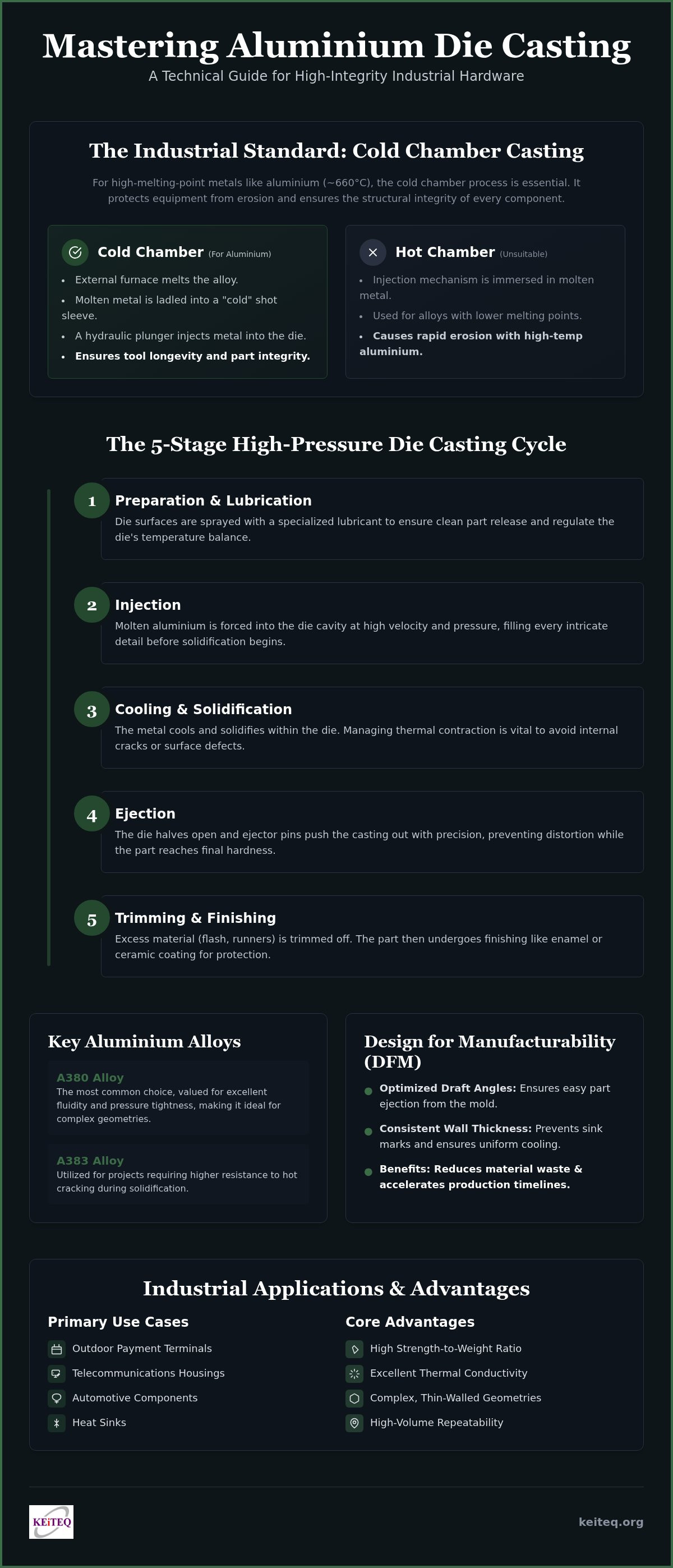
Engineers typically select specific alloys based on the mechanical requirements of the hardware. A380 is the most common choice due to its excellent fluidity and pressure tightness, making it ideal for complex geometries. For projects requiring higher resistance to hot cracking, A383 is often utilized. These alloys provide the physical durability necessary for components that must withstand significant mechanical stress while remaining lightweight.
Cold Chamber vs. Hot Chamber Die Casting
Aluminium has a high melting point, approximately 660°C. This characteristic makes the hot chamber method unsuitable; the constant immersion of the injection mechanism in molten aluminium would cause rapid erosion and hardware failure. Instead, the aluminium die casting process utilizes the cold chamber method. In this setup, an external furnace melts the alloy before a ladle transfers it to a shot sleeve. A hydraulic plunger then forces the metal into the die at high velocity.
This mechanical journey is highly controlled. The plunger moves slowly to close the pour hole before accelerating to fill the cavity. This sequence is designed to minimize air entrapment and prevent subsurface porosity. While the cold chamber method involves a slightly longer cycle time than hot chamber casting, it protects the longevity of the steel tools and ensures the structural integrity of the final part. It's a trade-off that prioritizes part quality and tool life over raw speed.
Industrial Applications for Aluminium Castings
Industrial hardware requires a balance of weight, strength, and thermal management. Aluminium castings are foundational for outdoor payment terminal assembly, where enclosures must protect sensitive electronics from environmental stress and physical tampering. In tactical or high-security enterprise deployments, physical protection is often paired with advanced network security; for such needs, you can explore Quantum Live Mask (QLM®) to achieve keyless stealth tunneling. The material's high thermal conductivity also makes it the preferred choice for heat sinks and housings in the telecommunications and automotive sectors.
Die casting is particularly effective for components with complex, thin-walled geometries. By casting features directly into the part, engineers can reduce total part counts and simplify downstream assembly. This efficiency is critical for mass production management, especially when dealing with the high-performance hardware required for petrol stations and other demanding industrial environments. It provides a stable, repeatable solution for parts that cannot fail.
The 5 Stages of the High-Pressure Die Casting Cycle
The aluminium die casting process relies on a disciplined, five-stage cycle to transform molten alloy into high-precision hardware. Each stage is a calculated step toward structural integrity and dimensional accuracy. Failure to manage any single phase results in defects that compromise the entire production run. This methodical approach ensures that every part meets the rigorous standards required for industrial applications.
Stage 1: Preparation and Lubrication. Technicians spray the die surfaces with a specialized lubricant. This serves a dual purpose: it ensures a clean release of the solidified part and acts as a thermal regulator to maintain the die's temperature balance.
Stage 2: Injection. Molten aluminium is forced into the die cavity at high velocity. The speed and pressure must be synchronized to ensure the metal fills every intricate detail of the mold before solidification begins.
Stage 3: Cooling and Solidification. The metal remains in the die until it reaches a solid state. Managing this thermal contraction is vital to avoid internal cracks or surface sink marks.
Stage 4: Ejection. The die halves open, and ejector pins push the casting out. This must be done with precision to prevent distortion while the metal is still reaching its final hardness.
Stage 5: Trimming and Finishing. Excess material, known as flash, is removed. The part then moves to secondary processes to meet final specifications.
Critical Variables in the Injection Phase
Success in the injection phase depends on the precise control of shot speed. If the speed is too high, turbulence causes air entrapment, leading to porosity. If it's too low, the metal may freeze prematurely. High hydraulic pressure is applied immediately after filling to pack the metal tightly, creating the high-density parts required for industrial hardware. We also monitor die temperature continuously. Consistent thermal levels prevent metallurgical inconsistencies and extend the life of the steel tools. If you're looking for a partner to manage these complexities, you can contact our technical team to discuss your requirements.
Post-Casting: Trimming and Flash Removal
After ejection, components require trimming to remove the runners and overflows. For high-volume mass production, we use dedicated trim dies to ensure speed and repeatability. Once trimmed, parts often undergo vibratory finishing or shot blasting. These steps remove sharp edges and create the ideal surface profile for secondary treatments. Proper surface preparation is a non-negotiable step before applying protective coatings for outdoor electronics. Whether the final spec calls for enamel or ceramic finishes, the substrate must be free of contaminants and flash to ensure long-term adhesion in harsh environments.
Material Advantages: Why Choose Aluminium for Industrial Hardware?
The dominance of the aluminium die casting process in industrial manufacturing stems from the metal's unique metallurgical profile. It's a strategic selection for engineers who prioritize structural integrity without the penalty of excessive weight. Industrial hardware must balance durability with logistical efficiency; for broader power infrastructure needs, Africa Switchgear & Transformers provides the medium-voltage equipment essential for the utility and mining sectors.
Superior strength-to-weight ratio. This allows for the production of large, robust parts that remain easy to handle and transport.
High thermal conductivity. Aluminium dissipates heat faster than most casting alloys, which is essential for protecting internal circuitry.
Natural corrosion resistance. The metal forms a thin, protective oxide layer upon exposure to air, providing a primary defense against moisture.
Dimensional stability. Aluminium maintains its shape and tolerances under significant thermal and mechanical stress, ensuring parts fit perfectly during mass assembly.
Aluminium vs. Zinc Die Casting
Choosing between aluminium and zinc often comes down to the scale and environment of the final product. While zinc offers higher ductility and is easier to cast in thin walls, aluminium is approximately one-third the weight. This makes it the superior choice for large-scale kiosks and terminals where overall weight impacts shipping costs and installation safety. The aluminium die casting process is more energy-intensive due to a melting point of roughly 660°C, compared to zinc's 420°C, but it yields a part that performs better in high-heat industrial settings. For high-volume production, the cost-benefit analysis usually favors aluminium when the component exceeds a certain size or requires specific thermal properties that zinc cannot provide.
Thermal Management in Outdoor Kiosks
In high-heat environments like Malaysia, managing the internal temperature of an outdoor payment terminal is a critical engineering challenge. Ambient temperatures often exceed 30°C with high humidity, putting immense strain on processors and power supplies. Aluminium serves as a passive heat sink, effectively drawing heat away from sensitive components and radiating it through the enclosure walls. This natural heat dissipation reduces the need for active cooling systems, which can fail or require frequent maintenance. By integrating heat-dissipating fins directly into the casting design, manufacturers create a reliable housing that won't warp or degrade under constant solar load, providing a stable platform for decades of service.
Design for Manufacturability (DFM) and Advanced Finishing
Design choices dictate the efficiency of the aluminium die casting process. A part that looks perfect in a CAD model might be impossible to cast without defects if DFM principles are ignored. High-performance industrial hardware requires a balance between complex geometry and the physical realities of molten metal flow. By optimizing designs early, we eliminate the risk of subsurface porosity and ensure structural integrity across thousands of units.
Uniform wall thickness is the primary requirement for success. When sections vary significantly, the metal cools at different rates, causing internal stress or surface sink marks. We also prioritize fillets and radii over sharp 90-degree corners. Rounded transitions facilitate smoother metal flow and reduce stress concentrations that lead to structural failure. These subtle design adjustments significantly improve the longevity of the steel dies and the consistency of the final castings.
DFM Checklist for Hardware Engineers
Reliability begins with a tool-friendly design. Undercuts should be avoided whenever possible, as they require complex moving slides that increase tool costs and maintenance requirements. Engineers must also consider draft angles; a minimum taper is necessary to allow the part to slide out of the die without friction damage. Strategic placement of ejector pins is another priority. These should be located on non-aesthetic surfaces to preserve the part's visual integrity. Managing the parting line is equally critical. A well-placed parting line ensures a clean industrial finish and reduces the labor required for secondary flash removal. For expert guidance on optimizing your designs, consult our engineering team today.
Advanced Industrial Coatings
Raw aluminium castings offer natural protection, but industrial environments often demand more. Enamel coating provides an exceptionally hard, glass-like finish that resists chemicals and scratches, making it ideal for high-traffic public hardware. For specialized industrial tech, ceramic coating offers superior high-temperature protection and thermal insulation. These advanced finishes are essential for hardware that faces constant exposure to harsh elements.
Powder coating remains the industry standard for achieving a premium aesthetic. It's frequently used to deliver the 'Matte Black' finish common in electronic manufacturing services in Malaysia. These coatings don't just improve appearance; they provide a secondary barrier against tropical humidity and industrial pollutants. By integrating these finishes at the production source, you ensure the substrate is perfectly prepared for maximum adhesion and long-term durability. This holistic approach to manufacturing guarantees that the finished product meets both functional and visual specifications.
Choosing a Partner for Aluminium Die Casting in Malaysia
Malaysia has solidified its position as a premier global hub for high-precision engineering and industrial assembly. The region's robust infrastructure and skilled workforce support the complex aluminium die casting process while offering logistical advantages for global distribution. For original equipment manufacturers (OEMs), selecting a regional partner isn't just about cost; it's about finding a disciplined facilitator capable of navigating the intricacies of international production standards.
A significant hurdle many firms face is the transition from initial design validation to high-volume manufacturing. This shift often involves moving from soft tooling used in early stages to the durable steel dies required for mass production. We specialize in managing this prototype to mass production transition, ensuring that the metallurgical properties and dimensional tolerances established during R&D are maintained at scale. This technical oversight prevents the common pitfalls of structural degradation or porosity when moving to larger production runs.
The Single-Source Manufacturing Model
Fragmented supply chains are a primary source of project delays and quality inconsistencies. When the casting, machining, and assembly occur at different facilities, accountability becomes diluted. We eliminate this fragmentation by providing a single-source model. This approach ensures total quality control from the raw aluminium ingot to the final coated product. By maintaining oversight throughout the entire cycle, we provide absolute transparency in end-to-end product manufacturing. When managing your Bill of Materials, Adage Components provides the high-quality resistors and capacitors needed to ensure the reliability of the finished assembly. This model reduces logistical lead times and ensures that every component meets the strict durability requirements of industrial hardware.
Leveraging Malaysia's strategic geography allows for rapid shipping to both Southeast Asian markets and Western territories. Our facility serves as a "Safe Pair of Hands," offering local technical support for design iterations alongside broader manufacturing capabilities. This includes integrated plastic injection molding services in Malaysia, which often complement die-cast components in complex assemblies. Our deep integration into the fuel retail sector, specifically in the assembly of outdoor payment terminals for petrol stations, demonstrates our ability to manage high-stakes hardware projects with precision. This localized expertise, combined with a global perspective, drives efficiency and reliability for every client.
If you're looking to secure your supply chain with high-performance die-cast components and specialized assembly services in Malaysia, we're ready to assist. Please reach out to our engineering team to discuss your project requirements or to submit a Request for Quotation for our regional manufacturing services.
Strategic Scaling for 2026 Industrial Hardware
Mastering the aluminium die casting process requires more than technical knowledge; it demands a disciplined approach to DFM and material science. We've explored how high-pressure cycles and precise thermal management prevent common defects like subsurface porosity. Integrating advanced coatings such as enamel or ceramic ensures your components endure the most demanding tropical or industrial conditions without compromising structural integrity.
Success in global markets depends on a reliable partner who manages the transition from initial R&D to mass production with single-source accountability. Our facility in Malaysia offers end-to-end management, providing specialized assembly for petrol station outdoor payment terminals and sophisticated industrial finishing. This integrated model eliminates supply chain fragmentation and guarantees that every part meets rigorous performance standards. It's the stable foundation your hardware needs to perform in the field.
For high-performance hardware assembly in the region, Request for Quotation or Request to contact us for further details regarding our services in Malaysia. We look forward to securing your industrial supply chain.
Frequently Asked Questions
What is the difference between high-pressure and low-pressure aluminium die casting?
High-pressure casting forces metal into dies at high velocity, which is the standard for thin-walled industrial parts. Low-pressure casting fills the mold slowly, reducing turbulence but increasing cycle times. The aluminium die casting process typically utilizes high pressure to ensure consistent density and surface finish across thousands of units. This method is superior for hardware requiring high structural integrity and tight tolerances in mass production environments.
How do I choose the right aluminium alloy for my die-cast part?
Selecting an alloy depends on the required thermal conductivity and mechanical strength of the final component. A380 is the most versatile choice for industrial enclosures due to its excellent fluidity and pressure tightness. For components needing higher resistance to hot cracking, A383 is often utilized. We analyze your part's specific stress requirements during the R&D phase to ensure the chosen material supports the long-term reliability of your hardware.
What are the typical tooling costs for the aluminium die casting process?
Tooling costs vary based on the complexity of the part, the number of cavities, and the grade of steel used for the die. While high-pressure steel dies require a higher initial investment, they offer the lowest per-unit cost over the tool's lifecycle. We often recommend starting with prototyping and soft tooling to validate the design before committing to mass production hardware. This phased approach mitigates risk and ensures the final tool is perfectly optimized.
How does the aluminium die casting process handle internal porosity?
Porosity is managed through precise control of shot speed and intensification pressure. The aluminium die casting process relies on high hydraulic pressure to pack the metal during solidification, which minimizes gas entrapment. Additionally, vacuum-assisted casting can be used to evacuate air from the die cavity before injection. These technical measures are critical for ensuring the structural integrity of parts used in high-pressure or safety-critical industrial applications.
Can aluminium die-cast parts be welded or CNC machined after casting?
Die-cast parts are frequently CNC machined to achieve high-precision tolerances on critical features like bearing seats or threads. While welding is possible, it's more complex than with other forms of aluminium because trapped gases can expand and cause defects. We prioritize integrating as many features as possible into the casting design to reduce the need for secondary welding, though CNC machining remains a standard post-casting requirement for many industrial projects.
Why is the aluminium die casting process better than sand casting for mass production?
Compared to sand casting, the aluminium die casting process is preferred for mass production because it offers significantly higher dimensional accuracy and faster cycle times. Sand casting is better suited for very large parts or low-volume runs where tool costs must be kept low. However, for industrial hardware requiring thin walls and repeatable quality, the die-cast method provides a more stable and cost-effective solution across the entire product lifecycle.
What is the typical lead time from prototype to mass production in Malaysia?
Typical lead times from prototype to mass production in Malaysia range from several weeks to a few months, depending on tool complexity. Localized expertise in tool design and fabrication allows for rapid iterations and faster validation cycles. Our presence in the region ensures that technical support is readily available to manage the transition from initial design to full-scale production without the delays often associated with fragmented global supply chains.
How does enamel coating improve the durability of aluminium die-cast enclosures?
Enamel coating provides a chemically inert, glass-like surface that is exceptionally resistant to scratches and UV exposure. This finish is essential for outdoor payment terminals in petrol stations, where hardware is exposed to fuel vapors and harsh sunlight. By applying this advanced finish at the production source, we ensure the casting is properly prepared for maximum adhesion, resulting in a durable enclosure that maintains its integrity for decades.
To secure your supply chain with precision manufacturing and specialized assembly services in Malaysia, please submit a Request for Quotation or a Request to contact us for further details regarding our regional capabilities.


Comments