
Aluminium Diecasting Manufacturer: A Strategic Reference for Industrial OEMs in 2026
Updated: Jul 15
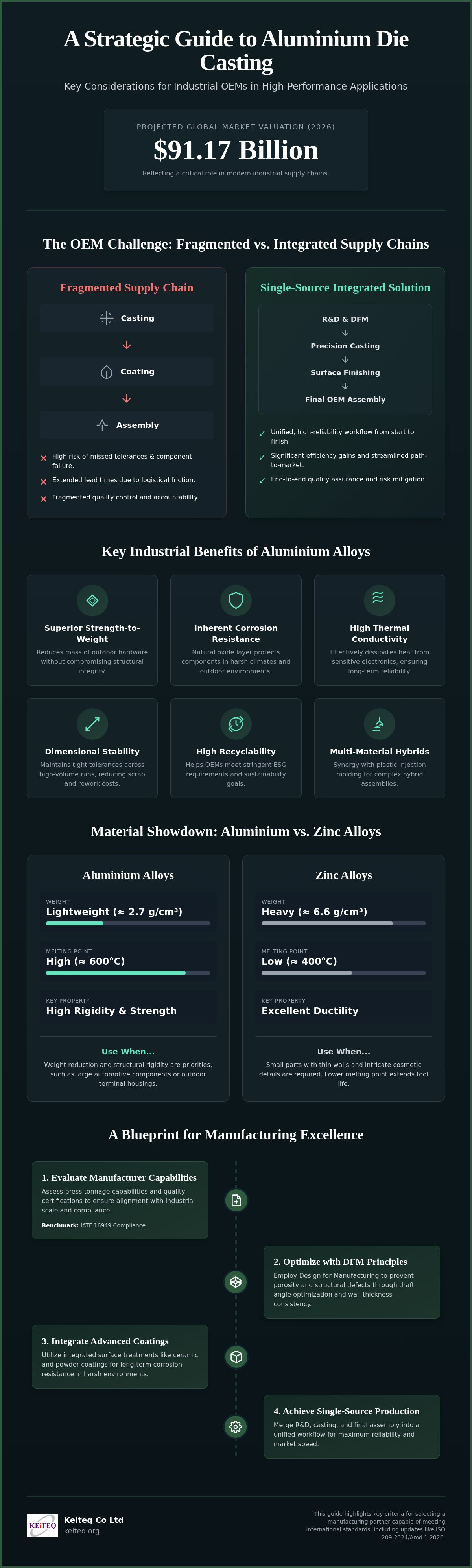
The global aluminium die casting market is projected to reach a valuation of $91.17 billion in 2026, yet many industrial OEMs still struggle with high component failure rates in demanding environments. Selecting the right aluminium diecasting manufacturer is no longer just about part cost; it's about mitigating the risks of a fragmented supply chain. You've likely experienced the logistical friction that occurs when casting, coating, and assembly are handled by separate vendors, often resulting in missed tolerances and extended lead times.
We've designed this reference to help you secure a safe pair of hands for end-to-end production. You'll learn how to evaluate technical selection criteria for complex geometries and ensure your components meet the latest international standards, including the ISO 209:2024/Amd 1:2026 amendment published in January. We'll also examine how integrated finishing services like ceramic and powder coating, combined with professional OEM assembly, can significantly streamline your path to market. This briefing outlines the transition from simple part sourcing to a comprehensive, results-oriented manufacturing strategy.
Table of Contents
Evaluating Aluminium Diecasting for High-Performance Industrial Hardware
Technical Capabilities: From High-Pressure Diecasting to Precision Tooling
Selecting an Aluminium Diecasting Manufacturer: Critical Quality Benchmarks
Optimizing Durability: Design for Manufacturing (DFM) and Advanced Coatings
Integrated Manufacturing: Why Keiteq is the Preferred Diecasting Partner for OEMs
Evaluating Aluminium Diecasting for High-Performance Industrial Hardware
High-pressure aluminium diecasting (HPDC) is a precision manufacturing process that forces molten alloy into steel molds under extreme pressure. This method produces complex, high-strength metal parts with exceptional repeatability and surface finish. In 2026, the global market for this technology is estimated to reach between $69.77 billion and $91.17 billion. This growth reflects its critical role in modern industrial supply chains, including specialized architectural elements from Bestel Kozijnen Op Maat. Choosing a competent aluminium diecasting manufacturer is essential for OEMs developing structural enclosures that protect sensitive electronics from mechanical stress and environmental ingress.
Aluminium offers a superior strength-to-weight ratio compared to most industrial metals. This characteristic allows engineers to reduce the mass of outdoor hardware without compromising structural integrity. Its natural oxide layer provides inherent corrosion resistance, which is a fundamental requirement for equipment exposed to varying climates. The die casting process for aluminium is particularly effective for large-scale production where consistency is non-negotiable.
Key Industrial Benefits of Aluminium Alloys
Aluminium is a primary choice for heat dissipation. Outdoor enclosures for power electronics or telecommunications rely on the metal's high thermal conductivity to prevent component overheating. This ensures long-term reliability in harsh environments. The material also maintains tight tolerances across high-volume production runs. This dimensional stability ensures that complex geometries fit perfectly during final assembly, reducing scrap rates and rework costs.
Sustainability has become a core procurement pillar. As of January 2026, the ISO 209:2024/Amd 1:2026 amendment has updated terminology for aluminium alloys, highlighting the industry's shift toward standardized, recyclable materials. Aluminium's high recyclability helps OEMs meet stringent 2026 ESG requirements while maintaining high performance standards. Partnering with an experienced aluminium diecasting manufacturer allows brands to leverage these material advantages through optimized part design.
Aluminium vs. Zinc Diecasting: Choosing the Right Substrate
Selecting the appropriate alloy depends on the specific mechanical requirements of the application. While both metals offer precision, their physical properties suit different industrial roles.
Use aluminium when weight reduction and structural rigidity are the priorities, such as in large automotive components or outdoor terminal housings. Zinc is often preferred for smaller parts with thinner walls and highly intricate cosmetic details. For a deeper technical comparison of heavy-duty applications, consult our zinc diecasting services guide.
Technical Capabilities: From High-Pressure Diecasting to Precision Tooling
Successful high-pressure diecasting is an engineering challenge that begins long before the first shot is fired. A Tier-1 aluminium diecasting manufacturer integrates Product R&D and Design at the earliest stages to optimize geometry for the casting process. This early intervention ensures that wall thicknesses are uniform and draft angles are sufficient to prevent drag marks. Engineering teams utilize advanced simulation software to predict metal flow and thermal gradients, identifying potential hot spots that could lead to shrinkage or structural weakness. This disciplined approach converts a conceptual design into a robust, manufacturable component.
Precision mold design is the foundation of production efficiency and part longevity. Tool and die mastery involves selecting high-grade H13 steel and implementing sophisticated internal cooling channels to manage cycle times. Effective thermal management within the die prevents premature heat checking, extending the life of the tool across hundreds of thousands of cycles. By maintaining tight control over die temperature, manufacturers ensure consistent part dimensions and surface quality, which reduces the need for extensive secondary processing.
High-Pressure Diecasting (HPDC) mechanics rely on the rapid injection of molten metal at velocities exceeding 40 meters per second. This force is necessary to achieve consistent density and minimal porosity in complex parts. Adherence to EPA manufacturing guidelines ensures that these high-intensity operations maintain environmental compliance and operational safety. In 2026, automation has moved beyond simple part extraction. Modern facilities utilize press-side robotics equipped with high-resolution imaging to monitor process variables in real-time, instantly flagging deviations in shot pressure or temperature.
The Prototyping and Soft Tooling Phase
Risk mitigation is a priority for industrial OEMs. Utilizing soft tooling allows an aluminium diecasting manufacturer to validate designs and material performance before committing to expensive mass production molds. This iterative R&D phase identifies design flaws that might only appear during assembly or functional testing. You can explore our prototyping and soft tooling capabilities to see how this stage reduces overall development risk. These feedback loops significantly improve final casting yields and accelerate the transition to full-scale manufacturing.
Secondary Operations and Precision Machining
The raw casting is often just the beginning. Secondary operations like post-casting CNC machining are required to achieve ultra-tight tolerances for mating surfaces and threaded inserts that casting alone cannot provide. Automated trimming and flash removal ensure aesthetic and functional consistency across every batch. Quality control is maintained through rigorous inspection protocols, including Coordinate Measuring Machine (CMM) analysis and X-ray testing to verify internal integrity. If you require a technical review of your part specifications, our team can assess your project requirements to ensure optimal manufacturing alignment.
Selecting an Aluminium Diecasting Manufacturer: Critical Quality Benchmarks
Selecting an aluminium diecasting manufacturer requires a deep dive into quality management systems that go beyond basic certifications. While ISO 9001 is a common baseline, industrial OEMs in 2026 prioritize IATF 16949 compliance. This standard ensures rigorous process control and defect prevention across the entire production lifecycle. Compliance with industry-specific regulations, such as those governing outdoor hardware or automotive safety, is non-negotiable for high-reliability applications. Procurement teams must verify that these standards are actively practiced on the factory floor, not just displayed on a certificate.
Production scale is largely defined by press tonnage capacity. A manufacturer equipped with a range from 250T to 2000T can accommodate a diverse portfolio, from small, intricate components to large structural housings. Machine redundancy is equally critical; a partner with multiple presses of the same tonnage ensures your production schedule remains intact even during scheduled maintenance. An integrated aluminium diecasting manufacturer also provides financial stability. Multi-year OEM contracts demand a partner with the capital to invest in dedicated tooling and capacity expansions as your product volume grows.
Geographic and logistical competence cannot be overlooked. A manufacturer with a global footprint and a strong US presence simplifies communication and reduces shipping complexities. This 'Safe Pair of Hands' philosophy is essential for maintaining a steady supply chain in a volatile global market. It ensures that your production partner understands both the practical realities of the factory floor and the strategic requirements of the boardroom.
Evaluating In-House vs. Outsourced Finishing
Managing a fragmented supply chain is a high-risk strategy for any OEM. When casting and coating are handled by different vendors, accountability vanishes if surface defects occur. An integrated manufacturer takes full ownership of the part from the molten state to the final powder-coated finish. This model reduces lead times and ensures that surface preparation perfectly matches the requirements of the chosen coating. You can learn more about the benefits of single-source manufacturing to see how this approach stabilizes global production.
The 'Global Facilitator' Checklist for Procurement
Procurement officers should use a structured audit to evaluate potential partners. This checklist ensures the manufacturer can function as a true facilitator rather than just a part supplier:
Capacity Audit: Verify machine redundancy for surge order handling.
Technical Support: Confirm the presence of on-site engineering teams for DFM consultations.
Transparency: Check for real-time production tracking and quality reporting capabilities.
Regulatory Alignment: Ensure the facility meets current ISO 8062 dimensional tolerance standards.
Optimizing Durability: Design for Manufacturing (DFM) and Advanced Coatings
Product durability begins with rigorous Design for Manufacturing (DFM) principles. A competent aluminium diecasting manufacturer applies these standards during the R&D phase to eliminate common casting defects before production begins. Draft angles are a primary concern; a typical requirement of 1.5 to 3 degrees ensures the part releases cleanly from the die without surface galling. Consistent wall thickness is equally vital. Variations in thickness cause uneven cooling, which leads to internal porosity and structural weak points. By integrating generous radii at every corner, engineers reduce stress concentration and improve metal flow during the high-pressure injection phase.
Raw diecast aluminium possesses natural corrosion resistance, but industrial applications in harsh environments require additional protection. Exposure to UV radiation, salt spray, and industrial chemicals can degrade the substrate over time. Surface finishing is not merely an aesthetic choice; it's a functional requirement for maintaining the mechanical integrity of the enclosure. For instance, to see how these protective standards are applied to architectural aluminium products, visit Trade Tech Windows & Doors. Selecting the right coating system depends on the specific stressors of the deployment site, ranging from standard powder coatings to high-performance industrial enamels.
Advanced Coating Solutions for Harsh Environments
Enamel coating provides the gold standard for chemical resistance and surface hardness. This frit-based finish is fused to the aluminium substrate, creating a barrier that resists aggressive solvents and mechanical abrasion. For compact electronic enclosures with high power densities, ceramic coating offers superior thermal load management. These coatings facilitate efficient heat dissipation while providing a durable, non-conductive surface. The demand for such high-performance finishes extends to specialized architectural and residential projects, where experts like Cabinet refinishing Denver apply professional-grade coatings to ensure long-term durability. To understand which finish suits your hardware, read our guide on protective coatings for outdoor electronics.
Case Study: Outdoor Payment Terminal Enclosures
Protecting sensitive electronics in petrol and gas station environments presents a unique challenge. These enclosures must withstand constant outdoor exposure, fuel vapor contact, and physical wear from high-traffic usage. The solution involves high-precision diecast aluminium housings treated with UV-stable powder coating. This combination ensures structural rigidity and long-term aesthetic consistency. Our integrated approach covers everything from the initial design to the final outdoor payment terminal assembly solutions. This end-to-end management eliminates the risks associated with fragmented vendor chains.
Achieving this level of durability requires early collaboration between design teams and production experts. If you're ready to optimize your component design for long-term reliability, you can contact our engineering team for a DFM review.
Integrated Manufacturing: Why Keiteq is the Preferred Diecasting Partner for OEMs
Keiteq provides a comprehensive manufacturing solution that eliminates the logistical friction of a fragmented supply chain. We manage the entire lifecycle from initial R&D and design to mass production and global logistics. This integrated approach ensures that the technical intent established during the engineering phase is preserved through final assembly. Selecting an aluminium diecasting manufacturer that offers this end-to-end oversight reduces the risk of part incompatibility and assembly delays. Our disciplined methodology positions us as a dependable pillar within your global supply chain, prioritizing functional trust and logistical competence.
Modern industrial hardware often requires a synergy of materials to achieve peak performance. Our facility integrates diecast metal with precision plastic injection molding to create complex hybrid assemblies. This capability allows OEMs to combine the structural rigidity of aluminium with the intricate functional details of plastic components. We extend this expertise into full OEM assembly, managing the integration of electronics, environmental seals, and mechanical hardware. The result is a ready-to-use unit that meets 2026 industrial standards for durability and performance in harsh environments.
Transitioning from Prototype to Mass Production
Transitioning from soft tooling to high-volume diecasting requires a disciplined scaling strategy. We utilize the data gathered during the prototyping phase to refine mass production molds, ensuring high yields and consistent quality from the first shot. This methodical progression minimizes the risk of structural defects as production volumes increase. For projects requiring complementary metal components, you can compare these processes to our OEM metal stamping services. Our quality assurance protocols remain active throughout the product lifecycle; we use continuous improvement cycles to maintain peak production efficiency.
Partnering with Keiteq for Your Next Project
A consultative approach is the foundation of a successful manufacturing partnership. Engaging our engineering team during the design phase allows for the optimization of draft angles and wall thicknesses, which directly impacts production costs and part longevity. Keiteq supports US-based OEMs by providing international production efficiency backed by a steady, experienced management team. We act as a safe pair of hands, navigating the complexities of global production to deliver consistent results. You can Contact Keiteq Co Ltd to discuss your specific aluminium diecasting requirements and secure a reliable production path for 2026.
Securing Your Industrial Supply Chain for 2026 and Beyond
Industrial OEMs require more than just a component supplier; they need a strategic partner capable of navigating the complexities of high-precision production. Successful projects in 2026 depend on a single-source model that integrates Product R&D with advanced finishing solutions. By consolidating casting, specialized ceramic or enamel coating, and full OEM assembly under one roof, you eliminate the risks associated with vendor fragmentation. This approach is particularly critical for high-stakes applications like outdoor payment terminal assembly, where environmental resistance and structural integrity are paramount.
Choosing the right aluminium diecasting manufacturer is the foundation of a resilient supply chain. Keiteq provides the technical expertise and disciplined process control needed to move from initial design to mass production with absolute certainty. We offer a holistic manufacturing ecosystem that prioritizes precision, scale, and international compliance. It's time to align your production with a partner that understands the practical realities of the factory floor. Our team is ready to help you optimize your component designs for maximum durability and logistical efficiency.
Request a Technical Consultation with Keiteq to discuss your specific manufacturing requirements. We look forward to facilitating your next successful project.
Frequently Asked Questions
What are the most common aluminium alloys used in diecasting for 2026?
The most common alloys in 2026 remain A380 and A383 due to their excellent balance of mechanical properties and fluid castability. A360 is frequently specified for applications requiring superior corrosion resistance and high ductility. These alloys align with the updated ISO 209:2024/Amd 1:2026 standards for chemical composition. Selecting the correct alloy ensures structural integrity and thermal performance in demanding industrial environments.
How does aluminium diecasting compare to metal stamping for large enclosures?
Aluminium diecasting is preferred for enclosures requiring complex 3D geometries, integrated heat sinks, or variable wall thicknesses. Metal stamping is generally limited to parts with uniform thickness and simpler profiles. Diecasting allows for the consolidation of multiple components into a single part, which reduces assembly labor and improves structural rigidity. This process is essential for protecting sensitive electronics in outdoor payment terminals.
What is the typical lead time for custom aluminium diecasting tooling?
Typical lead times for high-pressure production molds range from 8 to 12 weeks, depending on part complexity and die size. Prototyping or soft tooling can often be completed in 3 to 5 weeks to facilitate rapid design validation. A professional aluminium diecasting manufacturer manages these timelines through disciplined project management to ensure mass production begins on schedule. Early engagement during the design phase helps minimize tool revision cycles.
Can aluminium diecasting achieve the same tolerances as CNC machining?
How do I choose between powder coating and enamel coating for my diecast parts?
Choice depends on the environmental stressors of the deployment site. Powder coating offers excellent UV protection and aesthetic variety for standard outdoor hardware. Enamel coating is the gold standard for environments requiring extreme chemical resistance and surface hardness. If your components face aggressive solvents or mechanical abrasion, enamel provides a more durable barrier. We evaluate your specific application to recommend the most cost-effective and reliable finishing solution.
What is 'porosity' in diecasting and how does Keiteq minimize it?
Porosity refers to small voids or gas pockets within the cast metal that can compromise structural integrity. Keiteq minimizes this through precise shot speed control and advanced vacuum-assisted diecasting techniques. Our engineering team also applies DFM principles to ensure uniform wall thicknesses, which prevents shrinkage porosity during the cooling phase. X-ray inspection is utilized to verify internal density and ensure every part meets safety standards.
Does Keiteq provide assembly services for diecast components?
Yes, we provide comprehensive OEM assembly services that integrate diecast parts with electronics, gaskets, and plastic components. This end-to-end management reduces supply chain fragmentation and ensures all mating parts fit perfectly. Our expertise includes specialized outdoor payment terminal assembly for petrol and gas stations. By handling the full production lifecycle, we deliver ready-to-use units that have undergone rigorous functional testing and quality verification.
Is aluminium diecasting cost-effective for mid-volume production runs?
Aluminium diecasting is highly cost-effective for mid-volume runs when part complexity would make CNC machining prohibitively expensive. While tooling requires an initial investment, the low per-piece cost and high production speed provide a rapid return on investment. Our use of soft tooling for smaller batches allows OEMs to access diecasting benefits without the full cost of hardened steel production molds. This flexibility supports agile manufacturing strategies in 2026.


Comments