
ATEX Plastic Molding in Malaysia: Compliance Guide
Updated: Sep 9
A single spark from an electrostatic discharge can transform a routine industrial operation into a catastrophic explosion within a hazardous environment. For global manufacturers, securing ATEX compliance plastic molding Malaysia is a critical safety mandate rather than a simple regulatory hurdle. We recognize that finding a production partner who understands the nuance of conductive polymers and electrostatic risk assessment is a significant challenge. The transition from a functional prototype to high-volume manufacturing in Southeast Asia often reveals technical gaps that compromise both safety and durability.
This guide provides a professional roadmap for navigating the complexities of ATEX-compliant injection molding, ensuring your components meet the rigorous standards of the 6th Edition ATEX Guidelines released in January 2026. You'll learn how to select materials that mitigate static build-up, manage the intricacies of mass production, and adhere to strengthened Malaysian OSHA enforcement. We cover everything from initial R&D to the final assembly of hardware for petrol stations and other explosive atmospheres. By the end of this briefing, you'll have the technical clarity needed to establish a reliable, compliant supply chain in Malaysia.
Table of Contents
Understanding ATEX Compliance in Plastic Injection Molding
ATEX stands for "Atmosphères Explosibles." It is a regulatory framework essential for any equipment operating where explosive mixtures of gases, vapors, or combustible dust are present. In industrial hardware, especially within fuel retail or chemical processing, plastic components play a dual role. They provide structural integrity while acting as a first line of defense against electrostatic discharge (ESD). Standard polymers are naturally insulative. This means they accumulate static charges that cannot dissipate. In a hazardous zone, this accumulation leads to a spark, which serves as an ignition source. Understanding ATEX Compliance requires a shift from viewing plastics as simple insulators to seeing them as engineered conductive or dissipative media. Achieving ATEX compliance plastic molding Malaysia requires rigorous adherence to these principles during the design phase.
The Regulatory Framework for Manufacturers
The EU ATEX directives, specifically 2014/34/EU for equipment and 1999/92/EC for workplace safety, have become the global benchmark for safety in explosive atmospheres. While these are European standards, their influence extends to Southeast Asian manufacturing hubs. For OEMs, the distinction between material-level properties and final product certification is critical. A resin might be rated for conductivity, but the molding process, gate placement, and wall thickness can alter these properties. It's not enough to simply use a "safe" material. You must verify that the finished part maintains its dissipative characteristics throughout its lifecycle. This is why securing plastic injection molding services in Malaysia involves more than just production; it requires a partner who provides comprehensive compliance documentation and understands the 6th Edition Guidelines updated in January 2026.
Risks of Non-Compliance in Hazardous Zones
Non-compliance in hazardous zones presents three primary risks: static discharge, mechanical friction, and thermal ignition. Static electricity is the most common culprit. When two non-conductive surfaces rub together, they create a charge. If the plastic part isn't modified to be dissipative, that charge stays on the surface until it finds a path to ground through a spark. Mechanical friction in moving parts, such as gears or levers in an outdoor payment terminal, can also generate localized heat. If this heat exceeds the ignition temperature of the surrounding vapor, a fire occurs. The legal implications for fuel retailers are severe. Failure to utilize compliant components can result in massive liability, environmental damage, and total operational shutdown under Malaysia's strengthened OSHA 1994 regulations. Reliability isn't just a goal; it's a legal requirement for survival in high-risk sectors. To manage the risks of maintenance and hot work in these volatile settings, check out PetroHab LLC for specialized hot work safety enclosures.
Engineering Conductive Plastic Components for Safety
Standard polymers like HDPE or PEEK offer the chemical resilience needed for fuel retail, yet their natural insulative properties pose a significant spark risk. To bridge this gap, we engineer specialized compounds that incorporate conductive fillers like carbon black or stainless steel fibers. Achieving ATEX compliance plastic molding Malaysia depends on the careful balance of these additives. Too little filler fails to create a reliable conductive path; too much makes the component brittle and prone to structural failure. We prioritize material integrity by calculating the exact percolation threshold required for each specific geometry.
The science of static dissipation relies on two primary metrics: surface and volume resistivity. Surface resistivity tracks how a charge travels across the component's exterior skin. Volume resistivity monitors the flow through the entire material body. In hazardous zones, we typically target a dissipative range between 10^5 and 10^9 ohms. This range prevents the rapid, uncontrolled discharge that leads to ignition. It allows static to bleed off safely to the ground at a controlled rate, maintaining a stable electrical state even during high-friction operations.
Maintaining this performance during the injection process is a complex technical challenge. High-pressure molding can induce shear stress that breaks down carbon fiber networks or causes uneven additive distribution. If the molding parameters aren't strictly controlled, the finished part won't meet the safety specifications of the original resin. We manage melt temperatures and injection speeds with precision to ensure the conductive network remains intact from the first shot to the last.
Material Selection for ATEX/Ex Environments
Dissipative compounds are often superior to purely conductive plastics for gas station hardware. They bleed off static at a controlled rate, which significantly reduces the risk of a high-energy spark. Because Malaysia's climate involves intense UV radiation and high humidity, we select resins that don't lose their dissipative properties through environmental degradation. Chemical resistance is equally vital. Components must remain stable when exposed to petrol, diesel, and various fuel additives without swelling, cracking, or losing their electrical properties over time.
Design for Manufacturing (DFM) in ATEX Molding
When sourcing high-performance materials like PTFE or technical plastics, you can visit Plastiques Elastomères to explore a wide selection of industrial polymers suitable for specialized engineering needs.
DFM is the stage where safety is baked into the part's geometry. Uniform wall thickness is non-negotiable. Variations in thickness lead to uneven cooling, which disrupts the distribution of conductive particles and creates "hot spots" of insulation. Weld lines are another critical concern. These occur where two melt fronts meet. If the conductive additives don't cross this interface, you're left with an insulative seam that could fail a compliance audit. You can optimize your injection mold design to relocate these lines to low-risk areas. If you need a partner to validate your material choice, contact our technical team for a detailed review.
The Strategic Advantage of ATEX Molding in Malaysia
Malaysia has evolved into a global center for Electronic Manufacturing Services (EMS), offering a sophisticated infrastructure for high-spec industrial production. For OEMs, achieving ATEX compliance plastic molding Malaysia represents a strategic decision to combine technical precision with geographical advantages. Unlike purely low-cost regions, Malaysia provides an ecosystem where engineering expertise in conductive polymers meets established quality management protocols. Keiteq Co Ltd provides the localized knowledge essential for components that must operate in volatile environments without compromise. We position our facility as a reliable pillar within this global supply chain, providing the stability required for long-term industrial projects.
The balance between cost-efficiency and technical capability is a hallmark of the Malaysian manufacturing sector. While some competitors claim that high-spec molding is exclusive to Western markets, our operations demonstrate that complex industrial assemblies are managed with equal or superior precision here. We leverage a workforce trained in advanced quality control and high-pressure injection techniques. This ensures that the dissipative properties required for hazardous environments are maintained consistently across millions of units. Our approach prioritizes functional trust and logistical competence over experimental claims.
Strategic proximity to global shipping lanes and key raw material suppliers further strengthens this regional advantage. Malaysia's logistics network facilitates the rapid movement of specialized resins and finished assemblies to international markets. Keiteq Co Ltd acts as a global facilitator, managing the intricacies of the supply chain so that your hazardous environment hardware reaches its destination on time and fully compliant with international directives. This proximity reduces lead times and allows for more agile responses to shifting market demands.
Regional Manufacturing Standards and Quality Control
Maintaining rigorous quality control is fundamental to industrial safety. Our operations align with international standards, including ISO 9001, to ensure every part meets the strict requirements of hazardous zone deployment. Local supply chain resilience allows us to mitigate the risks of global disruptions, providing a stable production environment for industrial OEMs. You can explore our manufacturing services in Malaysia to see how we integrate these standards into our daily floor operations, ensuring each component adheres to the safety benchmarks established during the R&D phase.
Logistics and Mass Production Management
Moving from initial design to high-volume output requires a disciplined approach to scaling. We utilize a structured lifecycle management process that often begins with soft tooling to validate ATEX properties before investing in hard steel molds. Navigating international trade and compliance from a Malaysian base is streamlined by our familiarity with global regulatory updates, such as the 6th Edition ATEX Guidelines. Keiteq Co Ltd specializes in managing the critical transition from prototype to mass production, ensuring that safety specifications remain intact as volumes increase and production cycles accelerate.
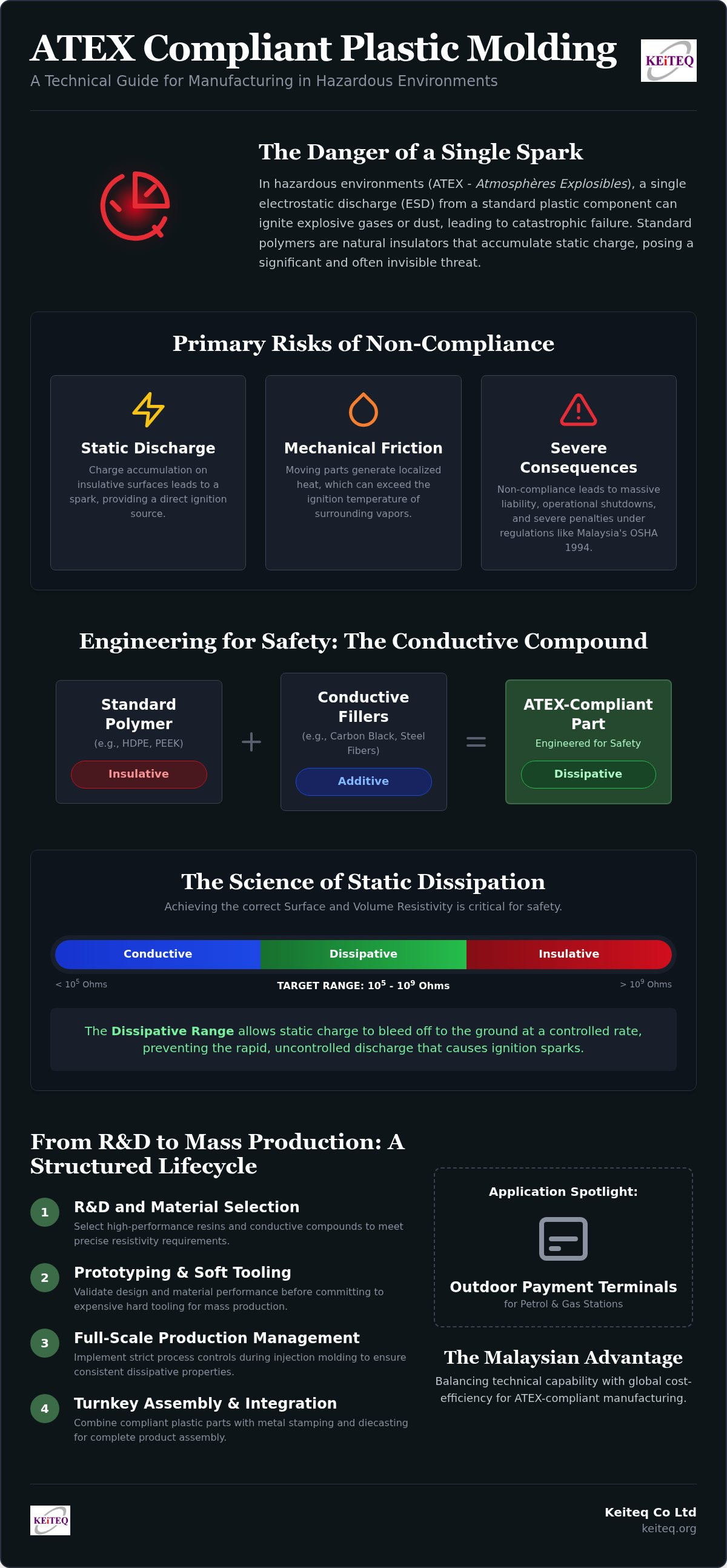
From R&D to Mass Production: Ensuring Regulatory Integrity
The transition from a validated design to a high-volume production line is the most vulnerable phase for safety-critical components. Maintaining ATEX compliance plastic molding Malaysia requires a disciplined R&D phase where safety specifications are integrated into the initial CAD models. Keiteq Co Ltd does not view R&D as a standalone creative exercise. It's a technical briefing designed to identify potential failure points in hazardous environments before the first mold is cut. This proactive approach ensures that every component performs as intended under extreme stress, protecting both the end-user and the manufacturer's reputation.
The Integrated R&D Process
Collaborative R&D involves a deep dive into the interaction between material properties and part geometry. We utilize soft tooling to produce functional prototypes that mirror the final part's dissipative characteristics. This allows for rigorous testing of surface and volume resistivity without the lead times of hard steel molds. For a broader look at this phase, read our guide on Strategic Product Design for Industrial Scale.
Rigorous testing protocols for conductivity and durability must be established before mass production begins. We subject parts to environmental stress tests, including UV exposure and temperature fluctuations, to ensure the dissipative properties remain stable. These tests are not optional; they are the foundation of the technical documentation required for the EU Declaration of Conformity. By validating these properties early, we eliminate the risk of costly recalls or catastrophic failure in the field.
Quality Assurance in High-Volume Molding
Achieving batch-to-batch consistency is the primary challenge in mass production management. Securing ATEX compliance plastic molding Malaysia involves employing advanced inspection techniques to verify that every unit meets the original specification. Conductive fillers must remain uniformly distributed to prevent insulative cold spots. When selecting a manufacturer for industrial scale, prioritize those who offer end-to-end transparency.
Scaling production shouldn't compromise safety or regulatory integrity. Our facility in Malaysia is equipped to handle the rigorous demands of hazardous environment hardware from the initial concept through to full-scale delivery. Keiteq Co Ltd provides the technical oversight needed to ensure that complex assemblies meet every environmental and safety standard. If you're ready to move your project into a compliant production environment, contact our technical team for a production review.
Turnkey Assembly for Outdoor Payment Terminals
Assembling an outdoor payment terminal for a gas station requires a unified engineering approach where disparate materials function as a single, safe system. Turnkey assembly integrates ATEX compliance plastic molding Malaysia with precision metal stamping and aluminium or zinc diecasting. This synergy ensures the final enclosure is both electrically dissipative and mechanically resilient. We manage the critical interfaces between plastic and metal to eliminate gaps where hazardous vapors might accumulate or where static discharge could occur. By consolidating these processes, we provide a streamlined path to market for safety-critical hardware.
Hardware Engineering for Fuel Retail
Unattended hardware in fuel retail environments faces constant exposure to volatile vapors and extreme weather. We engineer these enclosures to maintain strict IP-rated seals, ensuring internal electronics remain protected from moisture and dust over long lifecycles. Our outdoor payment terminal assembly solutions prioritize the structural stability of the entire unit. For a deeper analysis of these challenges, see our briefing on Engineering Durable Hardware for Fuel Retail. We ensure that every seal and joint adheres to the safety benchmarks established during the initial design phase.
Advanced Industrial Finishing
Surface treatments provide the final layer of protection for hardware deployed in explosive atmospheres. While the plastic components manage static, the metal elements require specialized finishing to resist corrosion and thermal ignition. We offer advanced enamel and ceramic coatings that provide a superior chemical barrier in petrol station environments. Powder coating is also available for components requiring high impact resistance and aesthetic durability. Detailed specifications on these treatments can be found in our guide on Protective Coatings for Outdoor Electronics.
Our integrated methodology in Malaysia reduces the risk of compliance failure by keeping the entire production lifecycle under one roof. From the first injection-molded part to the final protective coating, we maintain the technical oversight needed for hazardous zone deployment. This holistic approach ensures that your complex industrial assemblies are durable, compliant, and ready for global distribution.
To secure a reliable manufacturing partner for your next hazardous environment project, please submit a Request for Quotation or a Request to contact us for further details regarding our specialized services in Malaysia.
Mastering Safety Standards in Industrial Production
Transitioning from design to deployment in explosive atmospheres requires a disciplined partner who understands the intersection of material science and regulatory rigor. We've explored how dissipative polymers and precision engineering eliminate ignition risks while maintaining structural durability. By integrating plastic injection molding with metal stamping and advanced finishing like ceramic or enamel coatings, you ensure your hardware survives the most demanding outdoor environments. This holistic approach is essential for safety-critical hardware like petrol station payment terminals.
Malaysia offers a strategic base for this complex manufacturing, combining cost-efficiency with high-tier technical capabilities. Our end-to-end management ensures that ATEX compliance plastic molding Malaysia remains a standard feature of your production lifecycle. We provide the stability and expertise needed to navigate global supply chain complexities with confidence, moving your project seamlessly from initial R&D to mass production. We look forward to helping you achieve your industrial safety goals.
For specialized technical manufacturing in Malaysia, please Request for Quotation or Request to contact us for further details regarding your ATEX compliance needs.
Frequently Asked Questions
What makes a plastic material ATEX compliant?
ATEX-compliant plastics must prevent electrostatic discharge through the addition of conductive fillers like carbon black or stainless steel fibers. The material's surface and volume resistivity must fall within the dissipative range, typically 10^5 to 10^9 ohms. This ensures static charges bleed off safely rather than creating a spark. Proper material selection is the foundation of ATEX compliance plastic molding Malaysia, ensuring reliability in volatile zones.
Can standard injection molding machines produce ATEX components?
Standard machines are used for production, but the process parameters must be strictly controlled. ATEX-compliant resins often have different flow characteristics and thermal sensitivities compared to standard polymers. High-pressure molding can disrupt the conductive filler network if not managed correctly. Success relies on the molder's expertise in handling specialized compounds and maintaining batch-to-batch consistency throughout the mass production management phase.
Why is Malaysia a preferred location for ATEX molding?
Malaysia offers a strategic balance of technical manufacturing expertise and cost-efficiency. As a global hub for Electronic Manufacturing Services (EMS), the region has a sophisticated infrastructure for high-spec industrial production. Manufacturers benefit from proximity to raw material suppliers and global shipping lanes. This makes Malaysia a reliable choice for OEMs looking to scale production while adhering to international safety standards for hazardous environments.
What is the difference between conductive and antistatic plastics?
The primary difference lies in the rate of static dissipation. Antistatic plastics only resist the initial generation of static, while conductive plastics provide a path for charges to move to ground. For ATEX environments, dissipative materials are often preferred because they bleed off charges at a controlled rate. This prevents high-energy sparks that could ignite flammable vapors or dust in volatile industrial zones.
How do industrial coatings improve ATEX safety?
Industrial coatings like enamel and ceramic provide a protective barrier against chemical corrosion and thermal ignition. In fuel retail environments, these finishes protect metal components from degrading when exposed to harsh fuels. Powder coating also adds aesthetic durability and impact resistance. These treatments ensure that the entire assembly, including plastic and metal parts, remains stable and safe during long-term deployment in hazardous outdoor areas.
Does Keiteq Co Ltd provide design support for ATEX compliance?
Keiteq Co Ltd provides comprehensive design support to ensure ATEX compliance plastic molding Malaysia is integrated into the initial part geometry. We assist OEMs in optimizing wall thickness and gate placement to ensure conductive fillers distribute evenly. Our engineering team bridges the gap between a theoretical design and a production-ready component that meets every safety-critical benchmark for hazardous zone deployment.
What industries require ATEX-certified plastic molding?
Any industry operating in potentially explosive atmospheres requires ATEX-certified components. This includes fuel retail and petrol station equipment, chemical processing plants, and pharmaceutical manufacturing. Grain handling and food processing facilities also require these specialized parts to manage combustible dust risks. Each sector relies on these components to prevent catastrophic accidents caused by electrostatic discharge or mechanical friction during daily operations.
How long does the transition from prototype to mass production take?
For businesses in the chemical, pharmaceutical, or food processing sectors that need to integrate precise measurement into their hazardous zones, you can check out Independent Scale Service for expert industrial weighing solutions.
The transition typically moves through several distinct phases, starting with soft tooling for initial material validation. This early stage allows us to verify the dissipative properties before committing to hard steel molds for high-volume output. While specific timelines depend on the assembly's complexity, we prioritize a structured approach that prevents regulatory setbacks. This disciplined scaling ensures that mass-produced units mirror the safety performance of the validated prototype.
To secure a reliable manufacturing partner for your next hazardous environment project, please submit a Request for Quotation or a Request to contact us for further details regarding our specialized services in Malaysia.


Comments