
Complex Hardware Assembly: A Comprehensive Guide for Manufacturers
Updated: Sep 3
A single manufacturing oversight in complex hardware assembly can escalate from a minor floor delay to a systemic production failure before the first batch reaches the end user. Maintaining procedural accuracy across intricate component integrations requires more than just skilled labor; it demands a disciplined approach to supply chain management and quality control. To ensure your production stays on track with reliable industrial components, you can check out OEM Materials & Supplies. You're likely familiar with how inconsistent product quality and rising assembly costs often stem from fragmented production cycles and unreliable component sourcing. These challenges don't just impact your bottom line; they compromise your reputation as a reliable provider in a competitive global market.
This guide provides a technical briefing on mastering complex hardware assembly by focusing on precision engineering and mass production management. You'll gain a clear understanding of best practices for streamlining the assembly line and identify the common pitfalls that lead to costly production bottlenecks. We will explore how integrated R&D, rigorous prototyping, and advanced finishing services create a stable foundation for manufacturing excellence. By the end of this article, you'll have the insights needed to transform your assembly process into a predictable, high-performance operation.
Table of Contents
Understanding Complex Hardware Assembly: Key Components and Processes
Complex hardware assembly refers to the systematic integration of multiple precision-engineered components, subassemblies, and electronic systems into a functional end product. Unlike simple mechanical assembly, this discipline demands exacting tolerances, validated material compatibility, and a structured workflow that accounts for every stage of the product lifecycle. In high-stakes manufacturing environments, the difference between a reliable product and a field failure often comes down to how rigorously assembly protocols are defined and enforced from the outset.
Components of Complex Hardware Assembly
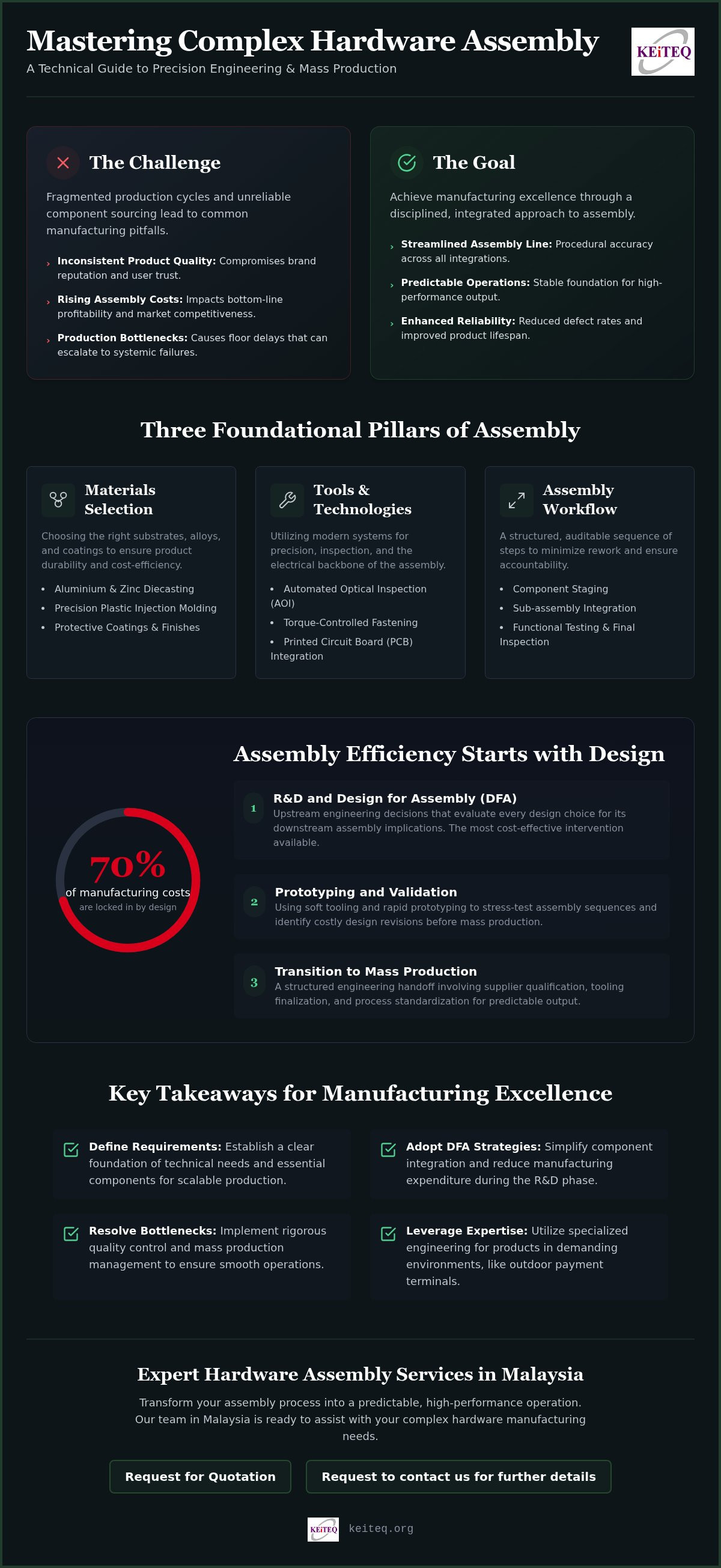
Successful assembly starts with three foundational pillars: materials selection, tooling capability, and workflow design. Each element directly influences product durability, production speed, and overall cost efficiency.
Materials selection: Choosing the right substrate materials, housing alloys, and protective coatings determines both the product's operational lifespan and its unit cost at scale. Aluminium diecasting, zinc diecasting, and precision plastic injection molding are common choices depending on the application's mechanical and thermal requirements.
Tools and technologies: Modern assembly lines rely on torque-controlled fastening systems, automated optical inspection (AOI), and soldering stations calibrated to component-specific thermal profiles. Central to most electronic assemblies is the printed circuit board (PCB), which serves as the electrical backbone connecting sensors, processors, and communication modules within the finished unit.
Assembly workflow: A structured workflow sequences component staging, sub-assembly integration, functional testing, and final inspection into discrete, auditable steps. This sequencing minimizes rework cycles and creates clear accountability at each production stage.
The Product Lifecycle and Its Impact on Assembly
Assembly efficiency isn't determined on the factory floor alone. It's largely decided during the R&D phase, when engineers make foundational decisions about component geometry, fastener types, and integration sequencing. Design for Assembly (DFA) methodology formalizes this upstream thinking by evaluating every design choice against its downstream assembly implications. Reducing part count, standardizing fastener specifications, and designing for tooling access are DFA principles that translate directly into lower labor hours and reduced defect rates during mass production. For manufacturers who want to extend these efficiency gains to other parts of their facility, you can check out Choice Bagging Equipment to explore specialized machinery for industrial material handling.
Prototyping plays a critical validation role before any tooling investment is committed. Soft tooling and rapid prototyping allow engineering teams to stress-test assembly sequences, identify interference fits, and confirm that component tolerances hold under real production conditions. This validation phase is where costly design revisions are caught early rather than discovered mid-production run.
The transition from prototype to mass production introduces its own set of challenges: supplier qualification, tooling finalization, and process standardization across multiple assembly stations. Manufacturers who treat this transition as a structured engineering handoff, rather than an informal scale-up, consistently achieve more predictable output quality and tighter cycle times from the first production batch onward. This pursuit of precision is also a hallmark of premium consumer engineering; for example, you can learn more about Cooneys Bike Care to see how meticulous assembly standards define their range of high-performance electric bikes.
Designing for Assembly: Best Practices and Considerations
Design decisions made early in the product development cycle carry disproportionate weight on the factory floor. By the time a product reaches mass production, roughly 70% of its manufacturing costs are already locked in by design choices. Addressing assembly efficiency at the engineering stage is not optional; it's the most cost-effective intervention available to any manufacturer.
Principles of Design for Assembly
Three core principles define effective DFA practice in complex hardware assembly: component reduction, handling optimization, and parts standardization.
Reduce the number of components: Every additional part introduces a potential failure point, an additional supplier relationship, and incremental assembly time. Before committing to a design, engineers should challenge each component's necessity: does it move relative to other parts? Does it need to be a different material? If neither answer is yes, consolidation is likely possible. Fewer parts mean shorter cycle times, lower inventory carrying costs, and simplified quality audits.
Design for ease of handling and orientation: Components that are symmetrical, self-locating, or feature clear insertion geometry reduce the cognitive load on assembly operators and minimize the risk of incorrect orientation. Parts that require manual re-positioning or visual inspection before insertion slow line throughput and introduce variability. Designing in physical cues, such as chamfers, asymmetrical features, or color-coded interfaces, directly reduces assembly errors at the station level.
Standardize parts across the product range: Using a common fastener specification, shared connector types, or interchangeable sub-assemblies across multiple product variants simplifies procurement, reduces safety stock requirements, and allows assembly teams to build procedural fluency across production runs. High-quality Engineered Metal Components and Fastening Solutions Manufacturing ensures that these standardized components meet the exacting tolerances required for consistent assembly performance.
Common Design Pitfalls
Overcomplicated designs are the most persistent cost driver in hardware manufacturing. When engineering teams optimize purely for product performance without accounting for assembly implications, they routinely create products that are technically sound but operationally expensive to build. Tight-tolerance fits that require specialized tooling, multi-step fastening sequences, and fragile sub-assemblies that can't withstand automated handling all add cost that compounds at scale.
Neglecting assembly feedback is equally damaging. Design teams that operate in isolation from production engineers consistently produce designs that look viable on-screen but create bottlenecks on the line. Cross-functional review, where assembly technicians, quality engineers, and procurement specialists all contribute during the design phase, surfaces practical constraints before they become production problems.
Skipping or compressing the prototyping phase is the third critical error. Validation through soft tooling and rapid prototyping exposes interference fits, tolerance stack-up issues, and handling difficulties under real production conditions. Proceeding to hard tooling without this step transfers the cost of design revisions to the most expensive point in the production cycle.
If you're working through a design that needs to balance engineering performance with production efficiency, connecting with an experienced assembly specialist early can prevent costly revisions downstream.
Challenges in Complex Hardware Assembly and How to Overcome Them
Execution on the factory floor is where theoretical design meets practical reality. Even the most efficient design for assembly (DFA) strategy can fail if the production environment lacks disciplined management. Challenges in complex hardware assembly often manifest as ballooning labor costs, high scrap rates, or missed delivery deadlines. Identifying these operational bottlenecks early allows for strategic intervention before they compromise the entire production run.
One such intervention involves maintaining the diagnostic health of the heavy machinery used on the factory floor; you can explore Jaltest MHE (Material Handling Equipment) Kit to ensure your material handling fleet remains operational and efficient.
Identifying Common Assembly Challenges
Operational friction usually stems from three areas: workforce capability, material availability, and procedural consistency. Addressing these requires a proactive management approach rather than a reactive one.
Labor costs and skills gaps: Precision assembly requires technicians who understand exacting tolerances and sensitive component handling. The shortage of skilled labor often leads to increased error rates. Manufacturers can mitigate this by implementing modular training programs and highly visual Standard Operating Procedures (SOPs) that reduce the cognitive load on the operator; additionally, you can learn more about EKOBOR to see how ergonomic workspace solutions further enhance technician focus and productivity.
Supply chain disruptions: Sourcing reliable components for specialized hardware, such as those used in outdoor payment terminals, is a constant hurdle. A single delayed sub-component can halt the entire line. Maintaining a diversified vendor base and conducting rigorous supplier audits ensures that material flow remains consistent even during market volatility.
Quality control issues: Inconsistency during the integration phase leads to expensive rework. Implementing intermediate testing checkpoints after each major sub-assembly stage prevents defects from being "buried" inside a finished unit. This staged approach ensures that only verified assemblies move forward to the final integration phase.
Effective Communication and Technology Integration
Bridging the gap between the engineering office and the assembly line is essential for maintaining production velocity. When communication silos exist, technical design changes often fail to reach the floor in real-time, leading to batches produced with outdated specifications. Integrated project management tools and digital work instructions ensure that every technician is working from the most current revision of the build plan.
Technology integration also plays a decisive role in error reduction. Leveraging automation for repetitive, high-precision tasks like torque application or electronic manufacturing services ensures uniformity that manual labor cannot match. Automated systems provide data logs for every unit, creating a digital trail that simplifies troubleshooting if a field failure occurs.
Finally, establishing a closed-loop feedback system allows the assembly team to report design-related difficulties back to the R&D department. This continuous improvement cycle ensures that future iterations of the product are even easier and more cost-effective to build. By treating assembly as a data-driven process rather than just a manual task, manufacturers can achieve the stability and scale required for global supply chain success.
Quality Assurance in Hardware Assembly: Ensuring Reliability
Reliability in complex hardware assembly isn't a post-production checkbox. It's an integrated engineering discipline that safeguards brand reputation and operational stability. For high-consequence products like outdoor payment terminals, a single component failure can result in significant downtime and costly field service interventions. Implementing a rigorous quality assurance (QA) framework ensures that every unit leaving the facility meets exact performance specifications and survives the rigors of its intended environment.
Implementing Quality Control Measures
Effective quality control (QC) relies on measurable benchmarks and disciplined procedural adherence. Without clearly defined KPIs, quality becomes subjective and inconsistent. Manufacturers must establish specific metrics, such as First Pass Yield (FPY) and defect density, to track the health of the assembly line in real-time.
Establishing quality benchmarks: Define acceptable tolerances for mechanical fit, electrical continuity, and aesthetic finish. For units requiring specialized coatings, such as powder coating or ceramic coating, thickness and adhesion tests serve as critical pass/fail criteria.
Regular inspections and audits: In-process quality control (IPQC) identifies deviations before they're buried within a sub-assembly. Scheduled audits of assembly stations ensure that technicians are following the latest Standard Operating Procedures (SOPs) and that calibrated tools are performing within range.
The role of documentation: Comprehensive build records provide the traceability required for industrial compliance. Every unit should have a digital birth certificate that logs component batch numbers, torque values, and test results. This data is invaluable for root cause analysis if a performance trend shifts during mass production.
Testing and Validation Post-Assembly
The testing phase validates that the sum of the parts functions as a cohesive system. Post-assembly validation should simulate real-world stressors to expose latent defects that aren't visible during static inspections. For outdoor hardware, this includes environmental stress screening (ESS) to verify that seals and enclosures maintain their integrity under temperature fluctuations and moisture exposure.
Functional testing goes beyond basic power-on checks. It involves cycling the hardware through its full range of operational states, including communication handshakes and peripheral interactions. Analyzing the data from these tests helps identify marginal components that might pass a simple check but fail under sustained load.
Integrating customer feedback into this loop transforms QA from a defensive measure into a strategic asset. Field performance data provides the ultimate validation of the assembly process. If specific failure modes emerge after deployment, those insights must flow back to the R&D and assembly teams to trigger process refinements. This closed-loop system ensures that the manufacturing process evolves alongside user requirements.
To implement a rigorous quality framework for your next production run, consult with our quality engineering team today to discuss your specific testing requirements.
Keiteq's Expertise in Complex Hardware Assembly
Keiteq operates as a global facilitator for manufacturers requiring high-precision integration and logistical competence. Our expertise in complex hardware assembly is grounded in a deep familiarity with the practical realities of both the factory floor and the boardroom. We provide a steady, disciplined approach to production that bridges the gap between initial design and final distribution. To ensure these intricate systems are protected during transit, Packaging For Industry (PFI) provides custom industrial solutions tailored to high-value hardware. By maintaining a centralized management structure, we eliminate the fragmentation that typically leads to inconsistent product quality and rising assembly costs.
We specialize in outdoor payment terminal assembly, specifically for petrol and gas stations where environmental durability is a non-negotiable requirement. These systems demand a holistic integration of metal stamping, plastic injection molding, and advanced finishing services to ensure long-term reliability in harsh conditions. Our team manages the entire technical briefing, ensuring that every component, from the mechanical housing to the internal electronics, meets rigorous industrial standards.
Why Choose Keiteq for Your Assembly Needs?
Choosing a manufacturing partner is about finding a "safe pair of hands" that values consistency and proven methodology. Keiteq's end-to-end service model ensures that technical requirements aren't lost during the transition between production phases.
Proven track record: We've successfully delivered complex projects by prioritizing functional trust and procedural accuracy. Our experience with electronic manufacturing services allows us to navigate the intricacies of international production with ease.
End-to-end service: From initial prototyping and soft tooling to full-scale mass production management, we maintain control over every variable. This vertical integration ensures that the quality benchmarks established during R&D are strictly maintained throughout the product lifecycle.
Adaptability and problem-solving: We don't just follow a blueprint; we apply our familiarity with industrial processes to identify efficiency gains. Whether it's optimizing aluminium diecasting for weight reduction or refining powder coating applications for better corrosion resistance, we adapt to your specific challenges.
Contact Us for Your Assembly Projects
A successful production run starts with a clear understanding of the project's strategic advantages and technical constraints. Our seasoned veterans are ready to guide you through the complexities of hardware manufacturing, providing the stability and scale required for global success. We invite you to request a consultation to discuss your specific needs and learn how our integrated approach to production and logistics can support your product development journey.
For tailored solutions and a detailed analysis of your project requirements, please submit a Request for Quotation. Our engineering team will review your specifications to provide a comprehensive briefing on how we can streamline your assembly process and ensure the reliability of your finished products.
Securing Long-Term Manufacturing Reliability
Mastering complex hardware assembly requires a disciplined integration of precision engineering and methodical production management. As we've explored, the success of a manufacturing run depends on front-loading assembly considerations during the R&D phase and maintaining rigorous quality benchmarks throughout the product lifecycle. Transitioning from a validated prototype to stable mass production is a technical hurdle that demands a partner with a safe pair of hands and deep industrial expertise. At Keiteq, we specialize in these high-stakes integrations, particularly for outdoor payment terminal assembly where environmental durability is paramount.
Our end-to-end product development expertise ensures that your technical requirements are met with procedural accuracy and cost efficiency. By prioritizing functional trust and proven methodology, we provide the stability your global supply chain needs to thrive. If you're ready to streamline your production and eliminate the bottlenecks associated with intricate component integration, we're prepared to assist. You can Request for Quotation today to discuss your specific project parameters. We look forward to helping you achieve a predictable, high-performance manufacturing outcome.
Frequently Asked Questions
What is the significance of Design for Assembly in manufacturing?
Design for Assembly (DFA) is critical because it addresses cost and complexity at the source. By reducing part counts and standardizing components, engineers can cut assembly time and lower inventory overhead. This proactive approach ensures that the product is inherently easier to build, which is essential for maintaining high throughput during mass production cycles.
How can I identify potential issues in my assembly process?
Identifying issues requires a combination of floor audits and data-driven monitoring. Tracking metrics like First Pass Yield (FPY) helps pinpoint stations where errors frequently occur. If a specific sub-assembly consistently fails functional testing, it suggests a misalignment in the assembly sequence or a need for improved technician training and better Standard Operating Procedures (SOPs).
What are the common materials used in complex hardware assembly?
Materials are chosen based on thermal requirements, mechanical strength, and physical durability. Aluminium and zinc diecasting are standard for structural housings, while precision-engineered plastics are used for internal component trays. For products like outdoor payment terminals, advanced finishing services like powder coating or ceramic coating are applied to protect the assembly from corrosion and UV damage.
How does quality assurance impact the final product?
Quality assurance acts as a safeguard against systemic production failures. By implementing rigorous testing phases, manufacturers can catch defects before they're integrated into the final unit. This disciplined approach to complex hardware assembly ensures that the finished product remains reliable in demanding industrial environments, significantly reducing the high costs associated with warranty claims and field service interventions.
What are the benefits of working with a specialized assembly manufacturer?
A specialized partner brings a seasoned perspective to the production line. They understand the nuances of precision engineering and can navigate the logistical challenges of international supply chains. This expertise allows manufacturers to transition from a prototype to a mass-produced unit with minimal friction, maximum procedural consistency, and a "safe pair of hands" for complex integrations.
How can technology improve my hardware assembly process?
Technology streamlines the workflow by replacing subjective manual tasks with objective, data-driven processes. Automated optical inspection (AOI) and torque-controlled tools ensure that every component is installed to exact specifications. These systems create a digital record for each unit, which is invaluable for maintaining compliance and performing root cause analysis if a performance trend shifts.
What steps should I take to ensure my assembly is efficient?
Achieving efficiency in complex hardware assembly requires a methodical progression from R&D to the factory floor. Engineers must first validate the assembly sequence through prototyping and soft tooling to identify interference fits early. Once on the line, using modular stations and visual work instructions helps maintain a steady rhythm while minimizing the risk of procedural errors during integration.


Comments