
Comprehensive Product Engineering Services: From R&D to Mass Production
Updated: Aug 30
What if the greatest risk to your hardware project isn't a lack of innovation, but the technical failure of industrial translation? Many technical directors realize too late that a successful prototype is a far cry from a mass-producible asset. You've likely faced the challenges of material selection errors or finishing defects that compromise performance in outdoor environments. Professional product engineering services from Keiteq Co Ltd provide the methodical framework needed to bridge the gap between initial R&D and large-scale manufacturing.
It's a common frustration to see a design fail during the scaling process because it wasn't built for the factory floor. This article promises to show you how a disciplined engineering strategy transforms complex concepts into manufacturable reality. We'll outline the path to a cost-efficient production strategy that doesn't sacrifice physical durability or procedural accuracy.
The following sections cover the entire lifecycle, from R&D and plastic injection molding to specialized ceramic coatings and final assembly. Keiteq Co Ltd will also highlight the strategic advantages of utilizing specialized engineering and manufacturing capabilities in Malaysia. This methodical guide ensures you have the technical briefing required to manage your next hardware project with confidence.
Table of Contents
What are Product Engineering Services in Hardware Manufacturing?
Product engineering services encompass the technical lifecycle of a physical asset, moving it from a conceptual sketch to a repeatable industrial reality. This process involves the rigorous design, development, and testing of a physical product to ensure it's fully optimized for manufacturability. It's not enough for a device to work in a controlled lab environment; it must withstand the pressures of high-volume assembly lines and the unpredictable nature of real-world usage, a challenge successfully navigated by specialized research hardware brands like ReadyPep. This discipline requires a deep technical understanding of how materials behave under stress and how specific production methods impact final performance.
At the center of this process is the Research and Development (R&D) phase. Here, engineers determine the most effective industrial pathways for the project. They decide whether a chassis requires the precision of prototyping and soft tooling or the high-strength durability provided by metal stamping and aluminium diecasting. By selecting these processes early, the engineering team establishes a foundation for a product that's both reliable and scalable. Accessing professional product engineering services in Malaysia allows global OEMs to leverage a workforce experienced in both R&D and high-precision industrial assembly.
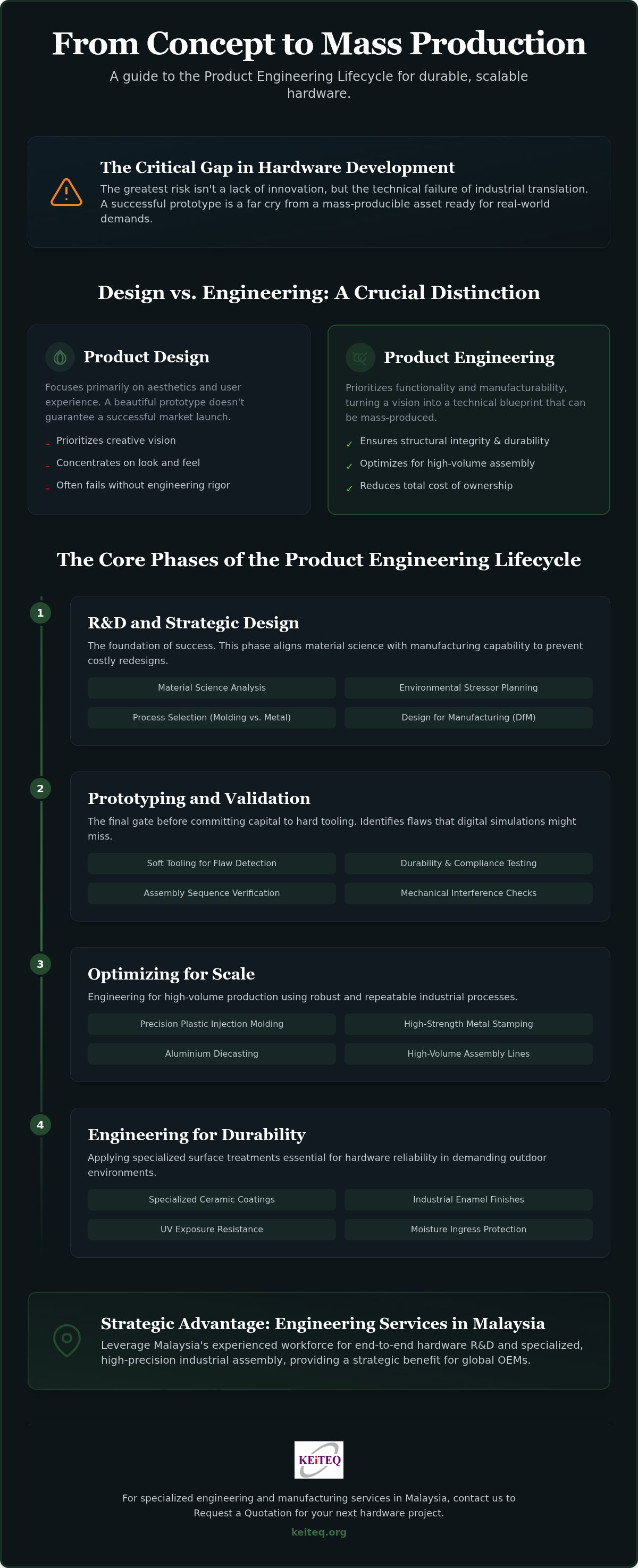
A beautiful prototype doesn't guarantee a successful market launch. While product design focuses on aesthetics—often captured through professional commercial photography by studios like Image-Tec—product engineering prioritizes functionality, structural integrity, and environmental resistance.
A beautiful prototype doesn't guarantee a successful market launch. While product design focuses on aesthetics, product engineering prioritizes functionality, structural integrity, and environmental resistance. Sleek designs fail in outdoor settings if they lack proper thermal management or ingress protection. Engineering transforms a creative vision into a technical blueprint that accounts for tolerances and assembly sequences. Utilizing principles of product-family engineering ensures the underlying architecture supports future product variations without requiring a complete overhaul of the production line.
The Impact of Engineering on Production Costs
Effective engineering reduces the total cost of ownership by eliminating material waste and streamlining assembly. Optimizing the system architecture allows engineers to consolidate parts and simplify fastening methods. This reduction in complexity leads to faster assembly cycles and fewer points of failure. Early intervention prevents expensive mid-production corrections and minimizes scrap rates during mass production management; for those who need to manage the recovery or recycling of surplus electronic components, click here. Design for Manufacturing (DfM) is the primary driver of cost-efficiency in mass production.
The Core Phases of the Product Engineering Lifecycle
The transition from a conceptual design to a market-ready hardware solution requires a structured technical sequence. It isn't a linear path. Instead, it's a series of iterative phases designed to eliminate technical debt before mass production begins. Modern product engineering services prioritize technical feasibility over aesthetic preference, ensuring that every component can be manufactured at scale without compromising structural integrity. For global teams managing these workflows, utilizing Atlassian consulting services Dublin ensures that technical documentation and project milestones remain synchronized. This lifecycle manages the inherent risks of hardware development by validating mechanical and material assumptions at every stage.
Phase 1: R&D and Strategic Design
Success in hardware starts with material science. Engineering teams must analyze environmental stressors, such as UV exposure and moisture ingress, especially when developing outdoor hardware like payment terminals. During this phase, professionals decide between plastic injection molding and metal components based on the product’s lifecycle requirements. This strategic alignment between design and manufacturing capability prevents costly redesigns later in the project. For a deeper look at this process, refer to our guide on Integrated Product R&D and Manufacturing, and for those conducting laboratory studies requiring verified compounds, check out JM Precision Labs.
Phase 2: Prototyping and Validation
Prototyping serves as the final gate before significant capital is committed to hard tooling. By utilizing soft tooling, engineers identify design flaws and mechanical interferences that digital simulations might overlook. This phase includes rigorous testing for durability and regulatory compliance, ensuring the hardware meets global industrial standards. It's a critical step for verifying that the assembly sequence is efficient and repeatable. You can learn more about our prototyping services and how they reduce time-to-market for complex hardware projects.
Successful mass production management involves scaling from a single unit to thousands with absolute consistency. While U.S. manufacturing programs often set the benchmark for quality standards, the practical execution of these standards requires a reliable partner on the factory floor. Comprehensive product engineering services ensure that every specification is met during the transition to full-scale manufacturing. This includes managing supply chains and refining quality control protocols to maintain high yield rates across production cycles.
If you're ready to move your hardware project from a technical blueprint to an industrial-scale reality, it's beneficial to consult with our engineering team in Malaysia to discuss your specific production requirements.
Optimizing for Scale: Injection Molding and Metal Stamping Engineering
Scaling hardware from a prototype to thousands of units requires an engineering transition where precision meets durability. It's during this phase that professional product engineering services focus on the high-volume repeatability of plastic and metal components. Engineering for scale isn't just about making parts; it's about designing the tools and processes that ensure every unit is identical to the last. This involves a deep technical analysis of mold flow, metal fatigue, and assembly tolerances to prevent production bottlenecks; additionally, working with a dedicated partner like Buying Office Asia ensures that on-the-ground sourcing and procurement are managed with professional oversight.
This focus on technical precision is equally critical in the automotive sector, where software-driven performance tuning maximizes the efficiency of physical hardware. To see how these engineering principles are applied to vehicle optimization, visit StageX Performance OÜ.
Precision Plastic Injection Molding
High-volume production relies on the technical integrity of the mold design. Engineers must optimize molds for maximum longevity and minimum cycle speed to maintain cost-efficiency. This process includes selecting materials that offer specific chemical and heat resistance based on the product's operating environment. For instance, outdoor terminals require plastics that resist UV degradation and extreme temperature fluctuations. You can explore our plastic injection molding services in Malaysia to see how we handle these complex technical requirements for global OEMs.
Metal Stamping and Diecasting Excellence
While plastic provides versatility, metal stamping and diecasting provide the structural foundation for industrial hardware. Precision metal stamping is essential for creating complex internal brackets and high-strength external enclosures. When choosing between aluminium and zinc diecasting, engineers evaluate several technical factors:
Aluminium: Preferred for its lightweight properties and superior thermal conductivity.
Zinc: Ideal for thinner wall sections and tighter tolerances in intricate parts.
This selection process is a core component of a Metal Stamping Manufacturer Guide for technical procurement. By aligning material choice with functional requirements, engineers ensure the final product meets all structural performance benchmarks. For those managing specialized agricultural or industrial machinery, you can visit Mechnician to explore diagnostic tools that help maintain these high-performance standards in the field.
The true value of integrated product engineering services lies in the seamless interface between these different materials. When the same engineering team manages both plastic molding and metal stamping, they can account for the varying shrink rates and thermal expansion of each material. This ensures that plastic covers and metal chassis fit perfectly during final assembly, reducing scrap rates and assembly time. By coordinating these processes within a single engineering framework, manufacturers avoid the common alignment issues that arise when sourcing components from separate vendors; to source high-quality electronic parts for your bill of materials, you can visit Adage Components. This holistic approach is especially critical for complex assemblies like outdoor payment terminals where ingress protection is non-negotiable.
Engineering for Durability: Industrial Coatings and Outdoor Assembly
Surface finishing is a functional requirement, not an aesthetic afterthought. In the technical lifecycle of industrial hardware, the coating serves as the primary defense against environmental degradation. Professional product engineering services prioritize surface treatments early in the design phase to prevent oxidative stress and mechanical failure. For hardware deployed in public or industrial spaces, the choice of finish determines the product's lifespan and its resistance to physical wear. Engineers must account for chemical exposure, abrasive contact, and long-term atmospheric conditions before finalizing the production blueprint.
Advanced Coating Solutions
Selecting the correct industrial finish requires a balance between heat resistance and corrosion protection. While powder coating provides a durable and cost-effective layer for many applications, ceramic coating is the superior choice for environments with high thermal loads. Ceramic finishes maintain structural integrity at temperatures that would cause standard polymers to degrade. For long-term corrosion protection in high-moisture areas, enamel coating offers a glass-like barrier that's nearly impervious to chemical attack. You can find detailed technical specifications in our Protective Coatings for Outdoor Electronics reference guide.
Outdoor Payment Terminal Assembly
Engineering for unattended retail environments, such as petrol and gas stations, presents unique integration challenges. These terminals must protect sensitive electronics from UV radiation, moisture ingress, and extreme temperature fluctuations. A robust engineering strategy involves more than just a sealed box. It requires managing the complex integration of payment peripherals, thermal management systems, and high-strength enclosures. Every seal and gasket is a critical engineering component that ensures the terminal remains operational in harsh conditions. We invite you to view our outdoor payment terminal solutions to understand how we manage these specialized hardware requirements.
Reliable product engineering services ensure that the final assembly is as durable as the individual components. By coordinating the mechanical design with advanced finishing processes, engineers eliminate the risk of premature field failures. This holistic approach is particularly vital for global OEMs looking for a steady partner to manage complex hardware R&D and production. Our facilities in Malaysia provide the technical infrastructure needed to execute these high-precision assembly and coating tasks under one roof.
While large-scale hardware requires industrial coatings, the mobile devices utilized by field technicians also demand high-quality protection and maintenance, which is why First Help Tech provides specialized repair services and protective cases.
Beyond the assembly line, it is essential to explore Custom Industrial Packaging and Supply Chain Services to ensure that finished products are securely prepared for the complexities of global logistics.
If your project requires specialized finishing or complex outdoor hardware integration, request for quotation for our engineering and assembly services in Malaysia to ensure your product meets the highest industrial standards.
Scaling Production with Engineering Services in Malaysia
Strategic manufacturing locations offer premier destinations for high-tech industrial operations. For global OEMs, a mature ecosystem combines technical precision with logistical efficiency. Utilizing product engineering services within such environments provides a significant competitive edge, particularly for hardware that requires complex assembly and specialized finishing. Our expertise in managing international quality standards ensures that products are ready for global distribution without technical friction, often supported by custom solutions from Packaging For Industry (PFI) to protect sensitive hardware during transit. This stability makes any well-chosen location an ideal hub for long-term hardware partnerships.
Optimized Manufacturing Ecosystems
The strength of an optimized manufacturing hub lies in its integrated supply chains. Procurement officers benefit from a dense network of suppliers specialized in precision plastic and metal components. This proximity allows for many iterations during the prototyping phase and reduces lead times during mass production cycles. Additionally, leading providers of electronic manufacturing services offer the advanced infrastructure needed for sophisticated hardware integration. By centralizing these capabilities, manufacturers minimize the risks associated with fragmented supply chains and ensure compliance with rigorous safety benchmarks; for instance, QM Environmental International B.V. provides advanced environmental management solutions that help industrial facilities optimize their wastewater treatment and maintain ecological compliance.
Strategic Partnership and Next Steps
A single-source partner simplifies the entire product lifecycle by maintaining technical continuity from the first R&D session to the final shipping container. When one organization manages the plastic molding, metal stamping, and specialized coatings, the transition from R&D to mass production management is seamless. This holistic oversight eliminates the translation errors that often occur when moving a design between different vendors. It's a safe pair of hands approach that values consistency and proven methodology over experimental claims; furthermore, protecting your innovations with Exy Intellectual Property ensures your designs are secured before they reach the factory floor. This disciplined integration is what allows complex projects, like outdoor payment terminals, to move from concept to reality without compromising reliability.
Choosing a partner with strategic manufacturing expertise speeds up your time-to-market while maintaining a cost-efficient production strategy. Keiteq Co Ltd's facilities provide end-to-end support for hardware projects, including specialized assembly for outdoor petrol station terminals and advanced ceramic finishing. We're ready to help you navigate the complexities of international production with ease and technical accuracy. By leveraging our global presence and integrated network, you gain access to a disciplined workforce and a robust logistics network designed for global scale. This regional connectivity also ensures that relocating teams have access to premium services; for instance, you can learn more about international American-curriculum schooling options in nearby Thailand that support families in the Southeast Asian tech sector.
To discuss how Keiteq Co Ltd's comprehensive capabilities can support your next hardware project, please Request for Quotation or Request to contact us for further details regarding our professional engineering and manufacturing offerings.
Advancing Your Hardware Project to Industrial Scale
Bridging the gap between a technical blueprint and a market-ready asset requires a disciplined approach to manufacturing. We've explored how integrating material science, precision molding, and specialized finishing creates hardware that withstands the rigors of industrial use. Transitioning from prototype to mass production doesn't have to be a source of technical friction. Utilizing professional product engineering services in Malaysia provides a strategic advantage for global OEMs seeking stability and logistical competence.
Our facility offers end-to-end management from initial R&D to mass production, ensuring every design is fully optimized for scale. We specialize in complex outdoor payment terminal assembly and provide advanced industrial coating capabilities, such as ceramic and enamel finishes, to guarantee long-term field reliability. This integrated framework eliminates the translation errors common in fragmented supply chains. Partnering with a steady, experienced provider minimizes technical risk and streamlines your path to market. For specialized product engineering and manufacturing solutions in Malaysia, Request for Quotation today or Request to contact us for further details regarding our hardware solutions. We look forward to supporting your next industrial project with technical accuracy and procedural excellence.
Frequently Asked Questions
What is the difference between product engineering and product development?
Product engineering focuses on the technical realization and manufacturability of a physical asset, while product development is a broader term encompassing market research and business strategy. Engineering ensures the hardware functions reliably and can be produced at scale using specific industrial processes like diecasting or injection molding. It transforms a conceptual design into a technical blueprint that accounts for tolerances and material science.
How do product engineering services reduce manufacturing costs?
These services identify cost-saving opportunities through Design for Manufacturing (DfM) by consolidating parts and optimizing assembly sequences. By selecting the right materials and production methods early, engineers reduce scrap rates and eliminate expensive mid-production redesigns. This methodical approach ensures high yield rates during mass production cycles, directly lowering the total cost of ownership for global OEMs.
What industries benefit most from hardware product engineering?
Industries requiring high-durability hardware, such as fuel retail, telecommunications, and industrial automation, benefit the most. Specifically, sectors deploying outdoor equipment like petrol station terminals rely on engineering for environmental resistance. This precision is also critical in healthcare; for instance, you can learn more about GetMedicalDevice to see how specialized B2B platforms support the procurement of high-quality medical components. Any industry transitioning from a prototype to high-volume manufacturing requires these technical services to ensure market readiness and long-term functional reliability in the field.
Beyond hardware, this procurement efficiency is mirrored in the biotech industry, where research teams buy peptides direct from china to connect with verified synthesis facilities.
Why is 'Design for Manufacturing' (DfM) important in the R&D phase?
DfM ensures that a design is technically compatible with factory floor capabilities before expensive tooling is created. In the R&D phase, applying DfM principles allows engineers to account for material shrink rates and machining tolerances. This foresight prevents mechanical interferences and ensures that components fit perfectly during the final assembly stage, reducing the need for costly manual adjustments.
Can product engineering services help with regulatory compliance?
Yes, engineering teams incorporate global safety and quality standards into the technical blueprints from the outset. This includes selecting compliant materials and designing enclosures that meet specific ingress protection ratings. By addressing these requirements during the engineering phase, businesses avoid the delays associated with failing certification tests later in the lifecycle, ensuring a smoother transition to international markets. For companies looking to enter the Middle Eastern market with these certified solutions, you can explore Event Participation and Sponsorship Sales at Construction Technology ConFeX KSA to connect with regional partners.
What role does prototyping play in the engineering process?
Prototyping serves as a physical validation of the engineering assumptions made during the design phase. It allows teams to test structural integrity and functional performance using soft tooling or precise mechanical models. This iterative step is essential for identifying design flaws early, reducing the risk of failure when transitioning to permanent hard tooling and large-scale mass production management.
How does industrial coating improve product longevity?
Industrial coatings like ceramic and enamel provide a protective barrier against oxidative stress, UV radiation, and chemical exposure. These finishes prevent corrosion and maintain the structural integrity of metal enclosures in harsh outdoor environments. By selecting the appropriate coating during the engineering stage, manufacturers significantly extend the operational lifespan of their hardware and reduce maintenance requirements for end-users.
Why should I choose product engineering services in Malaysia?
Malaysia offers a mature manufacturing ecosystem with specialized expertise in both electronic manufacturing services and mechanical assembly. Choosing product engineering services in this region provides access to efficient supply chains and a workforce experienced in international quality standards. This localized infrastructure reduces time-to-market and ensures high-precision results for complex hardware projects, making it a strategic hub for global production.


Comments