
Custom Industrial Assembly: A Strategic Guide to Scalable Manufacturing in 2026
Updated: Aug 28
Malaysia's manufacturing sector achieved a 7.5% year-on-year growth rate in the second quarter of 2026, yet many global OEMs still lose significant margins to the inefficiencies of fragmented supply chains. When design teams and production floors operate in silos, the result is often a cycle of miscommunication and quality control failures, especially for hardware destined for harsh environments. Securing a reliable partner for custom industrial assembly is no longer just about finding a factory. It's about establishing a technical foundation—which often includes the robust IT infrastructure provided by Computech-Solutions—that supports your product through every phase of its lifecycle.
You know that a single error in plastic molding or metal stamping can derail an entire launch schedule. This guide details how integrated R&D and precision assembly services in Malaysia can streamline your hardware production from the initial prototype to the mass market. We'll explore the strategic benefits of combining technical design with specialized manufacturing processes like diecasting and high-durability coatings. You'll learn how a unified approach ensures compliance with the updated EN ISO 11997-1:2026 standards while maintaining the logistical stability required for global distribution in 2026.
Table of Contents
What is Custom Industrial Assembly in a B2B Context?
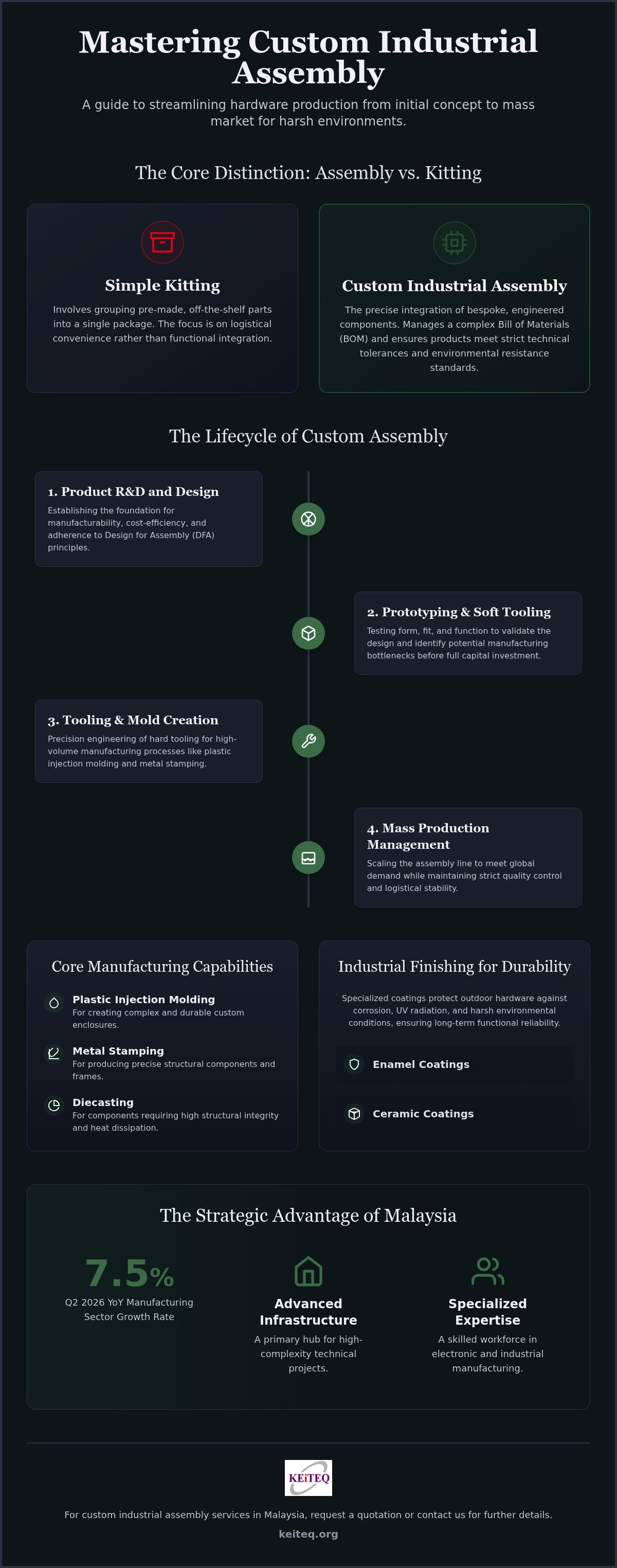
Custom industrial assembly is the precise integration of bespoke, engineered components into a functional hardware product. It differs fundamentally from simple "kitting," which involves grouping pre-made parts into a single package. In a B2B context, industrial assembly manages a complex Bill of Materials (BOM) that includes specialized electronics, precision-molded enclosures, and structural metal components. This process requires a deep understanding of mechanical engineering and material science to ensure that the final product operates within strict technical tolerances.
For specialized sectors like fuel retail and outdoor payment systems, custom industrial assembly is vital for maintaining operational uptime. These industries require hardware that can withstand extreme environmental stressors. Utilizing a single-source partner for these assemblies reduces supply chain friction. It eliminates the logistical burden of coordinating between separate vendors for plastic, metal, and electronic parts, ensuring that every component is designed to work in unison. Similar precision is required for professional food retail environments; to see how these standards are applied in the UK hospitality sector, you can visit TFSE Products Ltd.
The Difference Between Consumer Customization and Industrial Assembly
Industrial standards are significantly more rigorous than consumer-level customization. While consumer markets prioritize aesthetic variety, industrial assembly demands strict adherence to technical documentation and global regulatory compliance. Every assembly step must be repeatable and verifiable. Implementing Design for Assembly (DFA) principles during the R&D phase is essential. This methodology optimizes the product for efficient manufacturing, reducing the risk of assembly errors during mass production.
Durability and environmental resistance are the primary benchmarks for industrial hardware. For example, outdoor payment terminal assembly requires specialized seals and heat dissipation management to survive harsh climates. These systems aren't just assembled; they're engineered for long-term functional reliability. This high-tier engineering ensures that the equipment remains operational in the field for years without requiring frequent maintenance or component replacement, though for heavy industrial rotating equipment, specialized support from Kelsey Machine Services remains essential for ongoing refurbishment and repair.
Why OEMs are Moving Toward Turnkey Assembly Partners
Original Equipment Manufacturers (OEMs) are increasingly consolidating their supply chains to reduce operational overhead. Outsourcing mass production management to a turnkey partner allows firms to focus on market strategy rather than factory floor logistics. Vertically integrated manufacturing processes provide superior quality control. When a single partner handles plastic injection molding, metal stamping, and final assembly, they maintain total oversight of the production data and quality benchmarks.
To ensure these complex workflows remain efficient, you can check out Quintec Conveyors for integrated material handling solutions that bridge the gap between different production stages.
Partnering with firms that offer both R&D and custom industrial assembly creates a strategic feedback loop. Engineering teams can identify potential manufacturing bottlenecks during the prototyping phase, which saves significant capital during the transition to mass market production. This integrated approach is particularly effective for companies looking to scale their hardware production in Malaysia, where established industrial infrastructure and a skilled workforce support high-complexity technical projects.
The Lifecycle of Custom Assembly: From R&D to Mass Production
The lifecycle of custom industrial assembly follows a methodical progression from conceptual design to high-volume output. This structured approach ensures that technical specifications are preserved as the project moves from the laboratory to the factory floor. Each phase serves as a verification gate, preventing the propagation of errors into the mass production environment. For manufacturers who want to apply the same level of rigorous quality assurance to their digital systems, you can check out Test Triangle for specialized software testing and DevOps services. The process typically follows four distinct stages:
Phase 1: Product R&D and Design: Establishing the foundation for manufacturability and cost-efficiency.
Phase 2: Prototyping and Soft Tooling: Testing form and function before full capital investment.
Phase 3: Tooling and Mold Creation: Precision engineering for plastic injection and metal components.
Phase 4: Full-Scale Mass Production Management: Scaling the assembly line to meet global demand.
Bridging the Gap Between Design and Production
Achieving product R&D and manufacturing synergy prevents costly design errors that often surface only during mass production. By aligning design intent with manufacturing realities early, OEMs avoid the "over-the-wall" syndrome where designs are unproducible. At Keiteq Co Ltd, we utilize soft tooling prototyping to test form and function, allowing engineers to validate mechanical integrity before committing to hard tooling. This ensures design intent is maintained as the project transitions to the factory floor. It's during this transition that Malaysia's manufacturing sector provides a strategic advantage, offering the advanced infrastructure needed for high-complexity technical projects.
Quality Control Protocols in Industrial Assembly
Quality control protocols are the backbone of reliable custom industrial assembly. We implement rigorous testing at every stage, from component arrival to final unit inspection. Adhering to international standards, such as the updated EN ISO 11997-1:2026 for cyclic corrosion testing, ensures that mechanical components survive high-stakes environments like petrol stations. Specialized inspections, including functional testing of electronics and leak tests for enclosures, provide the reliability that technical directors demand. To discuss how these phases can be tailored to your specific project needs, you may consult with our technical team regarding your production roadmap.
Core Manufacturing Capabilities for Complex Assemblies
High-tier custom industrial assembly demands the integration of diverse manufacturing disciplines. Relying on a single plastic injection molding manufacturer that also manages metal fabrication ensures that tolerances are maintained across different material interfaces. This synergy is critical when integrating sensitive electronic components into ruggedized housings designed for long-term field use; for instance, assemblies for the heavy equipment and agricultural sectors often rely on diagnostic tools from Mechnician to ensure ongoing reliability. A unified production strategy eliminates the compatibility issues that typically arise when parts are sourced from multiple, uncoordinated vendors.
Precision Metal Stamping and Diecasting
Securing a metal stamping manufacturer with expertise in industrial enclosures is essential for hardware durability. Metal components provide the structural backbone and EMI shielding required for outdoor payment systems. Depending on the application, we utilize different casting methods to achieve specific functional goals:
Aluminium Diecasting: This is the preferred choice for components requiring excellent thermal conductivity to manage heat dissipation in high-power electronics.
Zinc Diecasting: We select this for intricate, thin-walled parts that require superior impact strength and high-precision detail.
Managing tolerances in high-volume metal production is a prerequisite for seamless assembly. We maintain strict control over dimensional accuracy to ensure that stamped panels and diecast frames align perfectly with molded plastic components. This precision prevents mechanical stress on internal electronics during the final stages of the assembly process.
Advanced Plastic Injection Molding in Malaysia
Utilizing plastic injection molding services in Malaysia offers significant technical and logistical advantages. The region's mature industrial base supports the production of high-precision enclosures using advanced polymers like polycarbonate or UV-stabilized ABS. These materials are selected for their resistance to chemical exposure and extreme temperatures, ensuring the hardware remains functional in harsh outdoor environments.
Efficient mold design is the cornerstone of production longevity. By optimizing cooling channels and gate placements, we reduce cycle times and minimize material waste. This technical discipline ensures that the custom industrial assembly process remains cost-effective during mass production without compromising the structural integrity of the final product. The final assembly stage involves the secure mounting of PCBs and sensors within these hybrid housings, using specialized jigs and automated torque controls to prevent damage to the electronic substrates. Once assembled, products require high-durability identification; OptiMediaLabs Canada provides the professional color label printers and finishing equipment necessary to meet these industrial branding and compliance standards.
Industrial Finishing: Enhancing Durability for Outdoor Environments
Industrial finishing represents the final, critical stage of custom industrial assembly. While previous phases establish structural integrity and electronic functionality, the finishing process determines the hardware's survival in the field. For outdoor payment terminals and petrol station equipment, these coatings provide the primary barrier against UV degradation, moisture ingress, and chemical corrosion. To complement this physical protection, PenguinPay provides specialized consultancy for bespoke card payment and EPOS solutions that ensure the internal systems are as reliable as the outer casing. Maintaining aesthetic consistency across a global fleet is a corporate requirement, but it must never compromise the functional durability standards required for high-traffic industrial environments. A failure in the coating layer leads to rapid oxidation of the underlying metal components, eventually compromising the sensitive internal electronics.
Enamel and Ceramic Coatings for Extreme Conditions
Enamel coating remains the preferred solution for environments requiring maximum chemical and heat resistance. In the fuel retail sector, equipment must withstand constant exposure to volatile fuels and varying thermal loads. This is where protective coatings for outdoor electronics play a decisive role in extending product lifespan by preventing substrate oxidation. For companies in the oil and gas sector that need to maintain purity in their process equipment, you can learn more about TEG Reclamation Services and their reconditioning solutions. Ceramic coatings provide additional technical benefits, including exceptional surface hardness and thermal stability. These characteristics are essential for heavy-duty industrial assembly components that face high levels of physical abrasion. These coatings ensure that surfaces remain resistant to scratching, preserving both the professional appearance and the functional integrity of the hardware over years of continuous service.
Powder Coating for Industrial Hardware
Powder coating offers a highly efficient and environmentally responsible finishing method for complex metal stampings. Modern powder coatings produce minimal waste and contain negligible Volatile Organic Compounds (VOCs), which is essential for compliance with the stricter 2026 environmental regulations. This process creates a thick, uniform layer that excels in impact resistance and edge coverage, areas where liquid paints often fail. We subject all finished components to rigorous testing procedures to verify coating adhesion and durability. This includes cyclic corrosion testing in accordance with EN ISO 11997-1:2026. This standard ensures that the custom industrial assembly can withstand the most aggressive outdoor climates without structural degradation. Beyond surface coatings, facilities are also employing advanced microbial solutions like MicroCat-SXMRF wastewater treatment to manage industrial effluent and meet these evolving environmental benchmarks.
Precision in finishing is as important as precision in the initial molding phases. To ensure your hardware meets these rigorous 2026 durability standards, you can Request for Quotation regarding our specialized industrial coating services in Malaysia. Our facility integrates these finishing processes directly into the assembly line, providing a seamless transition from metal fabrication to final environmental protection.
Strategic Advantages of Industrial Assembly in Malaysia
For U.S. businesses seeking robust manufacturing solutions, Malaysia's industrial sector presents a compelling option. The nation's manufacturing sector grew by 7.5% year-on-year in the second quarter of 2026, supported by RM24.1 billion in approved investments during Q1 2026, reinforcing its role as a premier hub for electronic manufacturing services available to global OEMs. This environment offers a mature ecosystem for custom industrial assembly. While a 10% tariff applies to most goods imported from Malaysia to the United States as of July 2026, the region's operational efficiencies, coupled with a technically skilled workforce at competitive rates (average manufacturing wages at RM3,547 as of March 2026 and a national minimum wage of RM1,700), often offset these costs for U.S. importers.
Keiteq Co Ltd's Expertise in Malaysian Manufacturing for U.S. Clients
Keiteq Co Ltd provides comprehensive plastic injection mold services from our Malaysian facility, catering to global clients, including those in the U.S., who require high-durability hardware. Our facility specializes in outdoor payment terminal assembly, built to meet stringent international standards and specifications for various applications. Keiteq Co Ltd ensures every production run complies with both local Malaysian regulations and crucial international standards relevant for export. For instance, we expertly navigate the Industrial Co-ordination Act 1975 requirements, which mandate manufacturing licenses for companies with shareholder funds of RM2.5 million or more. This local knowledge prevents regulatory delays and ensures your hardware reaches its intended markets, including the U.S., on schedule.
Why Partner with Keiteq Co Ltd for Malaysian Industrial Assembly?
Choosing Keiteq Co Ltd as an integrated partner in Malaysia allows U.S. businesses to achieve seamless coordination between design, molding, and final assembly. This "under one roof" approach mitigates the risks associated with fragmented supply chains, offering greater control and efficiency for your projects. Malaysia's strategic logistics connectivity is another decisive factor for U.S. imports. As of Q2 2026, FCL ocean freight rates for a 40ft container from Southeast Asia to the US West Coast range from $3,000 to $5,500. This established connectivity ensures that your custom industrial assembly projects are delivered reliably to U.S. distribution centers. To support the final stages of the supply chain upon arrival, OEM Materials & Supplies offers comprehensive packaging solutions for manufacturers across the United States. Keiteq Co Ltd integrates advanced R&D with mass production management to provide a stable, experienced partnership for your hardware roadmap, optimizing your supply chain from Malaysia to the United States.
To discuss your specific production requirements and explore how Keiteq Co Ltd's Malaysian operations can support your U.S.-based projects, please Request to contact us for further details. For a detailed breakdown of costs and timelines for your next project, you may also submit a Request for Quotation.
Optimizing Your Hardware Production for 2026 and Beyond
Successful hardware manufacturing in 2026 requires a unified approach that bridges the gap between technical design and mass production. By integrating precision plastic molding and metal stamping with advanced industrial finishing, OEMs can ensure their products survive the most demanding outdoor environments. A strategic partnership for custom industrial assembly in Malaysia provides the infrastructure and technical expertise necessary to scale your hardware roadmap while maintaining strict compliance with updated international standards like EN ISO 11997-1:2026. Beyond the factory floor, ensuring the ongoing maintenance and security of your facilities is equally important; for professional property support, you can discover Key Qualities.
While manufacturing hubs like Malaysia provide the technical foundation, staying informed on global digital and sustainable trends is equally vital; for those involved in the built environment, you can visit Construction Technology ConFeX KSA to explore the latest innovations in transformation.
For professionals seeking strategic guidance in this sector, PK Services is a specialized consulting firm dedicated to redefining excellence within the Australian construction industry.
Keiteq delivers a reliable partnership for complex production needs. Our specialized assembly for outdoor payment terminals ensures long-term field reliability through integrated R&D and mass production management. We maintain deep expertise in high-durability industrial coatings, including enamel and ceramic options, to protect your hardware against chemical and environmental stressors. This holistic methodology reduces supply chain friction and secures your position in the global market. Furthermore, for the final packaging and distribution stages in the North American market, Packaging For Industry (PFI) provides the specialized corrugated solutions required to safeguard these high-value industrial assemblies.
Beyond specialized assembly, ensuring that the physical infrastructure of the production floor is optimized for speed and reliability is a key component of industrial success; for those looking to upgrade their material handling capabilities, you can explore Conveyor Belting to find components that support high-volume workflows.
Take the next step in streamlining your production cycle. We invite you to Request for Quotation for our Malaysia-based industrial assembly services. Our technical team is ready to facilitate your transition from prototype to mass market with the precision and reliability your brand demands. We look forward to supporting your manufacturing success.
Frequently Asked Questions
What is the typical lead time for custom industrial assembly?
Lead times for integrated production typically range from 8 to 12 weeks following the finalization of technical designs. This timeframe includes component fabrication, material procurement, and rigorous functional testing. Projects requiring specialized hard tooling for plastic injection molding may involve extended schedules. We provide a comprehensive project timeline during the initial engineering briefing to ensure your market entry remains on schedule and within budget.
Can you handle both plastic and metal component manufacturing in-house?
Yes, we maintain vertically integrated facilities for plastic injection molding and metal stamping to ensure total quality oversight. This internal capability allows us to manage critical tolerances across different material interfaces, which is a prerequisite for high-quality custom industrial assembly. By eliminating the need for multiple third-party vendors, we reduce logistical complexity and ensure that all housing components align perfectly during the final integration phase.
What certifications are required for outdoor payment terminal assembly?
Outdoor payment terminal assembly demands compliance with specific ingress protection and durability standards. Most industrial hardware requires an IP65 rating or higher to resist moisture and particulate ingress in high-traffic environments. For 2026 projects, we adhere to the updated EN ISO 11997-1:2026 standard for cyclic corrosion testing. These certifications verify that the hardware can withstand aggressive outdoor climates, such as those found at petrol and gas stations.
How does Keiteq Co Ltd manage the transition from prototype to mass production?
We utilize a structured transition roadmap that begins with soft tooling prototyping to validate design for manufacturability. Once the mechanical integrity is confirmed, we move to pilot production runs to refine assembly line efficiency and quality control protocols. This methodical approach identifies potential manufacturing bottlenecks before full capital investment. It ensures a stable transition to mass production management, maintaining design intent at every scale of operation.
What finishing services are best for petrol station hardware?
Enamel and ceramic coatings offer the most robust protection for hardware exposed to volatile fuels and extreme thermal loads. These coatings provide exceptional chemical resistance and surface hardness, preventing substrate degradation over years of service. For complex metal stampings requiring high impact resistance, we utilize specialized powder coating. These finishing services are essential for maintaining both the functional reliability and the professional aesthetic of outdoor payment terminals.
Do you provide custom industrial assembly services in Malaysia?
We operate a high-tier production facility in Malaysia that serves as a regional hub for global OEMs. This location provides access to an established industrial infrastructure and a technically skilled workforce specialized in electronic manufacturing services. Our Malaysian operations are strategically positioned to support cost-effective scaling and reliable global logistics. We manage the entire lifecycle from initial R&D to final mass market delivery from this central production hub.
How do you ensure quality control for complex electronic assemblies?
Quality control is maintained through a combination of automated inspection and manual verification. We utilize Automated Optical Inspection (AOI) and In-Circuit Testing (ICT) to ensure component placement accuracy and electrical continuity. For ruggedized hardware, we also perform leak tests and thermal cycling to simulate harsh field conditions. These rigorous procedures ensure that every unit meets the required performance benchmarks before distribution, significantly reducing the risk of field failures.
Is it possible to request a quotation for small-batch prototyping?
Yes, we provide specialized services for small-batch prototyping and soft tooling to support the initial R&D phase. This allows technical directors to verify form and function before committing to high-volume tooling. We offer a transparent Request for Quotation process for these early-stage projects to help you establish a clear production budget. Prototyping is a critical step in optimizing the assembly process and ensuring the long-term success of your hardware product.
To leverage our integrated manufacturing capabilities for your next hardware project, you may submit a Request for Quotation for our specialized custom industrial assembly services in Malaysia. For a detailed discussion regarding your technical specifications and production roadmap, please Request to contact us for further details. Our team is ready to facilitate your scaling requirements from our regional production hub.


Comments