
Custom Injection Molding Johor: Top Precision Solutions
Updated: Sep 4
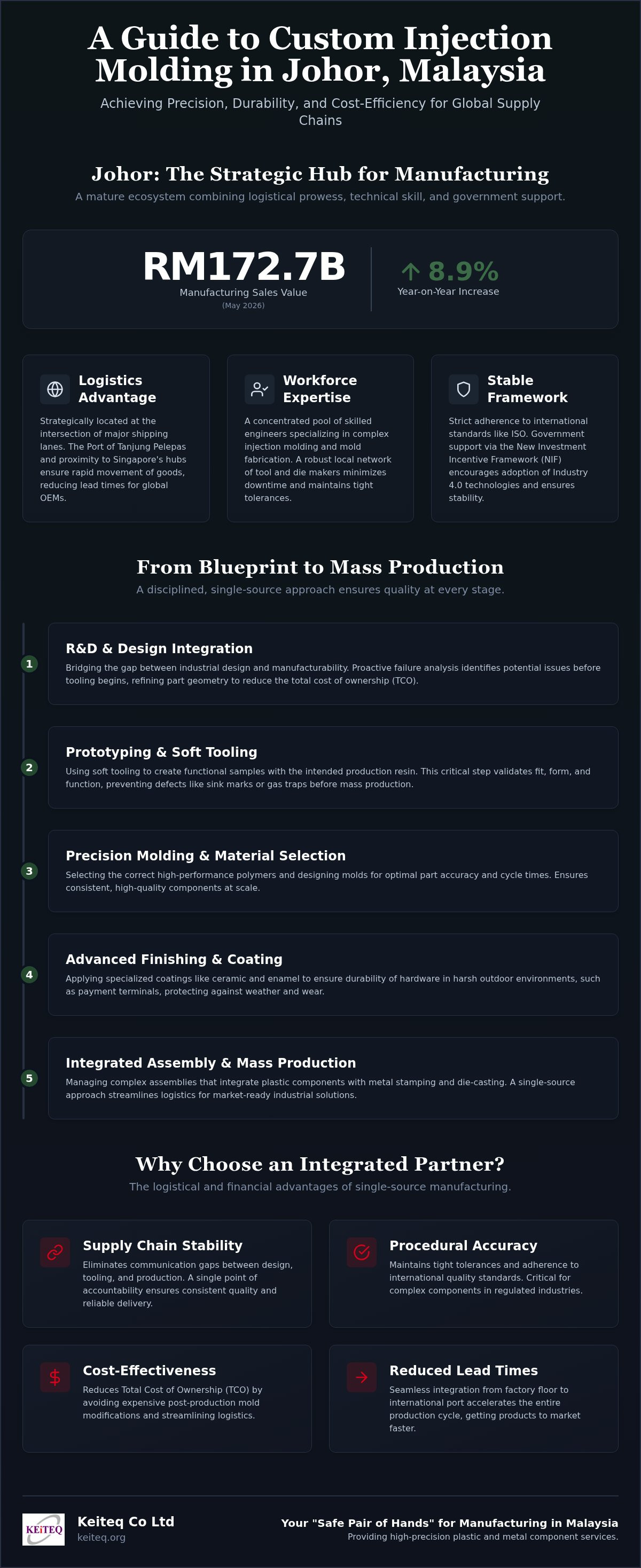
Malaysia's manufacturing sector reached a sales value of RM172.7 billion in May 2026, an 8.9% increase that reinforces the region's status as a premier industrial hub. For technical directors, securing reliable custom injection molding Johor is a critical step in maintaining global supply chain stability and procedural accuracy.
You understand the difficulty of managing parts that must withstand extreme environments, especially when communication gaps between design and production teams lead to failures. A fragmented supply chain often results in finishes that lack the durability required for outdoor hardware. This article provides a roadmap for your manufacturing process in Malaysia, moving from initial R&D and precision tooling into advanced industrial finishing.
We'll examine how single-source manufacturing provides the logistical competence required for complex assemblies like outdoor payment terminals. You'll learn how to achieve high-durability coatings and cost-effective production while maintaining the professional standards your stakeholders demand. By the end, you'll see why an integrated approach is the most reliable path to market-ready industrial solutions.
Table of Contents
Why Johor is the Strategic Hub for Custom Injection Molding in 2026
Johor has solidified its position as a primary industrial pillar within the Southeast Asian manufacturing corridor. By mid-2026, the region's contribution to Malaysia's RM172.7 billion manufacturing sales value highlights a mature ecosystem of plastic and metal component manufacturers. For procurement officers, custom injection molding Johor offers a unique combination of high-precision output and regional cost-efficiency. The region maintains strict compliance with international quality standards, including ISO certifications, which ensures procedural accuracy for global supply chains while providing lower operational overheads than neighboring Singapore.
The Logistics Advantage of Johor Bahru
The geographic position of Johor Bahru provides a significant strategic advantage for global trade. It sits at the intersection of major international shipping lanes, allowing for rapid movement of finished goods. The Port of Tanjung Pelepas serves as a critical node for global OEMs targeting European and North American markets. Because Johor is adjacent to Singapore's logistics hubs, companies benefit from world-class financial services and secondary shipping options. This infrastructure readiness supports high-volume industrial production without the bottlenecks found in less developed regions. It allows for a seamless transition from factory floor to international port, reducing lead times for complex hardware projects.
Workforce Expertise and Technical Infrastructure
Technical proficiency is a hallmark of the Malaysian manufacturing sector. The region hosts a concentrated pool of skilled engineers who specialize in complex injection moulding processes and mold fabrication. This expertise is supported by a robust network of tool and die makers, ensuring that maintenance and precision adjustments happen on-site rather than overseas. This localized support system minimizes downtime and maintains the tight tolerances required for industrial-grade parts.
The policy landscape further strengthens this technical foundation. The New Investment Incentive Framework (NIF), effective March 1, 2026, provides tax allowances based on high-value job creation and local supply chain development. This framework encourages manufacturers to adopt Industry 4.0 technologies, such as IoT connectivity and automated quality control systems. Consequently, plastic injection molding services in Malaysia are positioned as a "Safe Pair of Hands" for companies requiring disciplined, large-scale production. The synergy between government support and technical veteran status creates a stable environment for long-term procurement strategies.
From Concept to Tooling: The Product R&D Phase
R&D serves as the blueprint for manufacturing success. It's the stage where theoretical design meets mechanical feasibility. In the context of custom injection molding Johor, R&D isn't an optional luxury; it's a procedural requirement for maintaining tight tolerances and high yields. By integrating design and production teams early, Keiteq identifies potential failure points before a single piece of steel is cut. This proactive approach aligns with the Malaysian government's aims to transition the nation toward high-value, technology-driven manufacturing.
Bridging the gap between industrial design and manufacturability requires a deep understanding of polymer science and mechanical engineering. Industrial designers often prioritize aesthetics, while production engineers focus on cycle times and part consistency. Keiteq's R&D integration resolves these competing interests by refining the part geometry to suit the injection process. This reduces the total cost of ownership (TCO) by eliminating the need for expensive mold modifications after the mass production phase has commenced.
Prototyping and Soft Tooling Strategies
Validating a design requires more than just a digital model. While 3D printing offers a quick visual reference, it doesn't replicate the mechanical stresses or flow characteristics of a molded part. Utilizing soft tooling allows engineers to produce functional samples using the intended production resin. This step is critical for testing fit, form, and function in real-world scenarios. Identifying molding defects like sink marks or gas traps at this stage prevents catastrophic delays during mass production. Transitioning from rapid prototypes to injection molded samples ensures that the final product meets every technical specification.
Design for Manufacturing (DFM) in Injection Molding
DFM is the discipline of optimizing a part's geometry to suit the injection process. Engineers must balance wall thickness to prevent warping while ensuring draft angles are sufficient for clean part ejection. These variables directly impact cooling times and, consequently, the overall production cost. Material selection is equally vital. Whether using commodity plastics or high-performance engineering polymers, the resin must match the environmental demands of the application. For a deeper dive into this process, review our Product R&D and Manufacturing Pillar.
Reducing the TCO requires a "Safe Pair of Hands" that understands the entire lifecycle of a component. Keiteq's integrated R&D services ensure that every design choice supports efficient mass production management. If you're ready to move from concept to a validated prototype, request a technical consultation with our engineering team in Malaysia.
Precision and Material Selection in Custom Molding
Precision begins with material science. Choosing the correct resin dictates the mechanical integrity and longevity of the final component. According to the Malaysian plastics industry overview, the sector is increasingly shifting toward high-performance engineering polymers to meet the demands of the automotive and electronics markets. This evolution is mirrored in the global push for circularity, where organizations like Healix are repurposing plastic fiber waste into high-quality circular polymers for industrial applications. For technical directors, plastic injection molding services in Malaysia provide the necessary expertise to navigate these complex material choices. Success in custom injection molding Johor requires a disciplined approach to resin properties, ensuring that the selected material aligns with both the mold's thermal characteristics and the part's functional requirements.
Engineering Polymers for Industrial Applications
Industrial hardware often requires specific resistances that commodity plastics cannot provide. Acrylonitrile Butadiene Styrene (ABS) offers high impact resistance, while Polycarbonate (PC) provides superior structural strength and heat resistance. For components requiring exceptional wear resistance and low friction, Nylon (PA) is the standard choice. Outdoor hardware faces additional challenges, specifically UV degradation and chemical exposure. Selecting resins with integrated UV stabilizers prevents the brittleness and discoloration that lead to field failures. Precision molding also involves calculating exact shrinkage rates. Engineers must account for these variables during the design phase to prevent warping in high-tolerance components, especially when working with semi-crystalline materials that exhibit non-uniform shrinkage.
Advanced techniques like overmolding and insert molding allow for the creation of multi-material parts in a single production sequence. Overmolding bonds a soft-touch exterior or a protective seal to a rigid core, enhancing both ergonomics and environmental resistance. Insert molding integrates metal components directly into the plastic part, providing structural reinforcement or electrical conductivity. These methods reduce manual assembly steps and minimize the risk of component failure in harsh environments. By consolidating these processes, manufacturers achieve greater part consistency and lower total production costs.
Tooling Longevity and Maintenance
The choice of mold material is a strategic decision based on production volume and part complexity. Hardened steel molds are essential for high-volume runs, offering the durability to withstand millions of cycles without losing dimensional accuracy. Aluminum molds are typically reserved for lower volumes or prototyping due to their shorter lifespan. Maintaining these assets is vital for consistent output. Keiteq employs predictive maintenance schedules to identify wear on gates, vents, and ejector pins before they impact part quality. This methodical approach ensures that your production line remains stable and predictable. When selecting a plastic injection molding manufacturer for industrial scale, it's vital to prioritize partners who integrate rigorous maintenance protocols into their core operations.
This focus on technical integrity extends to the machinery used throughout the broader industrial supply chain, where advanced diagnostic tools from Mechnician help ensure that heavy equipment and specialized vehicles remain in peak operational condition.
Advanced Finishing and Coating for Industrial Components
Industrial hardware often fails in the field because standard finishes cannot withstand the high UV and humidity typical of Southeast Asian environments. For projects utilizing custom injection molding Johor, the coating process is as critical as the initial design. Standard spray paints lack the molecular density required to resist chemical exposure or physical abrasion over a multi-year service life. Transitioning to high-performance industrial coatings ensures that components maintain their functional integrity and professional appearance in the harshest conditions.
Protecting Outdoor Electronics and Terminals
High-traffic infrastructure, such as an outdoor payment terminal, requires a specialized finishing strategy. These units face constant user interaction and exposure to fuel vapors. Ceramic coatings are the preferred choice for these applications because they provide an ultra-hard surface that resists scratches and thermal stress. Alternatively, powder coating offers a resilient, thick layer that provides excellent impact protection and aesthetic consistency. The selection between ceramic and powder coating depends on the specific environmental stressors the hardware will encounter. For a comprehensive technical comparison, refer to our Protective Coatings for Outdoor Electronics guide.
Enamel coating provides a glass-like barrier that is virtually impervious to chemical corrosion and environmental degradation. It's the standard for components used in high-acidity or salt-heavy environments where other finishes would peel or oxidize. Ceramic coatings offer similar benefits but with a focus on heat resistance and surface hardness. These advanced finishes aren't just about aesthetics; they're about reducing the risk of field failures and extending the product lifecycle.
Quality Control in Industrial Finishing
Operational reliability is confirmed through a series of rigorous verification steps. Adhesion testing ensures the finish remains bonded under mechanical stress, while salt spray testing simulates years of corrosive exposure in industrial or coastal settings. Maintaining color consistency across large production batches is managed through digital spectrophotometry to ensure brand uniformity. All coating processes in Malaysia must comply with international environmental standards, including RoHS and REACH regulations, which restrict the use of hazardous substances. This commitment to compliance and precision makes Keiteq a "Safe Pair of Hands" for complex industrial projects. If your hardware requires high-durability protection, contact our finishing specialists to discuss your technical specifications.
Integrated Assembly and Mass Production Management in Malaysia
Single-source manufacturing reduces logistical friction by consolidating multiple production stages under one roof. Combining custom injection molding Johor with metal stamping allows for the cohesive assembly of complex industrial hardware. This synergy ensures that plastic enclosures and metal internal structures fit together with absolute precision, eliminating the tolerance stack-up issues often found when using multiple vendors. For global OEMs, this integrated approach provides supply chain transparency and simplified reporting, as every component is tracked through a centralized management system.
Managing the transition from a validated prototype to full-scale production requires disciplined scaling. This phase involves refining cycle times and finalizing quality control benchmarks to ensure consistency across thousands of units. Keiteq's mass production management focuses on maintaining the procedural accuracy established during the R&D phase. By overseeing the entire lifecycle in Malaysia, we provide a "Safe Pair of Hands" that protects your intellectual property and ensures that the final output matches the technical specifications of the initial design.
OEM Assembly and Electronic Manufacturing Services (EMS)
Integrating molded plastic enclosures with metal components and electronics is a core capability within our Johor facilities. This specialized assembly is essential for high-reliability hardware, such as outdoor payment terminals for petrol and gas stations. These units require precise integration of user interfaces, payment modules, and protective seals within a durable housing. Our electronic manufacturing services in Malaysia offer a turnkey solution that covers everything from component sourcing to final functional testing. This ensures that every finished unit is ready for immediate field deployment.
Mass Production Scaling and Quality Assurance
This specialized manufacturing approach is also vital for other automated retail technologies; for example, the premium vending solutions from Blumenautomat24 require high-precision assembly and durable housings to maintain reliable 24/7 service for florists.
Operational efficiency is maintained through the application of Lean Manufacturing principles. We optimize the balance between automated and manual assembly to achieve the best results for cost and precision. Automation is utilized for high-repetition tasks to ensure uniformity, while skilled technicians handle complex integration steps that require manual dexterity. This methodical scaling is supported by a rigorous quality assurance framework. For a detailed look at our production standards, consult our End-to-End Product Manufacturing Guide. We prioritize procedural accuracy at every stage to ensure that mass production remains predictable and cost-effective.
Securing a reliable partner for custom injection molding Johor is the first step toward a stable global supply chain. If you require precision-engineered components and integrated assembly services within the Malaysia region, we're ready to assist. Request for Quotation or Request to contact us for further details to discuss how our Malaysia-based manufacturing capabilities can support your next industrial project.
Securing Industrial Stability with Integrated Manufacturing in 2026
Achieving a reliable production cycle requires more than high-quality presses. It demands a holistic integration of R&D, precision tooling, and advanced industrial finishing. By centralizing these processes within the Malaysia region, global OEMs can eliminate communication gaps and reduce total cost of ownership. The strategic landscape for custom injection molding Johor offers a mature ecosystem capable of handling complex assemblies, such as outdoor payment terminals for petrol stations.
Technical directors benefit from specialized finishing options, including enamel, ceramic, and powder coating, which ensure durability in harsh environments. Our approach transitions seamlessly from initial design validation to high-volume mass production management, providing a "Safe Pair of Hands" for your critical hardware projects. This disciplined methodology maintains procedural accuracy and logistical competence across the entire supply chain. We prioritize stability and functional trust to ensure your components meet every international standard.
For high-precision industrial solutions in Malaysia, Request for Quotation or Request to contact us for further details. We look forward to supporting your next manufacturing milestone with precision and reliability.
Frequently Asked Questions
What are the benefits of sourcing custom injection molding in Johor?
Strategic proximity to Singapore and major ports like Tanjung Pelepas provides a significant logistical edge for global exports. Johor offers a mature ecosystem of toolmakers and material suppliers that reduces supply chain fragmentation. This infrastructure allows for high-volume production with lower overheads than other regional hubs. Procurement teams find that custom injection molding Johor provides a stable environment for long-term manufacturing partnerships due to the region's technical veteran status.
How do I choose between different plastic resins for outdoor industrial use?
Selecting resins like Polycarbonate (PC) or UV-stabilized ABS is essential for maintaining structural integrity under high solar exposure. These engineering polymers resist brittleness and discoloration caused by ultraviolet radiation. Chemical resistance is also a factor; for example, Nylon (PA) is often preferred for its durability against industrial solvents. Our engineers evaluate the specific environmental stressors of your application to ensure the selected material prevents premature field failures and maintains tolerances.
Can Keiteq handle both plastic molding and metal stamping in-house?
Keiteq integrates plastic injection molding and metal stamping within a single-source manufacturing model to reduce logistical friction. This in-house capability eliminates the communication gaps often found when managing multiple vendors. By controlling both processes, we ensure that plastic enclosures and metal internal components fit with absolute precision. This integration is critical for complex industrial hardware that requires high-tolerance assembly and consistent mechanical performance across every unit produced in our facilities.
What specialized coatings are available for high-durability hardware?
We provide high-durability finishes including enamel, ceramic, and powder coating for various industrial components. Enamel coating offers a glass-like barrier against chemical corrosion, while ceramic coatings provide exceptional heat and wear resistance. Powder coating is utilized for its impact protection and aesthetic consistency in high-traffic hardware. These advanced coatings are specifically designed to extend the service life of equipment operating in harsh outdoor or corrosive industrial environments where standard paint would fail.
How long does the transition from prototype to mass production typically take?
The transition from prototype to mass production depends on the complexity of the mold and the number of design iterations required. Initial soft tooling and prototyping phases allow for functional testing within a few weeks. Once the design is validated, the fabrication of hardened steel production molds can take several more weeks. We prioritize a disciplined scaling process to ensure that mass production consistency is achieved without compromising the technical specifications of your design.
Does Keiteq provide assembly services for outdoor payment terminals in Malaysia?
Keiteq specializes in the assembly of outdoor payment terminals for petrol and gas stations within our Malaysia facilities. This service integrates molded plastic housings, metal stamped components, and electronic modules into a turnkey product. Our assembly lines are optimized for high-reliability hardware that must withstand constant user interaction and environmental stress. We manage the entire process from component sourcing to final functional testing for these specialized industrial units to ensure field readiness.
What quality certifications should I look for in a Johor-based manufacturer?
You should prioritize manufacturers that maintain current ISO certifications, such as ISO 9001, to ensure quality management systems are in place. These certifications serve as proof points for a factory's commitment to procedural accuracy and international standards. In the Malaysian manufacturing sector, compliance with RoHS and REACH regulations is also vital for ensuring environmental safety. These standards ensure that your custom injection molding Johor partner operates with the discipline required for global supply chain integration.
How does Keiteq manage the R&D process for new product development?
Our R&D process begins with a comprehensive Design for Manufacturing (DFM) analysis to bridge the gap between aesthetics and feasibility. We utilize soft tooling to produce functional samples for testing fit, form, and function before committing to mass production molds. This integrated approach identifies potential molding defects early, reducing the total cost of ownership. Our engineering team manages every step from the initial concept to mass production management to ensure technical reliability.


Comments