
Custom Mold Fabrication Malaysia: Expert Design Guide
Updated: Sep 2
Why do so many precision engineering projects stall the moment they move from the design office to the factory floor? For many procurement officers and technical directors, the disconnect between initial design and final output results in costly delays and unexpected tooling failures. If you've faced communication gaps or inconsistent quality during high-volume runs, you're not alone. Successful custom mold fabrication Malaysia requires more than just a vendor; it demands a partner capable of aligning technical specifications with the practical realities of the production line.
You already know that a successful product launch depends on stability and logistical competence. This guide will show you how integrated R&D and precision mold fabrication can streamline your transition from prototype to mass production. By leveraging direct access to engineering expertise and local manufacturing hubs, you can achieve lower production costs without compromising on quality. We'll examine the strategic advantages of the "China Plus One" approach and how specialized Malaysian facilities provide the durability and procedural accuracy required for global supply chains.
Table of Contents
The Strategic Role of Custom Mold Fabrication in Malaysia
Custom mold fabrication isn't merely the act of cutting steel to a specific shape; it's the complex engineering of precision tools designed to sustain the rigors of mass production. For global OEMs, custom mold fabrication Malaysia represents the intersection of technical expertise and logistical stability. By treating fabrication as an extension of the R&D process, manufacturers can identify potential failure points before they manifest on the production line. This integrated approach ensures that the resulting tool is optimized for high-performance output and long-term durability.
Why Malaysia for Industrial Tooling?
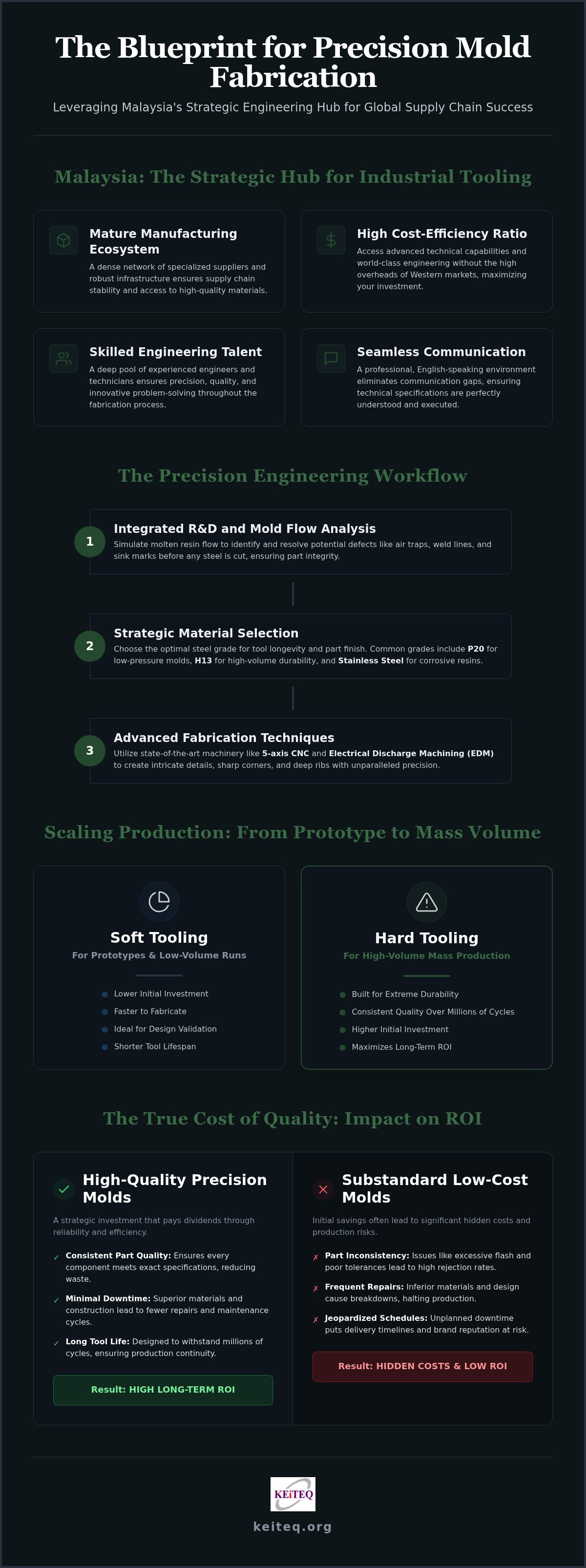
Malaysia has established itself as a top-tier destination for precision engineering due to its mature manufacturing ecosystem. The region's infrastructure supports a dense network of skilled engineers and specialized material suppliers, providing a strategic hub for global supply chain stability. Businesses benefit from a high cost-efficiency ratio, gaining access to advanced technical capabilities without the overhead typical of Western markets. The English-speaking professional environment is another critical advantage, as it facilitates seamless technical communication between design teams and the factory floor. This clarity is essential for executing the technical nuances of the injection moulding process across complex product assemblies.
The Impact of Mold Quality on Long-Term ROI
Investment in precision tooling is a strategic decision that dictates the total cost of ownership for a product. While lower-cost alternatives might seem attractive during the procurement phase, they often result in significant hidden expenses. Substandard molds frequently suffer from issues like excessive flash, part inconsistency, and frequent downtime for repairs. These failures don't just increase maintenance costs; they jeopardize delivery schedules and brand reputation. Conversely, a high-quality mold built with superior materials and precise tolerances ensures consistent part quality over millions of cycles. Mold ROI is the balance between tooling longevity and cycle time efficiency.
Precision Engineering: Plastic Injection Mold Design and Fabrication
Industrial-scale manufacturing requires more than basic tooling; it demands high-precision engineering that accounts for the complex physics of polymer behavior. Professional custom mold fabrication Malaysia providers utilize mold flow analysis to simulate how molten resin fills the cavity. This simulation identifies potential air traps, weld lines, and sink marks before any steel is cut. By resolving these issues during the design phase, engineers ensure the physical tool performs reliably under high-pressure conditions, maintaining part integrity across thousands of cycles.
Choosing the right steel grade is vital for tool longevity and part finish. P20 steel is typically used for large, low-pressure molds, while H13 is the industry standard for high-volume runs due to its excellent heat resistance and durability. Stainless steel options are essential for corrosive resins or applications requiring a high-gloss finish. The Malaysian Investment Development Authority supports this sector's growth, ensuring that local facilities have access to global material standards and advanced machinery. For specific regional expertise, reviewing plastic injection mold Malaysia capabilities provides a benchmark for industrial standards.
The Mold Design Workflow
The transition from a 3D product design to tool path generation is a methodical process. Engineers must account for material shrinkage and draft angles to ensure easy part ejection without surface damage. A critical component of this workflow is the strategic placement of cooling channels. Efficient cooling reduces cycle times and prevents part warp, directly impacting the final production cost. This level of technical oversight is why an integrated product R&D and manufacturing approach is superior to siloed procurement. It prevents the common design-to-tooling errors that often plague less experienced shops.
Advanced Fabrication Techniques
Fabricating intricate mold details requires advanced machinery like 5-axis CNC machining and Electrical Discharge Machining (EDM). EDM is particularly effective for creating sharp corners or deep, narrow ribs that traditional cutters can't reach. Industrial-grade plastic components often require tolerances as tight as +/- 0.05mm. Achieving this consistency across high-volume runs requires a deep understanding of thermal dynamics and material science. There's also a significant synergy found when working with a plastic and metal component manufacturer. Managing both materials under one roof ensures that secondary assemblies fit perfectly every time. If you're planning a complex industrial project, you can contact our engineering team for a technical review of your requirements.
From Prototyping to Mass Production: Scaling Your Tooling
Scaling a product from an initial concept to a global market presence requires a disciplined approach to tooling strategy. The transition from prototyping to full-scale production is a critical juncture where engineering decisions directly impact long-term profitability. In the context of custom mold fabrication Malaysia, this process begins with validating the design through functional prototypes. Organizations like the Federation of Malaysian Manufacturers emphasize the importance of this stage to ensure regional competitiveness and manufacturing excellence. By testing the design in a controlled environment, you can confirm part geometry and material performance before committing to expensive production steel.
The decision to move from a single-cavity prototype tool to a multi-cavity production mold depends on two factors: design stability and projected volume. If the design is still subject to revision, hard tooling represents a premature financial risk. However, once the assembly is finalized and demand forecasts exceed 50,000 units, the shift to high-cavity molds becomes essential to drive down per-unit costs. This transition requires a partner who understands how to translate prototype data into a robust, high-volume production environment.
Soft Tooling for R&D and Low-Volume Runs
Soft tooling, often constructed from high-grade aluminum or pre-hardened steel, serves as the bridge between design and mass production. These tools offer significantly shorter lead times, often delivering parts within weeks rather than months. Utilizing prototype and soft tooling allows engineers to test material behavior and part functionality under real-world conditions. This stage is invaluable for identifying "molding windows," which are the specific temperature and pressure ranges required for a perfect part. The data gathered here informs the final design of the mass production tool, ensuring that the more expensive hard steel mold is optimized from day one.
Hard Tooling for High-Volume OEM Success
For production runs intended to exceed 100,000 cycles, hard tooling is mandatory. These molds are typically fabricated from hardened tool steels like H13 or S7, which are capable of withstanding the extreme thermal and mechanical stresses of continuous operation. Success in high-volume manufacturing isn't just about the initial build; it's about rigorous maintenance and repair strategies. Tool longevity depends on systematic cleaning, lubrication, and regular inspection of moving components like ejector pins and sliders. Professional mass production management integrates these maintenance protocols into the production schedule. This proactive approach prevents unexpected failures and ensures that custom mold fabrication Malaysia projects deliver consistent quality across the entire product lifecycle.
Selecting a Manufacturing Partner: Quality Standards and Durability
Beyond maintenance, efficient lifecycle management of industrial materials is key; for those managing specialized tooling, Carbide Kings offers a professional solution for the valuation and supply of industrial tungsten and carbide scrap materials.
A common misconception in industrial procurement is the belief that any machine shop with a CNC mill can execute complex industrial assemblies. This oversimplification often leads to project delays when the final product fails to meet functional requirements in the field. Technical directors must look beyond basic machining to find a partner capable of managing custom mold fabrication Malaysia within a holistic manufacturing framework. A vendor's ability to handle high-precision tooling alongside electronic manufacturing services in Malaysia indicates the level of sophistication necessary for modern hardware. Experience in outdoor payment terminal assembly serves as a critical litmus test for quality; these devices require perfect mechanical alignment to protect sensitive electronics from environmental ingress.
Material and Finishing Compliance
Hardware destined for public or industrial spaces demands rigorous material selection to ensure long-term durability. UV resistance and robust environmental sealing are non-negotiable for outdoor components that face constant exposure to sunlight and moisture. Secondary processes like powder, ceramic, and enamel coatings add significant value by providing a barrier against corrosion and physical wear. Enamel coatings are particularly effective for high-touch surfaces, offering a glass-like finish that resists chemicals and scratching. While industrial applications prioritize protection, these same finishing standards often translate to the world of high-end craftsmanship; for a look at how precision meets aesthetic beauty, you can visit KaMila Fine Jewellery to explore their handcrafted collections. Industrial finishing must meet international durability standards like IP65 or higher. Selecting a partner with in-house finishing capabilities ensures that custom mold fabrication Malaysia projects maintain consistency from the mold cavity to the final protective layer.
Reliability in mass production is built on empirical data and strict inspection gates. Coordinate Measuring Machines (CMM) are essential for mold verification, allowing engineers to confirm that tool dimensions match 3D CAD models within microns. This precision is vital when the molded part must interface with metal components or electronic housing. First Article Inspection (FAI) acts as the final gatekeeper before full-scale production, ensuring that the first parts off the line meet all structural and aesthetic benchmarks. There is a distinct strategic advantage in working with a metal stamping manufacturer who understands multi-material assemblies. This synergy prevents the fitment issues that typically occur when plastic and metal parts are sourced from separate, disconnected vendors. To ensure your project meets these industrial benchmarks, you can Request for Quotation for a detailed technical assessment.
Keiteq’s Integrated Approach to Custom Mold Fabrication in Malaysia
Keiteq Co Ltd serves as a Global Facilitator for international OEMs, providing high-precision execution through its Malaysian facility. By integrating R&D, design, and custom mold fabrication Malaysia into a single procedural flow, the brand eliminates the traditional silos that cause production delays. This holistic methodology ensures that the strategic intent of the product design is maintained from the initial CAD model to the final mass-produced part. By housing engineering expertise alongside production capacity, Keiteq provides a steady and reassuring presence for technical directors who require stability and logistical competence.
End-to-End Solutions for Industrial OEMs
Industrial OEMs require stability within their global supply chains to mitigate risks and maintain quality. Keiteq manages the entire lifecycle of a project, acting as a single point of contact for complex hardware requirements. This centralized management reduces administrative overhead and minimizes the technical risks associated with multi-vendor procurement. The facility’s specialized assembly capabilities for petrol and gas station outdoor payment terminals demonstrate a deep understanding of complex mechanical and electronic integration. These projects require high-performance finishing and precise component fitment, all of which are managed through Keiteq’s plastic injection molding services in Malaysia. This end-to-end oversight ensures that every component, from the internal frame to the specialized coating, meets the exact requirements of the outdoor environment.
Your Partner for Precision in Malaysia
Success in precision manufacturing is built on functional trust and procedural accuracy. Keiteq’s approach prioritizes reliability, ensuring that every tool is built to withstand the rigorous demands of the factory floor. Technical directors can rely on a partner that understands the nuances of international production standards and local execution. This steady, disciplined presence makes Keiteq a safe pair of hands for any custom mold fabrication Malaysia project. Whether you're transitioning from a prototype or scaling for a global rollout, the synergy between mold design and final assembly ensures a seamless production path. We invite technical directors to collaborate on their next complex hardware project, leveraging our regional expertise to achieve consistent, industrial-grade results.
Strategic Manufacturing for Global Markets
Strategic manufacturing requires more than just procurement; it demands a disciplined alignment between engineering design and factory execution. By integrating R&D with precision tooling, you eliminate the communication gaps that lead to inconsistent quality and unexpected failures. Malaysia serves as a dependable pillar in the global supply chain, offering the technical maturity and logistical stability required for complex hardware projects.
Successful custom mold fabrication Malaysia depends on selecting a partner with proven expertise in multi-material assemblies and high-performance finishing. Keiteq provides specialized capabilities in outdoor payment terminal assembly and integrated design, ensuring your product withstands harsh environments through advanced industrial coatings. This holistic approach secures your transition from prototype to mass production while maintaining strict compliance with international standards. Our team is ready to help you navigate the intricacies of industrial-scale production.
For professional services within the Malaysian market, please Request for Quotation or submit a Request to contact us for further details. We look forward to supporting your next industrial project with precision and reliability.
Frequently Asked Questions
What are the typical lead times for custom mold fabrication in Malaysia?
Lead times for building a custom injection mold in Malaysia typically range from 4 to 14 weeks. This timeframe is influenced by the complexity of the design and the required tool steel grade. Simple prototype tools are completed more quickly, while multi-cavity production molds require extensive machining and verification. Keiteq optimizes this schedule by finalizing design specifications during the R&D phase to prevent mid-fabrication delays.
How does Keiteq ensure the durability of molds for high-volume production?
We ensure durability by utilizing high-grade hardened steels like H13 and implementing rigorous maintenance protocols. For high-volume production, tool longevity is achieved through systematic cleaning and regular inspection of moving components. Our integrated approach to custom mold fabrication Malaysia means we design the tool for the specific thermal stresses of your production cycle. This proactive strategy prevents premature wear and ensures part consistency across millions of cycles.
Can you handle both plastic injection molding and metal stamping in-house?
Yes, Keiteq manages both plastic injection molding and metal stamping within our integrated manufacturing framework. This dual capability allows for the seamless assembly of multi-material products, such as outdoor payment terminals. By handling both processes, we eliminate the fitment issues that often occur when sourcing components from separate vendors. This holistic oversight ensures that plastic housings and metal internal frames align perfectly during the final assembly phase.
What materials are best suited for outdoor electronic enclosures?
High-performance engineering plastics with UV stabilizers are best for outdoor electronic enclosures. These materials resist degradation from sunlight and extreme temperatures. To further enhance durability, we apply specialized coatings such as enamel, ceramic, or powder coating. These surface treatments provide a robust barrier against corrosion and moisture. It's essential for these materials to meet industrial standards like IP65 to ensure long-term reliability in harsh environments.
Do you provide soft tooling services for initial product prototyping?
We provide soft tooling services specifically for initial product prototyping and low-volume market testing. These aluminum or soft steel molds allow technical directors to validate part geometry and material behavior without the high cost of hardened production steel. Data gathered during the soft tooling phase informs the final design of the mass production mold. This strategy reduces technical risk and accelerates your transition to full-scale manufacturing.
How do you manage quality control for intricate industrial components?
Quality control for intricate industrial components involves the use of Coordinate Measuring Machines (CMM) and First Article Inspection (FAI). CMM verification ensures that the mold dimensions match the CAD model within precise tolerances. FAI serves as a final gatekeeper to approve the structural and aesthetic quality of the parts before mass production begins. These protocols provide the empirical data necessary to maintain consistency across complex hardware projects.
What is the process for requesting a quotation for Malaysian manufacturing services?
The process begins with a technical review of your design files and production requirements. For professional services within the Malaysian market, please submit a Request for Quotation through our contact portal. Alternatively, you may submit a Request to contact us for further details to speak directly with our engineering team. We provide detailed technical briefings to align our fabrication capabilities with your specific mass production goals.
How does Malaysia compare to China for custom mold fabrication in 2026?
Malaysia has become a strategic alternative to China due to the "China Plus One" strategy and a mature engineering ecosystem. In 2026, Malaysia offers significant advantages including 100% foreign equity in manufacturing and an English-speaking professional environment. The Malaysian Investment Development Authority also provides a streamlined incentive framework for international firms. These factors, combined with high technical proficiency, make custom mold fabrication Malaysia a stable choice for global supply chains.


Comments