
DFM in Plastic Injection Molding: A Guide for OEMs
Updated: Aug 31
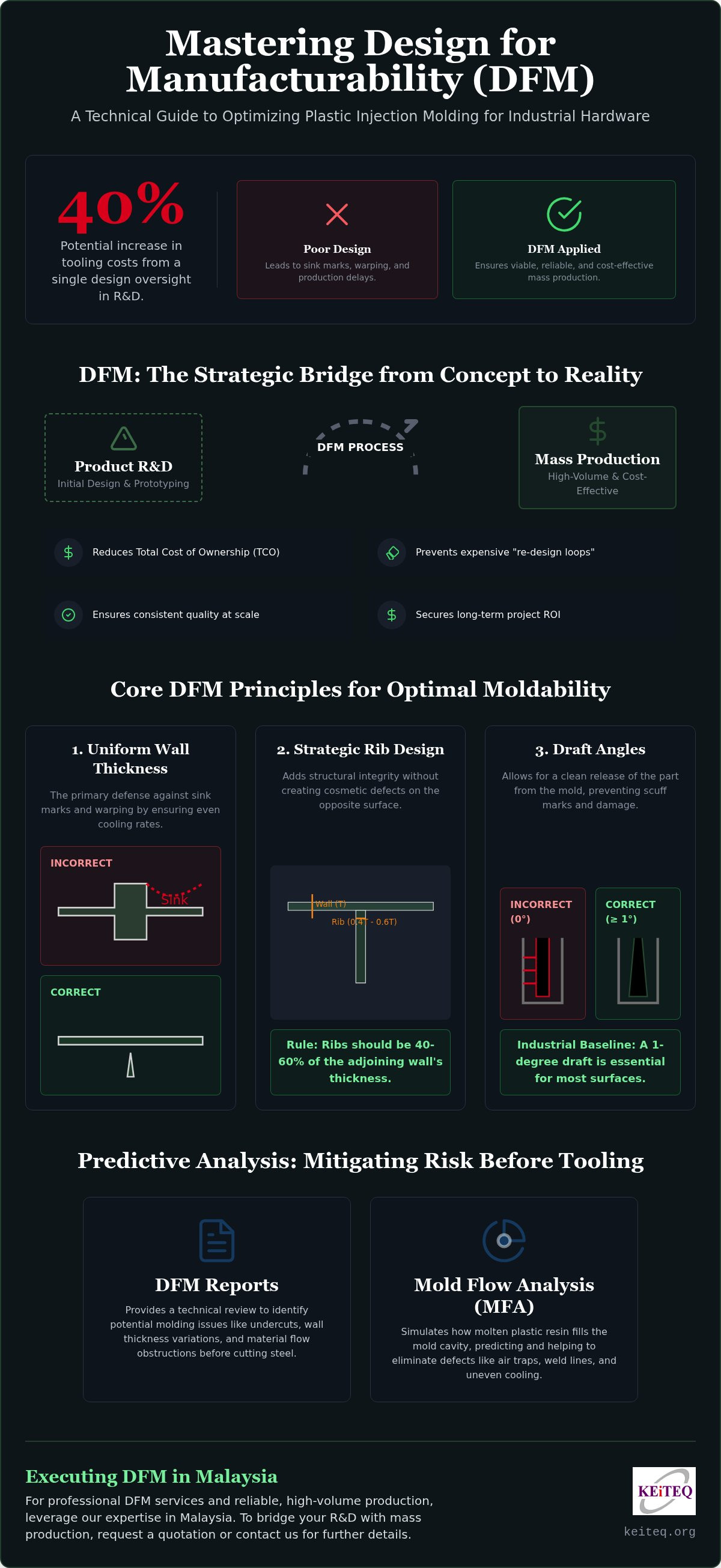
A single design oversight in the R&D phase can inflate tooling costs by as much as 40 percent before the first part even leaves the mold. For original equipment manufacturers, the gap between a successful prototype and a viable mass-produced component is often wider than anticipated. You understand that unexpected delays and part defects, such as sink marks or warping, don't just hurt your budget; they compromise your reputation for reliability in a competitive global supply chain.
Effective design for manufacturability plastic injection molding serves as the strategic bridge that aligns your engineering intent with the practical realities of the factory floor. It's the difference between a project that stalls in soft tooling and one that transitions seamlessly to high-volume output. This guide provides a technical briefing on DFM principles designed to reduce production costs and eliminate common manufacturing bottlenecks. We'll explore how to optimize part geometry, wall thickness, and material selection to ensure your industrial assemblies meet the highest standards of precision and durability. By mastering these variables, you can secure a faster time-to-market and establish a more resilient production lifecycle.
Table of Contents
Understanding Design for Manufacturability (DFM) in the Plastic Injection Molding Lifecycle
DFM is the proactive engineering discipline of optimizing part designs for efficient, high-volume production. It's a critical bridge between initial Product R&D and Mass Production Management. While many engineers focus solely on "design for function," this approach often ignores the physical constraints of the factory floor. A part that performs perfectly in a CAD simulation might still fail during physical ejection or suffer from cooling inconsistencies that lead to structural weakness.
Comprehensive design for manufacturability plastic injection molding ensures that every feature is optimized for the molding process itself. This reduces the Total Cost of Ownership (TCO) for OEMs by identifying potential failures before expensive steel is cut. When you align engineering intent with manufacturing reality, you secure the ROI of the entire project. It's about creating a design that's not just functional, but repeatedly producible at scale with zero compromise on quality. This level of precision is essential for innovative hardware brands like Timeqube, whose visual timers rely on high-quality plastic components to function effectively in professional environments.
Why DFM is the Foundation of Industrial Hardware
The most significant risk in hardware development is the "re-design loop." This occurs when a design is finalized and tooling is commissioned, only for the manufacturer to discover the part can't be produced reliably. Fixing these errors after tooling has been cut is exponentially more expensive than addressing them during the design phase. Proper design for manufacturability plastic injection molding ensures that high-volume production runs maintain tight tolerances across thousands of cycles. DFM is a strategic alignment between engineering intent and factory floor capability.
The Economic Impact of Proper Mold Design
Optimizing a design for the mold directly impacts the bottom line through reduced cycle times and minimized material waste. Even a two-second reduction in cycle time can lead to massive cost savings over a production run of 100,000 units. Similarly, proper mold design influences the longevity of the tool. A well-designed part places less stress on the mold, reducing maintenance requirements and extending the tool's service life. This level of technical foresight is essential for Integrated Product R&D and Manufacturing. It ensures that the transition from prototype to mass production is a controlled, predictable process rather than a series of expensive corrections.
Essential Design Guidelines for Optimal Plastic Part Moldability
High-performance engineering requires strict adherence to geometric constraints. In design for manufacturability plastic injection molding, the physical behavior of molten resin dictates the success of the component. Adhering to technical guidelines during the R&D phase ensures that parts remain dimensionally stable and aesthetically consistent throughout high-volume production cycles.
Maintaining uniform wall thickness is the primary defense against sink marks and warping. Variations in thickness cause uneven cooling rates. This leads to internal stresses that can compromise the structural integrity of industrial assemblies. When designers implement strategic radii and fillets, they improve material flow and reduce stress concentrators, ensuring the part can withstand the rigors of its intended application.
Wall Thickness and Rib Design Strategies
Effective rib design follows a specific ratio. Ribs should typically be 40% to 60% of the thickness of the adjoining wall to prevent sink marks on the visible surface. When managing wall transitions in complex geometries, use gradual tapers rather than abrupt steps to maintain flow consistency. If your final component requires high-performance coatings like ceramic or powder coating, ensure the geometry allows for uniform coverage without pooling in deep recesses. If you're refining a complex assembly for mass production, you can contact our engineering team for a technical review of your part geometry.
Draft Angles and Surface Finish Requirements
Draft angles are essential for the clean release of the part from the mold cavity. Without sufficient draft, the part may drag against the mold walls, causing scuff marks or damaging the surface finish. A 1-degree draft is the industrial baseline, but textured parts require significantly more. High-texture finishes often necessitate 3 to 5 degrees of draft to prevent dragging during ejection. Proper draft also allows for more strategic placement of ejector pins. This ensures that ejection forces are distributed evenly without marring critical functional surfaces or causing part deformation.
Rib-to-Wall Ratio: Keep ribs at 40-60% of the base wall thickness to avoid aesthetic defects.
Radii Implementation: Use a minimum radius of 0.5mm to reduce stress and improve resin flow.
Boss Design: Ensure bosses are supported by ribs if they are tall to prevent bending during assembly.
The Strategic Value of DFM Reports and Mold Flow Analysis (MFA)
A professional DFM report is more than a technical summary; it's a critical risk mitigation tool for procurement and technical directors. It provides a definitive roadmap for gate locations, parting lines, and ejector layouts before any capital is committed to steel tooling. For complex industrial hardware, this document serves as the final validation of the design for manufacturability plastic injection molding strategy. It ensures that every stakeholder understands how the part will be formed, where aesthetic blemishes like knit lines might appear, and how the tool will function at scale. Without this report, OEMs risk expensive tool modifications that can delay market entry by months.
Visualizing the Injection Process through MFA
Mold Flow Analysis (MFA) allows engineers to simulate the filling, packing, and cooling phases of the injection cycle with high precision. This simulation identifies potential air traps, weld lines, and significant pressure drops that could lead to structural failures in the field. By visualizing these variables, engineers pinpoint "hot spots" that cause dimensional instability or excessive internal stresses. This predictive capability is a core component of our Plastic Injection Molding Services in Malaysia. It allows for adjustments in gate size or wall thickness before the design is finalized, ensuring a stable process window for mass production.
Gate and Ejector Pin Optimization
Gate placement is a critical engineering decision that balances material flow with the final assembly requirements of the product. Strategic placement ensures optimal resin distribution while minimizing gate vestige on visible or functional surfaces. Simultaneously, the layout of ejector pins must be meticulously balanced to prevent part deformation during the cooling and ejection stages. If ejection force is applied unevenly, even a well-molded part can warp or crack upon release. DFM reports provide the technical certainty needed to align manufacturing capabilities with the product's functional needs.
The integration of Design, Development, and Delivery (D3) streamlines the entire approval process by removing technical silos. By consolidating these phases into a single workflow, OEMs can move from R&D to mass production management without the friction of managing disparate vendors. This holistic approach ensures that the insights gained during MFA are directly applied to the final production environment. It results in a more reliable supply chain and a significant reduction in the total cost of ownership for complex industrial assemblies.
Advanced DFM Considerations for Complex Industrial Assemblies
Industrial hardware often requires features that standard molding cannot accommodate without mechanical complexity. design for manufacturability plastic injection molding at this level involves managing undercuts through the strategic use of sliders, lifters, and collapsible cores. These mechanisms allow for the creation of holes, slots, or threads that are not parallel to the pull direction of the mold. While these features increase initial tooling investment, they are essential for creating cohesive, single-piece enclosures that maintain structural integrity. By addressing these mechanical requirements during the design phase, you ensure that complex geometries are repeatable across high-volume production runs. This level of technical rigor is also critical for medical-grade assemblies; for specialized healthcare components, check out GetMedicalDevice for cardiac rhythm management products.
Engineering for Outdoor Payment Terminals
Outdoor hardware, such as payment terminals for petrol stations, demands a higher level of technical scrutiny. Enclosures must achieve specific IP ratings to protect sensitive electronics from moisture, dust, and fuel vapors. This requires a precise integration of plastic molding with metal stamping and diecasting components to ensure environmental sealing. Effective Outdoor Payment Terminal Assembly relies on DFM to ensure that mating surfaces between disparate materials are perfectly aligned. Reducing component count through Design for Assembly (DFA) further minimizes potential leak points and simplifies the final mass production process. If you are developing high-stakes industrial hardware, you can Request for Quotation to begin your technical design review.
Material Synergy and Overmolding Techniques
Harsh environments demand materials that offer UV resistance and thermal stability to prevent degradation over time. Material selection in DFM is the primary determinant of a part's physical durability and outdoor longevity. For manufacturers focusing on sustainability, utilizing high-quality circular polymers from Healix can help meet environmental goals while ensuring the material's mechanical properties align with production requirements. Overmolding is a key technique used to integrate soft-touch gaskets or ergonomic grips directly onto a rigid thermoplastic substrate. This process eliminates the need for secondary adhesive operations and creates a superior bond. However, engineers must ensure chemical compatibility between the different resins to prevent delamination during the cooling phase. By addressing these material synergies during the R&D phase, OEMs can avoid catastrophic field failures and reduce long-term maintenance costs.
IP-Rated Sealing: Design mating surfaces with grooves for overmolded gaskets to ensure environmental protection.
Slider Integration: Use sliders for lateral features to avoid complex secondary machining operations.
UV Stability: Select resins with built-in UV stabilizers for hardware exposed to direct sunlight.
Component Consolidation: Use DFA principles to combine multiple parts into a single molded component where possible.
Executing DFM in Malaysia: Bridging R&D and Mass Production
Malaysia has emerged as a primary destination for OEMs seeking stability and technical precision. Unlike many regional competitors, the Malaysian manufacturing sector offers a sophisticated blend of advanced infrastructure and a highly skilled engineering workforce. This environment is ideal for executing complex design for manufacturability plastic injection molding strategies that require tight coordination between the design office and the factory floor. By localizing production in this region, OEMs gain access to a "safe pair of hands" that understands both the intricacies of international compliance and the practicalities of high-volume output. Malaysia isn't merely a cost-effective choice; it's a high-precision engineering hub for global supply chains.
From Prototype to Production in Malaysia
Prototyping and soft tooling are essential for validating DFM assumptions before committing to high-volume hard tooling. In Malaysia, the availability of specialized soft tooling services allows OEMs to test functional assemblies in real-world conditions. This phase identifies any remaining geometric issues or material flow discrepancies that software simulations might've missed. As production scales, the focus shifts to maintaining strict dimensional tolerances across millions of cycles. Utilizing a Plastic Injection Mold Malaysia partner ensures that the transition from soft tooling to mass production is managed with technical discipline. This methodical approach minimizes the risk of defects and ensures that your components are ready for industrial assembly.
Managing the Global Supply Chain from a Regional Base
The strategic benefits of operating from Malaysia extend beyond the factory floor. The nation's robust logistics network and adherence to international quality standards provide a reliable foundation for global supply chains. Keiteq facilitates this transition by providing end-to-end Mass Production Management, ensuring that the initial engineering intent is preserved throughout the product lifecycle. Our facilities maintain rigorous quality control protocols to meet the demands of sectors like fuel retail and industrial hardware. This integrated approach to Electronic Manufacturing Services in Malaysia reduces the friction often associated with managing disparate vendors. It provides a holistic solution that bridges the gap between initial design and final delivery.
For OEMs seeking to stabilize their supply chain through expert manufacturing, Keiteq offers a comprehensive suite of services based in Malaysia. To discuss your project requirements or to receive a technical design review, please Request for Quotation or a Request to contact us for further details regarding our regional offerings.
Securing the ROI of Your Manufacturing Lifecycle
Mastering design for manufacturability plastic injection molding is the most effective way to eliminate production bottlenecks and reduce long term unit costs. By aligning engineering intent with factory floor realities during the R&D phase, you prevent the expensive re-design loops that stall time to market. This technical foresight ensures that complex industrial hardware, from environmental enclosures to specialized outdoor payment terminal assemblies, remains dimensionally stable and structurally sound across high volume production runs.
Success in the global supply chain requires a steady, experienced partner who can navigate the transition from soft tooling to mass production management. Keiteq provides this stability through our precision manufacturing facilities in Malaysia; we offer end to end lifecycle support and technical discipline. For professional plastic injection molding services in Malaysia, Request for Quotation or Request to contact us for further details regarding your next project. We're ready to help you build reliable, high quality components for your most demanding industrial applications.
Frequently Asked Questions
What is the difference between DFM and DFA in plastic molding?
DFM focuses on optimizing individual part geometries for the molding process to ensure they're producible without defects. DFA focuses on reducing the total component count and simplifying the assembly of the final product. While DFM ensures the moldability of a single component, DFA ensures that multiple parts fit together efficiently. This reduces labor costs and minimizes assembly errors in complex industrial hardware like outdoor payment terminals.
How much can Design for Manufacturability reduce production costs?
While exact savings depend on the project's complexity, industry professionals report that effective design for manufacturability plastic injection molding can reduce total production costs by 20% to 30%. These savings result from shorter cycle times, reduced material waste, and the elimination of secondary machining. By identifying flaws during the R&D phase, OEMs avoid the significant capital expenditure required to modify hardened steel molds after production starts.
What are the most common design defects identified in a DFM report?
DFM reports primarily identify geometric issues that lead to physical failures. Common findings include non-uniform wall thicknesses that cause sink marks or warping and insufficient draft angles that lead to part dragging during ejection. Other frequent issues involve sharp internal corners that act as stress concentrators and improper gate locations that create visible knit lines. Addressing these variables early ensures a more stable and repeatable mass production run.
When is the best time to perform Mold Flow Analysis?
Perform Mold Flow Analysis during the late stages of the design process, specifically before finalizing the mold design and cutting steel. It serves as a final validation of the part's geometry and material selection. By simulating the injection cycle early, engineers can predict how the resin will fill the cavity, identify potential air traps, and adjust cooling line layouts to ensure dimensional stability before significant capital is committed.
Can DFM help with selecting the right plastic material?
Yes, DFM is essential for aligning material properties with the physical constraints of the mold. Different resins exhibit varying shrink rates and flow characteristics. A comprehensive DFM review evaluates whether the chosen material can fill thin sections or if it requires specific draft angles to release from the tool. This process ensures the selected thermoplastic provides the necessary UV resistance and structural durability for the part's intended industrial environment. To source high-quality technical plastics and elastomers, learn more about Plastiques Elastomères.
Cooling time is directly proportional to the square of the part's wall thickness. Thicker sections take significantly longer to solidify, which increases the overall cycle time and reduces production efficiency. Non-uniform thickness also creates internal stresses as thinner sections cool faster than thicker ones, leading to warping. Maintaining a consistent wall thickness is a fundamental principle of design for manufacturability plastic injection molding to ensure predictable cooling and part quality.
Why is Malaysia a preferred location for plastic injection molding services?
Malaysia offers a strategic combination of high-precision engineering talent and advanced manufacturing infrastructure. The region is known for its strict adherence to international quality standards and robust logistics networks, making it a stable hub for global supply chains. OEMs benefit from a business environment that supports both soft tooling for prototypes and full-scale mass production. This regional expertise ensures that complex industrial components are manufactured with high reliability.
Does Keiteq provide DFM services for outdoor payment terminal components?
Keiteq provides specialized DFM services specifically tailored for outdoor payment terminal components used in petrol and gas stations. Our engineering team reviews enclosures for IP-rated environmental sealing and structural integrity. We integrate plastic molding with metal stamping and diecasting to ensure all components within the assembly function reliably in harsh outdoor environments. To discuss your project requirements, please Request for Quotation or a Request to contact us for further details regarding our regional offerings.


Comments