
Electromechanical Assembly: 2026 Strategic Guide for OEMs
Updated: Aug 16
Relying on a fragmented network of vendors for your electronic and mechanical components is no longer just a logistical headache; it's a primary driver of product failure and delayed market entry. You've likely experienced the frustration of mechanical enclosures failing in harsh outdoor environments or the ballooning costs of in-house R&D. Securing reliable electromechanical assembly services is the only way to maintain a competitive edge as we move into the 2026 production cycle.
We understand that managing separate PCB and mechanical assembly partners often leads to misaligned tolerances and communication gaps. This strategic guide provides the roadmap you need to master complex enclosure integration and specialized industrial coatings under a single roof. You'll learn how to leverage Malaysia's New Incentive Framework, implemented on March 1, 2026, and the latest IPC-A-630A standards to reduce your time-to-market. We'll examine why a consolidated manufacturing hub is the safest pair of hands for your 2026 industrial hardware requirements, ensuring your operations remain compliant with the updated ISO 9001:2026 quality standards.
Table of Contents
Defining Electromechanical Assembly Services in 2026
Electromechanical assembly services represent the physical convergence of electronic circuitry and mechanical structure. This process involves the meticulous integration of printed circuit boards, wire harnesses, and sensors into specialized housings. These housings often include precision plastic molding or diecast metal components. The discipline draws from the core principles of Electromechanics, focusing on how electrical systems interact with mechanical movement or structural protection. While simple electronics assembly focuses on the board level, integrated electromechanical solutions focus on the finished, functional device ready for field deployment.
In 2026, the industry has moved decisively beyond the traditional "build-to-print" model. Leading providers now offer comprehensive Product R&D and Manufacturing capabilities. This shift is driven by the demand for "smart" enclosures that do more than just hold components. Modern enclosures must facilitate thermal management, provide EMI shielding, and often incorporate user interfaces like touchscreens or biometric scanners. For OEMs, this means the assembly partner is no longer just a manual laborer; they're a technical consultant ensuring that the mechanical "body" protects the electronic "brain" in diverse environments. For those working with heavy-duty vehicle electronics, you can visit Mechnician to see how advanced diagnostic software integrates with these types of sophisticated hardware systems.
The Shift Toward Turnkey Box Build Solutions
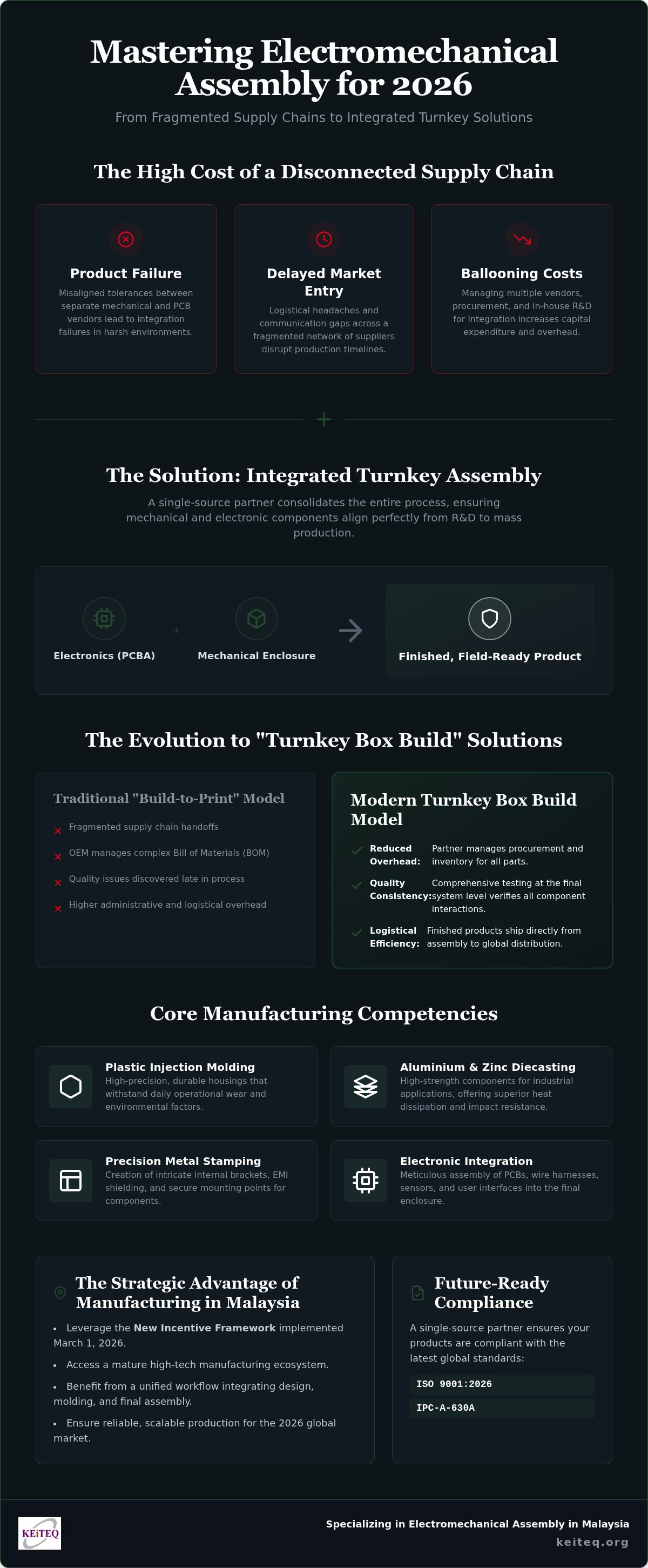
A turnkey "Box Build" encompasses the entire assembly process. It starts with the PCBA and continues through to final enclosure integration, cabling, and consumer-ready packaging. Turnkey electromechanical assembly services allow OEMs to offload the management of a complex Bill of Materials (BOM). By utilizing a single-source partner, manufacturers eliminate the logistical friction found in fragmented supply chains. This single-source accountability ensures that mechanical tolerances and electronic specifications align perfectly before the product leaves the factory floor. It's a method that prioritizes system-level reliability over component-level speed.
In specialized applications like automotive electronic control units, this reliability is further enhanced by expert software calibration; for example, StageX Performance OÜ provides professional ECU tuning services that ensure optimal performance of integrated hardware.
Reduced Overhead: Providers manage procurement and inventory for hundreds of individual parts, reducing the OEM's administrative burden.
Quality Consistency: Comprehensive testing occurs at the final system level, ensuring that the interaction between parts is verified.
Logistical Efficiency: Finished products ship directly from the assembly line to global distribution centers, bypassing multiple handling stages.
OEM vs. EMS: A Collaborative Partnership Model
Modern OEMs no longer view Electronic Manufacturing Services (EMS) as simple contractors. They function as strategic extensions of the OEM's internal production capacity. This relationship relies on shared data and transparent communication to navigate the global supply chain. Strategic EMS is a partnership model that initiates at the R&D phase to ensure manufacturability and long-term production stability. This collaborative approach is essential for maintaining compliance with the newly released ISO 9001:2026 standards and the IPC-A-630A requirements for electronic box assemblies. In regions like Malaysia, this model is supported by a mature ecosystem that integrates design, molding, and final assembly into a unified, results-oriented workflow.
The Core Components: Fusing Mechanical Precision and Electronics
Effective electromechanical assembly services require a deep integration of mechanical engineering and electronic precision. The mechanical enclosure provides the structural foundation for every device. High-precision plastic injection molding services produce durable housings that withstand daily operational wear. For heavy-duty industrial applications, aluminium and zinc diecasting provide the high-strength requirements necessary for structural integrity. These diecast components offer superior heat dissipation and impact resistance compared to standard materials. Precision metal stamping complements these structures by:
Creating intricate internal brackets for component stability.
Providing EMI shielding to isolate sensitive electronics.
Establishing secure mounting points for wire harnesses and sensors.
It's a multi-material approach that is a hallmark of sophisticated electromechanical assembly services, ensuring every component is secured against vibration and mechanical shock. This fusion ensures that delicate PCBs remain protected against mechanical stress and environmental factors throughout the product's lifecycle.
Advanced Industrial Finishing and Protective Coatings
Standard paint doesn't survive the rigors of industrial use. High-performance protective coatings for outdoor electronics are essential for longevity. Enamel and ceramic coatings provide exceptional resistance to extreme temperatures, corrosive chemicals, and prolonged UV exposure. These advanced finishes are not merely aesthetic; they're functional layers that prevent structural degradation. Powder coating remains a preferred choice for high-traffic kiosks and terminals due to its impact resistance and color stability. By integrating these coatings at the point of manufacture, OEMs can eliminate the need for secondary vendors and significantly reduce the risk of part contamination during transit. Companies looking to optimize these processes can consult with our technical team to determine the best material specifications.
Case Study: Outdoor Payment Terminal Assembly
Assembling outdoor payment terminals for petrol stations demonstrates the complexity of modern electromechanical integration. These units must maintain strict IP ratings to prevent moisture and dust ingress. Precision-engineered gaskets and interlocking enclosure designs are coupled with secure mounts for card readers, encrypted displays, and secure payment modules. The robust Manufacturing in Malaysia landscape provides the technical infrastructure to manage these complex bills of materials efficiently. Successful deployment depends on the seamless coordination of these secure modules within a ruggedized mechanical shell that can withstand 24/7 public use.
Operational success at these locations also involves managing the environmental impact of industrial activities. To address this, many site operators integrate advanced microbial products from QM Environmental International B.V. to handle wastewater and soil remediation, ensuring that the entire facility meets modern sustainability goals.
Strategic Advantages of Outsourcing Electromechanical Assembly
Outsourcing electromechanical assembly services converts fixed manufacturing costs into a scalable variable model. This strategy eliminates the need for massive capital investment in specialized factory infrastructure. OEMs don't need to purchase proprietary diecasting machinery or metal stamping presses. They utilize the provider's existing assets instead. This CapEx reduction allows companies to redirect capital toward core R&D or market expansion. It's a pragmatic approach for firms that prioritize fiscal agility over owning a physical factory floor.
Established supply chain networks significantly accelerate time-to-market. A partner with a mature procurement system manages long-lead components effectively. Moving from an initial prototype to high-volume mass production happens within a single facility. This continuity prevents the data loss and tolerance errors often seen when switching vendors between production stages. OEMs also gain immediate access to technical experts in industrial coatings and mechanical integration. These professionals provide the safe pair of hands needed for complex hardware without the cost of a permanent internal headcount.
Design for Manufacturability (DFM) and R&D Synergy
Early engineering involvement is a primary defense against production delays. Integrating electromechanical assembly services during the design phase allows for Design for Manufacturability (DFM) optimizations. Engineers analyze how mechanical enclosures interact with electronic components to identify potential assembly bottlenecks. Innovative plastic injection molding can often consolidate multiple parts into a single structural unit. This reduction in part count simplifies the final assembly and lowers the overall bill of materials. It's a proactive approach that ensures the product is optimized for the factory floor before the first tool is cut. Successful DFM prevents the "design-fail-redesign" loop that plagues uncoordinated production cycles.
Supply Chain Resiliency in a Volatile Market
Manufacturing in 2026 requires a resilient approach to component sourcing. EMS providers leverage bulk purchasing power to secure critical sensors and semiconductors. This scale provides a level of supply chain stability that individual OEMs rarely achieve alone. Full traceability is maintained throughout the production cycle, often requiring specialized network oversight; to see how managed IT services can secure such digital ecosystems, you can visit JP Technical. This is a non-negotiable requirement for industrial payment terminals and medical hardware. Integrated providers also manage complex logistics and regional warehousing. This support enables Just-in-Time (JIT) delivery schedules. It ensures that finished assemblies arrive at the distribution center exactly when they're needed, reducing the OEM's inventory carrying costs and improving cash flow.
How to Evaluate and Select an Electromechanical Partner
Selecting a partner for electromechanical assembly services requires a rigorous audit of technical capabilities and operational stability. The ideal provider must demonstrate mastery over both the "brain" (the PCBA) and the "body" (the mechanical enclosure). If a vendor lacks expertise in either area, the integration phase often suffers from tolerance mismatches and assembly delays. Verify that the partner adheres to the latest industry benchmarks. This includes the IPC-A-630A standard for electronic box assemblies and the updated ISO 9001:2026 quality management framework. Financial stability is equally critical. You need a partner capable of supporting product lifecycles that often span a decade or more. A "Safe Pair of Hands" approach ensures that your intellectual property and production schedules remain secure throughout the partnership.
In-House Manufacturing Capabilities vs. Subcontracting
Many assembly firms act as mere aggregators. They subcontract mechanical components to third parties, which leads to "margin stack-up" and inflated costs for the OEM. This fragmentation also introduces quality control risks, as the primary contractor has less oversight of the external factory floor. There is a distinct advantage in choosing a partner with an integrated metal stamping manufacturer capability in-house. Controlling the production of internal brackets, shields, and housings under one roof ensures consistent quality. It allows for immediate adjustments if mechanical tolerances need refinement during the initial production run. This vertical integration is the most effective way to maintain a lean supply chain and protect your project's bottom line.
Testing, Validation, and IP Protection
Robust testing protocols are mandatory for industrial and outdoor hardware. Your partner should provide comprehensive functional testing and Environmental Stress Screening (ESS) to simulate real-world conditions. These tests identify infant mortality failures in electronics and verify the seal integrity of the mechanical enclosure. Protecting sensitive intellectual property is also a priority during the R&D and prototyping phases. Ensure the provider has strict data silos and physical security measures in place to prevent IP leakage. Robust ERP integration is essential for managing complex electromechanical BOMs. This digital infrastructure provides full traceability from the raw material stage to the finished unit. To see how these standards are applied to your specific project, contact our technical team for a detailed consultation.
The Strategic Advantage of Manufacturing in Malaysia
Malaysia remains a dominant force in the global high-tech sector, offering a stable environment for complex production. The nation's industrial infrastructure supports a mature ecosystem for plastic injection mold Malaysia operations, allowing for the rapid scaling of mechanical components. Its strategic geographic location provides an efficient gateway to global markets, ensuring cost-effective shipping routes. Technical directors benefit from a highly skilled, English-speaking workforce deeply familiar with international quality standards. This logistical and technical foundation is essential for OEMs seeking reliable electromechanical assembly services for their global product distribution.
Regional Expertise in Industrial Hardware and Kiosks
The concentration of electronic manufacturing services in Malaysia has created a niche for high-complexity hardware. Products like petrol station kiosks and outdoor payment terminals require a level of integration that few regions can match. Manufacturers here have immediate access to advanced surface finishing and protective coating facilities. Export-oriented production is further enhanced by Free Industrial Zones (FIZ), which provide the administrative and tax frameworks necessary for global competitiveness. These zones ensure that complex assemblies move from the factory floor to the shipping port with minimal friction, supporting the Just-in-Time requirements of international OEMs.
Keiteq Co Ltd: Your Integrated Partner for Malaysia-Based Assembly
Keiteq Co Ltd integrates Western engineering design with the logistical advantages of Southeast Asian manufacturing. We provide comprehensive electromechanical assembly services that prioritize functional trust and physical durability. By maintaining all critical processes under one roof, Keiteq Co Ltd eliminates the risks associated with multi-vendor supply chains. We serve as a "Safe Pair of Hands" for OEMs distributing products from Malaysia to international markets. Every project at Keiteq Co Ltd is managed with a results-oriented approach, ensuring that your industrial hardware is built to the highest specifications. Our operations are fully aligned with the regional New Incentive Framework, positioning Keiteq Co Ltd as a stable partner for your 2026 production cycle.
Optimizing Your 2026 Production Cycle
Success in the 2026 manufacturing landscape depends on moving away from fragmented supply chains toward integrated solutions. Consolidating your electromechanical assembly services with a single provider eliminates communication gaps and ensures structural and electronic alignment. This methodology is particularly vital for specialized outdoor payment terminal assembly, where hardware must survive extreme environmental stress without failure. By centralizing these complex processes, you reduce the risk of tolerance errors and significantly shorten your time-to-market.
Keiteq Co Ltd provides the steady, expert oversight required for high-complexity industrial projects. By leveraging integrated plastic and metal manufacturing within strategic Malaysia-based operations, we offer a "Safe Pair of Hands" for global OEMs. Our team focuses on results-oriented production that meets the rigorous quality standards discussed throughout this guide. We don't just assemble parts; we manage the entire production lifecycle to ensure your product's long-term performance in the field.
For professional electromechanical assembly services in Malaysia, please Request to contact us for further details or submit a Request for Quotation. Keiteq Co Ltd is ready to support your market entry with precision and reliability.
Frequently Asked Questions
What is the difference between electromechanical assembly and simple PCB assembly?
Electromechanical assembly involves the physical integration of electronic circuit boards with mechanical housings, wire harnesses, and sensors. While simple PCB assembly stops at the board level, these services manage the entire system architecture. This ensures that the final product—whether it is an industrial terminal or a precision-engineered ergonomic desk from EKOBOR—is fully functional and ready for deployment in its intended enclosure.
Why is Design for Manufacturability (DFM) critical in electromechanical services?
DFM prevents production delays by identifying mechanical and electronic misalignments before mass production begins. It allows engineers to consolidate parts through advanced molding or stamping techniques. This proactive phase reduces the total bill of materials and ensures that the assembly process is as lean and repeatable as possible.
What are the benefits of using a single-source partner for enclosures and electronics?
A single-source partner provides total system accountability and eliminates the logistical friction of managing multiple vendors. This integration prevents the margin stack-up that occurs when subcontracting mechanical parts. OEMs benefit from tighter quality control and a more resilient supply chain, which is essential for maintaining production stability in 2026.
How does Keiteq Co Ltd ensure the durability of outdoor payment terminals?
Keiteq Co Ltd utilizes in-house aluminium diecasting and specialized gaskets to prevent moisture and dust ingress. Every terminal undergoes Environmental Stress Screening (ESS) to verify performance under extreme temperatures. These terminals are engineered to withstand the high-traffic rigors of petrol station environments while protecting sensitive payment modules.
What types of industrial coatings are best for harsh environments?
Enamel and ceramic coatings offer the highest resistance to UV exposure, chemical corrosion, and extreme heat. Powder coating is another effective option for high-traffic kiosks because of its superior impact resistance and aesthetic durability. The choice of coating depends on the specific environmental stressors the hardware will encounter during its lifecycle.
Why is Malaysia a strategic hub for electromechanical assembly in 2026?
Malaysia offers a mature manufacturing ecosystem supported by the New Incentive Framework (NIF) implemented on March 1, 2026. The region provides a skilled workforce and efficient global shipping lanes that reduce time-to-market. It's a reliable base for global OEMs seeking high-tech electromechanical assembly services within a stable regulatory environment.
How do you handle the transition from prototype to mass production?
The transition is managed through a disciplined validation phase that uses soft tooling to refine mechanical tolerances. Keeping the prototyping and mass production teams in the same facility ensures that technical data remains consistent. This continuity prevents the quality drift that often happens when a project moves between different manufacturing partners.
What quality certifications should an electromechanical assembly partner hold?
Partners should hold ISO 9001:2026 certification and adhere to the IPC-A-630A standard for electronic box assemblies. These benchmarks ensure the provider follows rigorous quality management and testing procedures. Keiteq Co Ltd maintains these standards to provide a safe pair of hands for complex industrial hardware requirements.
For professional electromechanical assembly services in Malaysia, please Request to contact us for further details or submit a Request for Quotation to discuss your 2026 production needs.


Comments