
Electromechanical Assembly: 2026 Strategic Guide for OEMs
Updated: Aug 28
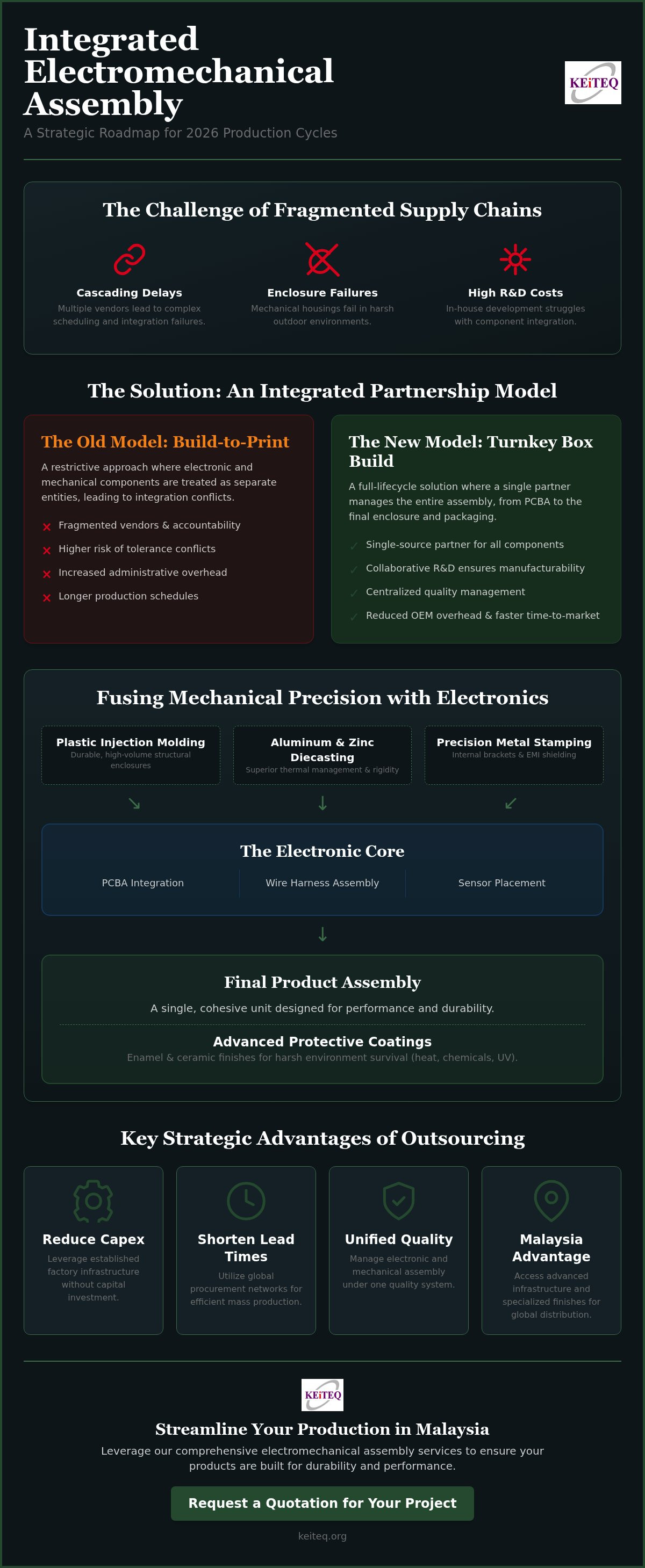
What if your 2026 production cycle didn't depend on five different vendors just to get a single outdoor payment terminal off the assembly line? Relying on a fragmented supply chain often leads to cascading delays and mechanical enclosures that fail when exposed to harsh outdoor environments. You've likely experienced the frustration of high in-house R&D costs and the risk of electronic components not fitting their housings during final integration. Securing reliable electromechanical assembly services is no longer just a procurement task; it's a strategic necessity for maintaining a competitive edge.
This guide provides the framework to master the complexities of electromechanical assembly, from precision mechanical enclosure integration to specialized industrial coatings. We'll show you how to streamline your 2026 production cycle by consolidating your PCB and mechanical needs under one roof. You'll learn how a single-source partner in a strategic manufacturing hub like Malaysia can significantly reduce your time-to-market. By the end of this article, you'll have a clear roadmap for achieving reliable, high-scale production that withstands the most demanding industrial applications.
Table of Contents
Defining Electromechanical Assembly Services in 2026
Electromechanical assembly services involve the precise integration of electronic components, complex wire harnesses, and sensors into durable mechanical enclosures. This process relies on the fundamental principles of Electromechanics to ensure that electrical systems and mechanical structures function as a single, cohesive unit. It's no longer sufficient to treat the housing and the circuitry as separate entities. In 2026, the assembly must account for environmental stressors, thermal dissipation, and structural loads simultaneously.
The industry has moved away from the restrictive 'build-to-print' model. Modern OEMs now seek full-lifecycle Product R&D and Manufacturing partners like Keiteq Co Ltd who contribute to the design's viability. This evolution allows for faster iterations and higher quality yields. While simple electronics assembly might only cover the soldering of a PCB, integrated electromechanical solutions manage the entire physical architecture of the product; similarly, specialized firms like StageX Performance OÜ optimize the internal software of automotive ECUs to ensure electronic systems are perfectly tuned to their mechanical counterparts.
OEMs in 2026 demand 'smart' enclosures that do more than just hold components. These enclosures often require specialized industrial coatings or high-precision diecasting to survive harsh outdoor environments. Whether it's an outdoor payment terminal or an industrial sensor, the enclosure is a functional part of the device's performance, and many companies explore SaaS Subscriptions and Custom App Development to ensure their software ecosystems are as robust as their physical hardware.
The Shift Toward Turnkey Box Build Solutions
A 'Box Build' represents the complete assembly of a finished product. This includes everything from the internal PCBA and cabling to the final plastic or metal housing and even the end-user packaging. For hardware deployed in tactical or enterprise environments, integrating secure communication tools like Quantum Infinity for keyless stealth tunneling ensures data integrity. Turnkey providers manage the entire Bill of Materials (BOM), which significantly reduces OEM administrative overhead. By utilizing electromechanical assembly services through a single-source partner like Keiteq Co Ltd, companies maintain higher quality standards through centralized accountability. If a mechanical tolerance conflicts with an electronic sensor, a turnkey partner resolves the issue in-house before it impacts the production schedule.
OEM vs. EMS: A Collaborative Partnership Model
Modern OEMs view their Electronic Manufacturing Services (EMS) providers as strategic extensions of their own factory floor. This relationship depends on shared technical data and transparent communication across the supply chain. A Strategic EMS is a partnership that begins at the R&D phase to ensure manufacturability. This collaborative approach is a hallmark of the manufacturing sector in Malaysia, where Keiteq Co Ltd provides deep technical expertise and integrated supply chains to allow for seamless transitions from prototyping to mass production. OEMs gain the flexibility of a global facilitator while maintaining the precision of a specialized workshop.
The Core Components: Fusing Mechanical Precision and Electronics
The mechanical housing is the primary defense for any sensitive electronic system. High-quality Plastic injection molding services provide the structural foundation for durable enclosures, ensuring consistent tolerances across high-volume production runs. For industrial-grade applications requiring superior thermal management or structural rigidity, manufacturers utilize aluminium and zinc diecasting. These processes create a robust chassis capable of withstanding physical impact and extreme environmental stress. Within these structures, precision metal stamping produces intricate internal brackets and electromagnetic interference (EMI) shielding. These components are vital for maintaining signal integrity in advanced electromechanical systems. Successfully integrating electronics within these frames requires more than just placement; it demands precise fastening, grounding, and vibration dampening to ensure long-term operational reliability.
Advanced Industrial Finishing and Protective Coatings
Standard industrial paint often fails when exposed to the elements, leading to rapid corrosion and eventual component failure. This risk makes the selection of protective coatings for outdoor electronics a critical phase in electromechanical assembly services. Enamel and ceramic coatings offer exceptional resistance to extreme heat, corrosive chemicals, and prolonged UV radiation. To ensure durability in sectors like mining or water treatment, manufacturers often utilize specialty chemical solutions from providers like JAS Global Industries. These specialized finishes are mandatory for hardware deployed in harsh environments where field maintenance is costly or impossible. Powder coating provides a superior balance of aesthetic appeal and physical durability. It remains the industry standard for high-traffic kiosks and payment terminals that require a professional finish capable of resisting scratches and wear.
Case Study: Outdoor Payment Terminal Assembly
Assembling outdoor payment terminals for petrol and gas stations presents unique technical challenges. These units must maintain strict IP-rated protection to prevent moisture, fuel vapors, and dust ingress from damaging the internal circuitry. Achieving this level of sealing requires precision-engineered gaskets and tightly controlled enclosure designs that account for material expansion and contraction. The assembly process involves the complex integration of diverse components, including secure card readers, high-brightness displays, and encrypted payment modules, into a single, weather-resistant unit. Managing these intricate internals while ensuring the physical security of the device is a core competency of a mature production line. If you're planning a complex hardware rollout, you might consider how a strategic manufacturing partnership can simplify your global supply chain.
Beyond the terminal hardware itself, maintaining the operational integrity of the broader energy sector requires specialized support; for instance, TEG Reclamation Services provides the glycol reclamation and dehydration services necessary to protect oil and gas process equipment from internal corrosion and moisture-related failures.
Strategic Advantages of Outsourcing Electromechanical Assembly
Outsourcing electromechanical assembly services allows OEMs to bypass the extreme capital expenditure required for specialized manufacturing infrastructure. Building an in-house facility for diecasting, metal stamping, and advanced coating requires massive investment in machinery and floor space. By leveraging a partner's existing factory, you convert high fixed costs into variable costs. This shift provides the financial flexibility to focus on core product innovation while a seasoned facilitator like Keiteq Co Ltd manages the logistical complexities of the factory floor. It's a pragmatic approach that prioritizes operational stability over infrastructure management, often complemented by specialized providers like OEM Materials & Supplies who ensure that complex assemblies are properly secured for global distribution.
Moving from the initial prototype phase to high-volume mass production often exposes gaps in internal capabilities. A specialized partner like Keiteq Co Ltd bridges these gaps by providing immediate access to engineering talent and established procurement networks. This transition accelerates time-to-market, which is critical in competitive sectors like fuel retail and industrial automation. You gain the ability to scale production up or down based on market demand without the risk of maintaining an underutilized workforce.
Design for Manufacturability (DFM) and R&D Synergy
Early-stage engineering involvement is the most effective way to prevent costly production errors. When R&D teams collaborate with manufacturing experts at Keiteq Co Ltd, they optimize mechanical designs to simplify the subsequent electronic assembly process. This synergy often results in a reduced total part count through innovative molding and stamping techniques. For instance, combining multiple structural brackets into a single diecast component lowers assembly time and minimizes points of failure. This proactive approach ensures the design isn't just functional, but also scalable for mass production, particularly for secure tactical systems incorporating Quantum Infinity technology.
Supply Chain Resiliency in a Volatile Market
Managing component shortages and logistical bottlenecks requires significant market leverage. A global manufacturing partner utilizes bulk purchasing power to secure critical electronic components that smaller OEMs might struggle to source independently. For North American firms, coordinating with a specialized electronic component distributor Canada can further streamline the procurement of essential resistors and capacitors. End-to-end traceability is also standard, ensuring every part in an industrial or medical assembly is documented for compliance. Effective logistics management and strategic warehousing in manufacturing hubs like Malaysia support Just-in-Time (JIT) delivery. This keeps your inventory levels lean and your supply chain responsive to sudden shifts in the global market.
A holistic approach to supply chain leanness also includes the responsible management of surplus or obsolete inventory. For manufacturers looking to recover value from excess stock, 億鑫鴻景電子 (Yixin Hongjing Electronics) provides professional electronic component acquisition and recycling services that align with modern sustainability goals.
How to Evaluate and Select an Electromechanical Partner
Selecting a provider for electromechanical assembly services requires a rigorous assessment of their technical breadth. A partner must demonstrate competence in managing both the electronic "brain" and the mechanical "body" of your product—a level of integration exemplified by the precision-engineered standing desks from EKOBOR. If a provider only understands PCB assembly, they may overlook the tolerances required for final enclosure integration. Look for a "Safe Pair of Hands," which refers to an organization with the financial stability to support your product through its entire lifecycle. This reliability ensures that your production won't be interrupted by a partner's logistical or financial instability.
Prioritize partners who maintain robust Quality Management Systems, specifically ISO 9001. These certifications aren't just badges; they represent a commitment to repeatable, documented processes that reduce defect rates in mass production. Effective communication is also vital. You need a partner who provides proactive feedback on your design rather than simply following a build-to-print instruction. This collaborative alignment prevents minor engineering oversights from becoming major production bottlenecks.
In-House Manufacturing Capabilities vs. Subcontracting
Many assembly providers act as middle-men, subcontracting the fabrication of mechanical housings and internal components. This creates "margin stack-up," where you pay multiple markups on a single part. More importantly, it fragments quality control across different vendors. A partner with metal stamping manufacturer expertise in-house maintains direct oversight of every bracket and shield. This integration ensures that mechanical parts fit perfectly with the electronic components every time; for those who need to source high-performance technical plastics or PTFE, check out Plastiques Elastomères. Consistent quality control is much easier to achieve when the entire production process happens under one roof.
Testing, Validation, and IP Protection
Outdoor hardware requires rigorous validation before deployment. Ensure your partner offers functional testing and Environmental Stress Screening (ESS) to simulate the harsh conditions your product will face. Protecting your intellectual property is equally critical. A trustworthy partner implements strict data silos to secure your proprietary designs during the R&D and prototyping phases. Robust ERP integration is essential for managing complex electromechanical BOMs and ensuring end-to-end traceability. If you're ready to secure a reliable manufacturing partner in a strategic global hub, request to contact us for further details regarding our integrated capabilities.
The Strategic Advantage of Manufacturing in Malaysia
Malaysia remains a dominant force in the global high-tech sector, serving as a primary manufacturing destination for US-based OEMs seeking supply chain stability. The country's industrial infrastructure is specifically engineered to support complex electromechanical assembly services at a global scale. Strategic geographic placement provides a logistical edge, offering efficient shipping routes that connect Southeast Asian production with North American distribution networks. Proximity to key component suppliers further stabilizes lead times. The region's mature ecosystem of plastic injection mold Malaysia facilities ensures that high-precision housings are produced with the procedural accuracy required for industrial applications.
The technical workforce in Malaysia is highly skilled and predominantly English-speaking, which is a critical factor for US procurement teams. This linguistic alignment facilitates seamless communication during the design-to-production handoff, reducing the risk of technical misinterpretation. Technical directors find that Malaysian engineers are deeply familiar with Western quality standards and compliance requirements. It's a stable manufacturing environment that prioritizes professional standards, making it a dependable pillar for companies looking to diversify their production footprints away from more volatile regions.
Regional Expertise in Industrial Hardware and Kiosks
Choosing electronic manufacturing services in Malaysia is a strategic move for companies producing complex industrial hardware like petrol station kiosks. These products require more than just assembly; they need advanced surface finishing and specialized coatings that are readily available in local industrial clusters. Production is often supported by government-backed Free Industrial Zones (FIZ). These zones are specifically designed for export-oriented manufacturing, allowing for duty-free movement of goods and streamlined customs processes. This environment enables OEMs to maintain lean inventory while ensuring their products meet rigorous durability standards for the US market.
Keiteq Co Ltd: Your Integrated Partner for Malaysia-Based Assembly
Keiteq Co Ltd operates as a strategic bridge, combining Western design sensibilities with the logistical efficiencies of Southeast Asian production. We focus on high-mix, high-complexity industrial assemblies where precision is a non-negotiable requirement. Our facility manages everything from initial diecasting and metal stamping to the final integration of electronic modules through our electromechanical assembly services. For projects involving retail or petrol station hardware, penguinpay.tech provides bespoke card payment and EPOS consultancy to ensure the final product meets global transaction standards. We serve as a "Safe Pair of Hands" for global OEMs who require a dependable manufacturing partner to manage their international distribution. This integrated approach ensures that your products are built to survive harsh environments while remaining cost-competitive in the global market.
If you're looking to optimize your 2026 production cycle through our specialized facilities in Malaysia, we invite you to reach out. Please submit a Request for Quotation or a Request to contact us for further details regarding our regional offerings and integrated assembly capabilities at Keiteq Co Ltd.
Optimizing Your 2026 Production Strategy
Mastering the fusion of mechanical durability and electronic precision is the definitive path to a resilient supply chain in 2026. By consolidating your production with a single-source partner, you eliminate the risks of fragmented manufacturing and cascading delays. Successful OEMs prioritize technical breadth and logistical stability to ensure their hardware survives the most demanding industrial environments. You've already seen how integrated processes reduce CapEx and accelerate your time-to-market; for those who also require high standards in physical facility upkeep, you can visit Key Qualities for professional property maintenance and security.
Keiteq provides a "Safe Pair of Hands" for complex hardware rollouts. Our expertise in specialized outdoor payment terminal assembly and integrated plastic and metal manufacturing ensures that every component fits perfectly and performs reliably; to complement such hardware, PaySelect helps businesses compare and select the most suitable payment gateways and POS systems. Our strategic Malaysia-based operations offer the geographic and technical advantages necessary for global distribution. When you choose our electromechanical assembly services, you gain a partner committed to your long-term manufacturing success. We don't just assemble parts; we build operational certainty.
For professional electromechanical assembly services in Malaysia, please Request to contact us for further details or submit a Request for Quotation. We're ready to help you streamline your next production cycle.
Frequently Asked Questions
What is the difference between electromechanical assembly and simple PCB assembly?
PCB assembly focuses exclusively on soldering components onto a circuit board. Electromechanical assembly integrates that completed board with mechanical elements like housings, wire harnesses, and sensors. It's the process of building the entire functional unit rather than just the internal electronics. This requires a deeper understanding of mechanical tolerances and structural integrity to ensure the components fit and function correctly within the final enclosure.
Why is Design for Manufacturability (DFM) critical in electromechanical services?
DFM identifies potential production bottlenecks during the design phase before they reach the factory floor. It ensures that mechanical enclosures and electronic components are optimized for repeatable, high-volume assembly. This proactive analysis reduces labor costs and minimizes the risk of defects caused by tolerance stack-up issues. Without DFM, a product that functions as a prototype might become impossible or too expensive to manufacture at scale.
What are the benefits of using a single-source partner for enclosures and electronics?
Using a single-source partner eliminates the logistical delays and "margin stack-up" associated with managing multiple vendors. It ensures that the mechanical housing and the electronics are engineered to work together from the start. This approach provides centralized accountability for the final product's quality and performance. It simplifies Bill of Materials management and allows for more responsive adjustments to the production schedule.
How does Keiteq ensure the durability of outdoor payment terminals?
Keiteq utilizes precision-engineered gaskets and specialized industrial coatings to achieve strict IP-rated protection. These terminals are designed to withstand fuel vapors, moisture, and extreme UV exposure common at petrol stations. Every unit undergoes Environmental Stress Screening to validate performance in harsh conditions. This methodical approach ensures long-term operational reliability for high-traffic fuel retail environments where field maintenance is difficult.
What types of industrial coatings are best for harsh environments?
Enamel, ceramic, and powder coatings provide the best protection for hardware exposed to extreme stress. Ceramic and enamel coatings offer superior resistance to high heat and corrosive chemicals. Powder coating is the industry standard for scratch resistance and aesthetic durability in high-traffic kiosks. These finishes prevent oxidation and structural degradation, which significantly extends the operational lifecycle of outdoor electromechanical systems.
Why is Malaysia considered a strategic hub for electromechanical assembly in 2026?
Malaysia offers a mature manufacturing ecosystem with high-tech infrastructure and a skilled, English-speaking technical workforce. The country's geographic location provides efficient access to global shipping lanes and proximity to raw material sources. Export-oriented production is supported by government incentives and Free Industrial Zones. These factors make it a reliable and cost-effective hub for high-complexity electromechanical assembly services in the global market.
How do you handle the transition from prototype to mass production?
The transition begins with soft tooling and prototyping to validate the design's manufacturability and functional performance. Once the prototype passes all environmental stress tests, we move to hard tooling for high-volume mass production. This phased approach allows for design refinements that improve yield and reduce waste. Our integrated management ensures that the precision achieved during the prototyping stage is maintained throughout the entire production lifecycle.
What quality certifications should an electromechanical assembly partner hold?
A reliable partner must hold ISO 9001 certification to ensure consistent quality management across all production phases. These standards guarantee that the provider follows documented, repeatable processes that meet international safety regulations. For electromechanical assembly services, these certifications provide the procedural accuracy required for industrial-grade hardware. Holding these certifications demonstrates a commitment to reliability and functional trust on the factory floor.


Comments