
Expert Kitchen Appliance Design and Prototyping Services
Updated: Sep 8
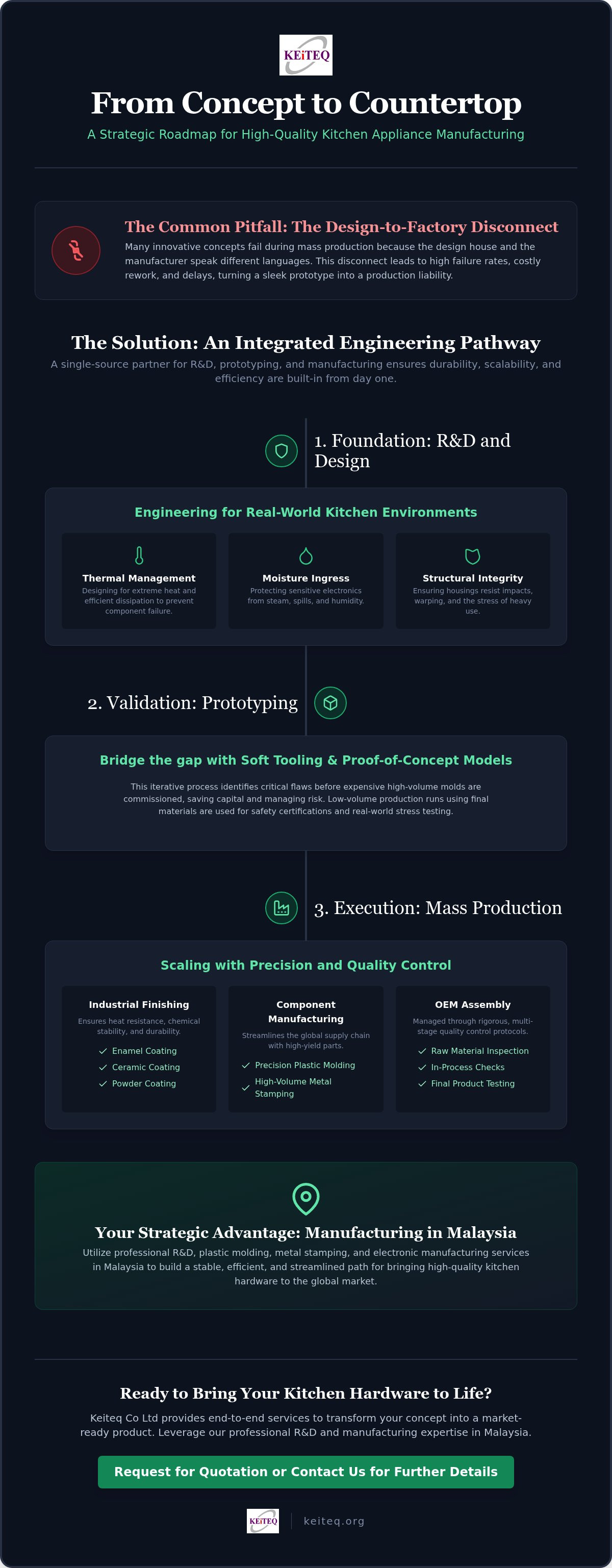
A sleek prototype means nothing if it cannot survive the rigors of the factory floor or the demands of the modern consumer. Many innovators discover too late that their design house and their manufacturer speak different languages, leading to high failure rates during the transition to mass production. Partnering with a specialized kitchen appliance design and prototyping company ensures that industrial durability and scalability are integrated into your product from day one. It's a strategic move that eliminates the friction often found in fragmented supply chains.
You've likely faced the difficulty of finding manufacturers who truly understand technical requirements like specialized enamel or ceramic coatings. This article explains how an integrated engineering partner transforms your concepts into market-ready products through rigorous testing and precision manufacturing. We'll preview a clear roadmap to mass production that utilizes single-source capabilities in molding, stamping, and assembly. You'll learn how leveraging professional R&D and manufacturing services in Malaysia provides a stable, efficient path to bringing high-quality kitchen hardware to the global market.
Table of Contents
The Strategic Role of Product R&D and Manufacturing in Kitchen Tech
Kitchen hardware requires a level of engineering precision that standard consumer electronics rarely encounter. A professional kitchen appliance design and prototyping company must account for extreme thermal management, moisture ingress, and structural integrity from the earliest conceptual stages. Integrated R&D isn't just about aesthetics. It's about aligning a product's vision with the practical realities of the factory floor. This alignment ensures that a sleek countertop device remains functional under heavy use and doesn't fail when scaled to thousands of units.
Design for Manufacturing (DfM) serves as the foundation for reducing long-term production costs. By identifying potential assembly bottlenecks during the prototyping phase, engineers simplify the bill of materials and reduce labor intensive processes. Keiteq bridges the gap between conceptual industrial design and mass production by maintaining a deep understanding of manufacturing constraints. This approach transforms a fragile prototype into a durable, market ready product that's optimized for efficiency. Success in this sector depends on a partner that treats production scalability as a primary design constraint from day one.
Industrial Design and Manufacturing Synergy
Designers must balance aesthetic appeal with the physical requirements of heat and moisture. Components like heating elements and motors generate significant internal stress that can warp poorly designed housings. Integrating internal components efficiently minimizes the device's footprint without compromising airflow or safety. Our engineering team focuses on structural optimization to ensure the chassis supports internal weight while resisting external impacts. Rigorous R&D identifies optimal part geometry to ensure maximum material yield and minimal scrap during high volume production cycles. This synergy prevents the common "design drift" that occurs when a product moves from a design house to a factory.
Navigating Regulatory and Safety Standards
Appliances must use food safe materials for any surface that contacts ingredients or steam. This requires a strict selection of polymers and coatings that don't leach chemicals at high temperatures. Compliance with international electrical safety standards is mandatory for high wattage devices to prevent fire hazards and ensure user protection. Engineering analysis, including finite element analysis and thermal simulation, ensures product longevity by predicting wear patterns before the first unit is ever built. Keiteq's expertise in electronic manufacturing services in Malaysia provides a stable framework for meeting these rigorous global standards. We provide a safe pair of hands for complex hardware that must perform reliably in demanding culinary environments.
Appliance Prototyping and Soft Tooling for Market Validation
A functional prototype is the first defense against catastrophic production failure. In the development of culinary hardware, a specialized kitchen appliance design and prototyping company utilizes proof-of-concept models to verify that theoretical engineering matches physical reality. These initial builds allow teams to test for thermal performance and mechanical durability under controlled conditions. This iterative design process identifies critical flaws in heat dissipation or component stress before expensive high-volume molds are commissioned. It's a disciplined approach to risk management that saves significant capital during the later stages of the product lifecycle.
Soft tooling serves as the essential bridge between a benchtop prototype and full-scale manufacturing. By using aluminum or pre-hardened steel molds, engineers can produce parts in the final intended material without the lead times of hardened steel tooling. This allows for low-volume production runs that are necessary for safety certifications and real-world stress testing. If you're ready to move from concept to physical reality, you can consult with our engineering team for a technical assessment of your project requirements.
The 5-Step Prototyping Process
The transition from a sketch to a working device follows a methodical sequence to ensure every technical requirement is met. This structured workflow minimizes errors and optimizes performance:
Step 1: Digital modeling and 3D simulation of appliance mechanics to predict airflow and heat distribution.
Step 2: Rapid prototyping using custom cnc cutting services or 3D printing for immediate physical evaluation of form and fit.
Step 3: Functional testing of heating elements, motor assemblies, and sensors to ensure they meet wattage and torque specifications.
Step 4: User interface and ergonomic validation to ensure the device is intuitive and safe for daily consumer use.
Step 5: Soft tooling for low-volume testing, providing parts for international certification and final market validation.
Transitioning from Prototype to Production
Once the prototype passes functional benchmarks, the focus shifts to mass production constraints. Engineers evaluate the performance of soft-tooled parts to identify where mold designs need optimization for faster cycle times or better material flow. This phase is where the expertise of a kitchen appliance design and prototyping company becomes invaluable, as they refine the geometry of internal chassis and housings for maximum durability. Utilizing Keiteq prototyping services ensures that your design is fully vetted for the production floor. Our facility in Malaysia offers integrated R&D and soft tooling capabilities that provide a clear roadmap to market-ready products, ensuring your hardware is both functional and scalable.
Industrial Finishing: Enamel, Ceramic, and Powder Coatings
Standard liquid paints often fail when exposed to the thermal cycling and chemical stressors of a modern kitchen. While many design houses focus on aesthetics, a specialized kitchen appliance design and prototyping company prioritizes functional coatings that ensure product longevity. Industrial finishes like enamel and ceramic provide a critical barrier against corrosion, food acids, and heat degradation. Without these specialized treatments, even the most advanced mechanical designs will suffer from surface failure and consumer dissatisfaction within months of use.
Enamel coating remains the gold standard for high-heat environments. Since it's essentially a glass-based finish fused to metal at temperatures exceeding 800 degrees Celsius, it offers unparalleled chemical stability and heat resistance. This makes it the ideal choice for oven interiors and cooktop components. For exterior housings and structural frames, powder coating provides a durable, chip-resistant alternative. It offers aesthetic versatility through a wide range of colors and textures while maintaining a higher level of environmental resistance than traditional wet spray methods.
Selecting the Right Coating for Your Appliance
Selecting a finish depends on the specific thermal and mechanical demands of the component. Enamel provides the highest heat resistance, often rated for temperatures up to 500 degrees Celsius. Ceramic coatings offer a middle ground, providing excellent wear resistance and thermal stability up to 450 degrees Celsius. Powder coatings are typically reserved for non-heat intensive areas where the operating temperature stays below 200 degrees Celsius. Keiteq's specialized finishing processes in Malaysia ensure that both metal and plastic components receive the exact treatment required for their specific role. This precision in selection directly impacts the product's lifecycle and the consumer's perception of quality.
Durability Testing for Surface Finishes
Surface finishes must undergo rigorous validation to ensure they survive real-world conditions. Salt spray and humidity testing are essential for appliance enclosures to prevent rust in kitchens with high moisture levels. Abrasion resistance protocols are applied to food-contact surfaces to ensure the coating doesn't degrade during cleaning or food preparation. Ceramic coating is preferred for high-end culinary gear because it provides an exceptionally hard, non-reactive surface that resists scratching and maintains its appearance under intensive daily use. Our engineering team utilizes these testing protocols to verify that every finish meets international standards for safety and durability. By integrating these industrial finishes early in the R&D phase, we ensure that the final product is as resilient as it is functional. This commitment to durability is a hallmark of industry leaders like Hopkins, whose commercial frying ranges are built to withstand the most demanding kitchen environments.
Transitioning from a validated prototype to industrial scale requires a partner that handles both high-precision polymers and structural metals. A competent kitchen appliance design and prototyping company understands that intricate housings require precise plastic injection molding to maintain aesthetic tolerances and user safety. At the same time, internal chassis components must be manufactured through metal stamping to provide the necessary rigidity for high-wattage components. Sourcing these diverse components from a single-source plastic injection molding manufacturer reduces logistical friction and ensures that the fit between plastic shells and metal frames remains consistent across thousands of units. This integration eliminates the common misalignment issues that occur when parts from different vendors reach the assembly line.
Plastic Injection Molding Services in Malaysia
Malaysia has emerged as a strategic hub for high-precision manufacturing. Procurement officers benefit from the regional expertise in technical polymers and advanced mold design found in this market. Large-scale production in Malaysia offers significant cost-efficiencies without sacrificing the tight tolerances required for modern kitchen tech. Leveraging Malaysia plastic injection molding services allows brands to tap into a mature supply chain that supports rapid scaling. This regional advantage is critical for maintaining competitive pricing in a global market while ensuring procedural accuracy on the factory floor. Our facility provides the scalability needed to move from small batches to full market distribution seamlessly.
Precision Metal Stamping and Diecasting
Kitchen appliances often require high-strength mechanical parts that can withstand constant thermal expansion and mechanical stress. Aluminium and zinc diecasting provide the durability needed for components like motor mounts, gear housings, and structural hinges. These materials offer superior heat dissipation and dimensional stability compared to polymers in high-stress zones. Integrating these diecast parts with precision metal stamping for internal chassis plates creates a robust, professional-grade assembly. This multi-material approach ensures the device remains stable during high-torque operations, such as blending or grinding. For a deeper look at strategic procurement, refer to the Keiteq metal stamping guide. Managing both metal and plastic production under one roof provides a steady, disciplined approach to complex hardware projects.
To optimize your production workflow and reduce supply chain complexity, you should request a technical consultation regarding our integrated manufacturing capabilities.
End-to-End Mass Production Management and OEM Assembly
Final assembly is where design theory meets the reality of high-volume logistics. Managing the complexity of multi-component appliances requires more than just floor space; it demands a disciplined approach to supply chain synchronization. A professional kitchen appliance design and prototyping company acts as a global facilitator, ensuring that plastic moldings, metal stampings, and electronic sub-assemblies converge without error. This turnkey approach provides a single point of accountability for global brands, reducing the risks associated with fragmented vendor networks and uncoordinated production schedules. For those looking to learn more about TFSE Products Ltd, their work in professional food display systems exemplifies the integration required for successful catering equipment.
Quality control protocols serve as the backbone of this mass production phase. It starts with raw material inspection to verify that all inputs meet chemical and structural specifications. As components move through the line, in-process testing monitors functional benchmarks like electrical continuity and thermal performance. The final product testing phase involves rigorous stress cycles to simulate years of intensive consumer use. This methodical oversight ensures that every unit leaving the facility maintains the same high standard established during the initial R&D phase. It's a steady, reliable process designed to protect your brand's reputation.
Integrating electronics and mechanical components in a single facility minimizes lead times and reduces the potential for communication gaps between engineering teams. Keiteq’s assembly facilities leverage Malaysia electronic manufacturing services to provide a strategic base for global distribution. This regional presence allows for cost-effective scaling while maintaining access to a highly skilled technical workforce familiar with international compliance standards. By centralizing the production lifecycle, we ensure that complex PCBAs are perfectly aligned with custom-molded housings and metal chassis. This logistical competence is essential for navigating the intricacies of international production.
Case Study: Outdoor and Heavy-Duty Appliance Assembly
Our expertise in high-durability hardware is reinforced by lessons learned from outdoor payment terminal assembly. These devices must survive extreme UV exposure, moisture ingress, and temperature fluctuations, much like heavy-duty kitchen appliances. Applying extreme-environment engineering to culinary gear ensures that your product can handle the intense steam and heat of a commercial or high-end residential kitchen. This "safe pair of hands" approach prioritizes functional trust over experimental claims, ensuring your hardware is built for physical durability and procedural accuracy.
If you're looking for a dependable manufacturing partner to bring your next project to life in Malaysia, please submit a Request for Quotation to start our technical review. For more information on our integrated OEM capabilities and regional offerings, feel free to Request to contact us for further details regarding your specific industrial appliance requirements.
Scaling Your Kitchen Innovation with Industrial Precision
Bringing a complex appliance to market requires a technical foundation built on industrial durability and manufacturing scalability. Integrating specialized finishing processes like enamel and ceramic coating early in the R&D phase ensures your hardware survives the rigorous demands of a modern kitchen. Transitioning through soft tooling and functional testing provides the necessary validation before you commit to high-volume production cycles. These steps are essential for ensuring long-term product reliability and consumer trust.
Partnering with a specialized kitchen appliance design and prototyping company that operates integrated facilities in Malaysia streamlines your supply chain. It reduces the logistical friction often found in fragmented production models. Our end-to-end capabilities in plastic molding, metal stamping, and OEM assembly provide a stable framework for your product's growth. We act as a safe pair of hands, managing the intricacies of mass production with procedural accuracy and discipline.
Ready to scale your product? Please submit a Request for Quotation or Request to contact us for further details regarding our Malaysia-based manufacturing services. We look forward to helping you deliver reliable, high-performance hardware to the global market.
Frequently Asked Questions
What is the typical timeline for kitchen appliance prototyping?
The timeline generally ranges from 4 to 12 weeks depending on the device's complexity. Digital modeling and 3D simulation happen first, followed by rapid prototyping using CNC machining or 3D printing. Testing for thermal performance and mechanical durability is critical for kitchen hardware. This methodical sequence ensures that flaws are identified before expensive production molds are cut. We maintain a steady pace to keep your project on schedule for market launch.
How does Keiteq ensure food-safe compliance during the design phase?
We ensure compliance by selecting certified food-safe materials and technical polymers that resist leaching at high temperatures. Our engineering team reviews material specifications during the initial R&D phase to meet international safety standards. We verify chemical stability and heat resistance through rigorous testing protocols. This attention to detail protects your brand and ensures the final appliance is safe for consumer use in demanding kitchen environments.
What are the benefits of manufacturing kitchen appliances in Malaysia?
Manufacturing in Malaysia provides access to a mature industrial hub with a skilled workforce and established logistics networks. It's a strategic choice for brands seeking cost-efficiencies without compromising on technical precision. Our kitchen appliance design and prototyping company leverages this regional expertise to offer integrated assembly and specialized finishing. Malaysia's position in the global supply chain ensures efficient distribution to international markets while maintaining high procedural standards.
Can Keiteq handle both plastic molding and metal stamping in-house?
Keiteq provides both plastic injection molding and precision metal stamping as part of our single-source manufacturing model. Most appliances require a complex mix of polymer housings and metal internal frames. By managing both processes in-house, we ensure that components fit together perfectly during final assembly. This integration reduces logistical complexity and eliminates the communication gaps that often occur when dealing with multiple specialized vendors across different regions.
What is the difference between soft tooling and hard tooling for appliances?
Soft tooling uses aluminum or pre-hardened steel to produce functional parts in the final material for testing and certification. It's an essential intermediate step for market validation. Hard tooling uses hardened steel for high-volume mass production, offering the durability needed for hundreds of thousands of cycles. We help you determine the optimal time to transition between these methods based on your production volume requirements and project timeline constraints.
Does Keiteq provide finishing services like enamel or ceramic coating?
We offer a comprehensive range of industrial finishes including enamel, ceramic, and powder coatings at our facility in Malaysia. Enamel is the gold standard for heat-intensive components, while ceramic coatings provide exceptional abrasion resistance for high-use gear. These specialized treatments are critical for preventing corrosion and surface failure in culinary settings. Integrating these finishes early in the development process ensures that your appliance remains durable and visually appealing over its entire lifecycle.
How do you manage the transition from a prototype to mass production?
We manage the transition by applying Design for Manufacturing (DfM) principles from the very first prototype. This approach identifies assembly bottlenecks and material waste issues before full-scale production begins. Once soft-tooling results are validated, we refine mold geometries for mass production efficiency. Our engineering team provides a clear roadmap to ensure that the final manufactured product performs exactly like the tested prototype, maintaining consistency across every unit produced.
Is it possible to request a contact for further details regarding OEM assembly?
You can certainly Request for Quotation or Request to contact us for further details regarding our OEM assembly services. Our technical directors are available to discuss the specifics of your project and how our Malaysia-based operations can support your goals. We provide a steady, disciplined communication flow to ensure all your engineering and logistical questions are answered. Contact us today to begin a professional partnership focused on delivering high-quality kitchen hardware.


Comments