
Industrial Component Manufacturing: A Strategic 2026 Quality Guide
Updated: Aug 8
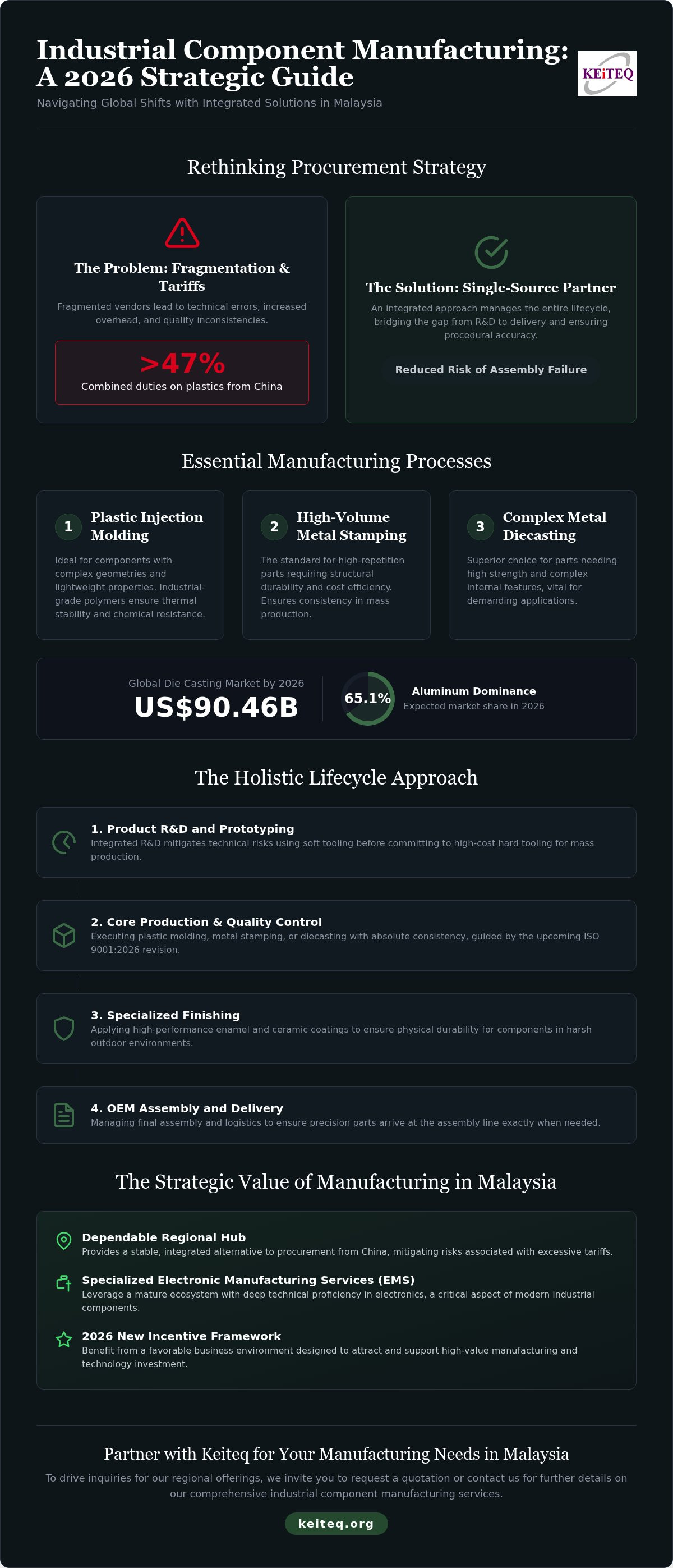
Combined duties on plastics from China can now exceed 47%, a statistic that has forced global OEMs to rethink their procurement strategies. You understand that maintaining quality consistency during mass production is a significant hurdle when design and assembly are handled by different vendors. This fragmentation often leads to technical errors and increased overhead. Success in industrial component manufacturing requires a stable, integrated approach that bridges the gap between initial R&D and final delivery. Leveraging regional expertise in Malaysia provides a strategic advantage for companies seeking technical proficiency without the burden of excessive tariffs.
This article provides a strategic guide to the manufacturing landscape of 2026, focusing on the essential processes and quality standards that define industry leaders. We'll explore the impact of the ISO 9001:2026 revision and the importance of high-performance coatings for durability in harsh environments. You'll also learn why Malaysia has emerged as a dependable pillar for electronic and plastic manufacturing under its new 2026 incentive framework. This overview clarifies how a single-source partner can manage the entire lifecycle from prototyping to mass production with total procedural accuracy.
Table of Contents
What is Industrial Component Manufacturing in 2026?
Industrial component manufacturing is the systematic production of specialized parts designed for seamless integration into larger industrial assemblies. To understand What is Manufacturing in a 2026 context, one must look at the shift toward integrated R&D and design-led models. This evolution ensures that engineering intent remains intact from the first CAD drawing to the final production run. It's no longer enough to simply follow a blueprint; manufacturers must now provide technical feedback that optimizes the part for mass production and long-term durability.
Global OEMs in aerospace, automotive, and fuel retail infrastructure now prioritize partners who offer more than just a single process. For example, fuel retail infrastructure requires rugged outdoor payment terminals that combine metal stamping, plastic molding, and specialized coatings. Single-source industrial component manufacturing has become the industry standard because it eliminates the technical drift that occurs when moving between disparate vendors. When one partner manages the full lifecycle, the risk of assembly failure is significantly reduced.
The Scope of Modern Industrial Production
Modern production goes beyond raw part fabrication. It involves the precise execution of finished component assembly where every micron matters. In high-volume OEM supply chains, the margin for error is non-existent. Reliability is built through a holistic understanding of single-source manufacturing benefits, where a single entity controls the quality of every sub-component. This control ensures that the final assembly meets rigorous durability standards, especially for equipment exposed to harsh environments. Precision is the foundation of functional trust.
Core Requirements for Industrial Partners
For 2026, logistical competence is equally vital for successful industrial component manufacturing. Partners must manage distribution while maintaining procedural accuracy, often collaborating with specialists like OEM Materials & Supplies to ensure that protective packaging solutions safeguard precision components during global transit. This includes navigating complex tariff landscapes and ensuring that specialized coatings or precision moldings arrive at the assembly line exactly when needed. Success is defined by stability and logistical competence.
Essential Processes: Plastic Molding, Metal Stamping, and Diecasting
High-volume production requires a disciplined approach to material science and mechanical engineering. The choice between plastic injection molding, metal stamping, or diecasting dictates the long-term viability and cost structure of an industrial component. Industrial component manufacturing thrives when processes are matched to the specific mechanical stresses of the final application. By 2026, the global die casting market is estimated to reach US$90.46 billion, reflecting a significant reliance on these core fabrication methods to meet global demand.
Plastic Injection Molding Services
For components requiring complex geometries and lightweight properties, plastic molding is the primary solution. Utilizing plastic injection molding services in Malaysia allows US-based OEMs to scale production while maintaining tight tolerances. Success depends on designing for moldability to reduce cycle times and material waste. Industrial-grade polymers are selected based on thermal stability and chemical resistance, ensuring parts perform reliably in demanding environments. Technical directors should consult with engineering experts to refine mold designs before committing to high-volume production cycles.
Metal Fabrication and Diecasting
Metal stamping remains the standard for high-repetition industrial parts that require structural durability and cost efficiency. However, when a component requires high strength and complex internal features, diecasting is often the superior choice. Aluminum is the dominant material in this sector, expected to account for 65.1% of the die casting market share in 2026. Choosing between these processes involves a careful analysis of structural integrity requirements versus the speed of stamping. Precision management of tolerances is critical, especially when integrating multi-material components into a single assembly.
Material selection directly impacts both tooling costs and the ability to navigate global trade barriers. With US tariffs on steel and aluminum remaining at 50% as of April 2026, sourcing and Manufacturing in Malaysia provides a strategic alternative for global supply chains. This offshore advantage allows for a more flexible production model, helping manufacturers mitigate the impact of high tariffs while maintaining the procedural accuracy required for industrial component manufacturing. A methodical transition from soft tooling to mass production ensures that material performance meets the rigors of the factory floor and the final field application.
The Foundation: Product R&D and Prototyping
Research and Development (R&D) serves as the bedrock of successful production. It is the most critical stage of industrial component manufacturing because it identifies potential failure points before they reach the factory floor. According to the official definition of the manufacturing sector, the process involves the transformation of materials into new products; a transition that requires absolute technical clarity. Without a rigorous R&D phase, OEMs often face costly revisions and production delays that could've been avoided through early stage simulation and analysis.
Design for Manufacturing (DfM) principles are essential for optimizing production speed and reducing scrap rates. These principles ensure that complex geometries are compatible with high volume processes like plastic injection molding or diecasting. A well executed DfM strategy allows for a seamless how to transition from prototype to mass production, ensuring that the final output matches the original engineering intent. Precision at this stage directly correlates with the reliability of the finished assembly.
Prototyping and Soft Tooling
Soft tooling acts as a vital bridge between conceptual design and full scale production. The primary role of soft tooling prototyping is risk mitigation. It enables engineers to test functional performance using production grade materials without the massive capital investment required for permanent hard tooling. Iterative design cycles allow for the validation of fit, form, and function. You can explore Keiteq Co Ltd's prototype development capabilities to see how functional testing accelerates market entry while maintaining strict quality standards.
R&D Integration for Complex Hardware
Managing technical documentation for precision components requires a disciplined, methodical approach. When R&D is integrated with the manufacturing partner, design intent is preserved throughout the industrial component manufacturing lifecycle. This integration prevents technical drift, where small deviations in the design phase lead to significant assembly issues later. An integrated partner provides a steady hand by overseeing the transition from soft tooling to mass production management. This holistic approach is particularly valuable for complex hardware where regional expertise ensures that every component meets global durability standards. Stability in the supply chain begins with a partner who understands the practical realities of both the laboratory and the factory floor.
Specialized Finishing and OEM Assembly Solutions
Finishing is the final layer of defense in industrial component manufacturing. While structural integrity is established during molding or stamping, the surface treatment determines how a part survives real-world exposure. For components used in fuel retail or heavy industry, standard finishes often fail to meet long-term durability requirements. High-performance coatings like enamel and ceramic provide the chemical and weather resistance necessary for decades of service. It's the difference between a part that corrodes in months and one that remains functional for years.
To ensure these systems stay operational after deployment, specialized diagnostic expertise from Mechnician is vital; for a master guide on heavy equipment diagnostic training, click here.
Beyond diagnostics, maintaining the physical integrity of heavy industrial rotating equipment is a critical part of industrial upkeep, with Kelsey Machine Services offering specialized repair and refurbishment to extend the life of critical machinery.
Delivering ready-to-use hardware for the fuel retail sector requires an integrated approach to production. Many OEMs struggle with the fragmentation between component fabrication and final assembly. By consolidating specialized finishing and assembly under a single management protocol, manufacturers ensure that every part fits and performs as intended. This reduces the risk of assembly line failures and accelerates the time-to-market for complex industrial products.
Industrial Coating and Surface Finishing
Choosing between ceramic and powder coating depends on the specific thermal and aesthetic requirements of the project. Ceramic coatings offer superior heat resistance, making them ideal for high-temperature industrial applications. Powder coating provides excellent impact resistance and a professional finish for general use. However, enamel coating remains the gold standard for superior chemical and weather resistance in outdoor environments. Adherence is only as good as the preparation. Strict surface preparation standards ensure that these coatings bond correctly to the substrate, preventing delamination and corrosion in the field.
Complex Assembly and Integration
OEM assembly represents the final stage of the production lifecycle. It involves the precise integration of electronics and mechanical parts within rugged enclosures. A prominent example is outdoor payment terminal assembly for petrol stations. These units must withstand extreme temperatures, UV exposure, and potential vandalism. Testing protocols for unattended hardware are rigorous, involving environmental stress screening and functional validation of the integrated electronics.
Managing the bill of materials (BOM) for such complex industrial component manufacturing projects requires meticulous attention to detail. Every sub-component must be verified for compliance with global standards before final integration. This methodical approach ensures that the final hardware is ready for immediate deployment. To discuss your specific project requirements and technical specifications, you can contact our technical team for a detailed consultation.
Strategic Advantages of Manufacturing in Malaysia
Malaysia has solidified its position as a critical node in the global supply chain, offering a unique blend of technical sophistication and strategic economic incentives. The New Incentive Framework (NIF), which went into effect on March 1, 2026, has redefined the landscape by prioritizing high-value technology transfer over simple capital investment. For global OEMs, this means access to a Special Tax Rate (STR) of 0 to 10 percent for up to 15 years, provided the project meets specific job creation and sustainability benchmarks. This framework makes industrial component manufacturing in the region not just a cost-saving measure, but a strategic move toward long-term operational stability and compliance with evolving global standards.
The country's reputation as a premier hub for electronic manufacturing services is built on decades of infrastructure development and a specialized workforce. This expertise extends directly into high-precision mechanical fabrication, particularly regarding plastic injection mold expertise in Malaysia. When navigating the modern contract manufacturing services landscape, technical directors must look for partners who can bridge the gap between design and high-volume output without the risk of procedural drift. The ability to combine electronic integration with rugged mechanical parts allows for the creation of sophisticated hardware in a single, controlled environment.
Regional Technical Expertise
Malaysia’s manufacturing sector is characterized by its strict adherence to international quality standards, including the latest ISO 9001:2026 and ISO 14001:2026 revisions. These facilities are specifically engineered for high-precision industrial component manufacturing, offering the technical discipline required for sectors like aerospace and automotive infrastructure. The strategic benefit of Southeast Asian production for global OEMs lies in this combination of high-tier engineering and favorable trade positioning. It allows companies to maintain healthy margins while ensuring the physical durability of every part that leaves the factory floor.
Logistics and Supply Chain Stability
Proximity to major shipping lanes and a mature network of raw material suppliers allows for a significant reduction in lead times compared to other regional hubs. Localized assembly and finishing services further streamline the supply chain, ensuring that finished hardware is ready for global distribution with minimal delay. Keiteq Co Ltd serves as the essential bridge between initial design intent and regional mass production management. By maintaining a steady presence on the factory floor and in the boardroom, Keiteq Co Ltd ensures that every component meets the rigorous standards of the global market. This logistical competence is what positions the region as a dependable pillar for complex industrial assemblies.
Securing Your 2026 Production Strategy
Successful industrial component manufacturing in 2026 requires a transition from fragmented sourcing to a unified lifecycle approach. You've seen how integrated R&D and soft tooling provide the necessary validation to prevent costly errors during mass production. By utilizing advanced industrial coating capabilities, such as enamel and ceramic finishes, you ensure your hardware withstands the most demanding outdoor environments. We've established ourselves as a reliable partner specialized in petrol and gas station outdoor payment terminals, bridging the gap between complex design and regional execution.
Our facilities in Malaysia offer the technical proficiency and logistical stability needed to optimize your global supply chain. For high-precision production and expert guidance on the ground, please Request for Quotation or send a Request to contact us for further details. We look forward to facilitating your next project with the discipline and accuracy your brand requires.
Frequently Asked Questions
What is the primary benefit of integrated R&D and manufacturing?
Integrated R&D and manufacturing eliminates technical drift and ensures design intent is preserved from prototype to final assembly. This approach allows engineers to identify production risks early, reducing the likelihood of costly revisions during the mass production phase. It creates a seamless feedback loop between designers and the factory floor, which is essential for maintaining precision in complex assemblies.
How does soft tooling differ from hard tooling in industrial production?
Soft tooling uses more flexible materials to create functional prototypes and low-volume runs for design validation. Hard tooling involves high-strength steel molds designed for high-volume mass production over hundreds of thousands of cycles. Soft tooling is a critical risk mitigation step that allows for iterative testing before you commit to the significant capital investment required for permanent production molds.
What industries benefit most from specialized enamel and ceramic coatings?
Industries operating in harsh outdoor or chemically aggressive environments, such as fuel retail and heavy infrastructure, benefit most from these coatings. Specialized enamel and ceramic treatments provide superior resistance to corrosion, UV exposure, and chemical abrasion. These finishes are critical for the longevity of hardware like outdoor payment terminals, where environmental durability directly impacts functional reliability.
Why is Malaysia considered a strategic hub for plastic injection molding?
Malaysia offers a combination of specialized technical expertise, advanced infrastructure, and competitive cost structures. The region's mature ecosystem for industrial component manufacturing is supported by the 2026 New Incentive Framework, which encourages high-value technology transfer. Access to regional experts in precision molding allows global OEMs to scale production while adhering to rigorous international quality standards.
What should I look for in an OEM assembly partner for outdoor hardware?
You should prioritize a partner with a proven track record in complex integration and environmental testing. Look for capabilities that include managing a detailed bill of materials and applying durable surface finishes like powder or ceramic coatings. A reliable partner manages the full lifecycle, ensuring that electronic components are securely integrated into rugged, weather-resistant enclosures that meet field performance requirements.
How long does the transition from prototype to mass production typically take?
The timeline for transitioning from prototype to mass production varies based on component complexity and the results of soft tooling validation. While simple parts might transition in a few weeks, complex industrial assemblies often require several months of iterative testing and mold refinement. A methodical approach ensures that all technical specifications are met before you initiate high-volume manufacturing runs.
Can Keiteq manage both metal and plastic component manufacturing simultaneously?
Yes, Keiteq specializes in both metal stamping and plastic injection molding to provide comprehensive industrial component manufacturing solutions. This dual capability allows for the production of multi-material assemblies, such as outdoor payment terminals, under a single quality management protocol. Consolidating these processes reduces logistical fragmentation and ensures that disparate components fit together with procedural accuracy.
What quality standards are typical for industrial component manufacturing in 2026?
Typical standards include the ISO 9001:2026 revision, which focuses on quality culture and risk management, and the ISO 14001:2026 environmental standard. Manufacturers must also comply with industry-specific regulations regarding material safety and physical durability. Adhering to these updated frameworks ensures that production processes are sustainable and capable of meeting the high precision requirements of global supply chains.


Comments