
Industrial Design to Production: Bridging the Gap for Scalable Hardware
The most critical failure point for any hardware project isn't the initial concept, but the transition from industrial design to production. You've likely invested significant capital into a prototype that looks perfect, yet finding a manufacturer capable of replicating that quality at scale remains a persistent challenge. High failure rates during the handoff phase often stem from a lack of integration between design intent and the practical realities of the factory floor. Precision matters, but scalability is what determines your market survival.
We understand the frustration of seeing quality degrade during high-volume runs or facing unexpected delays due to complex assembly requirements. This article provides a comprehensive roadmap for transforming conceptual designs into mass-produced physical products through rigorous DFM and prototyping. We'll explore how to reduce your time-to-market and manage reliable mass production within Malaysia's specialized manufacturing sector. By aligning your R&D with proven industrial processes, you can ensure your hardware scales efficiently without compromising on technical standards or procedural accuracy.
Table of Contents
What is Industrial Design to Production?
The transition from industrial design to production represents the critical translation of conceptual aesthetics into functional, manufacturable hardware. While many associate design strictly with visual appeal, the industrial aspect focuses on the ability to replicate that form millions of times with zero variance in quality. Understanding What is Industrial Design? requires looking beyond the sketchpad to the assembly line. This phase is where you determine your product's true return on investment. If a design isn't optimized for mass replication, your margins will erode through high scrap rates and assembly errors.
The distinction between craft design and industrial design lies in scalability. A craft approach focuses on the perfection of a single unit, while industrial design prioritizes the consistency of the entire production run. Product R&D serves as the first line of defense in this process. By validating manufacturing feasibility during the initial design stages, engineers can identify whether a specific geometry is suitable for metal stamping or if it requires complex plastic molding techniques. This early intervention ensures that the final product remains both aesthetically pleasing and economically viable.
Theoretical Design vs. Production Design
A beautiful 3D model often fails on the factory floor because it lacks consideration for physical constraints like draft angles, wall thickness, or material shrinkage. Production design requires a deep integration of mechanical engineering with industrial aesthetics. When you maintain single-source accountability through integrated product R&D and manufacturing, you eliminate the communication gaps that lead to technical failures. This approach ensures that the person designing the part understands the exact limitations of the injection molding machine or the diecasting press used in the final run. It's about building for reality, not just for a screen.
The 'Valley of Death' in Hardware Development
The transition from a working prototype to mass production is often called the 'Valley of Death' because it's where most hardware projects stall. Common bottlenecks include unverified tolerances and a lack of specialized tooling. Early-stage R&D prevents these issues by creating a roadmap for scalability before the first tool is cut. Detailed, procurement-ready documentation is essential here. Without precise technical drawings and material specifications, project timelines slip as manufacturers struggle to interpret vague design intent. Reliable documentation transforms a concept into a repeatable industrial process, moving your project safely from the lab to the market.
Design for Manufacturing (DFM): Optimising for Scale
Successful industrial design to production hinges on the rigorous application of engineering principles that prioritize scalability over theoretical perfection. Design for Manufacturing (DFM) serves as the bridge between a creative vision and a repeatable industrial process. By adhering to established Design for Manufacturing (DFM) guidelines, engineers can identify potential assembly bottlenecks before they manifest on the factory floor. The core objective is to achieve a balance between aesthetic intent and the physical limitations of high-speed production lines.
Simplification and standardization are the primary drivers of hardware ROI. Reducing part counts minimizes assembly complexity; this directly lowers the probability of human error and mechanical failure. When components are standardized, procurement becomes more efficient and lead times stabilize. Material selection also plays a decisive role, particularly when hardware must withstand environmental stressors. Choosing UV-stabilized plastics or corrosion-resistant alloys for outdoor equipment ensures long-term durability. If you are currently evaluating your part geometry for mass production, you can contact our technical team for a DFM assessment to identify cost-saving opportunities.
Prototyping and Soft Tooling Strategies
Moving directly from a digital model to permanent hard tooling is a high-risk strategy that often leads to expensive re-work. Utilizing soft tooling prototyping allows for the creation of functional parts that mimic the properties of mass-produced components. This intermediate step provides a platform for rigorous functional testing, ensuring that snaps, hinges, and enclosures perform as expected under stress. Iterative feedback from these early runs allows engineers to refine final molds, ensuring that the transition to mass production is seamless and devoid of technical surprises.
Functional Reliability in Complex Assemblies
Engineering for high-traffic environments, such as petrol station kiosks, requires a focus on extreme durability and weatherproofing. Thermal management is a critical consideration during the design phase; enclosures must dissipate heat effectively to protect internal electronics in tropical climates. Addressing these challenges early ensures compliance with international safety standards and prevents quality degradation during high-volume runs. Precision manufacturing requires a disciplined approach to tolerances, where every millimeter is accounted for to maintain the integrity of the assembly over thousands of cycles. This methodical focus on reliability is what separates a successful product launch from a costly technical failure.
Core Processes in Industrial Design to Production
Selecting the optimal manufacturing path for industrial design to production requires a methodical evaluation of part geometry and projected annual volumes. High-volume runs demand processes that offer low per-unit costs, such as metal stamping or multi-cavity injection molding. Complex geometries with varying wall thicknesses often necessitate diecasting to maintain structural integrity and dimensional stability. Managing multi-material assemblies for specialized equipment involves a deep understanding of how plastic and metal components interact under mechanical and thermal stress. This technical selection phase determines the long-term viability of your hardware project.
The synergy between materials is fundamental in industrial hardware. Metal components provide the structural skeleton and essential EMI shielding, while plastic components offer ergonomic form and weather resistance. A cost-benefit analysis often reveals that while diecasting involves higher initial tooling costs, it provides superior precision for complex, three-dimensional parts that require high strength. Metal stamping remains the preferred choice for high-speed production of flat or shallow-formed enclosures. It offers maximum material efficiency and rapid cycle times for large-scale procurement needs.
Precision Plastic Injection Molding
Durable hardware depends on precise resin selection. Engineers must choose polymers based on specific durability requirements and chemical resistance, especially for outdoor or industrial applications. Plastic injection mold design is the foundation of high-yield production; it must account for cooling cycles and gate placement to prevent warping or sink marks. Advanced multi-cavity molding techniques allow global OEMs to scale rapidly by producing multiple identical components in a single cycle. This approach significantly reduces machine time and lowers the overall cost per part.
Metal Stamping and Diecasting Solutions
Choosing between Aluminium and Zinc diecasting depends on the required strength-to-weight ratio and specific finishing needs. Aluminium offers excellent thermal conductivity and corrosion resistance, whereas Zinc allows for thinner wall sections and tighter tolerances. A specialized metal stamping manufacturer plays a vital role in enclosure fabrication. They ensure that repetitive mechanical components meet exact specifications every time. Achieving tight tolerances in complex metal geometries requires high-tonnage presses and precision-engineered dies. This hardware discipline maintains consistency across thousands of units, ensuring that final assemblies fit together perfectly without manual adjustment.
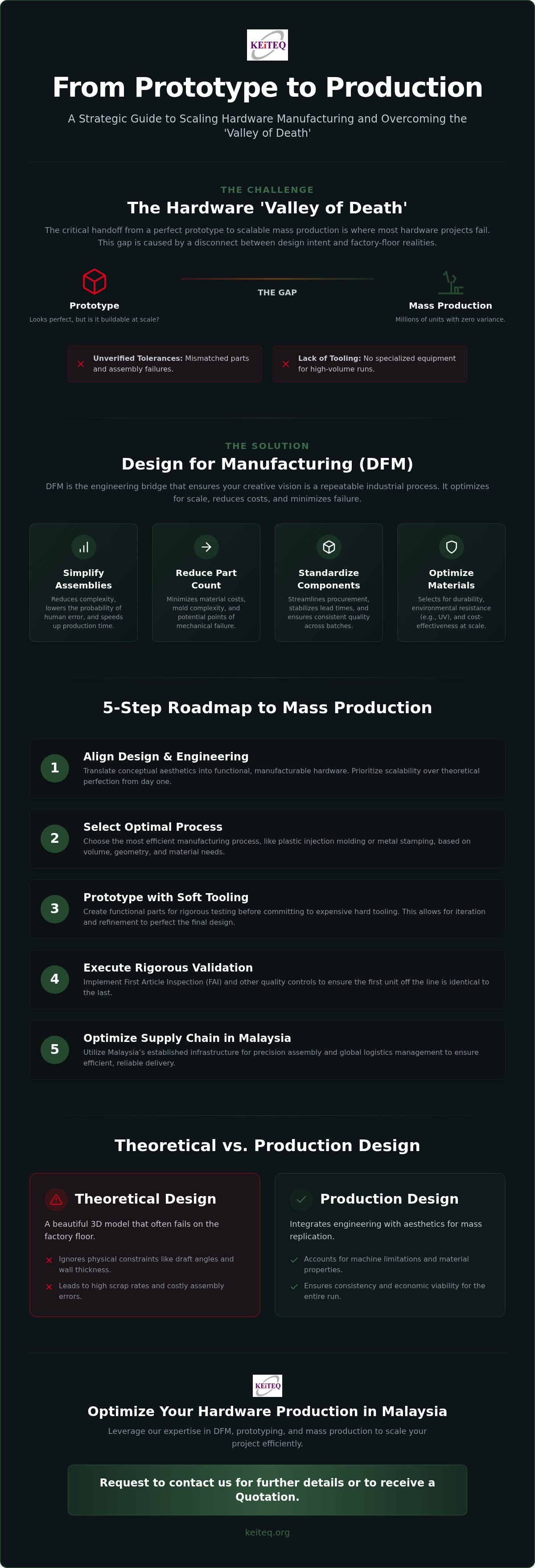
5 Steps to Manage Prototype to Mass Production
Transitioning from a validated prototype to a full production line requires a disciplined, sequential approach. This process is the core of the industrial design to production workflow. Precision is not optional; it is the baseline for scalability. For US-based hardware firms, managing this phase effectively prevents the quality degradation that often plagues high-volume runs by ensuring that every unit meets strict domestic durability expectations. By following a structured roadmap, you can stabilize your supply chain and ensure that the final hardware remains faithful to the original engineering intent.
Final Design Validation: A final audit of DFM principles ensures that the design is technically sound for high-speed assembly. It's the last chance to address potential failure points before capital is committed to permanent tooling.
Tooling Fabrication and FAI: Hard tooling is a major capital investment. First Article Inspection (FAI) provides the necessary verification that the physical output matches CAD specifications exactly.
Pilot Run: This stage tests the assembly line and verifies quality control protocols under real-world conditions. It's essential for identifying bottlenecks in the process utilities and refining machine parameters.
Mass Production Scale-up: Yield optimization is the priority. High yields directly correlate with project ROI and reduced material waste, ensuring the project remains economically viable at scale.
Post-Production Finishing: Final post-production steps define the product's longevity and brand perception. This includes advanced coatings and final stress testing to verify environmental resistance.
Industrial Surface Finishing and Coating
Protective coatings are non-negotiable for hardware exposed to harsh environments. Utilizing protective coatings for outdoor electronics ensures that your hardware resists corrosion and UV degradation. Ceramic coatings offer superior heat resistance, while enamel provides extreme durability for high-traffic surfaces. Powder coating remains a versatile solution for impact resistance. Maintaining aesthetic consistency across high-volume batches requires automated finishing lines and rigorous color-matching protocols to ensure every unit meets professional standards.
Mass Production Management and Quality Control
Implementing rigorous QC at every stage of the assembly process is the only way to maintain reliability across thousands of units. Managing global supply chain logistics from the factory floor requires a partner that understands international compliance and procurement-ready documentation. The role of OEM assembly services is critical in turnkey hardware delivery. Keiteq Co Ltd provides the expertise needed for complex assemblies, ensuring that precision components are integrated with procedural accuracy. If you're ready to move your project to the factory floor, Request for Quotation for our specialized production management to ensure a seamless transition.
Strategic Manufacturing Partnerships in Malaysia and Beyond
Selecting a strategic partner for the transition from industrial design to production is as vital as the engineering itself. For hardware firms based in the US, Malaysia has emerged as a premier global hub, particularly for plastic injection molding services. The nation's manufacturing sector demonstrated its robustness with a sales value of RM173.1 billion in early 2026, supported by a skilled workforce of 2.4 million employees. Centralized production in Southeast Asia offers significant logistical advantages, allowing for efficient global distribution and reduced lead times to North American markets. This regional expertise provides the technical infrastructure necessary to scale complex hardware without the risks associated with less established manufacturing corridors. With the government generally allowing 100% foreign equity in most manufacturing sectors, the region offers a stable environment for long-term industrial investment by international OEMs.
Specialized Hardware for Petrol and Gas Stations
Unattended payment kiosks in outdoor environments demand a specific level of engineering discipline that bridges the gap between US design standards and offshore production realities. These systems must integrate complex electronics within ruggedized metal and plastic enclosures to withstand 24/7 exposure to high humidity and varying temperatures. Keiteq Co Ltd serves as a trusted petrol station hardware OEM, specializing in the assembly of outdoor payment terminals. Our processes ensure that sensitive components remain protected from environmental stressors while maintaining high uptime for fuel retail operators. We focus on the synergy between design R&D and physical assembly to secure long-term reliability for critical infrastructure. This specialized approach addresses the common pain point of quality degradation during high-volume runs by maintaining strict adherence to technical specifications.
Global Standards with Regional Execution
Meeting US and European quality standards through Malaysia-based production is a proven strategy for global OEMs seeking to optimize their supply chains. The region's manufacturing landscape is governed by clear regulations, such as the requirement for a manufacturing license when shareholders' funds reach RM2.5 million. This institutional maturity provides a 'Safe Pair of Hands' for international contract manufacturing, whether you're a US-based startup or an established industrial firm. Keiteq Co Ltd ensures that every production run complies with international safety and durability requirements. Malaysia's New Tax Incentive Framework (NIF) further supports this by linking incentives to measurable economic outcomes, ensuring that your production partner remains committed to high-performance standards. By leveraging this regional execution, US businesses can achieve the precision required for high-stakes hardware projects while optimizing their total cost of ownership.
Ready to move your project to the next phase? Request to contact us for further details regarding our specialized manufacturing and assembly capabilities in Malaysia. For a detailed breakdown of costs and production timelines tailored to your specific hardware needs, please submit a Request for Quotation. Our technical team is prepared to facilitate your transition from design to mass production with professional certainty and logistical competence.
Scaling Your Hardware with Industrial Precision
Successfully bridging the gap from industrial design to production requires a methodical commitment to engineering discipline and logistical coordination. You've seen how integrating Design for Manufacturing (DFM) early prevents the common pitfalls of the 'Valley of Death' during scale-up. Choosing the right partner in Malaysia provides access to specialized capabilities, from precision diecasting to advanced finishing techniques that ensure long-term durability in the field.
We provide a reliable foundation for your project through ISO-compliant mass production management and specialized outdoor hardware assembly. Our advanced industrial coating facilities are equipped to handle complex finishing requirements, ensuring your components meet the highest professional standards. Ready to move your industrial design to the factory floor? Request for Quotation or Request to contact us for further details regarding our specialized manufacturing services in Malaysia. We're prepared to help you navigate the complexities of global hardware delivery with certainty and technical expertise.
Frequently Asked Questions
What is the difference between industrial design and product design?
Industrial design is a specialized discipline focused on the physical manufacturability and mass replication of hardware, serving as the technical foundation for industrial design to production. While product design is a broader term that often encompasses digital interfaces and user experience, industrial design specifically addresses the mechanical constraints of the factory floor. It ensures that a conceptual form can be produced consistently across high-volume runs without losing structural or aesthetic integrity.
How long does the transition from design to mass production typically take?
The timeline for transitioning a complex hardware project from initial concept to full-scale manufacturing generally ranges from six to twelve months. This period includes essential phases such as DFM validation, tooling fabrication, and First Article Inspection (FAI). For US-based firms, this window also accounts for the coordination of global supply chains and the implementation of rigorous quality control protocols to ensure the final output meets international safety standards.
What are the most common mistakes in Design for Manufacturing (DFM)?
The most frequent errors involve ignoring physical molding constraints, such as inadequate draft angles or inconsistent wall thicknesses that lead to sink marks. Failing to account for material shrinkage or specifying overly tight tolerances where they aren't functionally necessary can significantly increase scrap rates. Addressing these issues during the R&D phase prevents expensive re-tooling and ensures that the assembly process remains efficient and cost-effective throughout the production lifecycle.
Why should I choose Malaysia for plastic injection molding services?
Malaysia provides a highly developed manufacturing infrastructure that offers a balance of technical expertise and competitive operational costs. The region is governed by a robust regulatory framework that supports 100% foreign equity, providing a stable environment for US companies to manage their offshore production. With a deep history in precision engineering and high-volume exports, the local sector is equipped to handle complex technical requirements while maintaining strict adherence to global compliance standards.
What is the benefit of using soft tooling for prototypes?
Soft tooling serves as a critical bridge between laboratory R&D and hard-tooled mass production, allowing for the creation of functional parts in production-grade materials. This approach enables engineers to conduct real-world stress tests and verify assembly fits without the high capital commitment of permanent steel molds. It is an essential step for validating the industrial design to production workflow, as it allows for iterative refinements based on physical performance data.
How does industrial coating improve the lifespan of outdoor hardware?
Advanced coatings like ceramic, enamel, and powder coating create a durable physical and chemical barrier against environmental stressors such as UV radiation and oxidation. For hardware like outdoor payment kiosks, these finishes are essential to prevent corrosion and maintain aesthetic standards over years of unattended use. By specifying the correct coating during the design phase, manufacturers can ensure that internal electronics remain protected from moisture and thermal fluctuations.
Can Keiteq Co Ltd manage the assembly of complex payment terminals?
Keiteq Co Ltd specializes in the OEM assembly of sophisticated outdoor payment terminals, particularly for the fuel retail and gas station sectors. Our facilities are equipped to manage the integration of complex electronics within ruggedized enclosures, ensuring every unit meets rigorous durability standards. We provide end-to-end mass production management, from initial design validation to final quality control, acting as a steady partner for firms requiring precision-engineered hardware solutions.
What documentation do I need to start a Request for Quotation?
To initiate a Request for Quotation, you should provide detailed 3D CAD files (such as STEP or IGES formats) along with 2D technical drawings that specify tolerances and critical dimensions. A comprehensive Bill of Materials (BOM) and clear material specifications are also necessary to ensure an accurate assessment of production costs. Providing procurement-ready documentation allows our technical team to evaluate your project's feasibility and provide reliable lead times for your manufacturing requirements.


Comments