
Industrial Enamel Coating: 2026 OEM Technical Guide
- 1 day ago
- 11 min read
Most procurement directors view finishing as the final step in the assembly line, but treating industrial enamel coating as an afterthought is a costly strategic error. In high-stakes environments like petrol stations or chemical processing plants, a standard paint job isn't a solution; it's a liability. You likely already recognize that corrosion and thermal stress are the primary drivers of hardware failure. Standard coatings often degrade under intense UV exposure or chemical contact, leading to premature maintenance cycles and brand erosion. This guide bridges the gap between basic finishing and long-term structural durability.
You'll discover how to integrate industrial enamel coating into your 2026 production strategy to achieve a finish that lasts over 20 years. We address the technical realities of the new ISO 11997-1:2026 cyclic corrosion standards and the UNI 11358 requirements for hot water resistance. This briefing covers the critical performance differences between enamel and powder coatings, the impact of 2026 EPA VOC regulations on material selection, and the logistical advantages of partnering with Keiteq Co Ltd for end-to-end production in Malaysia. By the end of this technical guide, you'll have a clear roadmap for securing your global supply chain against environmental degradation.
Table of Contents
Understanding Industrial Enamel Coating: Durability for Harsh Environments
The Vitreous Enamelling Process: From R&D to Mass Production
Enamel vs. Alternative Industrial Coatings: A Strategic Comparison
Engineering Design Requirements for Successful Enamel Application
Keiteq’s Industrial Coating and Manufacturing Services in Malaysia
Understanding Industrial Enamel Coating: Durability for Harsh Environments
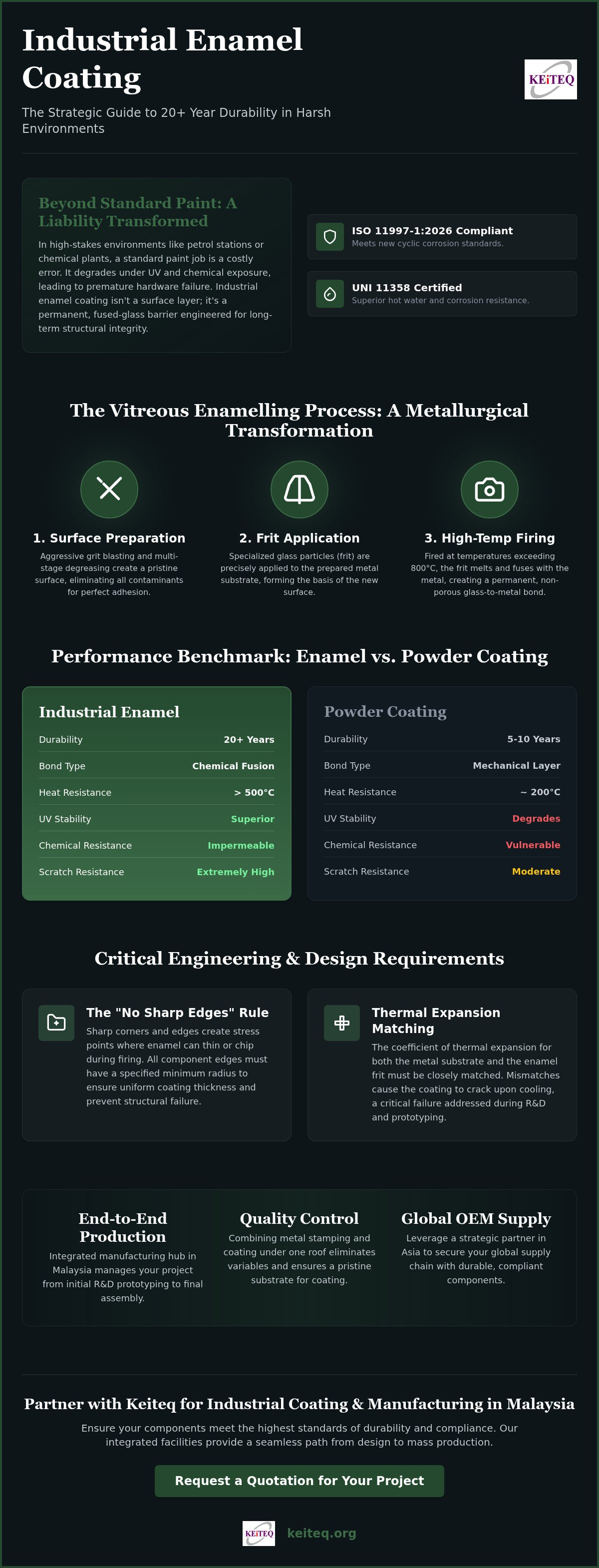
Industrial enamel coating represents a sophisticated glass-to-metal fusion that transcends the capabilities of traditional organic paints. Unlike standard coatings that sit on the surface, this process creates a permanent chemical bond between the substrate and the finish. As we move into 2026, global industrial standards like the new ISO 11997-1:2026 prioritize cyclic corrosion resistance and long-term structural integrity. OEMs now require finishes that don't just look good but survive decades of environmental stress. It's a shift from disposable aesthetics to permanent durability.
The Material Science of Vitreous Enamel
The core of this technology lies in the frit, a specialized glass composition ground into fine particles. During the firing process, the frit melts and reacts with the metal surface. This creates Vitreous enamel, a composite material that inherits the hardness of glass and the strength of metal. This fusion occurs at temperatures often exceeding 800°C, ensuring the final product remains stable in environments where temperatures reach or exceed 500°C. It won't peel, flake, or blister because it's no longer a separate layer; it's part of the component itself.
Why OEMs Choose Enamel for Outdoor Terminals
For hardware like an outdoor payment terminal, the finish must withstand more than just weather. Vandalism, such as graffiti and scratching, is a constant threat to public-facing electronics. Industrial enamel is nearly impossible to scratch with common tools and resists almost all solvents, making graffiti removal simple without damaging the substrate. In high-salinity coastal areas or industrial zones with heavy chemical exposure, the coating provides an impermeable barrier against oxidation. It's the standard for reliability in the global supply chain.
Keiteq facilitates this complex process through its integrated facilities in Malaysia. By managing the R&D and design phases alongside mass production, we ensure that the industrial enamel coating application is optimized for the specific geometry of petrol station hardware. This end-to-end approach eliminates the risks of third-party handoffs and ensures compliance with 2026 regulatory shifts regarding VOC emissions and coating durability. We position ourselves as a steady partner, delivering components that meet the rigorous UNI 11358 standards for hot water and corrosion resistance.
The Vitreous Enamelling Process: From R&D to Mass Production
The transition from raw metal to a finished industrial component requires a disciplined sequence of chemical and thermal treatments. This isn't a superficial application; it's a metallurgical transformation. According to the EPA Definition of Porcelain Enameling, the process involves the fusion of inorganic glass to a metal substrate. This fusion only succeeds when the manufacturing environment maintains absolute control over surface contaminants and temperature gradients. Achieving a reliable finish depends on the precision of the application and the stability of the firing environment.
Surface Preparation and Metal Stamping Synergy
Quality begins with the substrate. Any microscopic oil residue or oxide layer will cause "fish-scaling" or bubbling during the firing stage. We utilize aggressive grit blasting and multi-stage degreasing to achieve the necessary surface profile for adhesion. This is why choosing an experienced metal stamping manufacturer is vital. If the stamping process introduces deep-seated drawing compounds or surface irregularities, the industrial enamel coating won't bond correctly. We integrate stamping and coating under one roof in Malaysia to eliminate these variables and ensure a pristine surface before the frit is applied.
Prototyping and Soft Tooling for Enamel
Design flaws often hide in thermal expansion mismatches. If the metal expands faster than the enamel during firing, the coating will crack upon cooling. We use soft tooling prototyping to test these variables before committing to mass production. This phase allows us to iterate on radii and material thickness, ensuring the final mass-produced part is structurally sound. We use two primary application methods: wet spraying for intricate geometries and electrostatic dry powder for superior edge coverage. Once applied, parts enter the furnace at temperatures between 750°C and 850°C. This high-heat environment liquefies the frit, creating the permanent bond required for extreme durability.
Our quality control protocols include ultrasonic thickness gauges and destructive bond integrity tests. These measures ensure every batch meets the 2026 standards for chemical and thermal resistance. It's a methodical approach that guarantees a reliable finish for complex hardware. If you're ready to discuss your specific component requirements, you can reach out to our engineering team for a technical review of your project.
Enamel vs. Alternative Industrial Coatings: A Strategic Comparison
Choosing the correct finish for industrial components requires a rigorous assessment of the end-use environment against the material's chemical properties. While organic finishes like powder coating are common, they often fail under the extreme stressors typical of 2026 industrial operations. The fundamental difference lies in the molecular structure. Powder coating relies on polymer resins that can degrade under intense UV radiation or soften when exposed to harsh solvents. In contrast, industrial enamel coating is an inorganic, mineral-based finish that remains chemically inert and physically stable for decades. This distinction is critical for procurement officers evaluating total cost of ownership over a 20-year lifecycle.
Performance Matrix for Industrial Finishes
A technical comparison reveals that while powder coating offers superior impact resistance due to its flexibility, it lacks the extreme hardness and dielectric strength of vitreous enamel. For hardware exposed to high-voltage environments or abrasive debris, enamel provides a surface hardness of 5 to 7 on the Mohs scale. This makes it an essential choice for protective coatings for outdoor electronics where environmental sealing is non-negotiable. Ceramic coatings offer high thermal resistance, but they often lack the thickness and absolute corrosion barrier provided by the glass-to-metal fusion of enamel. When evaluating ROI, the initial capital expenditure of enamelling is offset by the elimination of maintenance cycles and recoating costs.
Environmental compliance also favors inorganic finishes. With 2026 EPA regulations tightening VOC limits for industrial painting, the transition to enamel represents a future-proof strategy. Because it consists of natural minerals and glass frits, it emits zero volatile organic compounds during its service life and is fully recyclable alongside the steel substrate. This aligns with global sustainability mandates while providing a finish that survives where organic polymers fail.
Selecting the Right Finish for Your Assembly
Successful OEM production often involves integrating diverse materials into a single assembly. We frequently manage projects where enamelled metal frames must interface with high-precision plastic injection molding components. This requires a deep understanding of thermal expansion and mechanical tolerances. Our electronic manufacturing services in Malaysia provide the necessary oversight to ensure these material synergies are maintained during mass production. By centralizing these processes, we reduce the logistical risks associated with managing multiple specialized vendors across different regions.
For procurement directors navigating the 2026 supply chain, selecting a regional partner with integrated capabilities is a strategic advantage. Our facilities in Malaysia offer a comprehensive range of finishing options, including powder, ceramic, and industrial enamel coating, allowing us to recommend the most technically sound solution for your specific application. To discuss your project specifications or to receive a technical assessment of your hardware design, please submit a Request for Quotation for our services in Malaysia.
Engineering Design Requirements for Successful Enamel Application
Engineering a component for industrial enamel coating requires a fundamental shift in design philosophy. Unlike organic coatings that accommodate sharp geometries, the glass-to-metal fusion process is governed by the laws of surface tension and thermal expansion. If the design doesn't account for the high firing temperatures, the resulting finish will suffer from chipping, uneven thickness, or structural failure. Precision at the R&D stage is the only way to guarantee a 20-year service life in harsh outdoor environments. It's a technical discipline where the geometry of the part directly dictates the success of the finish.
The "No Sharp Edges" rule is the most critical constraint. Glass naturally pulls away from sharp corners during the liquid phase of firing, leading to "burn-off" where the metal remains unprotected. We require a minimum radius of 2.0mm on all edges to ensure uniform coverage. Additionally, design for drainage is paramount. If the slurry or powder becomes trapped in deep recesses or tight folds, it creates "heavy" spots that crack during cooling. Designers must incorporate vent holes and avoid blind cavities to allow the enamel to flow and drain freely.
Design for Manufacturing (DFM) in Enamelling
Material selection is the foundation of a successful bond. We recommend low-carbon steel or specialized enamelling grades with low hydrogen permeability. Standard cold-rolled steels often outgas during firing, causing bubbles and craters in the finish. Integrating professional metal stamping expertise early in the design cycle prevents these defects. Precision stamping ensures that weld lines are minimized and that the mechanical stress within the part is evenly distributed, reducing the risk of warping at the 750°C to 850°C firing threshold.
Testing and Compliance Standards
Reliability is verified through rigorous adherence to international standards. We test for acid resistance and adhesion using ASTM and ISO protocols, including the ISO 11997-1:2026 cyclic corrosion test for long-term stability. Industrial buyers should pay close attention to PEI ratings, which categorize the coating's resistance to abrasion and wear. The PEI scale provides a numerical value from 1 to 5 that dictates the suitable traffic and wear conditions for the enamelled surface. For petrol station hardware and outdoor terminals, we target ratings that ensure maximum scratch and chemical resistance. To ensure your design meets these technical requirements, contact our engineering team in Malaysia for a comprehensive DFM review.
Keiteq’s Industrial Coating and Manufacturing Services in Malaysia
Malaysia’s emergence as a dominant manufacturing corridor in Southeast Asia provides OEMs with a unique combination of technical expertise and logistical efficiency. At the heart of this hub, Keiteq Co Ltd, through its operations at Keiteq Direct Sdn. Bhd. in Johor, provides end-to-end mass production management. We specialize in the assembly of outdoor payment terminals and petrol station hardware. Our facility integrates diverse manufacturing disciplines, ensuring that components treated with industrial enamel coating are perfectly synchronized with high-precision plastic and metal parts. This centralized control minimizes the risk of assembly mismatches and reduces lead times for efficient global distribution from our Malaysian base.
Regional Supply Chain Advantages
Access to specialized engineering talent and high-quality raw materials defines our operational success within the region. Keiteq Co Ltd's Malaysian operations are certified with ISO 9001:2015 and IATF 16949, meeting the rigorous quality standards required for export to diverse international markets. By maintaining sales and engineering support in Thailand alongside our primary production base in Malaysia, we offer a comprehensive regional footprint that supports complex global supply chain requirements. We navigate the intricacies of international production and logistics from our established Malaysian hub, applying a steady, experienced approach that values consistency over experimental claims.
Partnering with Keiteq for Your Next Project
Keiteq Co Ltd applies a "Safe Pair of Hands" philosophy to every project we undertake. This begins with our plastic injection molding services in Malaysia, where we produce durable housings and internal components for industrial electronics. Our expertise in plastic injection mold Malaysia requirements allows us to design tooling that accounts for the precise tolerances needed when interfacing with enamelled steel panels. We manage the entire transition from initial prototyping and soft tooling to full-scale mass production, providing a seamless path for complex hardware development.
Our integrated approach ensures that every industrial enamel coating application is supported by robust R&D and design validation. Keiteq Co Ltd doesn't just apply a finish; we manage the entire lifecycle of the component to ensure it survives the most demanding outdoor environments. Direct communication is the first step toward securing your 2026 production strategy. We invite procurement directors and technical leads worldwide to engage with our regional experts based in Malaysia. Please submit a Request for Quotation or a Request to contact us for further details regarding our specialized manufacturing and industrial enamel coating services in Malaysia.
Securing Your 2026 Production Strategy
Integrating industrial enamel coating into your hardware design is a decisive step toward long-term field reliability. As we've explored, achieving a 20-year service life requires more than just a high-quality frit; it demands rigorous adherence to Design for Manufacturing (DFM) principles, including radiused edges and precise thermal expansion matching. By addressing these technical requirements during the prototyping phase, you eliminate the risks of premature coating failure and structural degradation in high-salinity or chemically aggressive environments.
Keiteq provides the specialized expertise necessary to navigate these complexities. From our strategic manufacturing hub in Malaysia, we offer end-to-end R&D and mass production management, with a specific focus on specialized outdoor payment terminal assembly. Our integrated approach ensures that your complex industrial components meet the highest international standards for durability and compliance. We invite you to leverage our regional technical capabilities for your next global OEM project.
Please submit a Request for Quotation regarding our industrial coating and manufacturing services in Malaysia or a Request to contact us for further details. We look forward to establishing a reliable production partnership for your industrial hardware needs.
Frequently Asked Questions
What is the typical lifespan of an industrial enamel coating?
Industrial enamel coating typically lasts over 20 years even in harsh outdoor environments. Because it's an inorganic glass-to-metal fusion, it doesn't suffer from the polymer degradation common in organic paints. It remains stable against UV radiation and extreme weather; this makes it the industry standard for long-term infrastructure and complex outdoor hardware that requires minimal maintenance over its entire service life.
Can enamel coating be applied to aluminum or zinc diecast parts?
Vitreous enamel isn't suitable for aluminum or zinc diecast components. The firing process requires temperatures between 750°C and 850°C, which exceed the melting points of these non-ferrous metals. For these specific materials, we recommend high-performance powder coating or ceramic finishes. These alternatives cure at much lower temperatures, which allows us to maintain the structural integrity of your diecast parts.
How does enamel coating handle extreme temperature fluctuations?
Enamel handles extreme temperature cycles exceptionally well once the frit's matched to the substrate's thermal expansion coefficient. It remains physically stable at temperatures exceeding 500°C. This stability makes it ideal for industrial components exposed to thermal stress. The chemical bond prevents peeling or blistering during rapid heating and cooling phases, ensuring the finish remains intact under high-heat industrial conditions.
Is industrial enamel coating resistant to graffiti and vandalism?
Yes, industrial enamel coating provides a high level of resistance to graffiti and physical vandalism. Its surface hardness ranges from 5 to 7 on the Mohs scale, which prevents most scratches from common tools. Its chemical inertness allows maintenance teams to use aggressive solvents to remove paint or markers. These chemicals won't damage the underlying finish or the metal substrate during the cleaning process.
What are the main design constraints when planning for an enamel finish?
The primary constraints include a mandatory 2.0mm minimum radius on all edges and the inclusion of drainage holes for the enamel slip. Sharp corners cause "burn-off" during firing, which leaves the edges unprotected. Engineers must also select low-carbon steel grades. This choice prevents outgassing and surface defects like "fish-scaling" that can occur during the high-heat fusion process in the furnace.
Is enamel coating more environmentally friendly than traditional industrial paints?
Enamel is significantly more environmentally friendly than traditional industrial paints. It's composed of natural minerals and glass frits, resulting in zero VOC emissions during its service life. Additionally, enamelled steel is fully recyclable. This characteristic aligns with 2026 sustainability mandates and reduces the long-term environmental impact of decommissioned industrial hardware, making it a responsible choice for modern global supply chains.
How does the cost of enamel compare to high-performance powder coating?
The initial application cost of enamel is typically higher than powder coating due to the complex surface preparation and high-temperature firing required. However, it offers a lower total cost of ownership over time. Because it eliminates the need for maintenance or recoating for over two decades, it provides a superior return on investment for long-life industrial assets and hardware located in inaccessible environments.
Can Keiteq manage the entire production process including enamel finishing in Malaysia?
Keiteq manages the entire production lifecycle from our strategic hub in Johor, Malaysia. Our services encompass R&D, design, metal stamping, and mass production management. We specialize in complex assemblies like outdoor payment terminals. This ensures that industrial enamel coating is integrated seamlessly into the end-to-end manufacturing process. We provide global OEMs with a steady, reliable partner for their entire regional production and finishing requirements.
For technical assessments of your hardware designs or to secure your 2026 production capacity, please submit a Request for Quotation regarding our industrial enamel coating services in Malaysia. You may also submit a Request to contact us for further details to speak with our engineering team in Johor about your specific project requirements.


Comments