
Industrial Plastic Part Production: A Strategic Guide to Scalable Manufacturing
Updated: Aug 30
The most expensive mistake in manufacturing isn't a high unit price; it's a fragmented supply chain that fails during mass production. Most procurement officers realize that plastic part production becomes a liability when R&D, precision molding, and industrial finishing are treated as isolated tasks. You've likely faced the inconsistency of part quality when managing disparate vendors or the technical friction that occurs during the design-to-production transition. These gaps lead to delays and compromised durability that industrial applications simply can't afford.
You deserve a steady, professional partner that provides a "safe pair of hands" for your complex projects. This guide promises to help you master the intricacies of the production lifecycle, from initial prototyping to high-volume management. We'll examine how leveraging a single-source partner in Malaysia provides the logistical competence and technical precision required for scalable success. By the end of this briefing, you'll understand how to integrate advanced coatings and precision injection molding into a seamless, results-oriented manufacturing strategy.
Table of Contents
The Foundation of Plastic Part Production: R&D and DFM
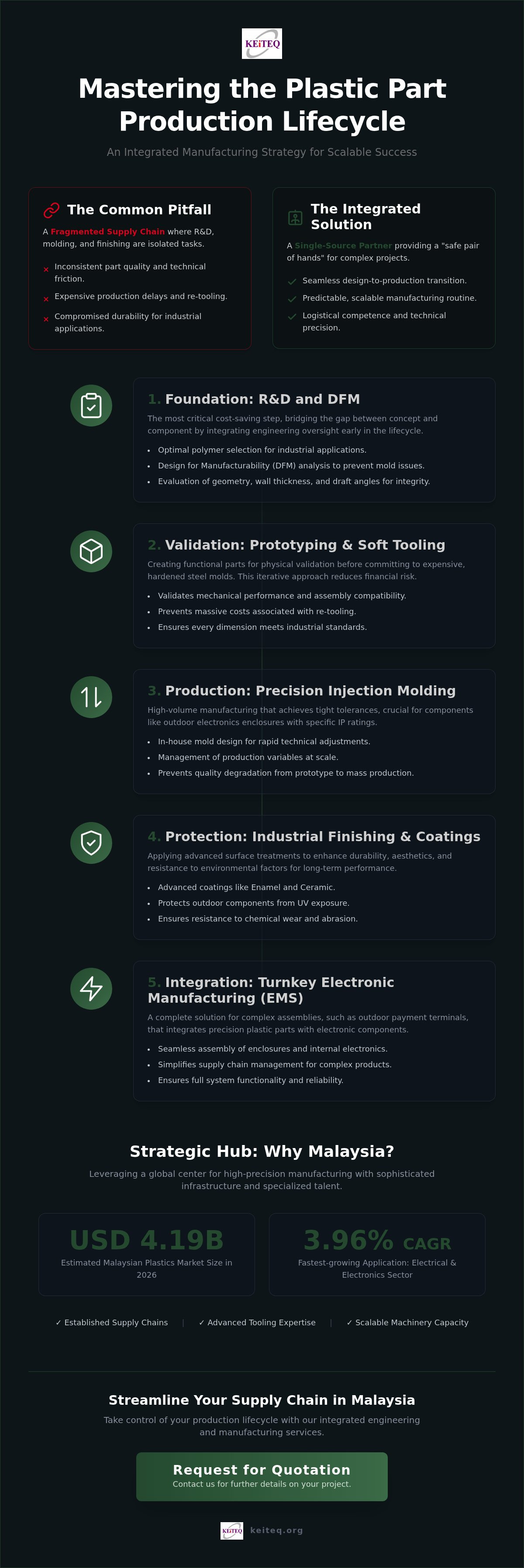
Successful plastic part production begins long before the first mold closes. It's an integrated engineering lifecycle, not a series of disconnected tasks. Many manufacturers treat design and production as separate silos, but this creates technical debt that surfaces during mass production. We see it as a unified process where Research and Development (R&D) dictates the eventual success of the factory floor. By identifying the correct polymer for industrial application early, you prevent material failure under stress and ensure long-term durability.
Design for Manufacturability (DFM) represents the most critical cost-saving step in the entire chain. It moves beyond aesthetics to address the practical realities of high-pressure injection molding. DFM analysis identifies potential issues like sink marks, warping, or uneven cooling before they become expensive production delays. Keiteq bridges the gap between your initial concept and the finished component through disciplined engineering oversight. This ensures that every part is optimized for the specific constraints of the molding machines and material properties.
Strategic Product R&D and Design
Engineering a part for industrial use requires deep analysis of geometry for mold flow and structural integrity. Our team evaluates wall thickness, draft angles, and gate placements to ensure uniform filling. This phase dictates whether a design favors standard thermoplastics or requires high-performance polymers for extreme environments. Material selection isn't just about cost; it's about matching the resin's mechanical properties to the part's functional requirements, including chemical resistance and tensile strength. Sourcing specialized materials such as PTFE from expert distributors like plastomere.com ensures that the technical plastics and elastomers meet the rigorous specifications required for industrial performance.
Prototyping and Soft Tooling Benefits
Validating a design requires physical evidence that a CAD model cannot provide. We utilize soft tooling prototyping to create functional parts before investing in hardened steel molds. This iterative testing phase reduces financial risk, validates mechanical performance, and ensures assembly compatibility. It's a "safe pair of hands" approach that prevents the massive costs associated with re-tooling after mass production has already commenced. Transitioning from digital files to physical prototypes ensures that every dimension meets industrial standards.
Our strategic presence in Malaysia allows us to leverage a sophisticated industrial infrastructure for these early stages. We act as a steady facilitator, ensuring your design is fully optimized for high-volume output. This methodical approach to plastic part production transforms a complex engineering challenge into a predictable, scalable manufacturing routine.
Precision Plastic Injection Molding Services in Malaysia
Malaysia's industrial landscape has evolved into a global center for high-precision manufacturing. The Malaysian plastics market reached an estimated USD 4.19 billion in 2026, with the electrical and electronics sector emerging as the fastest-growing application at a 3.96% CAGR. This growth underscores the region's sophisticated capacity for complex plastic part production. High-volume injection molding for industrial components demands more than just speed; it requires the ability to achieve tight tolerances for enclosures that must withstand outdoor exposure and mechanical stress.
Achieving these standards involves a deep understanding of the mechanics of high-volume production. When producing enclosures for outdoor electronics, even a fraction of a millimeter in deviation can compromise ingress protection (IP) ratings. Malaysia's manufacturing hubs provide the technical infrastructure to manage these variables at scale. This allows OEMs to transition from small batches to full-scale mass production without the quality degradation often seen in less mature markets.
Selecting a Plastic Injection Molding Manufacturer
A reliable production partner must demonstrate both advanced tooling expertise and significant machinery capacity. In-house mold design is a critical requirement for long-term stability. It allows for immediate technical adjustments and prevents the friction found when outsourcing tool maintenance to third parties. For businesses seeking scalable solutions, plastic injection molding services in Malaysia offer a strategic advantage through established supply chains and specialized engineering talent. If you're looking to stabilize your supply chain, you might contact our technical team to discuss your specific machinery requirements.
Quality Control in High-Volume Production
Part consistency in high-volume environments relies on disciplined quality control protocols. Managing the plastic injection mold lifecycle is a technical necessity to prevent tool degradation over time. Without scheduled maintenance and precision monitoring, tool wear results in defects like flash, sink marks, or warping. These issues compromise the fit and function of complex industrial assemblies. We implement methodical inspection systems to maintain professional standards across every production cycle, ensuring that every unit meets the same rigorous criteria as the validated prototype.
Scalability isn't just about adding more machines. It's about maintaining a "safe pair of hands" approach through logistical competence and procedural accuracy. By leveraging Malaysia’s robust industrial power and skilled labor force, we provide the stability required for continuous, high-output operations.
Beyond Molding: Industrial Finishing and Coating Solutions
Industrial components often operate in environments that degrade raw polymers. While high-performance resins provide a foundation, surface finishing is the critical layer that ensures long-term survival. In the context of plastic part production, finishing isn't an elective aesthetic choice; it's a functional requirement. Without proper treatment, components exposed to UV radiation, caustic chemicals, or abrasive mechanical wear will fail prematurely. This leads to increased maintenance cycles and potential system downtime that hurts the bottom line.
Keiteq provides a comprehensive suite of finishing services that transform molded parts into resilient industrial assets. We prioritize physical durability and procedural accuracy, ensuring that every coating application meets the specific rigors of the intended environment. By integrating these processes under one roof in our Malaysia facilities, we eliminate the logistical friction of managing multiple vendors. This single-source approach ensures that the bond between the substrate and the coating is optimized during the manufacturing window, preventing delamination.
Specialized Industrial Coating Options
Our facility is equipped to handle diverse coating requirements based on the part's mechanical exposure. We offer several high-performance options:
Ceramic coating: This provides superior heat and wear resistance for components used near high-temperature machinery or in abrasive zones.
Powder coating: It's the industry standard for achieving durable, high-performance aesthetics that resist impact and corrosion.
Enamel coating: This represents the ultimate solution for the harshest industrial environments, offering unmatched chemical stability and surface hardness.
Protective Coatings for Outdoor Electronics
Outdoor electronics face constant environmental assault. For devices like outdoor payment terminals, the enclosure must act as a fortress. Our finishing protocols are designed to meet international standards for environmental protection, specifically targeting high Ingress Protection (IP) ratings. You can find more technical data in our reference guide for protective coatings. These coatings prevent moisture ingress and oxidation, extending the lifecycle of the internal electronics and reducing field failures.
High-quality industrial finishes also provide significant OEM value. A professional appearance signals reliability to the end user, reinforcing the brand's position as a provider of premium hardware. Whether it's a petrol station terminal or a factory control panel, the finish is the first line of defense and the primary point of visual contact. We ensure that your plastic part production lifecycle concludes with a finish that matches the engineering precision of the mold itself.
Managing the Transition from Prototype to Mass Production
Moving from a functional prototype to industrial-scale output requires more than just repeating a process at a larger scale. It's a structured path that demands rigorous tooling procurement and production line setup. In plastic part production, the transition phase is where most technical risks reside. We mitigate these risks through disciplined supply chain integration, ensuring that plastic and metal components are manufactured in parallel to maintain assembly tolerances. This methodical approach prevents the "design-to-production" friction that often stalls industrial projects when multiple vendors are involved. To further secure these components during the logistics phase, Packaging For Industry (PFI) provides a strategic guide to engineering and protection for industrial applications.
A "safe pair of hands" personality is vital here. You need a partner that understands the practical realities of the factory floor and the boardroom alike. By focusing on procedural accuracy during the setup phase, we ensure that the eventual mass production run is stable, predictable, and fully aligned with your initial R&D objectives.
Efficiency in high-volume runs is measured through established KPIs, focusing heavily on yield rates and cycle time optimization. A fragmented supply chain often leads to poor communication during this critical phase. Utilizing single-source manufacturing for complex projects provides a unified technical briefing for all departments. This approach ensures compliance with global quality and safety standards while maintaining a steady production rhythm. It's a strategy that prioritizes reliability over experimental claims. To start scaling your project with a reliable partner, you can Request for Quotation for our mass production services.
OEM Assembly and Integrated Solutions
Many industrial products require the synergy between plastic molding and metal stamping. Managing these distinct processes under one roof reduces lead times and eliminates the compatibility issues common with multiple vendors. Secondary operations are equally vital for a finished industrial part. Our facilities in Malaysia handle a range of integrated services:
Ultrasonic welding for permanent, high-strength plastic bonds.
Silk screening for durable industrial labeling and branding. To complement these processes with on-demand solutions, you can explore Sale of industrial label printing hardware and consumables for high-performance identification.
Professional personnel identification solutions, such as the high-quality name badges manufactured by Imagin Products Ltd, for integrated corporate branding.
Full OEM assembly for complex multi-component systems.
By integrating these workflows, we provide a holistic approach to production and logistics. This methodical sequence ensures that the transition from a validated design to a market-ready product is efficient and comprehensive. To ensure that precision-engineered parts are protected during global transit, you can visit OEM Materials & Supplies for specialized packaging solutions tailored to complex manufacturing needs. Our presence in Malaysia allows us to navigate the intricacies of international production with ease, positioning us as a dependable pillar within your global supply chain. We focus on physical durability and procedural accuracy to ensure that every final assembly meets the most rigorous industrial standards.
Malaysia provides a robust industrial ecosystem for full-scale electronic assembly. The electrical and electronics sector is the fastest-growing application in the region, with a projected CAGR of 3.96% through 2031. This growth reflects the country's capacity to handle the sophisticated integration required for industrial hardware. For global OEMs, a turnkey approach is the most efficient way to manage complex projects, as it consolidates the entire lifecycle from component manufacturing to final testing. This strategy reduces logistical overhead and eliminates the communication gaps that often occur when dealing with multiple regional vendors. Similarly, for specialized procurement needs in the healthcare sector, you can explore Verified Supplier Membership to find high-quality products from trusted medical brands.
Keiteq acts as a global facilitator, providing the logistical competence and technical precision needed for high-stakes industrial hardware. We understand that plastic part production is just one component of a larger system. By managing the entire assembly process, we ensure that every mechanical and electronic element works in perfect synergy. This methodical approach positions us as a dependable pillar within your supply chain, offering stability and proven methodology for products destined for international markets.
Integrated Electronic Manufacturing
Successful hardware deployment requires the seamless integration of plastic enclosures with PCBAs and various peripherals. Our electronic manufacturing services in Malaysia provide a comprehensive solution for this integration. We don't just assemble parts; we manage the technical interface between different materials and components. Every fully assembled unit undergoes rigorous testing and validation protocols to ensure it meets industrial performance standards. This ensures that the final product is ready for immediate deployment upon arrival at your distribution center.
Specialized Hardware for Petrol and Gas Stations
Assembling hardware for fuel retail environments presents specific engineering challenges. Our expertise in outdoor payment terminal assembly focuses on creating durable units that survive unattended, outdoor environments. These terminals must resist environmental stress while maintaining 100% operational uptime. By leveraging our Malaysian-based assembly lines, we provide a strategic advantage for global distribution. We utilize the region's sophisticated infrastructure to navigate international shipping and compliance requirements with ease. This integrated methodology ensures that your plastic part production and electronic assembly needs are met through a single, authoritative partner. Similarly, in the field of biotechnology, ReadyPep offers specialized research tools that adhere to these same principles of precision and manufacturing quality.
Securing Your Industrial Supply Chain
Mastering plastic part production requires more than technical skill; it demands a steady partner capable of navigating the transition from initial R&D to high-volume assembly. We've examined how Design for Manufacturability and advanced industrial coatings provide the physical durability necessary for harsh environments. By consolidating these services within a strategic hub like Malaysia, you eliminate the risks associated with fragmented vendor management and poor communication during the design-to-production transition.
Keiteq Co Ltd serves as a dependable pillar for complex projects, specializing in high-stakes hardware like outdoor payment terminals for petrol stations. Our end-to-end management provides the stability and procedural accuracy required for scalable success in the global market. We're ready to facilitate your production needs with the discipline and expertise your brand deserves. Let us manage the practical realities of the factory floor while you focus on your strategic growth.
Take the next step in securing your manufacturing future. You can Request for Quotation for your next project in Malaysia, or Request to contact us for further details regarding our integrated manufacturing solutions.
Frequently Asked Questions
What is the most cost-effective plastic manufacturing process for mass production?
Injection molding is the most cost-effective method for high-volume runs. While initial tooling represents a significant capital expenditure, the per-unit cost drops significantly as volume increases. This process ensures exceptional repeatability and cycle efficiency. It's the standard for producing complex industrial components that require consistent mechanical properties and precise dimensions across thousands of identical units in a scalable manufacturing environment.
How does Design for Manufacturability (DFM) affect the cost of plastic part production?
DFM directly influences the total cost of plastic part production by identifying technical risks before they reach the factory floor. By optimizing part geometry for mold flow and uniform cooling, engineers can prevent sink marks and warping. This reduces material waste and eliminates the need for expensive post-production tool modifications. A disciplined DFM review ensures a stable process, resulting in higher yield rates and lower long-term maintenance costs.
Why should I choose plastic injection molding services in Malaysia?
Malaysia offers a strategic combination of sophisticated industrial infrastructure and a highly skilled technical workforce. The region's established supply chains for electronics and polymers provide a stable environment for complex production projects. By choosing a partner in Malaysia, global OEMs benefit from logistical competence and regional incentives. It's a "safe pair of hands" for those requiring disciplined mass production management and high-precision engineering.
What is the difference between prototyping and mass production tooling?
Prototyping tooling, often called soft tooling, is typically made from aluminum or softer alloys to validate part design and function quickly. It's intended for small batches and iterative testing. Mass production tooling utilizes hardened steel designed to withstand hundreds of thousands of high-pressure cycles. This professional-grade tooling maintains tight tolerances and surface integrity over years of continuous use, ensuring part consistency across the entire product lifecycle.
Can plastic parts be coated with industrial finishes like ceramic or enamel?
Industrial finishes like ceramic and enamel can be applied to plastic parts to provide superior environmental protection. These coatings are essential for components exposed to high heat, corrosive chemicals, or abrasive mechanical wear. By enhancing the surface hardness and chemical stability of the polymer substrate, these finishes extend the functional life of the part. This is a critical requirement for hardware used in unattended outdoor industrial applications.
What are the benefits of using a single-source manufacturer for plastic and metal parts?
A single-source manufacturer eliminates the logistical friction and technical inconsistencies that occur when managing multiple vendors. By handling plastic molding, metal stamping, and assembly under one roof, the provider ensures that all components fit perfectly within the final system. This integrated approach reduces lead times, simplifies communication, and provides a unified quality control protocol. It's an efficient way to manage complex OEM projects with high procedural accuracy.
How long does it take to move from a plastic part prototype to mass production?
Moving from a validated prototype to mass production involves a structured path of tool design, fabrication, and process validation. The timeline is dictated by the complexity of the mold and the specific requirements of the production line setup. A methodical partner manages these phases concurrently to minimize delays. This ensures that the transition of plastic part production to industrial-scale output is predictable and fully aligned with the project's specifications.
What quality standards should a plastic part manufacturer in Malaysia follow?
Manufacturers in Malaysia should adhere to ISO 9001 quality management systems to ensure consistent procedural standards. For regional compliance, SIRIM certification is often necessary to validate material safety and industrial performance. These standards provide procurement officers with the assurance that every production cycle meets rigorous global criteria. Following these protocols ensures that finished components are reliable, durable, and ready for deployment in complex international supply chains.
To begin your next project with Keiteq Co Ltd, please Request for Quotation or a Request to contact us for further details regarding our professional manufacturing services in Malaysia.


Comments